https://github.com/ilovepixelart/matador
An async dashboard for toro queues.
https://github.com/ilovepixelart/matador
dashboard fastapi htmx jobs monitoring python queue redis toro
Last synced: about 1 hour ago
JSON representation
An async dashboard for toro queues.
- Host: GitHub
- URL: https://github.com/ilovepixelart/matador
- Owner: ilovepixelart
- License: mit
- Created: 2026-06-08T16:12:53.000Z (21 days ago)
- Default Branch: main
- Last Pushed: 2026-06-23T20:15:58.000Z (6 days ago)
- Last Synced: 2026-06-30T00:32:21.893Z (about 1 hour ago)
- Topics: dashboard, fastapi, htmx, jobs, monitoring, python, queue, redis, toro
- Language: Python
- Size: 1.17 MB
- Stars: 1
- Watchers: 0
- Forks: 0
- Open Issues: 0
-
Metadata Files:
- Readme: README.md
- License: LICENSE
Awesome Lists containing this project
README
# matador 🗡️
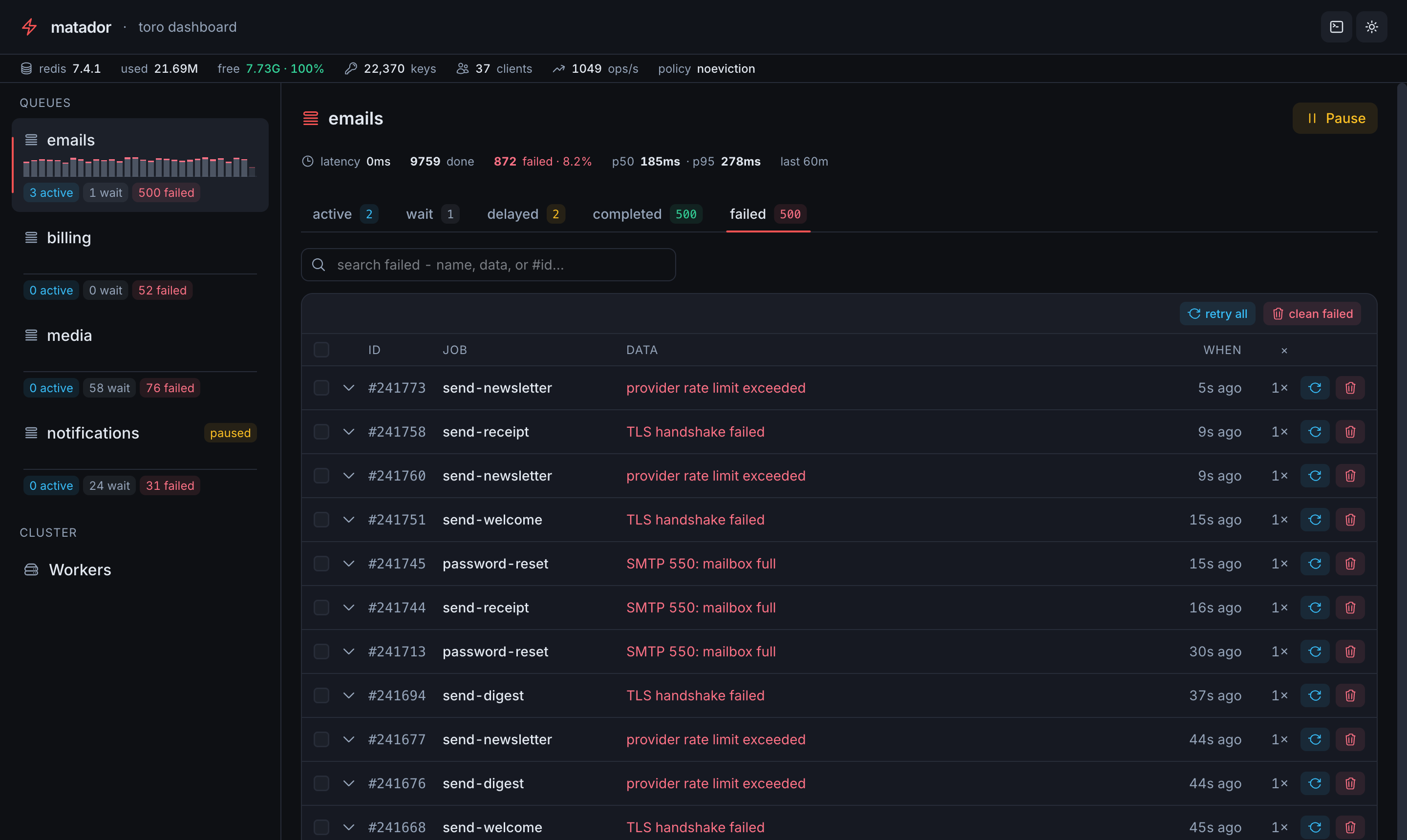
A live, **server-rendered** dashboard for [toro](https://github.com/ilovepixelart/toro)
queues - watch queues, inspect jobs, and act on them (retry, remove, promote,
pause…) from the browser.
[](https://pypi.org/project/matador-dashboard/)
\
[](https://pypi.org/project/matador-dashboard/)
[](https://pepy.tech/project/matador-dashboard)
[](https://github.com/ilovepixelart/matador/blob/main/LICENSE)
\
[](https://sonarcloud.io/summary/new_code?id=ilovepixelart_matador)
[](https://sonarcloud.io/summary/new_code?id=ilovepixelart_matador)
\
[](https://sonarcloud.io/summary/new_code?id=ilovepixelart_matador)
[](https://sonarcloud.io/summary/new_code?id=ilovepixelart_matador)
[](https://sonarcloud.io/summary/new_code?id=ilovepixelart_matador)
```bash
pip install matador-dashboard # the import name is `matador`
```
> Installed as **`matador-dashboard`** on PyPI (the name `matador` was taken), but
> you `import matador`.
## What it is
FastAPI + Jinja on the server, **HTMX + Tailwind** on the page - no SPA, no build
step to run. Every queue / tab / page is a real URL, so reload, back/forward and
deep-links all work. It reads straight from Redis through toro's async API.
## Features
- **Queues sidebar** with per-state counts, a **per-queue activity sparkline**
(last hour, all queues on one shared scale, failures in red), and **state
tabs** (active / waiting / delayed / completed / failed) that swap the job
list over HTMX.
- **Health chips** per queue: latency (age of the next job in line, warns past
30s), completed/failed counts with failure share, and average duration over
the last hour - server-rendered SVG, no chart library.
- **Flows** - toro's parent/child job trees, shown root-first: a flow is its
root job moving through the normal tabs (parked roots fold into active), with
children hidden from the lists and a recursive tree on the job detail with
per-node status pills and fan-in progress that counts completions only;
destructive actions warn that removing a parent takes its whole subtree. The
active tab also carries a **flow-throughput strip** - whole flows completed/
failed over the last hour, with end-to-end flow-duration percentiles.
- **Job detail** lazy-loaded on expand: data, options, return value, timings,
logs, and stack traces - syntax-highlighted server-side (Pygments, no client JS).
- **Search** within a state by job id or a name/data substring.
- **Live updates** over SSE - counts refresh as jobs complete, no reload.
- **Actions**: pause/resume a queue, retry/remove/promote a job, retry-all,
clean a state, and schedulers (run-now / remove) - each behind a styled confirm
dialog (not `window.confirm`).
- **Numbered pagination**, a **Redis health bar** (memory, clients, eviction
policy), and a persistent **dark / light** theme.
## Run it
```bash
uv run python scripts/seed.py # optional: populate demo data
uv run uvicorn scripts.run:app --reload # http://localhost:8000
```
`scripts/run.py` watches a few demo queues; edit the list there, or wire it up yourself.
## Integrate into an existing app
matador is an ASGI app - `mount` it into your FastAPI/Starlette service at any path.
URLs are `root_path`-aware (Starlette `url_for`), so a sub-path mount just works.
```python
from fastapi import Depends
from matador import create_app
app.mount(
"/toro",
create_app(
["emails", "billing"],
connection=redis, # share your existing redis pool
dependencies=[Depends(require_admin)], # protect it with your auth
),
)
```
- **Mount anywhere** - links, static assets and the SSE stream all carry the mount
prefix automatically; works behind a path-stripping reverse proxy too.
- **`connection=`** - pass your `redis.asyncio.Redis` so matador shares your pool
(it never closes a connection it didn't open). Omit it to open its own from `url=`.
This is also the right way to embed: a mounted sub-app's lifespan doesn't run, so
the host should own the connection.
- **`dependencies=`** - applied to every route, so your app's auth gates the
dashboard. (The `/static` mount isn't covered - wrap the whole mount if the assets
themselves need auth.)
- Other stacks (Django, Flask, non-Python): run matador standalone and reverse-proxy.
## Security
matador ships no auth of its own - it inherits the host app's via
`dependencies=`, or sits behind an authenticating reverse proxy. An app built
without `dependencies` logs a warning at startup, because every route
(including delete/retry/pause) is open to whoever can reach it.
- **CSRF**: the same-origin guard turns on automatically when `dependencies`
are configured (auth usually means cookies, and cookies are what make CSRF
real). Pass `require_same_origin=` explicitly to override.
- **Stack traces** are shown in job detail by default and can leak source
paths or secrets from exception messages - `show_stacktraces=False` hides
them when the audience shouldn't see internals.
- The dashboard can do whatever its Redis connection can do; scope that Redis
user/network accordingly. See toro's `docs/security.md` for the queue-side
model.
Standalone is just the no-extras case:
```python
app = create_app(["emails", "billing"], url="redis://localhost:6379")
```
It serves **HTML** (an HTMX UI), not a JSON API - point a browser at it.
## Develop
Managed with [uv](https://astral.sh/uv); the Astral toolchain throughout.
```bash
uv sync # venv + deps + dev group
uv run ruff check . && uv run ruff format . # lint (strict) + format
uv run ty check # type check
uv run pytest # unit + integration (needs Redis on :6379)
uv run pytest -m e2e # Playwright browser tests (run separately)
# rebuild the stylesheet while editing templates/styles
./tailwindcss -i styles/input.css -o matador/static/app.css --watch
```
## License
[MIT](https://github.com/ilovepixelart/matador/blob/main/LICENSE)