https://github.com/indaco/herald
HTML-inspired typography for terminal UIs in Go
https://github.com/indaco/herald
charmbracelet cli go golang lipgloss styled-text terminal terminal-ui tui typography
Last synced: 4 months ago
JSON representation
HTML-inspired typography for terminal UIs in Go
- Host: GitHub
- URL: https://github.com/indaco/herald
- Owner: indaco
- License: mit
- Created: 2026-03-17T22:28:56.000Z (5 months ago)
- Default Branch: main
- Last Pushed: 2026-03-25T06:22:06.000Z (5 months ago)
- Last Synced: 2026-03-26T10:50:57.095Z (5 months ago)
- Topics: charmbracelet, cli, go, golang, lipgloss, styled-text, terminal, terminal-ui, tui, typography
- Language: Go
- Homepage:
- Size: 577 KB
- Stars: 1
- Watchers: 0
- Forks: 0
- Open Issues: 0
-
Metadata Files:
- Readme: README.md
- License: LICENSE
Awesome Lists containing this project
README
herald
HTML-inspired typography for terminal UIs in Go.



Quick Start |
Elements |
Composition |
Customization |
Themes |
Ecosystem |
Examples
herald maps familiar HTML elements (H1-H6, P, Blockquote, UL, OL, Code, HR, BR, Tables, Alerts, and inline styles) to styled terminal output, built on [lipgloss v2](https://github.com/charmbracelet/lipgloss).
It ships with a Rose Pine-inspired default theme, built-in themes matching the Charm ecosystem (Dracula, Catppuccin, Base16, Charm), and full style customization via functional options and ColorPalette.
Works with any CLI or TUI - and if you use [huh](https://github.com/charmbracelet/huh) or other Charm-based libraries, the built-in themes pair seamlessly with theirs out of the box.
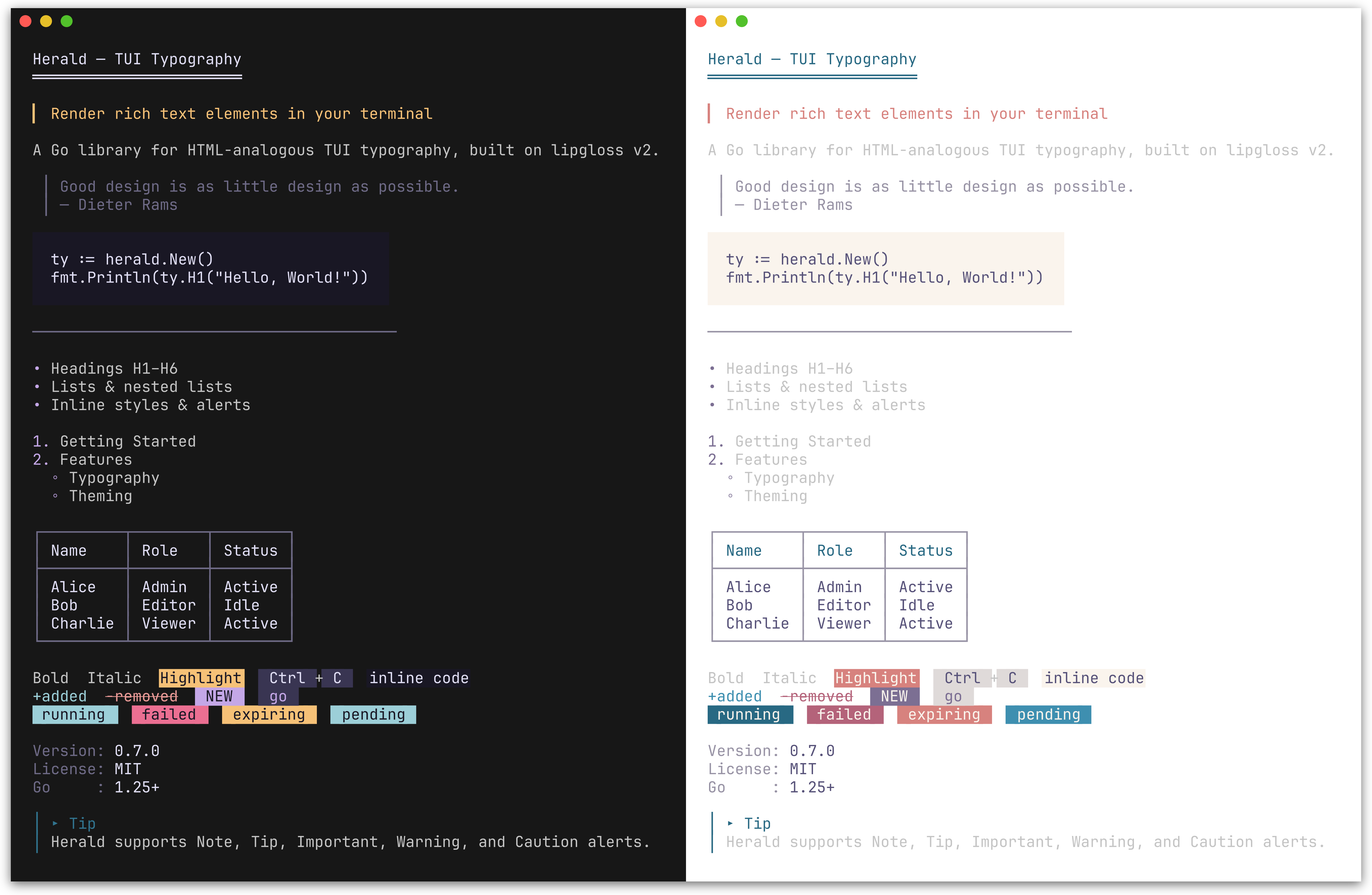
Default Rose Pine theme (dark and light). herald also ships with Dracula, Catppuccin, Base16, and Charm themes.
## Installation
```sh
go get github.com/indaco/herald@latest
```
Requires Go 1.25 or later.
## Quick Start
```go
package main
import (
"fmt"
"github.com/indaco/herald"
)
func main() {
ty := herald.New()
fmt.Println(ty.H1("Getting Started"))
fmt.Println(ty.P("herald renders terminal typography using lipgloss styles."))
fmt.Println(ty.UL("Headings", "Block elements", "Inline styles"))
}
```
> [!TIP]
> **Working with Markdown input?** [herald-md](https://github.com/indaco/herald-md) is a companion module that parses Markdown (CommonMark + GFM via goldmark) and maps each element to the corresponding herald typography method - so you can render `.md` content with the same themed output, no manual wiring required.
>
> ```sh
> go get github.com/indaco/herald-md@latest
> ```
> [!TIP]
> **Need themed CLI help pages?** [herald-help](https://github.com/indaco/herald-help) renders `--help` output with herald's full theming. Adapters for [cobra](https://github.com/indaco/herald-help/tree/main/cobra), [urfave/cli](https://github.com/indaco/herald-help/tree/main/urfave), and [kong](https://github.com/indaco/herald-help/tree/main/kong) are available as sub-modules.
>
> ```sh
> go get github.com/indaco/herald-help@latest
> ```
## Available elements
### Headings
Preview
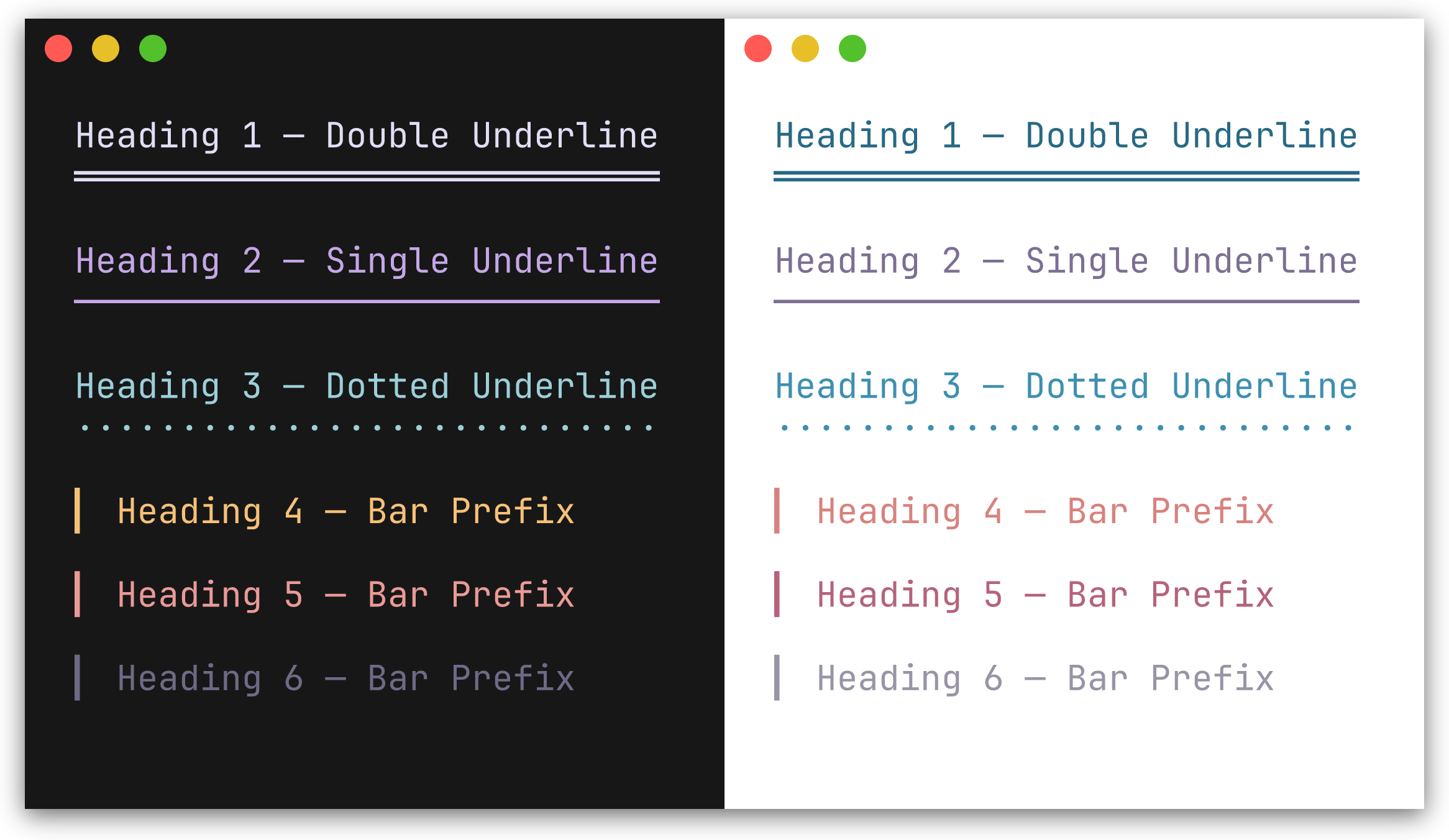
H1-H3 render with a repeated underline character beneath the text. H4-H6 render with a left bar prefix.
| Method | Decoration | Default character |
| ---------- | ---------- | ----------------- |
| `H1(text)` | underline | `═` |
| `H2(text)` | underline | `─` |
| `H3(text)` | underline | `·` |
| `H4(text)` | bar prefix | `▎` |
| `H5(text)` | bar prefix | `▎` |
| `H6(text)` | bar prefix | `▎` |
```go
fmt.Println(ty.H1("Main Title"))
fmt.Println(ty.H2("Section"))
fmt.Println(ty.H4("Subsection"))
```
### Block elements
Preview
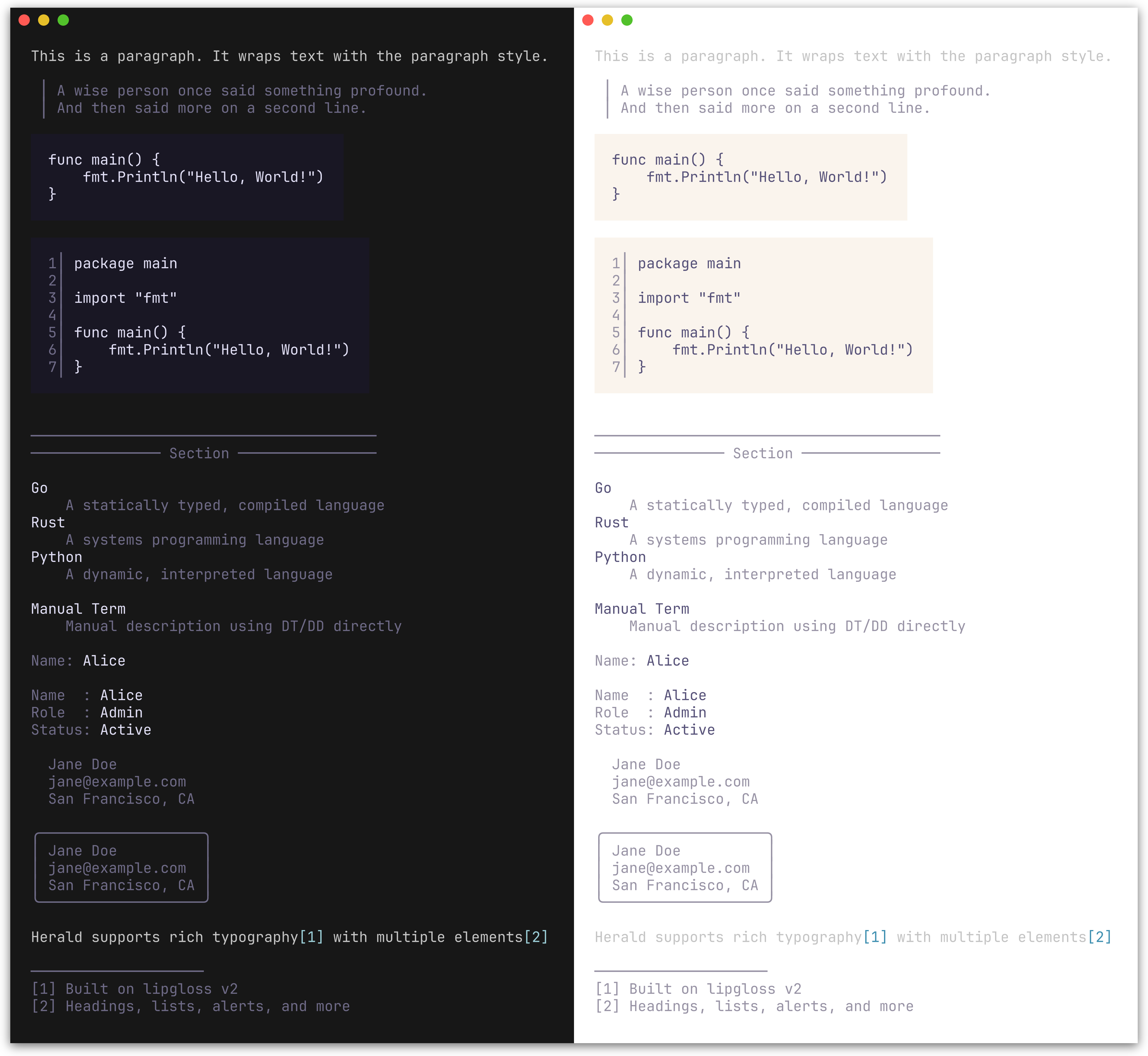
| Method | Description |
| ------------------------------------- | ----------------------------------------------------------------------------- |
| `P(text)` | Paragraph |
| `Blockquote(text)` | Indented block with a left bar; supports multi-line input |
| `CodeBlock(text, lang)` | Fenced code block with padding; optional line numbers and syntax highlighting |
| `HR()` | Horizontal rule, configurable width and character |
| `HRWithLabel(label)` | Horizontal rule with a centered label, e.g. `── Section ──` |
| `DL(pairs)` | Definition list from `[][2]string` pairs (term, description) |
| `DT(text)` | Definition term (standalone) |
| `DD(text)` | Definition description (standalone) |
| `KV(key, value)` | Key-value pair rendered as `key: value` with independent styling |
| `KVGroup(pairs)` | Aligned key-value list from `[][2]string` pairs; keys are right-padded |
| `KVGroupWithOpts(pairs, opts...)` | Like `KVGroup` with per-call options for separator, styling, and indentation |
| `Address(text)` | Contact/author block; renders multi-line text in a distinctive italic style |
| `AddressCard(text)` | Bordered card variant of `Address` with rounded border |
| `FootnoteRef(n)` | Inline footnote reference marker, e.g. `[1]` |
| `FootnoteSection(notes)` | Numbered footnote list with divider; returns `""` if notes is empty |
| `Fieldset(legend, content, width...)` | Bordered box with legend embedded in top border; auto-width or explicit |
| `Figure(content, caption)` | Content with styled caption below |
| `FigureTop(content, caption)` | Content with styled caption above |
| `BR()` | Line break, analogous to `
` |
| `Section(blocks...)` | Joins blocks with single newlines; keeps a heading tight against its content |
| `Compose(blocks...)` | Joins pre-rendered blocks with double newlines; empty blocks are skipped |
```go
fmt.Println(ty.Blockquote("First line.\nSecond line."))
fmt.Println(ty.CodeBlock("func main() {\n\tfmt.Println(\"hello\")\n}"))
fmt.Println(ty.HR())
fmt.Println(ty.HRWithLabel("Section"))
fmt.Println(ty.DL([][2]string{
{"Go", "A statically typed, compiled language"},
{"Rust", "A systems programming language"},
}))
// Standalone terms and descriptions
fmt.Println(ty.DT("Go"))
fmt.Println(ty.DD("A statically typed, compiled language"))
// Key-value pairs
fmt.Println(ty.KV("Name", "Alice"))
fmt.Println(ty.KVGroup([][2]string{
{"Name", "Alice"},
{"Role", "Admin"},
{"Status", "Active"},
}))
// KVGroup with per-call options: no separator, pre-styled keys, indented
fmt.Println(ty.KVGroupWithOpts([][2]string{
{ty.Var("--output"), "Output destination"},
{ty.Var("--verbose"), "Enable verbose output"},
}, herald.WithKVGroupSeparator(""), herald.WithKVRawKeys(true), herald.WithKVIndent(2)))
fmt.Println(ty.Address("Jane Doe\njane@example.com\nSan Francisco, CA"))
// Footnotes compose with paragraphs via string concatenation
fmt.Println(ty.P("herald supports rich typography" + ty.FootnoteRef(1) + " with multiple elements" + ty.FootnoteRef(2)))
fmt.Println(ty.FootnoteSection([]string{
"Built on lipgloss v2",
"Headings, lists, alerts, and more",
}))
// Fieldset: bordered box with legend
fmt.Println(ty.Fieldset("Server Config", "Host: localhost\nPort: 8080\nTLS: enabled"))
// Figure: content with caption
fmt.Println(ty.Figure(ty.CodeBlock("SELECT * FROM users"), "Figure 1: Query example"))
fmt.Println(ty.FigureTop(ty.Table([][]string{
{"Name", "Role"},
{"Alice", "Admin"},
}), "Table 1: User roles"))
```
```text
╭─ Server Config ──────────────────────╮
│ Host: localhost │
│ Port: 8080 │
│ TLS: enabled │
╰──────────────────────────────────────╯
```
```go
// BR inserts a line break
fmt.Println(ty.P("Line one" + ty.BR() + "Line two"))
// Section groups blocks with single newlines instead of double
fmt.Println(ty.Compose(
ty.H2("Shopping List"),
ty.Section(
ty.H4("Fruits"),
ty.UL("Apples", "Bananas", "Cherries"),
),
ty.Section(
ty.H4("Vegetables"),
ty.UL("Carrots", "Spinach"),
),
))
```
### Inline styles
Preview
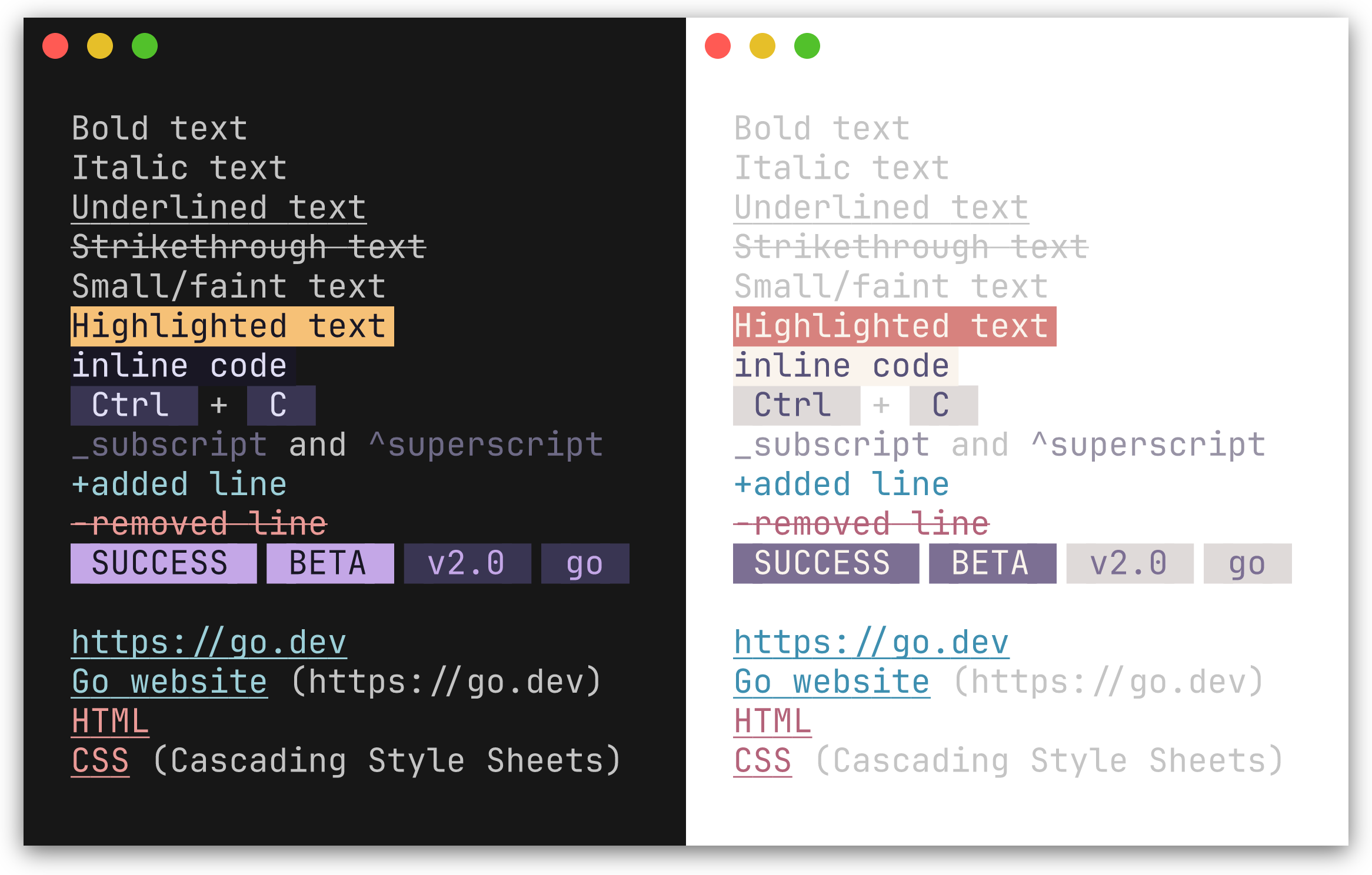
| Method | Renders as |
| ----------------------------- | ------------------------------------------------------------------------------------------- |
| `Code(text, lang)` | Inline code with background highlight; `lang` is optional, used when a CodeFormatter is set |
| `Bold(text)` | Bold |
| `Italic(text)` | Italic |
| `Underline(text)` | Underlined |
| `Strikethrough(text)` | Strikethrough |
| `Small(text)` | Faint |
| `Mark(text)` | Highlighted background |
| `Link(label, url)` | Styled link; `url` is optional - when both differ, renders as `label (url)` |
| `Kbd(text)` | Keyboard key indicator |
| `Abbr(abbr, desc)` | Abbreviation; `desc` is optional, appended in parentheses |
| `Sub(text)` | Renders with `_` prefix (style not configurable via options) |
| `Sup(text)` | Renders with `^` prefix (style not configurable via options) |
| `Ins(text)` | Inserted text, prefixed with `+` |
| `Del(text)` | Deleted text, prefixed with `-`, strikethrough |
| `Q(text)` | Inline quotation with styled curly quotes (\u201C \u201D) |
| `Cite(text)` | Citation styling (italic + muted) |
| `Samp(text)` | Sample output styling (monospace, distinct from `Code`) |
| `Var(text)` | Variable name styling (italic + accent color) |
| `Badge(text)` | Styled pill/tag label (e.g. `[SUCCESS]`, `[BETA]`) |
| `BadgeWithStyle(text, style)` | Badge with a one-off style override |
| `Tag(text)` | Subtle pill/category label (lighter variant of Badge) |
| `TagWithStyle(text, style)` | Tag with a one-off style override |
| `SuccessBadge(text)` | Badge using the theme's success color (green) |
| `WarningBadge(text)` | Badge using the theme's warning color (amber) |
| `ErrorBadge(text)` | Badge using the theme's error color (red) |
| `InfoBadge(text)` | Badge using the theme's info color (blue) |
| `SuccessTag(text)` | Tag using the theme's success color |
| `WarningTag(text)` | Tag using the theme's warning color |
| `ErrorTag(text)` | Tag using the theme's error color |
| `InfoTag(text)` | Tag using the theme's info color |
```go
fmt.Println(ty.Bold("important") + " and " + ty.Italic("nuanced"))
fmt.Println(ty.Kbd("Ctrl") + " + " + ty.Kbd("C"))
fmt.Println(ty.Link("Go website", "https://go.dev"))
fmt.Println(ty.Abbr("CSS", "Cascading Style Sheets"))
fmt.Println(ty.Sub("2") + "O" + ty.Sup("n"))
fmt.Println(ty.Ins("added line"))
fmt.Println(ty.Del("removed line"))
fmt.Println(ty.Q("To be, or not to be"))
fmt.Println(ty.Cite("The Go Programming Language"))
fmt.Println("Output: " + ty.Samp("Hello, World!"))
fmt.Println("Set " + ty.Var("PORT") + " to configure the server")
fmt.Println(ty.Badge("SUCCESS") + " " + ty.Badge("BETA"))
fmt.Println(ty.Tag("v2.0") + " " + ty.Tag("go"))
// Semantic variants use the theme's status colors automatically
fmt.Println(ty.SuccessBadge("running"), ty.ErrorBadge("failed"), ty.WarningBadge("expiring"), ty.InfoBadge("pending"))
fmt.Println(ty.SuccessTag("healthy"), ty.ErrorTag("critical"), ty.WarningTag("degraded"), ty.InfoTag("maintenance"))
```
```text
important and nuanced
[Ctrl] + [C]
Go website (https://go.dev)
CSS (Cascading Style Sheets)
_2O^n
+added line
-removed line
SUCCESS BETA
v2.0 go
```
In a color terminal, `Badge` renders with a filled background pill and `Tag` with a lighter variant.
### Lists
Preview
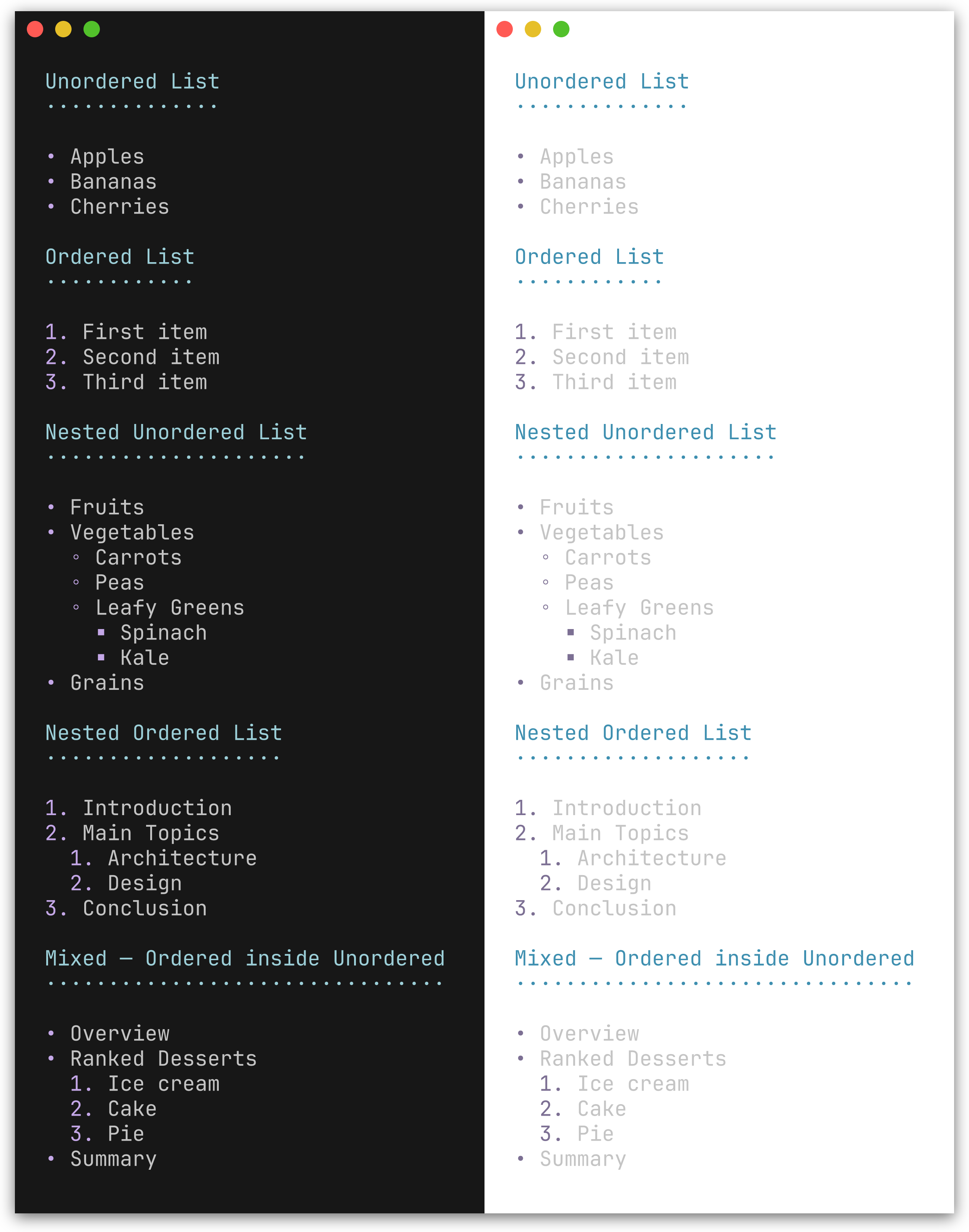
| Method | Description |
| ------------------ | -------------------------------------------------------- |
| `UL(items...)` | Unordered list with bullet character (default `•`) |
| `OL(items...)` | Ordered list with `1.`, `2.`, `3.` markers |
| `NestUL(items...)` | Nested unordered list with bullet cycling |
| `NestOL(items...)` | Nested ordered list with optional hierarchical numbering |
```go
fmt.Println(ty.UL("Apples", "Bananas", "Cherries"))
fmt.Println(ty.OL("First", "Second", "Third"))
```
#### Nested lists
`NestUL` and `NestOL` render hierarchical lists with configurable indentation, bullet cycling, and mixed nesting.
**Constructors:**
| Function | Description |
| --------------------------------------- | ----------------------------------- |
| `Item(text)` | Leaf item (no children) |
| `Items(texts...)` | Batch-convert strings to leaf items |
| `ItemWithChildren(text, children...)` | Item with unordered sub-list |
| `ItemWithOLChildren(text, children...)` | Item with ordered sub-list |
```go
// Nested unordered list with mixed sub-lists
fmt.Println(ty.NestUL(
herald.Item("Fruits"),
herald.ItemWithChildren("Vegetables",
herald.Item("Carrots"),
herald.Item("Peas"),
),
herald.ItemWithOLChildren("Ranked Desserts",
herald.Item("Ice cream"),
herald.Item("Cake"),
),
))
```
```text
• Fruits
• Vegetables
◦ Carrots
◦ Peas
• Ranked Desserts
1. Ice cream
2. Cake
```
```go
// Nested ordered list
fmt.Println(ty.NestOL(
herald.Item("Introduction"),
herald.ItemWithOLChildren("Main Topics",
herald.Item("Architecture"),
herald.Item("Design"),
),
herald.Item("Conclusion"),
))
```
```text
1. Introduction
2. Main Topics
1. Architecture
2. Design
3. Conclusion
```
Enable `WithHierarchicalNumbers(true)` for outline-style numbering (`2.1.`, `2.2.`):
```go
ty := herald.New(herald.WithHierarchicalNumbers(true))
fmt.Println(ty.NestOL(
herald.Item("Introduction"),
herald.ItemWithOLChildren("Main Topics",
herald.Item("Architecture"),
herald.Item("Design"),
),
herald.Item("Conclusion"),
))
```
```text
1. Introduction
2. Main Topics
2.1. Architecture
2.2. Design
3. Conclusion
```
### Tables
Preview
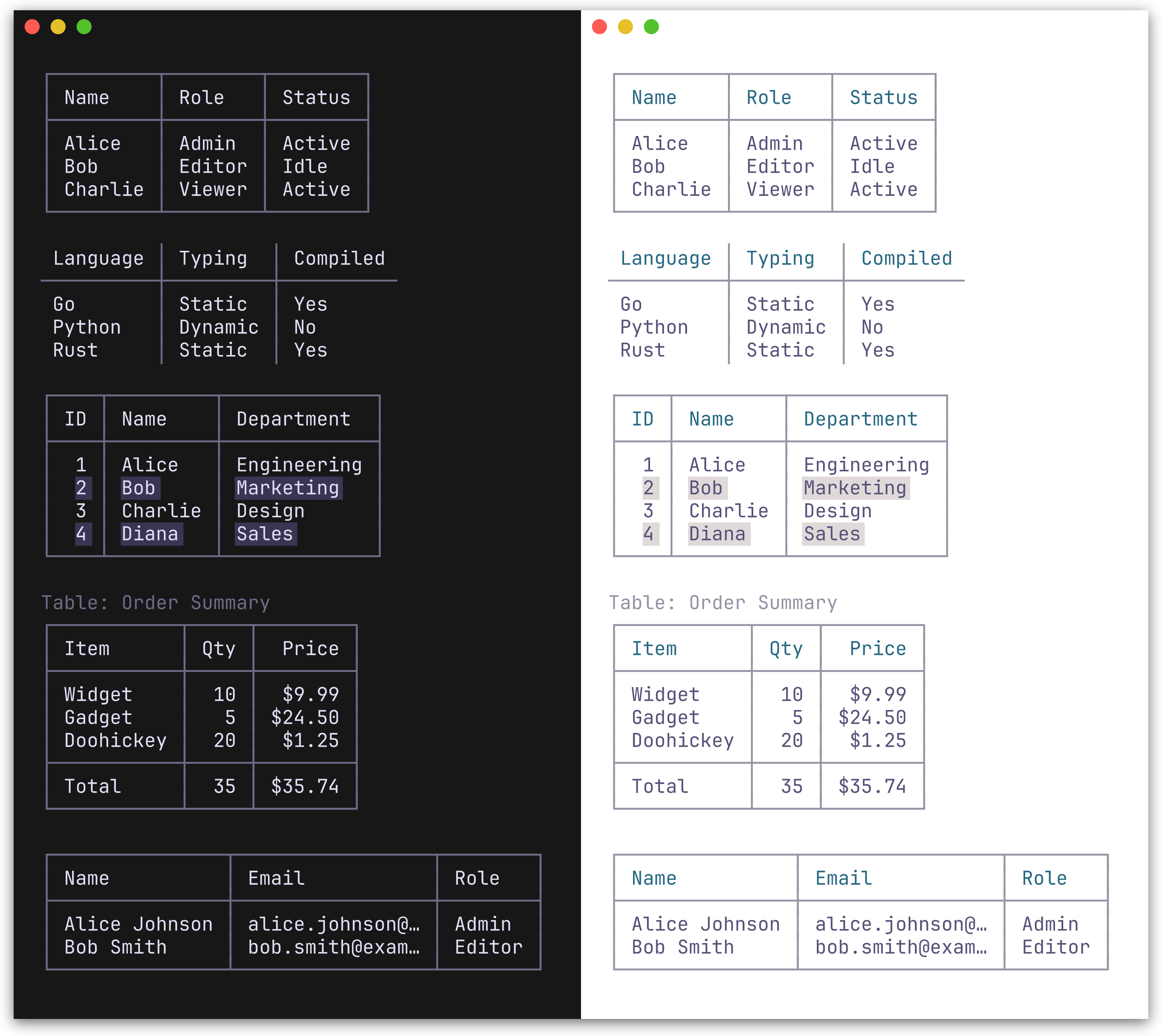
`Table` renders a table from a `[][]string` slice. The first row is treated as the header. Two border presets are available: `BoxBorderSet()` (default, full Unicode box-drawing) and `MinimalBorderSet()` (header and column separators only, no outer border).
```go
fmt.Println(ty.Table([][]string{
{"Name", "Role", "Status"},
{"Alice", "Admin", "Active"},
{"Bob", "Editor", "Idle"},
}))
```
**Bordered (default):**
```text
┌───────┬────────┬────────┐
│ Name │ Role │ Status │
├───────┼────────┼────────┤
│ Alice │ Admin │ Active │
│ Bob │ Editor │ Idle │
└───────┴────────┴────────┘
```
**Minimal:**
```go
ty := herald.New(herald.WithTableBorderSet(herald.MinimalBorderSet()))
```
```text
Name │ Role │ Status
───────┼────────┼────────
Alice │ Admin │ Active
Bob │ Editor │ Idle
```
`TableWithOpts(rows [][]string, opts ...TableOption)` accepts per-table options for column alignment, row separators, striped rows, captions, and footer rows:
```go
// Column alignment, footer row, and caption
fmt.Println(ty.TableWithOpts([][]string{
{"Item", "Qty", "Price"},
{"Widget", "10", "$9.99"},
{"Gadget", "5", "$24.50"},
{"Total", "15", "$34.49"},
},
herald.WithCaption("Order Summary"),
herald.WithFooterRow(true),
herald.WithColumnAlign(1, herald.AlignRight),
herald.WithColumnAlign(2, herald.AlignRight),
// Or set all column alignments at once
// herald.WithColumnAligns(herald.AlignLeft, herald.AlignRight, herald.AlignRight),
))
```
```go
// Truncate long cell content
ty.TableWithOpts(rows,
herald.WithMaxColumnWidth(15),
)
```
| Table option | Description |
| ----------------------------- | ----------------------------------------------------- |
| `WithColumnAlign(col, align)` | Set alignment for a column (`AlignLeft/Center/Right`) |
| `WithColumnAligns(aligns...)` | Set alignments for all columns positionally |
| `WithRowSeparators(true)` | Horizontal lines between body rows |
| `WithStripedRows(true)` | Alternating row background for readability |
| `WithCaption(text)` | Caption above the table |
| `WithCaptionBottom(text)` | Caption below the table |
| `WithFooterRow(true)` | Treat last row as a styled footer with separator |
| `WithMaxColumnWidth(n)` | Truncate all columns to `n` chars with `…` |
| `WithColumnMaxWidth(col, n)` | Truncate a specific column (overrides global max) |
### Alerts
Preview
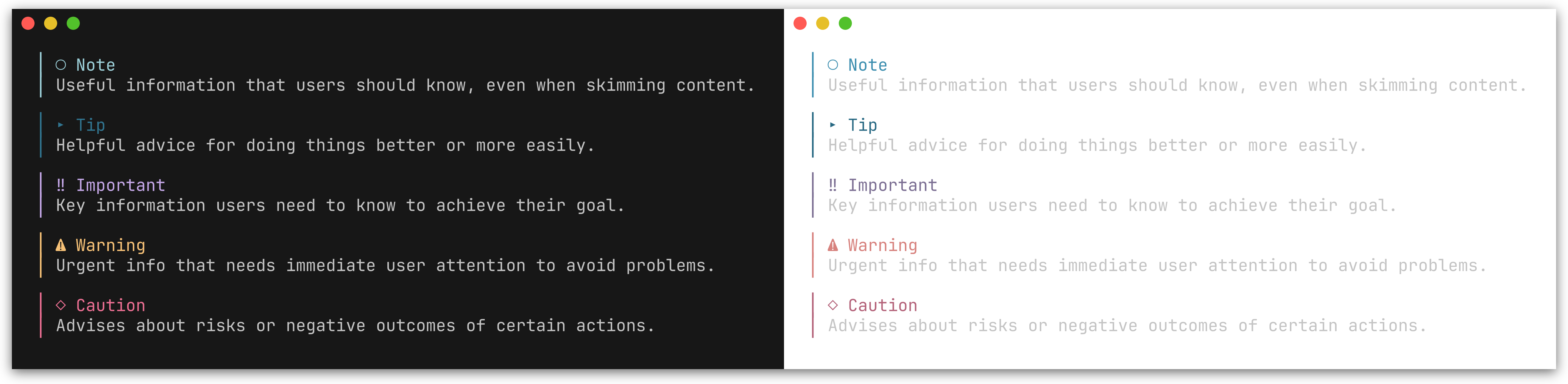
GitHub-style alert callouts with colored bars, icons, and labels. Five types are supported: Note, Tip, Important, Warning, and Caution.
| Method | Icon | Color | Description |
| ----------------- | ---- | ------ | --------------------------------- |
| `Note(text)` | `○` | Blue | Useful information for the reader |
| `Tip(text)` | `▸` | Green | Helpful advice |
| `Important(text)` | `‼` | Purple | Key information |
| `Warning(text)` | `⚠` | Amber | Urgent attention needed |
| `Caution(text)` | `◇` | Red | Risk or negative outcomes |
```go
fmt.Println(ty.Note("Useful information that users should know."))
fmt.Println(ty.Tip("Helpful advice for doing things better."))
fmt.Println(ty.Important("Key information users need to know."))
fmt.Println(ty.Warning("Urgent info that needs immediate attention."))
fmt.Println(ty.Caution("Advises about risks or negative outcomes."))
```
```text
│ ○ Note
│ Useful information that users should know.
│ ⚠ Warning
│ Urgent info that needs immediate attention.
```
See [`examples/002_alerts/`](examples/002_alerts/) for the full output of all five alert types.
You can also use the generic `Alert` method with an `AlertType`:
```go
fmt.Println(ty.Alert(herald.AlertNote, "Generic alert call."))
```
## Composition patterns
herald provides typography primitives - you compose them for higher-level patterns. Here are some common recipes.
### Status messages
Combine inline styles for colored status output:
```go
ty := herald.New()
// Success / error with Ins/Del
fmt.Println(ty.Ins("Build completed successfully")) // green, prefixed with +
fmt.Println(ty.Del("3 tests failed")) // red, prefixed with -
// Semantic badges use the theme's status colors automatically
fmt.Println(ty.SuccessBadge("PASS") + " " + "All checks passed")
fmt.Println(ty.ErrorBadge("FAIL") + " " + "Linter found 2 issues")
fmt.Println(ty.WarningBadge("EXPIRING") + " " + "Certificate expires in 7 days")
fmt.Println(ty.InfoBadge("PENDING") + " " + "Deployment queued")
// Semantic tags for subtle status labels
fmt.Println(ty.SuccessTag("healthy") + " " + ty.Tag("v2.1.0"))
// Generic Badge/BadgeWithStyle for non-semantic cases
fmt.Println(ty.Badge("BETA") + " " + ty.Tag("go"))
```
### Annotated sections
Pair headings with alerts for contextual guidance:
```go
fmt.Println(ty.Compose(
ty.H2("Database Migration"),
ty.Warning("Back up your database before proceeding."),
ty.P("Run the following command to apply migrations:"),
ty.CodeBlock("go run ./cmd/migrate up"),
))
```
### Author blocks in release notes
Use `AddressCard` for styled contact information:
```go
fmt.Println(ty.Compose(
ty.H2("Release v2.0"),
ty.P("Major performance improvements and new API surface."),
ty.AddressCard("Maintained by\nJane Doe\njane@example.com"),
))
```
### Rich paragraphs with references
Compose inline elements and footnotes within paragraphs:
```go
fmt.Println(ty.Compose(
ty.P(
"herald" + ty.FootnoteRef(1) + " is built on " +
ty.Link("lipgloss", "https://github.com/charmbracelet/lipgloss") +
" and supports " + ty.Bold("rich text") + ", " +
ty.Code("inline code") + ", and " + ty.Kbd("Ctrl") + "+" + ty.Kbd("C") +
" key indicators.",
),
ty.FootnoteSection([]string{"A Go library for TUI typography"}),
))
```
### Tight heading-body groups
`Compose` inserts a blank line (`\n\n`) between every block. When a heading (e.g. H4) already has `MarginBottom`, this produces unwanted triple spacing. `Section` solves this by joining its blocks with a single newline, and the resulting group becomes one block to `Compose`:
```go
fmt.Println(ty.Compose(
ty.H2("Release Notes"),
ty.Section(
ty.H4("Bug Fixes"),
ty.UL("Fixed crash on empty input", "Resolved race condition"),
),
ty.Section(
ty.H4("Features"),
ty.UL("Added Section method", "Added BR method"),
),
))
```
### Global padding and framing
herald renders typography elements. Layout concerns - padding, centering, and framing - belong at the output boundary using lipgloss directly. This avoids double-wrapping when composing inline elements inside block elements.
**Per-element wrapping** - apply a frame style to each rendered line:
```go
ty := herald.New()
frame := lipgloss.NewStyle().Padding(0, 2)
fmt.Println(frame.Render(ty.H1("Title")))
fmt.Println(frame.Render(ty.P("Body text with " + ty.Bold("bold"))))
```
**Whole-output wrapping** - build all output first, then wrap once:
```go
page := ty.Compose(
ty.H1("Title"),
ty.P("Body text"),
ty.HR(),
)
fmt.Println(frame.Render(page))
```
## Customization
### Functional options
Pass options to `herald.New()` to override individual styles or tokens.
```go
ty := herald.New(
herald.WithHRWidth(60),
herald.WithBulletChar("-"),
herald.WithH1Style(
lipgloss.NewStyle().Bold(true).Foreground(lipgloss.Color("#FF0000")),
),
)
```
**Style options** - each accepts a `lipgloss.Style`:
#### Headings
| Option | Targets |
| ----------------------------- | ------------------ |
| `WithH1Style` - `WithH6Style` | Heading levels 1-6 |
#### Blocks
| Option | Targets |
| ------------------------ | ----------------- |
| `WithParagraphStyle` | `P` |
| `WithBlockquoteStyle` | `Blockquote` text |
| `WithBlockquoteBarStyle` | `Blockquote` bar |
| `WithCodeInlineStyle` | `Code` |
| `WithCodeBlockStyle` | `CodeBlock` |
| `WithHRStyle` | `HR` |
| `WithHRLabelStyle` | `HRWithLabel` |
#### Inline
| Option | Targets |
| ------------------------ | --------------- |
| `WithBoldStyle` | `Bold` |
| `WithItalicStyle` | `Italic` |
| `WithUnderlineStyle` | `Underline` |
| `WithStrikethroughStyle` | `Strikethrough` |
| `WithSmallStyle` | `Small` |
| `WithMarkStyle` | `Mark` |
| `WithLinkStyle` | `Link` |
| `WithKbdStyle` | `Kbd` |
| `WithAbbrStyle` | `Abbr` |
| `WithInsStyle` | `Ins` |
| `WithDelStyle` | `Del` |
| `WithQStyle` | `Q` |
| `WithCiteStyle` | `Cite` |
| `WithSampStyle` | `Samp` |
| `WithVarStyle` | `Var` |
#### Lists & definitions
| Option | Targets |
| --------------------- | ---------------------- |
| `WithListBulletStyle` | Bullet/number marker |
| `WithListItemStyle` | List item text |
| `WithDTStyle` | Definition term |
| `WithDDStyle` | Definition description |
#### Key-value
| Option | Targets |
| ------------------ | --------------------------- |
| `WithKVKeyStyle` | `KV` / `KVGroup` key text |
| `WithKVValueStyle` | `KV` / `KVGroup` value text |
#### Address
| Option | Targets |
| ---------------------------- | --------------------- |
| `WithAddressStyle` | `Address` |
| `WithAddressCardStyle` | `AddressCard` content |
| `WithAddressCardBorderStyle` | `AddressCard` border |
#### Fieldset
| Option | Targets |
| ------------------------- | ------------------ |
| `WithFieldsetStyle` | `Fieldset` content |
| `WithFieldsetBorderStyle` | `Fieldset` border |
| `WithFieldsetLegendStyle` | `Fieldset` legend |
#### Figure
| Option | Targets |
| ------------------------ | ---------------- |
| `WithFigureCaptionStyle` | `Figure` caption |
#### Badge & Tag
| Option | Targets |
| ------------------------- | ---------------------- |
| `WithBadgeStyle` | `Badge` |
| `WithTagStyle` | `Tag` |
| `WithSemanticPalette(sp)` | All 8 semantic methods |
| `WithSuccessBadgeStyle` | `SuccessBadge` |
| `WithWarningBadgeStyle` | `WarningBadge` |
| `WithErrorBadgeStyle` | `ErrorBadge` |
| `WithInfoBadgeStyle` | `InfoBadge` |
| `WithSuccessTagStyle` | `SuccessTag` |
| `WithWarningTagStyle` | `WarningTag` |
| `WithErrorTagStyle` | `ErrorTag` |
| `WithInfoTagStyle` | `InfoTag` |
#### Footnotes
| Option | Targets |
| -------------------------- | ------------------------- |
| `WithFootnoteRefStyle` | `FootnoteRef` |
| `WithFootnoteItemStyle` | `FootnoteSection` items |
| `WithFootnoteDividerStyle` | `FootnoteSection` divider |
#### Tables
| Option | Targets |
| --------------------------- | ----------------------- |
| `WithTableHeaderStyle` | Table header cells |
| `WithTableCellStyle` | Table body cells |
| `WithTableStripedCellStyle` | Alternating body rows |
| `WithTableFooterStyle` | Table footer row |
| `WithTableCaptionStyle` | Table caption text |
| `WithTableBorderStyle` | Table border characters |
#### Alerts
| Option | Targets |
| ----------------------------- | ------------------- |
| `WithAlertStyle(type, style)` | Alert of given type |
#### Callbacks
| Option | Targets |
| ----------------------- | ------------------------------------------------------- |
| `WithCodeFormatter(fn)` | Syntax-highlighting callback for `Code` and `CodeBlock` |
---
**Token options** - each accepts a `string`, `int`, or `bool`:
#### Heading tokens
| Option | Default | Description |
| ------------------------ | ------- | ------------------------------ |
| `WithH1UnderlineChar(c)` | `═` | Underline character for H1 |
| `WithH2UnderlineChar(c)` | `─` | Underline character for H2 |
| `WithH3UnderlineChar(c)` | `·` | Underline character for H3 |
| `WithHeadingBarChar(c)` | `▎` | Bar prefix character for H4-H6 |
#### List tokens
| Option | Default | Description |
| ------------------------------ | ------------------ | ----------------------------------------------------- |
| `WithBulletChar(c)` | `•` | Bullet character for `UL` |
| `WithNestedBulletChars(chars)` | `•`, `◦`, `▪`, `▹` | Bullet characters cycling per depth for `NestUL` |
| `WithListIndent(n)` | `2` | Spaces per nesting level for `NestUL`/`NestOL` |
| `WithHierarchicalNumbers(b)` | `false` | Outline-style numbering for nested `OL` (e.g. `2.1.`) |
#### Block tokens
| Option | Default | Description |
| ----------------------------- | ------- | --------------------------------------- |
| `WithHRChar(c)` | `─` | Character repeated for `HR` |
| `WithHRWidth(w)` | `40` | Width of `HR` in characters |
| `WithBlockquoteBar(c)` | `│` | Left bar character for `Blockquote` |
| `WithCodeLineNumbers(b)` | `false` | Show line numbers in `CodeBlock` |
| `WithCodeLineNumberSep(c)` | `│` | Separator between line numbers and code |
| `WithCodeLineNumberOffset(n)` | `1` | Starting line number for code blocks |
#### Inline tokens
| Option | Default | Description |
| ------------------- | -------- | -------------------------------- |
| `WithInsPrefix(c)` | `+` | Prefix for `Ins` (inserted text) |
| `WithDelPrefix(c)` | `-` | Prefix for `Del` (deleted text) |
| `WithQuoteOpen(c)` | `\u201C` | Opening quote character for `Q` |
| `WithQuoteClose(c)` | `\u201D` | Closing quote character for `Q` |
#### Fieldset tokens
| Option | Default | Description |
| ---------------------- | ------- | ------------------------------------------- |
| `WithFieldsetWidth(w)` | `0` | Default width for `Fieldset` (0 = auto-fit) |
#### Key-value tokens
**Theme-level** (set via `herald.New()`):
| Option | Default | Description |
| -------------------- | ------- | ------------------------------------------------- |
| `WithKVSeparator(c)` | `:` | Separator between key and value in `KV`/`KVGroup` |
**Per-call** (passed to `KVGroupWithOpts`):
| Option | Default | Description |
| ------------------------- | ------------- | ---------------------------------------------------------- |
| `WithKVGroupSeparator(s)` | theme default | Override separator for this call (empty string = no colon) |
| `WithKVRawKeys(bool)` | `false` | Skip applying KVKey style (keys are pre-styled) |
| `WithKVRawValues(bool)` | `false` | Skip applying KVValue style (values are pre-styled) |
| `WithKVIndent(n)` | `0` | Prepend n spaces of indentation to each line |
#### Table tokens
| Option | Default | Description |
| ------------------------ | ---------------- | ----------------------------------------------------------- |
| `WithTableBorderSet(bs)` | `BoxBorderSet()` | Border character set (`BoxBorderSet` or `MinimalBorderSet`) |
| `WithTableCellPad(n)` | `1` | Spaces of padding inside each table cell |
#### Footnote tokens
| Option | Default | Description |
| ----------------------------- | ------- | ----------------------------------------------- |
| `WithFootnoteDividerChar(c)` | `─` | Character repeated for footnote section divider |
| `WithFootnoteDividerWidth(w)` | `20` | Width of footnote section divider |
#### Alert tokens
| Option | Default | Description |
| ----------------------------- | -------- | ---------------------------------------- |
| `WithAlertBar(c)` | `│` | Left bar character for alerts |
| `WithAlertIcon(type, icon)` | per-type | Override icon for a specific alert type |
| `WithAlertLabel(type, label)` | per-type | Override label for a specific alert type |
### Code formatting
`WithCodeFormatter` accepts a `func(code, language string) string` callback. When set, `Code()` and `CodeBlock()` pass the raw text and language string to the formatter before applying the lipgloss style.
```go
import (
"strings"
"github.com/alecthomas/chroma/v2/quick"
"github.com/indaco/herald"
)
func chromaFormatter(style string) func(code, language string) string {
return func(code, language string) string {
var buf strings.Builder
err := quick.Highlight(&buf, code, language, "terminal256", style)
if err != nil {
return code
}
return strings.TrimRight(buf.String(), "\n")
}
}
ty := herald.New(
herald.WithCodeFormatter(chromaFormatter("catppuccin-mocha")),
)
fmt.Println(ty.CodeBlock(`func main() { fmt.Println("hello") }`, "go"))
```
See [`examples/200_chroma-syntax-highlighting/`](examples/200_chroma-syntax-highlighting/) for a chroma-based example, or [`examples/201_tree-sitter-syntax-highlighting/`](examples/201_tree-sitter-syntax-highlighting/) for a tree-sitter-based alternative.
### Line numbers in code blocks
Enable line numbers with `WithCodeLineNumbers(true)`. Line numbers are right-aligned, styled with `CodeLineNumber` (defaults to the `Muted` palette color), and separated from code by `CodeLineNumberSep` (default `│`). Line numbers are added after the `CodeFormatter` runs, so they work with syntax highlighting.
```go
ty := herald.New(
herald.WithCodeLineNumbers(true),
)
fmt.Println(ty.CodeBlock("func main() {\n\tfmt.Println(\"hello\")\n}", "go"))
```
```text
1│ func main() {
2│ fmt.Println("hello")
3│ }
```
When displaying a snippet from a larger file, set a custom starting line number with `WithCodeLineNumberOffset`:
```go
ty := herald.New(
herald.WithCodeLineNumbers(true),
herald.WithCodeLineNumberOffset(42),
)
fmt.Println(ty.CodeBlock("func greet(name string) string {\n\treturn \"Hello, \" + name\n}"))
```
```text
42│ func greet(name string) string {
43│ return "Hello, " + name
44│ }
```
Customize the separator and style:
```go
ty := herald.New(
herald.WithCodeLineNumbers(true),
herald.WithCodeLineNumberSep(":"),
herald.WithCodeLineNumberStyle(lipgloss.NewStyle().Foreground(lipgloss.Color("#888888"))),
)
```
The following option controls the visual appearance of line numbers:
| Option | Targets |
| ------------------------- | ----------------------- |
| `WithCodeLineNumberStyle` | Code block line numbers |
## Themes
### Built-in themes
herald ships with named themes that match [huh](https://charm.land/huh)'s built-in color palettes. Colors auto-adapt to light/dark terminal backgrounds using `lipgloss.HasDarkBackground`. See [Pairing with huh](#pairing-with-huh) for how to use matching themes across herald and huh.
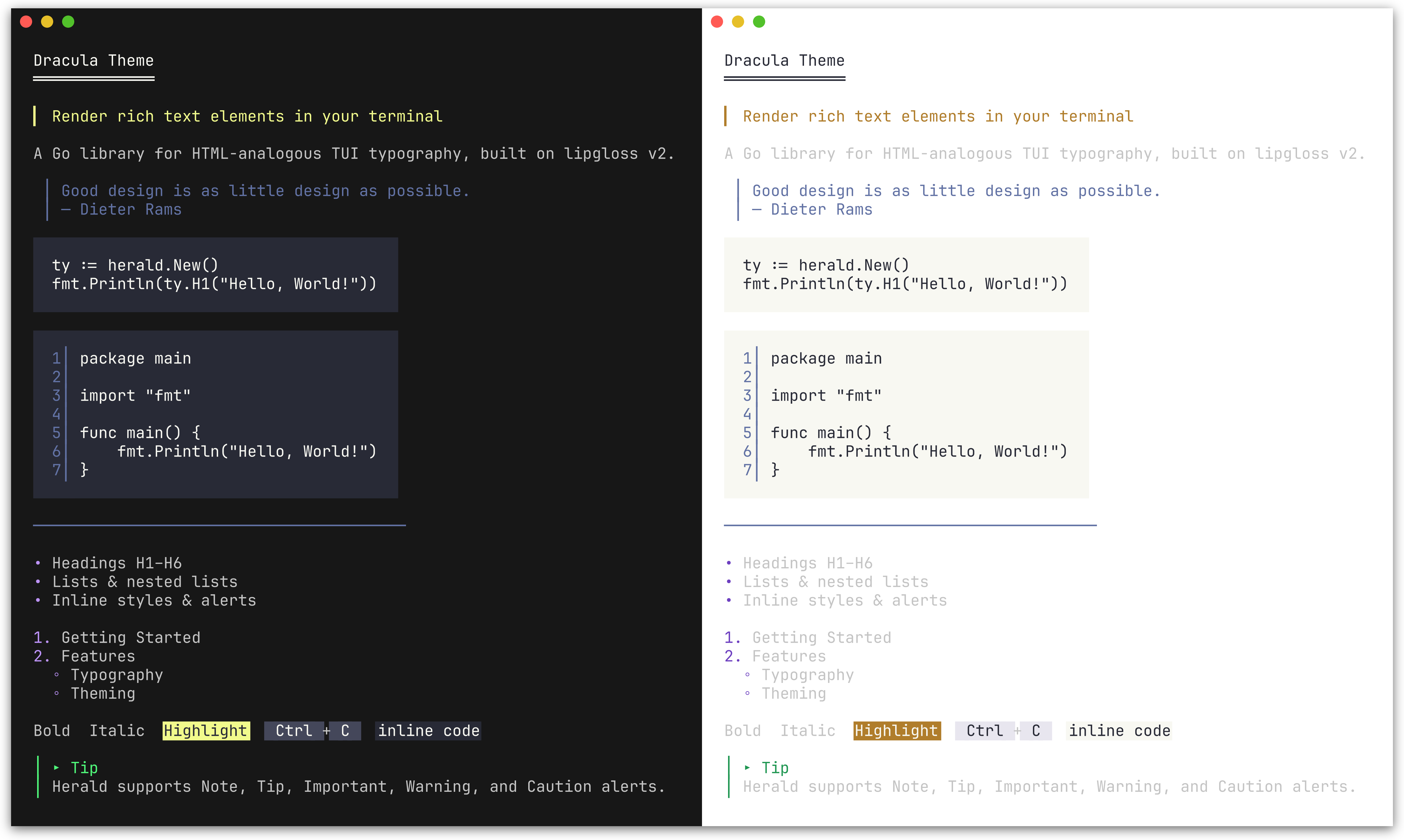
DraculaTheme()
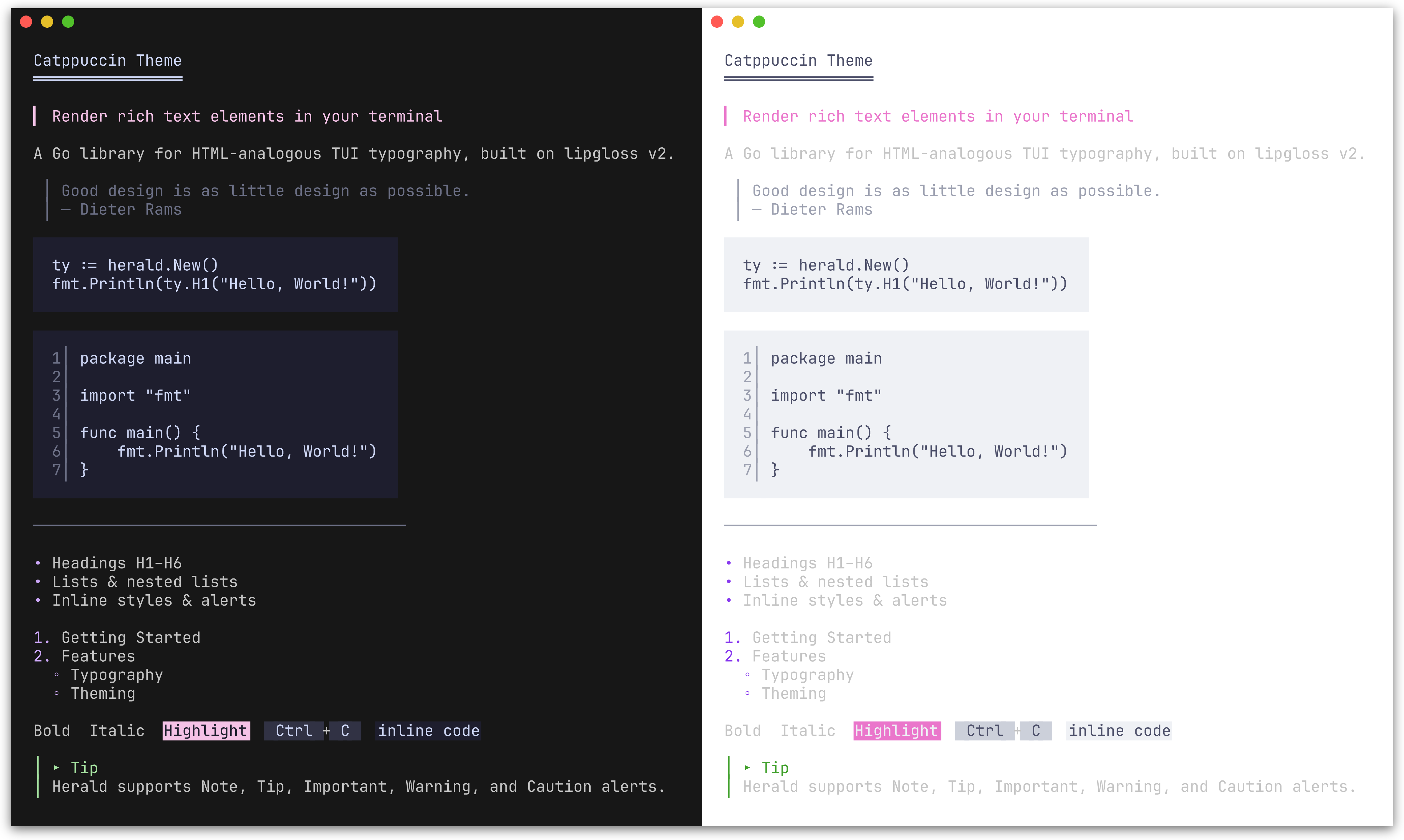
CatppuccinTheme()
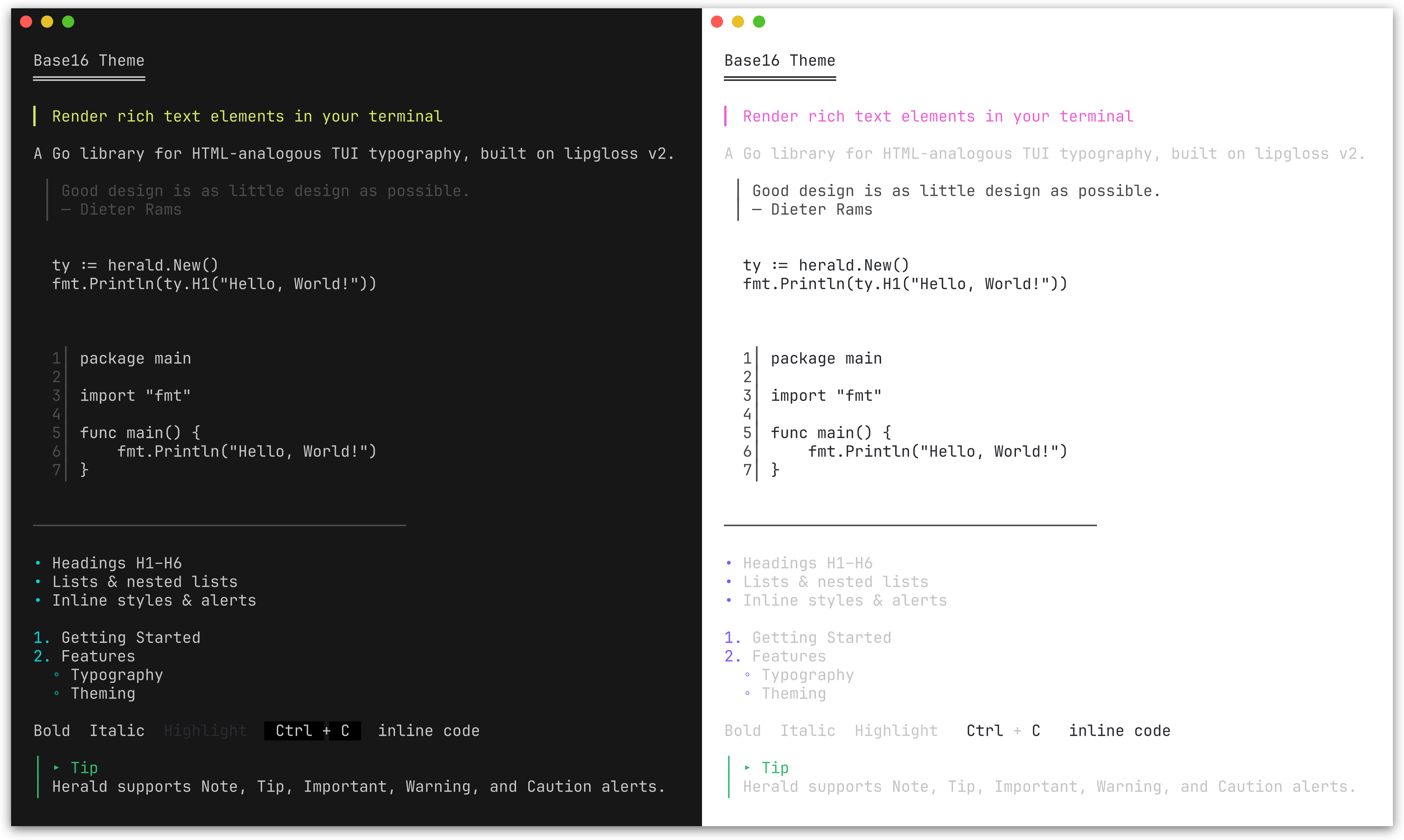
Base16Theme()
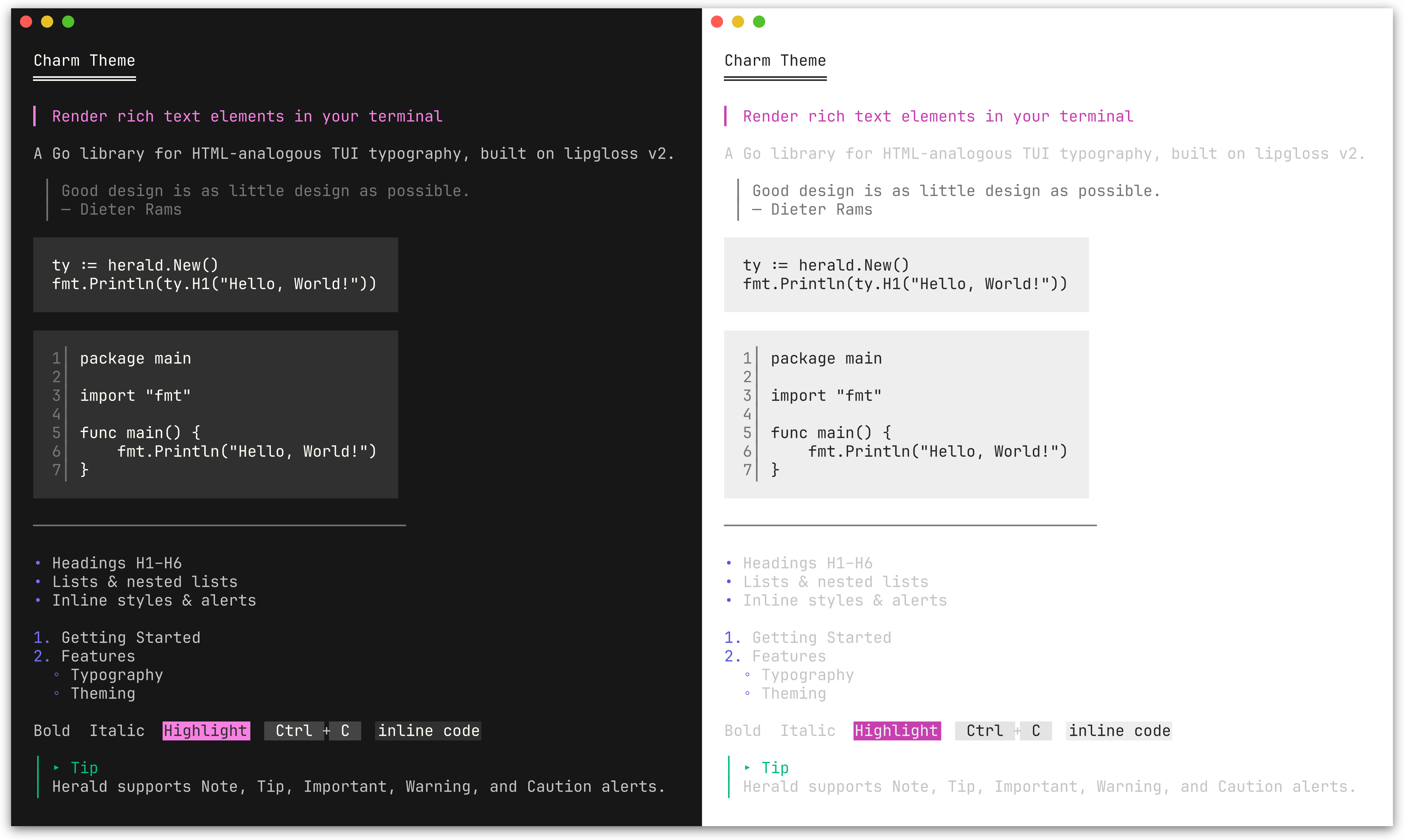
CharmTheme()
```go
ty := herald.New(herald.WithTheme(herald.DraculaTheme()))
```
### Color palette
`ColorPalette` lets you define 9 colors and derive a complete theme from them. All style fields map from this palette; token options (characters, widths) are unaffected and retain their defaults. Alert colors are handled separately via `AlertPalette`.
| Field | Maps to |
| ----------- | ---------------------------------------------------------------------------------------------------------------------------------------------------------------------------------------------------------------------------- |
| `Primary` | H1 headings |
| `Secondary` | H2, list bullets, `Badge` background, `Tag` foreground |
| `Tertiary` | H3, links, `Ins`, `FootnoteRef` |
| `Accent` | H4, mark background, `Var` |
| `Highlight` | H5, `Abbr`, `Del` |
| `Muted` | H6, blockquote, HR, `HRLabel`, sub/sup, `DD`, `KVKey`, `Address`, `AddressCard`, `AddressCardBorder`, `FootnoteItem`, `FootnoteDivider`, line numbers, table border, caption, `Q`, `Cite`, `FigureCaption`, `FieldsetBorder` |
| `Text` | Body text, paragraphs, list items, inline code, `DT`, `KVValue`, table cells, footer, `Samp`, `Fieldset` content |
| `Surface` | Background for `Kbd`, `Tag`, striped table rows |
| `Base` | Background for inline code, code blocks; mark fg, `Badge` fg |
Pass the palette to `New()` via `WithPalette`, or call `ThemeFromPalette` to construct a `Theme` value directly.
Use `lipgloss.LightDark` to define adaptive colors that automatically adjust to the terminal's background:
```go
lightDark := lipgloss.LightDark(lipgloss.HasDarkBackground(os.Stdin, os.Stdout))
// Nord-inspired palette
palette := herald.ColorPalette{
Primary: lightDark(lipgloss.Color("#5E81AC"), lipgloss.Color("#88C0D0")),
Secondary: lightDark(lipgloss.Color("#81A1C1"), lipgloss.Color("#81A1C1")),
Tertiary: lightDark(lipgloss.Color("#8FBCBB"), lipgloss.Color("#8FBCBB")),
Accent: lightDark(lipgloss.Color("#EBCB8B"), lipgloss.Color("#EBCB8B")),
Highlight: lightDark(lipgloss.Color("#BF616A"), lipgloss.Color("#BF616A")),
Muted: lightDark(lipgloss.Color("#7B88A1"), lipgloss.Color("#4C566A")),
Text: lightDark(lipgloss.Color("#2E3440"), lipgloss.Color("#ECEFF4")),
Surface: lightDark(lipgloss.Color("#D8DEE9"), lipgloss.Color("#3B4252")),
Base: lightDark(lipgloss.Color("#ECEFF4"), lipgloss.Color("#2E3440")),
}
ty := herald.New(herald.WithPalette(palette))
```
Each `lightDark(lightColor, darkColor)` call returns a single adaptive color that picks the right variant based on the terminal background. This is the same approach used by herald's built-in themes and `DefaultTheme()`.
Plain `lipgloss.Color` values (without `LightDark`) work too - they apply the same color regardless of terminal background.
#### Semantic palette
`SemanticPalette` defines four status colors used to derive the themed `SuccessBadge`, `WarningBadge`, `ErrorBadge`, `InfoBadge`, `SuccessTag`, `WarningTag`, `ErrorTag`, and `InfoTag` styles.
| Field | Semantic meaning | Default derivation from `ColorPalette` |
| --------- | ----------------------------- | -------------------------------------- |
| `Success` | Running, passed, healthy | `Tertiary` (green in most themes) |
| `Warning` | Expiring, degraded | `Accent` (amber in most themes) |
| `Error` | Failed, critical, down | `Highlight` (red in most themes) |
| `Info` | Informational, neutral status | `Secondary` (blue in most themes) |
`ThemeFromPalette` automatically derives a `SemanticPalette` from your `ColorPalette`, so existing custom palettes produce valid semantic badge and tag styles without any changes.
Use `WithSemanticPalette` to override all four semantic colors at once:
```go
ty := herald.New(
herald.WithSemanticPalette(herald.SemanticPalette{
Success: lipgloss.Color("#22c55e"),
Warning: lipgloss.Color("#f59e0b"),
Error: lipgloss.Color("#ef4444"),
Info: lipgloss.Color("#3b82f6"),
}),
)
```
Individual styles can be overridden with `WithSuccessBadgeStyle`, `WithErrorTagStyle`, and the other per-variant options listed in [Badge & Tag](#badge--tag).
#### Alert palette
`AlertPalette` lets you override the 5 alert colors independently from the main `ColorPalette`. By default, alert colors are derived from the semantic palette (`DefaultAlertPalette` maps `Info->Note`, `Success->Tip`, `Warning->Warning`, `Error->Caution`), with `Important` using `ColorPalette.Secondary`. Changing the semantic palette therefore updates alert colors too.
Use `WithAlertPalette` to override all 5 alert colors independently:
```go
ty := herald.New(
herald.WithAlertPalette(herald.AlertPalette{
Note: lightDark(lipgloss.Color("#0969DA"), lipgloss.Color("#58A6FF")),
Tip: lightDark(lipgloss.Color("#1A7F37"), lipgloss.Color("#3FB950")),
Important: lightDark(lipgloss.Color("#8250DF"), lipgloss.Color("#D2A8FF")),
Warning: lightDark(lipgloss.Color("#9A6700"), lipgloss.Color("#D29922")),
Caution: lightDark(lipgloss.Color("#CF222E"), lipgloss.Color("#F85149")),
}),
)
```
Individual alert icons and labels can also be customized:
```go
ty := herald.New(
herald.WithAlertIcon(herald.AlertTip, "💡"),
herald.WithAlertLabel(herald.AlertNote, "Info"),
)
```
You can combine `WithPalette` with other options to override specific fields after the palette is applied:
```go
ty := herald.New(
herald.WithPalette(palette),
herald.WithHRWidth(60),
herald.WithBulletChar("-"),
)
```
### Custom theme
The easiest way to customize is to start from an existing theme and modify specific fields:
```go
custom := herald.DefaultTheme()
custom.H1 = lipgloss.NewStyle().Bold(true).Foreground(lipgloss.Color("#FF0000")).MarginBottom(1)
custom.BulletChar = "-"
ty := herald.New(herald.WithTheme(custom))
```
For a fully custom theme, construct a `Theme` struct directly:
```go
custom := herald.Theme{
H1: lipgloss.NewStyle().Bold(true).Foreground(lipgloss.Color("#FFFFFF")),
H2: lipgloss.NewStyle().Bold(true).Foreground(lipgloss.Color("#AAAAAA")),
Paragraph: lipgloss.NewStyle().MarginBottom(1),
// set remaining Theme fields as needed...
H1UnderlineChar: "=",
H2UnderlineChar: "-",
H3UnderlineChar: ".",
HeadingBarChar: ">",
BulletChar: "*",
HRChar: "-",
HRWidth: 40,
BlockquoteBar: "|",
}
ty := herald.New(herald.WithTheme(custom))
```
## Pairing with huh
herald is designed to complement [huh](https://github.com/charmbracelet/huh) - a form and prompt library for the terminal. Together they cover the full output story of a CLI: herald handles formatted display (instructions, section headers, results, documentation), while huh handles user input.
Since both are built on lipgloss, herald ships with themes that match huh's built-in palettes exactly. You get visual consistency across your entire CLI without any manual style coordination.
```go
ty := herald.New(herald.WithTheme(herald.DraculaTheme()))
fmt.Println(ty.H1("Project Setup"))
fmt.Println(ty.P("Answer a few questions to scaffold your project."))
form := huh.NewForm(
huh.NewGroup(
huh.NewInput().Title("Project name").Value(&name),
huh.NewSelect[string]().Title("Language").Options(...).Value(&lang),
),
).WithTheme(huh.ThemeDracula())
form.Run()
fmt.Println(ty.H2("Summary"))
fmt.Println(ty.DL([][2]string{
{"Name", name},
{"Language", lang},
}))
```
See [`examples/203_huh-form/`](./examples/203_huh-form) for a runnable example, and [`examples/204_huh-wizard/`](./examples/204_huh-wizard) for a multi-step wizard combining herald and huh.
## Pairing with bubbletea
herald works inside [bubbletea](https://github.com/charmbracelet/bubbletea) applications - build your content with herald, then display it in a bubbletea viewport or model. Herald handles the typography, bubbletea handles the interactivity.
```go
func buildContent(ty *herald.Typography) string {
return ty.Compose(
ty.H1("Release Notes"),
ty.Badge("STABLE")+" "+ty.Tag("v2.0.0"),
ty.HRWithLabel("Features"),
ty.UL("New dashboard", "Dark mode support"),
ty.Tip("Run `go get -u` to upgrade."),
)
}
// Pass to a bubbles viewport for scrolling
m.viewport.SetContent(buildContent(ty))
```
See [`examples/205_bubbletea-release-viewer/`](./examples/205_bubbletea-release-viewer) for a scrollable release notes viewer and [`examples/206_bubbletea-explorer/`](./examples/206_bubbletea-explorer) for a sidebar + viewport explorer.
## Pairing with tview
herald works with [tview](https://github.com/rivo/tview) via `tview.ANSIWriter`, which translates lipgloss ANSI output into tview's internal color tags.
```go
ty := herald.New()
textView := tview.NewTextView().
SetDynamicColors(true).
SetScrollable(true).
SetWordWrap(true)
w := tview.ANSIWriter(textView)
fmt.Fprintln(w, ty.H1("Herald + tview"))
fmt.Fprintln(w, ty.P("ANSI escape sequences are converted to tview color tags."))
fmt.Fprintln(w, ty.UL("Headings", "Lists", "Alerts", "Tables"))
```
See [`examples/207_tview-explorer/`](./examples/207_tview-explorer) for a sidebar + content pane explorer.
## Examples
Runnable examples are in the [`examples/`](examples/) directory:
| Example | Description |
| -------------------------------------------------------------------------------------- | --------------------------------------------------------------------------------- |
| [000_default-theme](examples/000_default-theme/) | All elements with the default Rose Pine theme |
| [001_lists](examples/001_lists/) | Flat, nested, mixed, and hierarchical lists |
| [002_alerts](examples/002_alerts/) | GitHub-style alert callouts (Note, Tip, Important, Warning, Caution) |
| [003_table](examples/003_table/) | Table rendering: bordered, minimal, alignment, striped rows, captions, and footer |
| [004_semantic-badges](examples/004_semantic-badges/) | Semantic badge and tag methods with default and custom `SemanticPalette` |
| [005_compose](examples/005_compose/) | Compose multiple rendered blocks into a single output |
| [006_section](examples/006_section/) | Section groups heading + content tightly; BR for line breaks |
| [100_custom-options](examples/100_custom-options/) | Override styles, decoration chars, and tokens via functional options |
| [101_custom-palette](examples/101_custom-palette/) | Custom adaptive theme from 9 colors using `ColorPalette` and `LightDark` |
| [102_builtin-themes](examples/102_builtin-themes/) | Built-in themes (Dracula, Catppuccin, Base16, Charm) matching huh |
| [103_catppuccin-theme](examples/103_catppuccin-theme/) | Build a full theme from the [Catppuccin](https://catppuccin.com) palette |
| [200_chroma-syntax-highlighting](examples/200_chroma-syntax-highlighting/) | Plug in chroma for syntax-highlighted code blocks |
| [201_tree-sitter-syntax-highlighting](examples/201_tree-sitter-syntax-highlighting/) | Plug in tree-sitter for AST-based syntax highlighting |
| [202_gotreesitter-syntax-highlighting](examples/202_gotreesitter-syntax-highlighting/) | Pure-Go tree-sitter highlighting via gotreesitter |
| [203_huh-form](examples/203_huh-form/) | Using herald with huh for interactive TUI forms |
| [204_huh-wizard](examples/204_huh-wizard/) | Multi-step project scaffolder with herald + huh |
| [205_bubbletea-release-viewer](examples/205_bubbletea-release-viewer/) | Scrollable release notes viewer with bubbletea viewport |
| [206_bubbletea-explorer](examples/206_bubbletea-explorer/) | Sidebar + scrollable content pane explorer with bubbletea |
| [207_tview-explorer](examples/207_tview-explorer/) | Sidebar + scrollable content pane explorer with tview |
| [208_figure-with-image](examples/208_figure-with-image/) | `Figure` with ASCII art image rendering via image2ascii |
## License
This project is licensed under the MIT License - see the [LICENSE](./LICENSE) file for details.