https://github.com/itchono/trajectorize
A tool for planning flights from one celestial body in KSP to another
https://github.com/itchono/trajectorize
cffi kerbal-space-program orbital-mechanics python spacecraft-trajectories
Last synced: 6 months ago
JSON representation
A tool for planning flights from one celestial body in KSP to another
- Host: GitHub
- URL: https://github.com/itchono/trajectorize
- Owner: itchono
- License: gpl-3.0
- Created: 2022-11-14T00:10:11.000Z (over 3 years ago)
- Default Branch: main
- Last Pushed: 2023-03-14T21:25:42.000Z (over 3 years ago)
- Last Synced: 2025-09-20T10:30:38.135Z (10 months ago)
- Topics: cffi, kerbal-space-program, orbital-mechanics, python, spacecraft-trajectories
- Language: Python
- Homepage: https://pypi.org/project/trajectorize/
- Size: 2.98 MB
- Stars: 3
- Watchers: 1
- Forks: 1
- Open Issues: 4
-
Metadata Files:
- Readme: README.md
- License: LICENSE
Awesome Lists containing this project
README

[](https://pypi.org/project/trajectorize/)
[](https://github.com/itchono/trajectorize/blob/main/LICENSE)
---
KSP Trajectory Optimizer.
This project is a reduced-scope version of [one of my other (currently incomplete) projects](https://github.com/itchono/gravity-assist-flyby-optimizer), as an intermediate stepping stone.
This tool computes trajectories between celestial bodies in KSP based on on-rails two-body patched conics, incorporating trajectory correction maneuvers for a variety of mission scenarios, such as:
* Ballistic Hohmann transfers for other planets
* Gravity assist flyby routes
Computationally-intensive code is implemented in C, with a Python wrapper made using `cffi`.
C code follows mostly C89, with some C99 features used. It has been tested against the latest versions of GCC (on Linux) and MSVC (on Windows 10).
# Installation
The simplest way to install is from PyPI:
`pip install trajectorize`
This will install the latest stable version of the package, and may include pre-compiled binaries for your platform.
The package is still in development, so you may want to install from the latest commit on the `main` branch instead:
Run `pip install git+https://github.com/itchono/trajectorize` to install the package from source.
You will need to have Python 3.8+, and a **C compiler installed** to compile the C code if installing from source. You will also need a C compiler installed if there are no pre-compiled binaries for your platform. If you're on Windows, you can find details about installing a C compiler [here](https://wiki.python.org/moin/WindowsCompilers).
The following platforms/compilers have been tested:
|Platform |Compiler |
|-----------------|-----------|
|Windows 10 | MSVC 14.16 (Visual Studio 2017)|
|Ubuntu 20.04 LTS (Dev Machine) | GCC 9.4.0 |
# Demos
Right now, full functionality is incomplete. There are, however, some cool demos showing off the capabilities of the package.
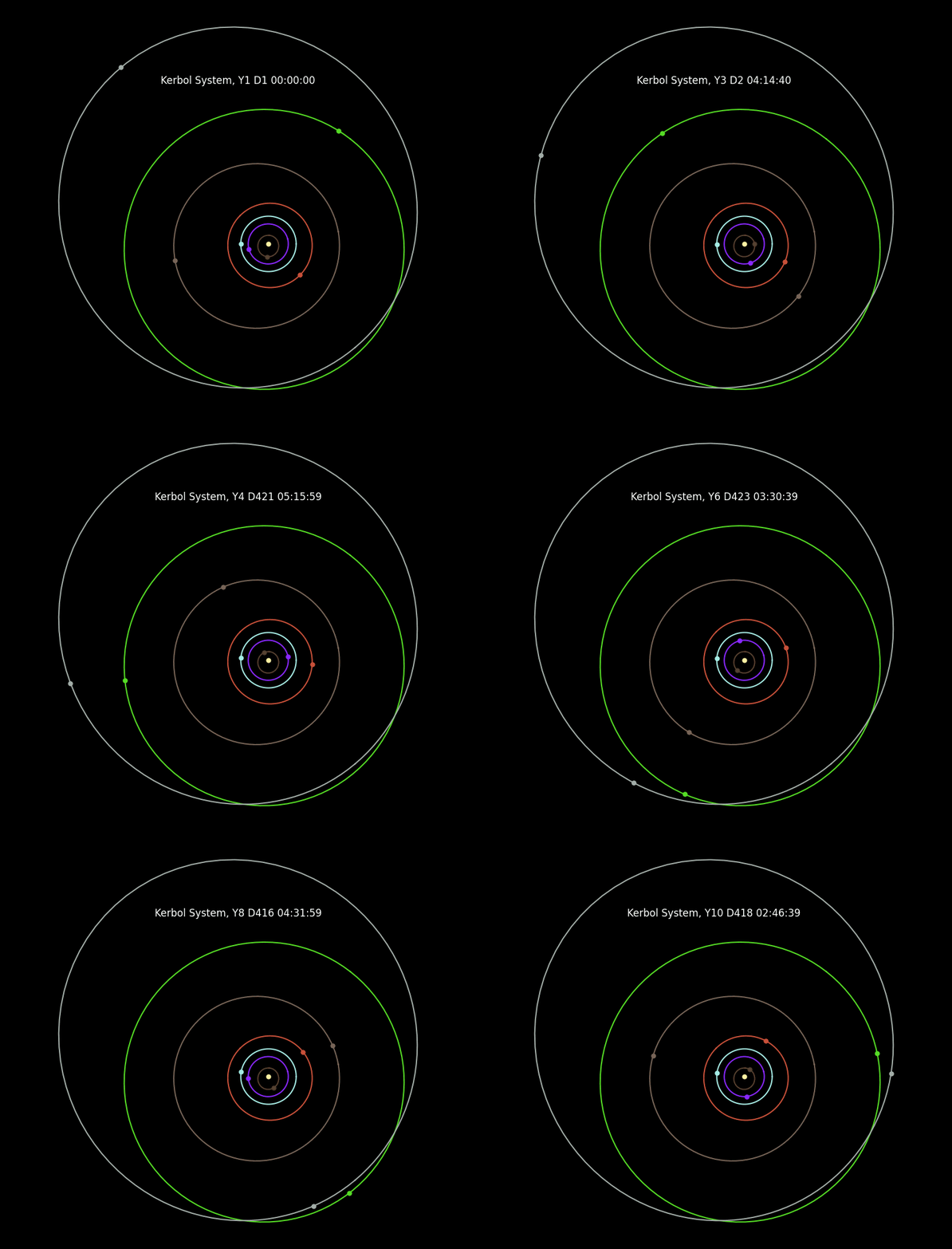
## Full Model of KSP Planetary System and Ephemerides
`python -m trajectorize.demos.kerbol_system_anim`
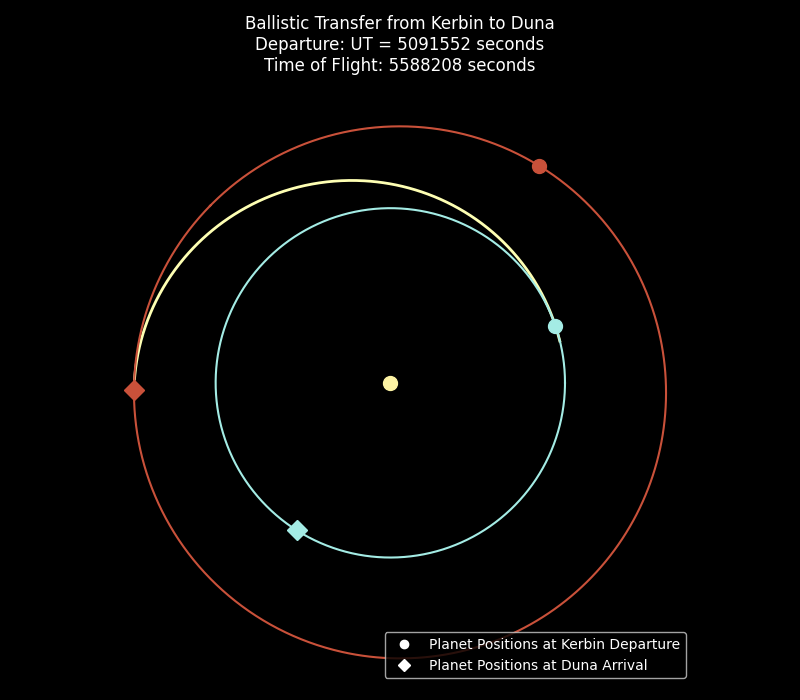
## Calculation of Ballistic Interplanetary Transfers Using Lambert's Problem
`python -m trajectorize.demos.kerbin_duna_transfer`
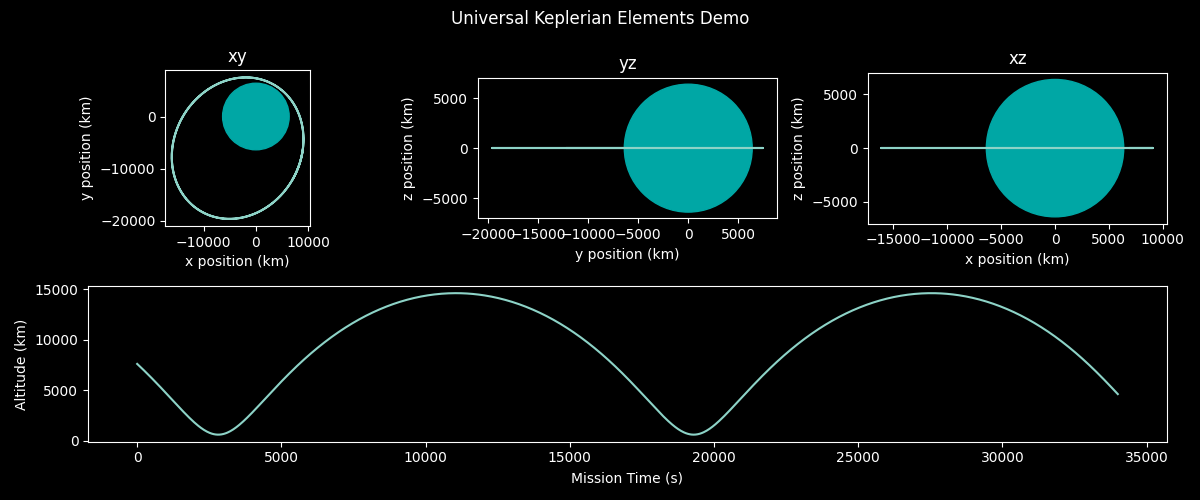
## Propagation of Two-Body Trajectories Using Universal Keplerian Elements
`python -m trajectorize.demos.orbit`
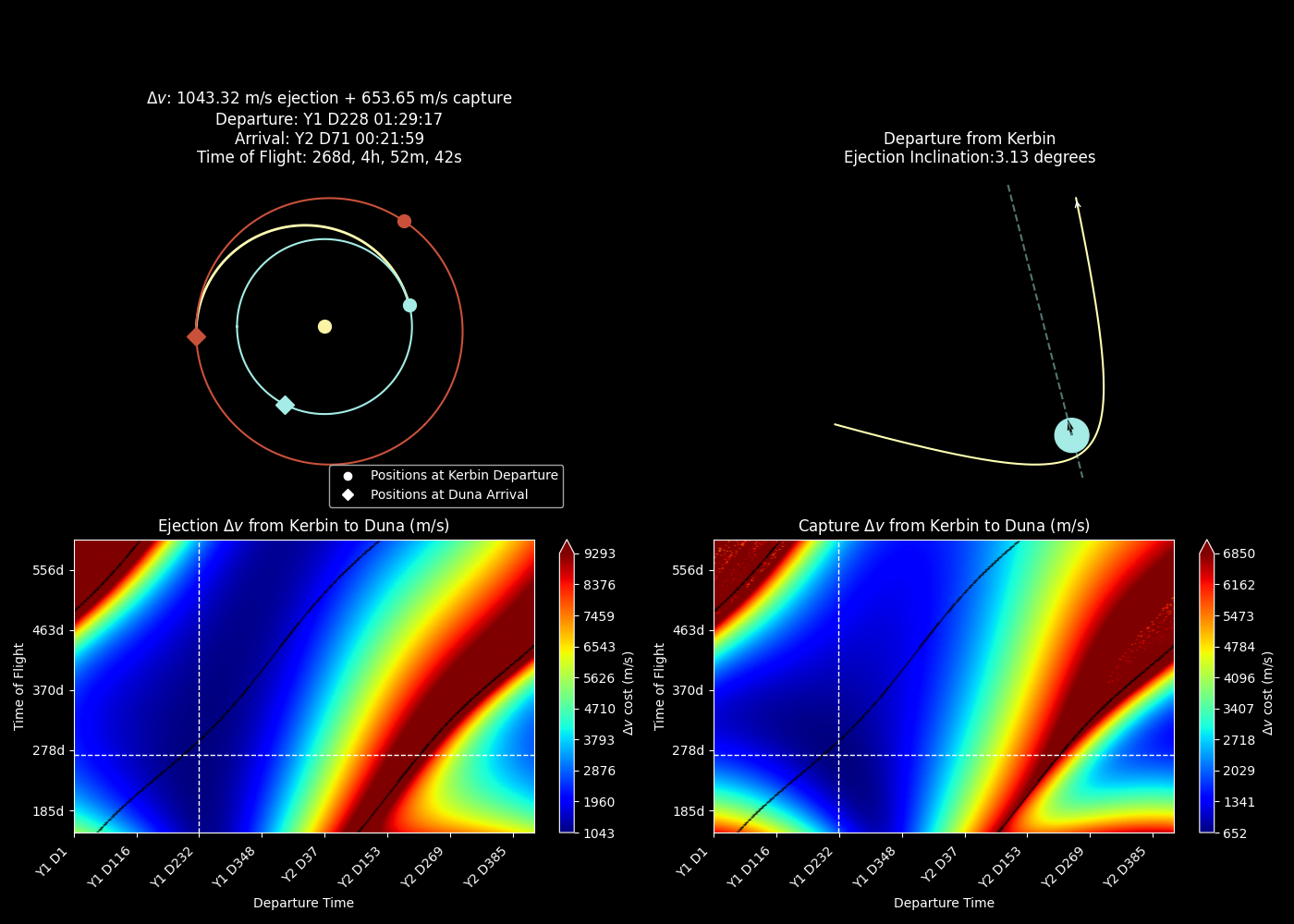
## Calculations of Optimal Transfers, Porkchop Plots
`python -m trajectorize.demos.single_transfer Kerbin Duna --capture_alt 60000`
# Inspirations
* [Interactive illustrated interplanetary guide and calculator for KSP](https://ksp.olex.biz/), by Olex
* [Launch Window Planner](https://alexmoon.github.io/ksp/), by AlexMoon