https://github.com/izzypt/libft
libft is a library with basic C functions that will help manipulate strings, manage memory, etc..
https://github.com/izzypt/libft
Last synced: about 9 hours ago
JSON representation
libft is a library with basic C functions that will help manipulate strings, manage memory, etc..
- Host: GitHub
- URL: https://github.com/izzypt/libft
- Owner: izzypt
- Created: 2022-11-24T23:50:48.000Z (over 3 years ago)
- Default Branch: main
- Last Pushed: 2022-12-15T19:42:44.000Z (over 3 years ago)
- Last Synced: 2025-11-08T02:04:15.094Z (8 months ago)
- Language: C
- Homepage:
- Size: 82 KB
- Stars: 0
- Watchers: 1
- Forks: 0
- Open Issues: 0
-
Metadata Files:
- Readme: README.md
Awesome Lists containing this project
README
## First Section
You must write your own function implementing the following original ones. ( Follow man description )
They do not require any external functions:
- isalpha
- isdigit
- isalnum
- isascii
- isprint
- strlen
- memset
- bzero
- memcpy
- memmove
- strlcpy
- strlcat
- toupper
- tolower
- strchr
- strrchr
- strncmp
- memchr
- memcmp
- strnstr
- atoi
In order to implement the two following functions, you will use malloc():
- calloc
- strdup
## Second Section
In the second part, you must develop a set of functions that are either not in the libc,
or that are part of it but in a different form.
### ft_substr
Prototype: char *ft_substr(char const *s, unsigned int start, size_t len);
Parameters:
s: The string from which to create the substring.
start: The start index of the substring in the string ’s’.
len: The maximum length of the substring.
Return: value The substring. NULL if the allocation fails.
External functs: malloc
Description : Allocates (with malloc(3)) and returns a substring from the string ’s’.
The substring begins at index ’start’ and is of maximum size ’len’.
### ft_strjoin
Prototype: char *ft_strjoin(char const *s1, char const *s2);
Parameters:
s1: The prefix string.
s2: The suffix string.
Return: The new string. NULL if the allocation fails.
External functs: malloc
Description : Allocates (with malloc(3)) and returns a new string, which is the result of
the concatenation of ’s1’ and ’s2’.
### ft_strtrim
Prototype: char *ft_strtrim(char const *s1, char const *set);
Parameters:
s1: The string to be trimmed.
set: The reference set of characters to trim.
Return: The trimmed string. NULL if the allocation fails.
External functs: malloc
Description : Allocates (with malloc(3)) and returns a copy of ’s1’ with the characters specified in ’set’
removed from the beginning and the end of the string.
### ft_split
Prototype: char **ft_split(char const *s, char c);
Parameters:
s: The string to be split.
c: The delimiter character.
Return: The array of new strings resulting from the split. NULL if the allocation fails.
External functs: malloc, free
Description : Allocates (with malloc(3)) and returns an array of strings obtained by splitting ’s’ using the
character ’c’ as a delimiter. The array must end with a NULL pointer.
### ft_itoa
Prototype: char *ft_itoa(int n);
Parameters:
n: the integer to convert.
Return: The string representing the integer. NULL if the allocation fails.
External functs: malloc
Description : Allocates (with malloc(3)) and returns a string representing the integer received as an argument.
Negative numbers must be handled.
### ft_strmapi
Prototype: char *ft_strmapi(char const *s, char (*f)(unsigned int, char));
Parameters:
s: The string on which to iterate.
f: The function to apply to each character.
Return: The string created from the successive applications of ’f’. Returns NULL if the allocation fails.
External functs: malloc
Description : Applies the function ’f’ to each character of the string ’s’, and passing its index
as first argument to create a new string (with malloc(3)) resulting
from successive applications of ’f’.
### ft_striteri
Prototype: void ft_striteri(char *s, void (*f)(unsigned int, char*));
Parameters:
s: The string on which to iterate.
f: The function to apply to each character.
Return: None
External functs: None
Description : Applies the function ’f’ on each character of
the string passed as argument, passing its index
as first argument. Each character is passed by address to ’f’ to be modified if necessary.
### ft_putchar_fd
Prototype: void ft_putchar_fd(char c, int fd);
Parameters:
Return:
External functs:
Description :
### ft_putstr_fd
Prototype: void ft_putstr_fd(char *s, int fd);
Parameters:
Return:
External functs:
Description :
### ft_putendl_fd
Prototype: void ft_putendl_fd(char *s, int fd);
Parameters:
Return:
External functs:
Description :
### ft_putnbr_fd
Prototype: void ft_putnbr_fd(int n, int fd);
Parameters:
n: The integer to output.
fd: The file descriptor on which to write
Return:
External functs: write
Description : Outputs the integer ’n’ to the given file descriptor.
# Useful Concepts to solve those exercises
Below some of the important concepts to understand and solve the exercises above.
- Strings & Arrays
- Pointers
- ASCII
- Dynamic Memory Allocation
- Structs
- Linked Lists
## Strings
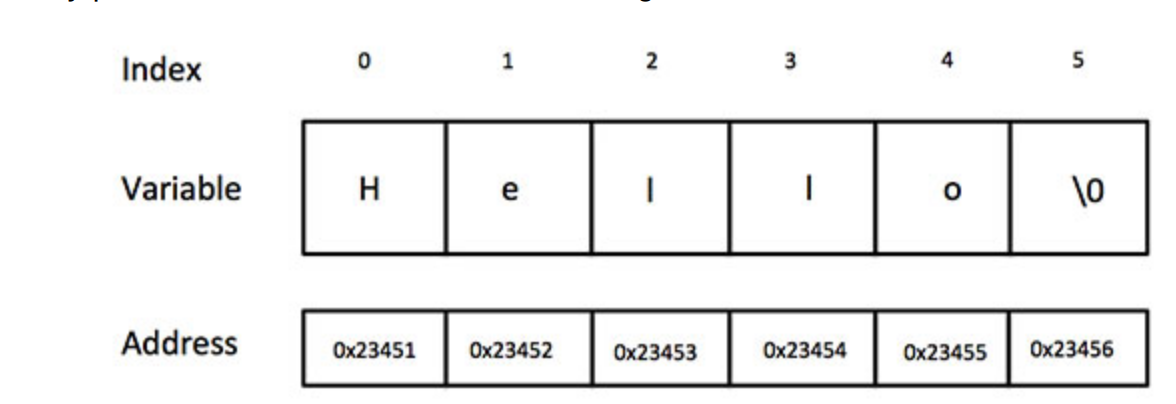
Strings are actually one-dimensional array of characters terminated by a null character '\0'. Thus a null-terminated string contains the characters that comprise the string followed by a null.
You do not place the null character at the end of a string constant. The C compiler automatically places the '\0' at the end of the string when it initializes the array.
## ASCII
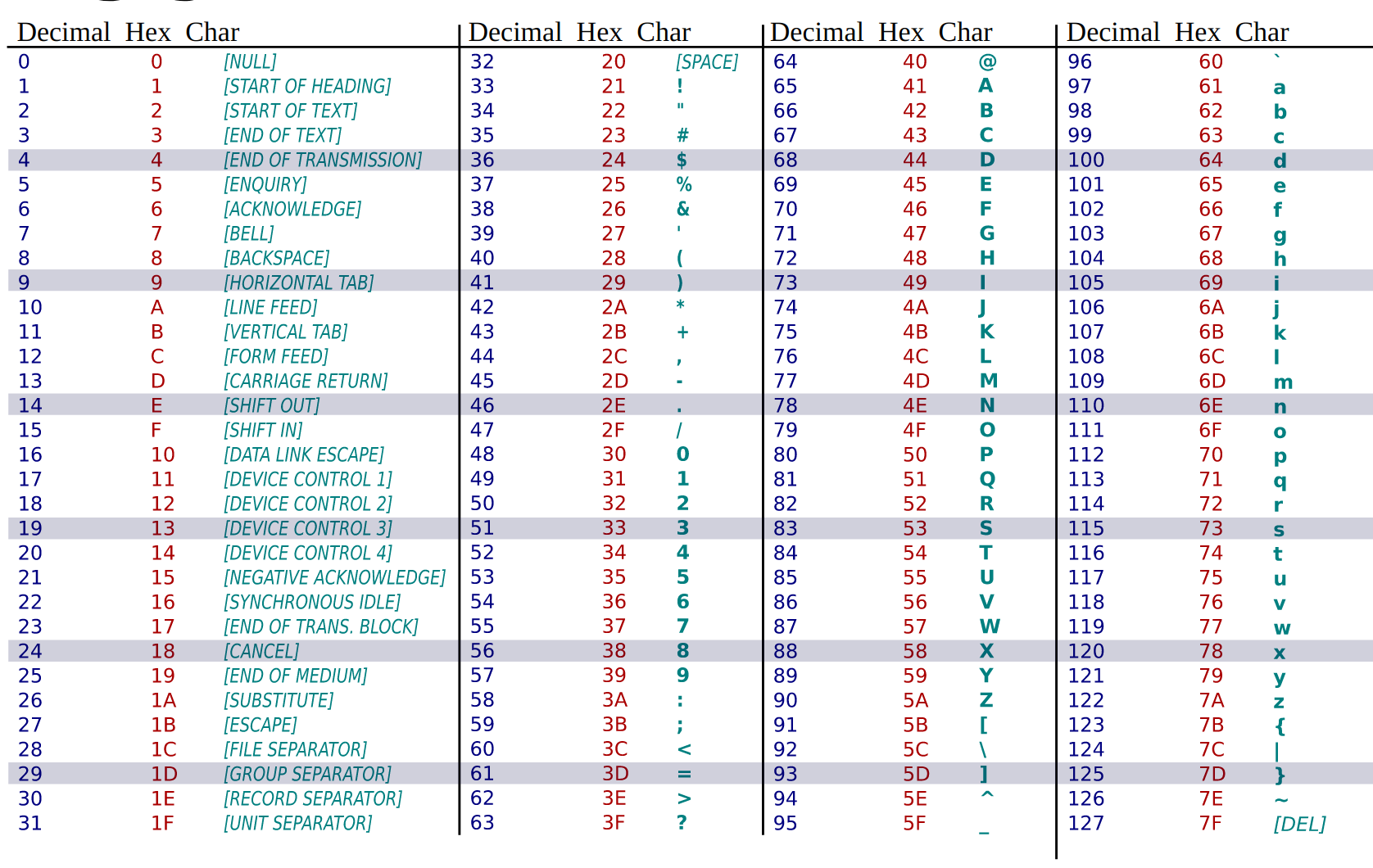
Computers can only understand numbers, so an ASCII code is the numerical representation of a character such as 'a' or '@' or an action of some sort.
ASCII assigns standard numeric values to letters, numerals, punctuation marks, and other characters used in computers.
ASCII is a 7-bit character set containing 128 characters. It contains the numbers from 0-9, the upper and lower case English letters from A to Z, and some special characters. The character sets used in modern computers, in HTML, and on the Internet, are all based on ASCII.
## Dynamic Memmory allocation
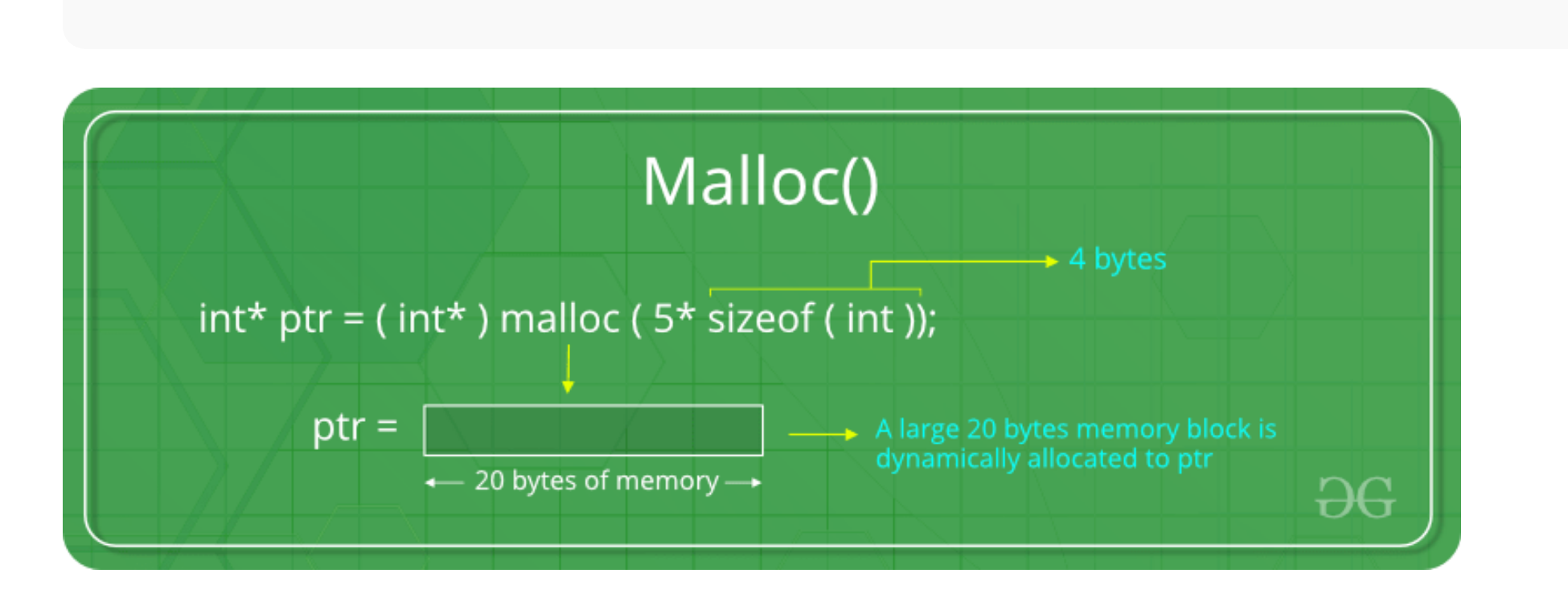
The “malloc” or “memory allocation” method in C is used to dynamically allocate a single large block of memory with the specified size. It returns a pointer of type void which can be cast into a pointer of any form. It doesn’t Initialize memory at execution time so that it has initialized each block with the default garbage value initially.
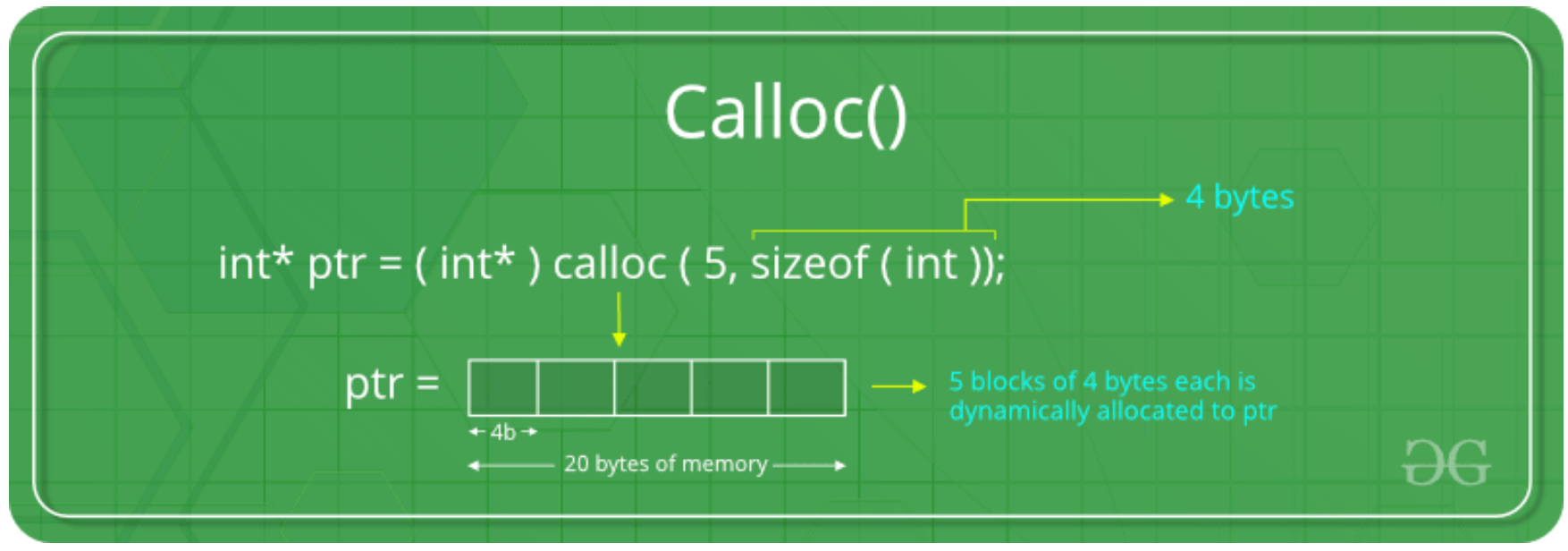
The “calloc” or “contiguous allocation” method in C is used to dynamically allocate the specified number of blocks of memory of the specified type. it is very much similar to malloc() but has two different points and these are:
It initializes each block with a default value ‘0’.
It has two parameters or arguments as compare to malloc().
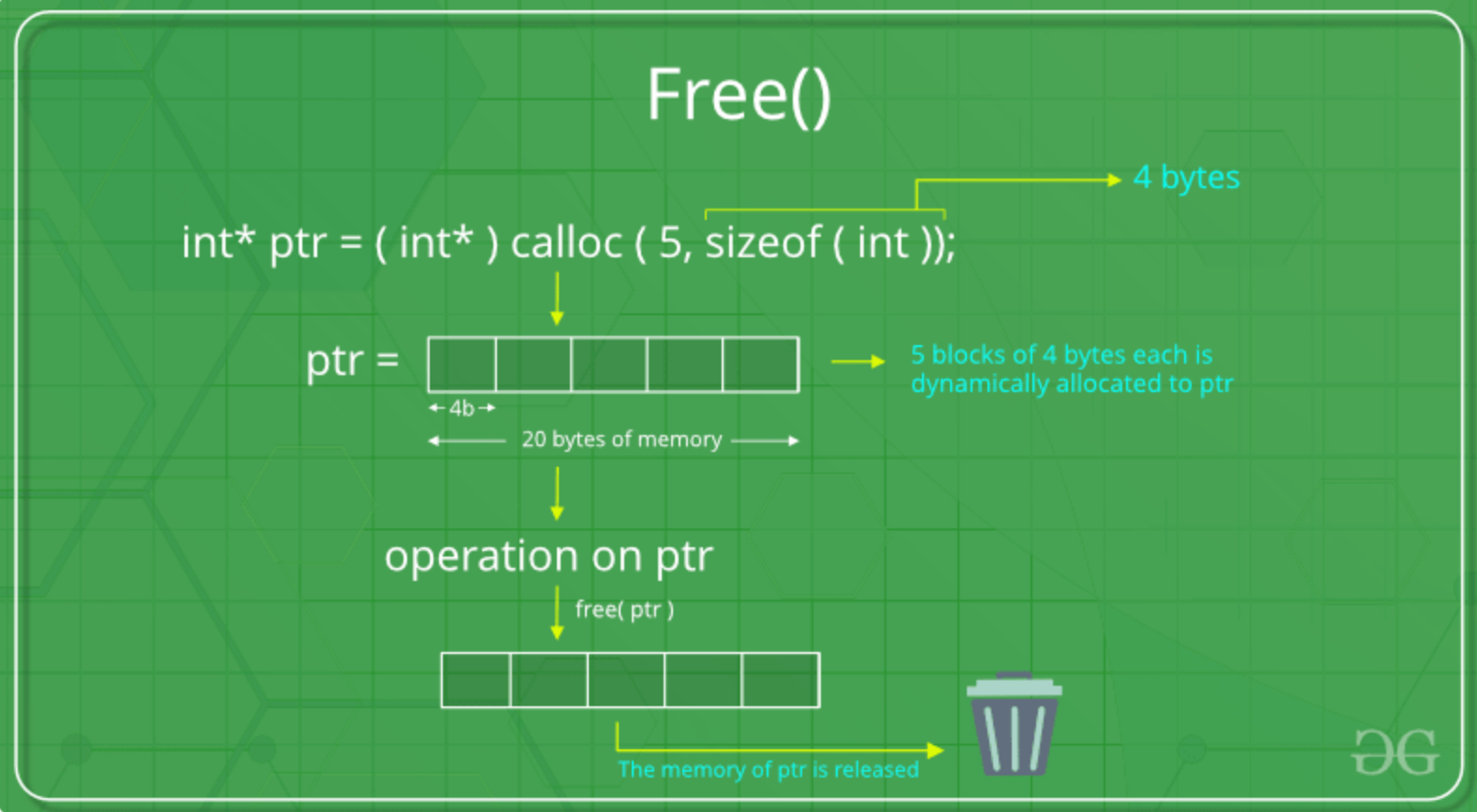
The “free” method in C is used to dynamically de-allocate the memory. The memory allocated using functions malloc() and calloc() is not de-allocated on their own. Hence the free() method is used, whenever the dynamic memory allocation takes place. It helps to reduce wastage of memory by freeing it.
## Heap
Presumably you mean heap from a memory allocation point of view, not from a data structure point of view (the term has multiple meanings).
A very simple explanation is that the heap is the portion of memory where dynamically allocated memory resides (i.e. memory allocated via malloc). Memory allocated from the heap will remain allocated until one of the following occurs:
The memory is free'd
The program terminates
If all references to allocated memory are lost (e.g. you don't store a pointer to it anymore), you have what is called a memory leak. This is where the memory has still been allocated, but you have no easy way of accessing it anymore. Leaked memory cannot be reclaimed for future memory allocations, but when the program ends the memory will be free'd up by the operating system.
Contrast this with stack memory which is where local variables (those defined within a method) live. Memory allocated on the stack generally only lives until the function returns (there are some exceptions to this, e.g. static local variables).
You can find more information about the heap in this article (https://en.wikipedia.org/wiki/Memory_management#HEAP).
## Structs
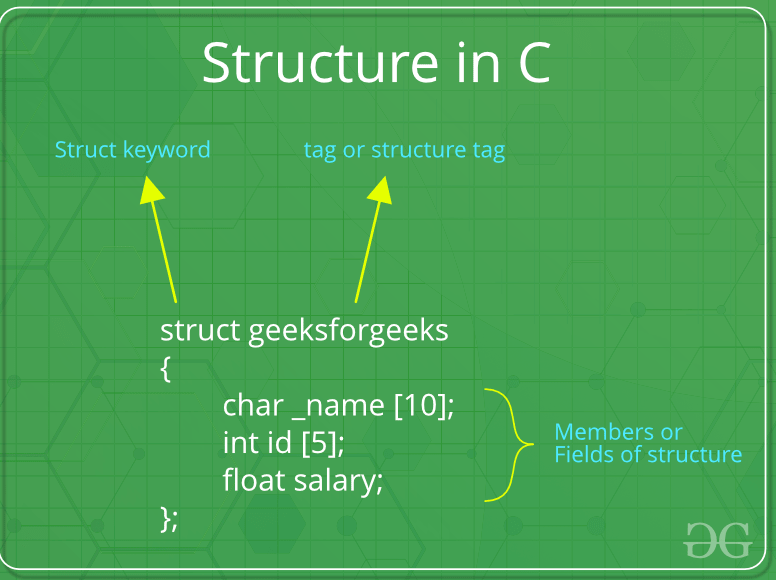
Structures (also called structs) are a way to group several related variables into one place. Each variable in the structure is known as a member of the structure.
To define a structure, you must use the struct statement. The struct statement defines a new data type, with more than one member. The format of the struct statement is as follows:
###
struct [structure tag] {
member definition;
member definition;
...
member definition;
} [one or more structure variables];
###
struct address
{
char name[50];
char street[100];
char city[50];
char state[20];
int pin;
} adress1, adress2;
A structure variable can be declared with structure declaration or as a separate declaration like basic types.
###
// A variable declaration with structure declaration.
struct Point
{
int x, y;
} p1; // The variable p1 is declared with 'Point'
// A variable declaration like basic data types
struct Point
{
int x, y;
};
int main()
{
struct Point p1; // The variable p1 is declared like a normal variable
}
Like primitive types, we can have pointer to a structure. If we have a pointer to structure, members are accessed using arrow ( -> ) operator.
###
#include
struct Point
{
int x, y;
};
int main()
{
struct Point p1 = {1, 2};
// p2 is a pointer to structure p1
struct Point *p2 = &p1;
// Accessing structure members using structure pointer
printf("%d %d", p2->x, p2->y);
return 0;
}
## Linked Lists
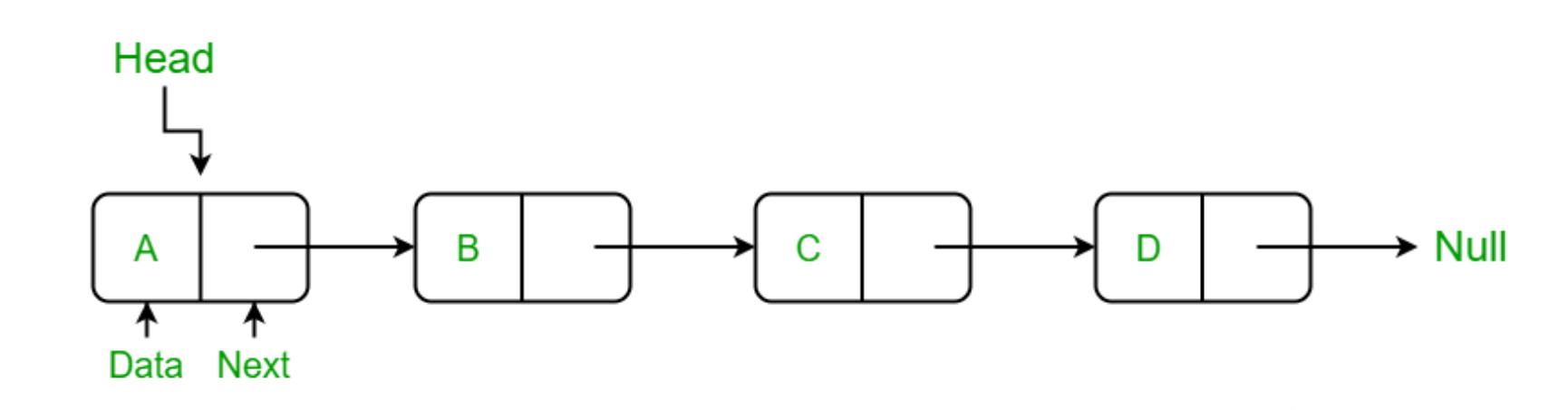
A linked list is a set of dynamically allocated nodes, arranged in such a way that each node contains one value and one pointer. The pointer always points to the next member of the list. If the pointer is NULL, then it is the last node in the list.
A linked list is held using a local pointer variable which points to the first item of the list. If that pointer is also NULL, then the list is considered to be empty.

Like arrays, a Linked List is a linear data structure. Unlike arrays, linked list elements are not stored at a contiguous location; the elements are linked using pointers. They include a series of connected nodes. Here, each node stores the data and the address of the next node.