https://github.com/jaehyeon-kim/dynamic-des
Real-time SimPy control plane to dynamically update parameters and stream outputs via external systems like Kafka, Redis, or Postgres. Built for event-driven digital twins.
https://github.com/jaehyeon-kim/dynamic-des
data-generation descrete-event-simulation digital-twin industry-4 kafka postgres python redis simpy simulation
Last synced: about 2 months ago
JSON representation
Real-time SimPy control plane to dynamically update parameters and stream outputs via external systems like Kafka, Redis, or Postgres. Built for event-driven digital twins.
- Host: GitHub
- URL: https://github.com/jaehyeon-kim/dynamic-des
- Owner: jaehyeon-kim
- License: mit
- Created: 2026-03-07T00:19:19.000Z (3 months ago)
- Default Branch: main
- Last Pushed: 2026-04-07T07:24:45.000Z (2 months ago)
- Last Synced: 2026-04-07T09:22:21.234Z (2 months ago)
- Topics: data-generation, descrete-event-simulation, digital-twin, industry-4, kafka, postgres, python, redis, simpy, simulation
- Language: Python
- Homepage: https://jaehyeon.me/dynamic-des/
- Size: 2.87 MB
- Stars: 3
- Watchers: 1
- Forks: 0
- Open Issues: 0
-
Metadata Files:
- Readme: README.md
- License: LICENSE
Awesome Lists containing this project
README
# Dynamic DES
[](https://github.com/jaehyeon-kim/dynamic-des/actions/workflows/pipeline.yml)
[](https://jaehyeon-kim.github.io/dynamic-des/)
[](https://badge.fury.io/py/dynamic-des)
[](https://pypi.org/project/dynamic-des/)
[](https://opensource.org/licenses/MIT)
**Real-time SimPy control plane for event-driven digital twins.**
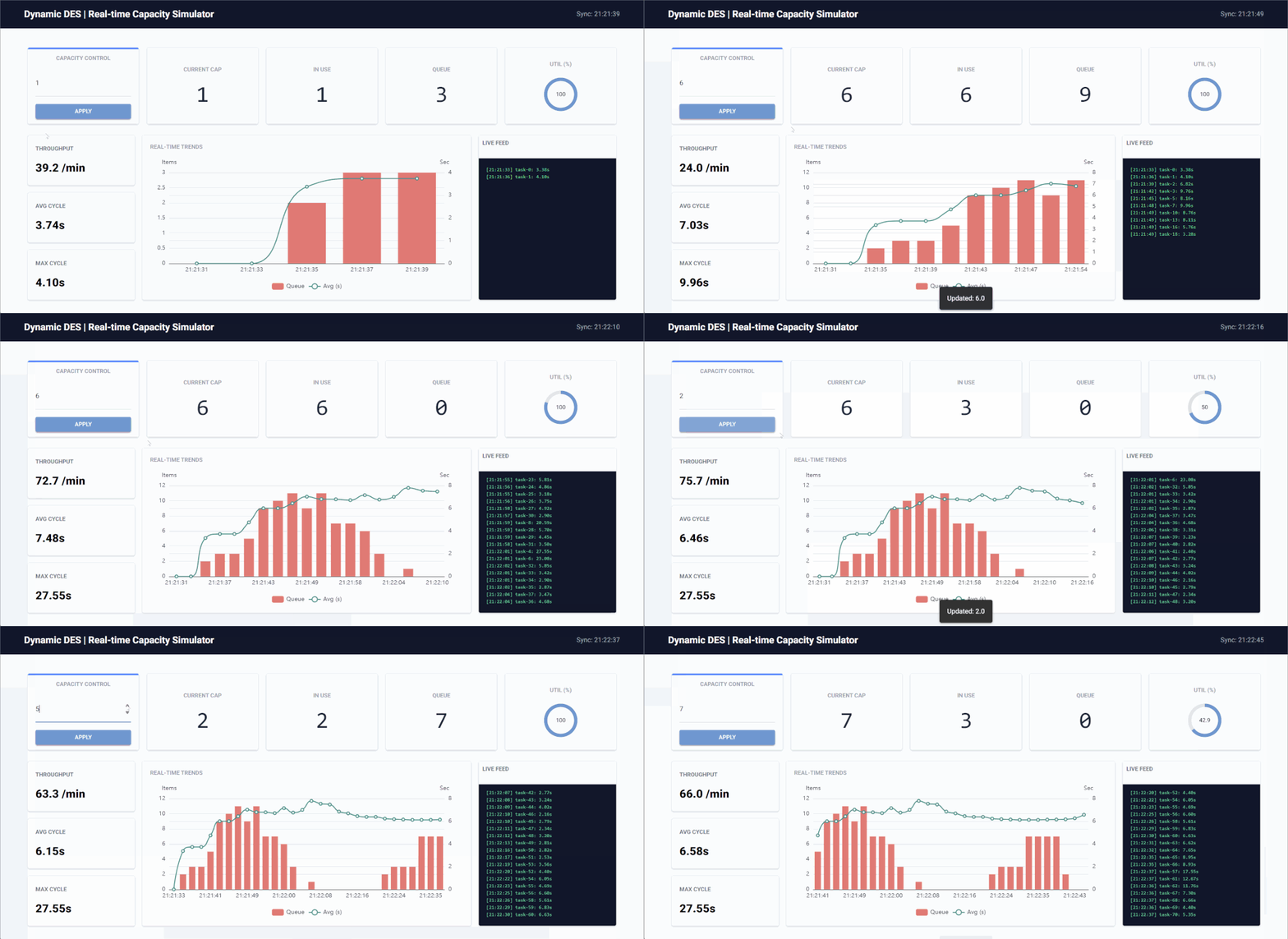
Dynamic DES bridges the gap between static discrete-event simulations and the live world. It allows you to update simulation parameters (arrivals, service times, capacities) and stream telemetry via **Kafka**, **Redis**, or **PostgreSQL** without stopping the simulation.
## Key Features
- **⚡ Real-Time Control**: Synchronize SimPy with the system clock using `DynamicRealtimeEnvironment`.
- **🔗 Dynamic Registry**: Dynamic, path-based updates (e.g., `Line_A.arrival.rate`) that trigger instant logic changes.
- **🚀 High Throughput**: Optimized to handle high throughput using `orjson` and local batching.
- **🛡️ Enterprise Ready**: Native `**kwargs` passthrough for SASL, mTLS, OAuth, and AWS IAM Kafka clusters.
- **📦 Pluggable Serialization**: Stream lightweight JSON by default, or map specific ML topics to lazy-loaded **Avro/Schema Registry** serializers (Confluent & AWS Glue).
- **🦆 Pydantic Duck-Typing**: Seamlessly publish strictly-typed Pydantic V2 models straight from your simulation logic.
- **🌍 Domain Agnostic**: Perfect for factory floors, crypto trading bots, or RPG game state management.
## Installation
Install the core library:
```bash
pip install dynamic-des
```
To include specific backends and enterprise features:
```bash
# For Kafka support
pip install "dynamic-des[kafka]"
# For Confluent Schema Registry (Avro)
pip install "dynamic-des[kafka,confluent]"
# For AWS Glue Schema Registry (Avro)
pip install "dynamic-des[kafka,glue]"
# For all backends (Kafka, Redis, Postgres, Dashboard, Avro)
pip install "dynamic-des[all]"
```
## Quick Start: Zero-Setup Demos
Dynamic DES comes with built-in examples and infrastructure orchestration so you can see it in action immediately.
**Run the local, dependency-free simulation:**
```bash
ddes-local-example
```
**Run the full Real-Time Digital Twin stack with Kafka and a live UI:**
```bash
# Start the background Kafka cluster (requires Docker)
ddes-kafka-infra-up
# Open a new terminal and run the simulation
# Ctrl + C to stop
ddes-kafka-example
# Open a new terminal and start the control dashboard (opens in browser)
# Visit http://localhost:8080
# Ctrl + C to stop
ddes-kafka-dashboard
# Clean up the infrastructure when finished
ddes-kafka-infra-down
```
## Building Your Own Simulation (Local Example)
The following snippet demonstrates a simple example. It initializes a production line, schedules an external capacity update, and streams telemetry to the console.
```python
import logging
from dynamic_des import (
CapacityConfig, ConsoleEgress, DistributionConfig,
DynamicRealtimeEnvironment, DynamicResource, LocalIngress, SimParameter
)
logging.basicConfig(
level=logging.INFO, format="%(levelname)s [%(asctime)s] %(message)s"
)
logger = logging.getLogger("local_example")
# 1. Define initial system state
params = SimParameter(
sim_id="Line_A",
arrival={"standard": DistributionConfig(dist="exponential", rate=1)},
resources={"lathe": CapacityConfig(current_cap=1, max_cap=5)},
)
# 2. Setup Environment with Local Connectors
# Schedule capacity to jump from 1 to 3 at t=5s
ingress = LocalIngress([(5.0, "Line_A.resources.lathe.current_cap", 3)])
egress = ConsoleEgress()
env = DynamicRealtimeEnvironment(factor=1.0)
env.registry.register_sim_parameter(params)
env.setup_ingress([ingress])
env.setup_egress([egress])
# 3. Create Resource
res = DynamicResource(env, "Line_A", "lathe")
def telemetry_monitor(env: DynamicRealtimeEnvironment, res: DynamicResource):
"""Streams system health metrics every 2 seconds."""
while True:
env.publish_telemetry("Line_A.resources.lathe.capacity", res.capacity)
yield env.timeout(2.0)
env.process(telemetry_monitor(env, res))
# 4. Run
print("Simulation started. Watch capacity change at t=5s...")
try:
env.run(until=10.1)
finally:
env.teardown()
```
### What this does
1. **Registry Initialization**: The `SimParameter` defines the initial state. The Registry flattens this into addressable paths (e.g., `Line_A.resources.lathe.current_cap`).
2. **Live Ingress**: The `LocalIngress` simulates an external event (like a Kafka message) arriving 5 seconds into the run.
3. **Zero-Polling Update**: The `DynamicResource` listens to the Registry. The moment the ingress updates the value, the resource automatically expands its internal token pool without any manual checking.
4. **Telemetry Egress**: The `ConsoleEgress` prints system vitals to your terminal, mimicking a live dashboard feed.
### Data Egress JSON Schemas
To ensure strict data contracts with external consumers (like Kafka, Redis, or PostgreSQL), `dynamic-des` uses Pydantic to validate all outbound payloads. Users can expect two distinct JSON structures depending on the stream type:
#### Telemetry Stream
Used for scalar metrics like resource utilization, queue lengths, or simulation lag.
```json
{
"stream_type": "telemetry",
"path_id": "Line_A.resources.lathe.utilization",
"value": 85.5,
"sim_ts": 120.5,
"timestamp": "2023-10-25T14:30:00.000Z"
}
```
#### Event Stream
Used for discrete task lifecycle events (e.g., a part arriving, entering a queue, or finishing processing).
```json
{
"stream_type": "event",
"key": "task-001",
"value": {
"status": "finished",
"duration": 45.2,
"path_id": "Line_A.service.lathe"
},
"sim_ts": 125.0,
"timestamp": "2023-10-25T14:30:04.500Z"
}
```
### More Examples
For more examples, including implementations using **Kafka** providers, please explore the [examples](./src/dynamic_des/examples/) folder.
## Core Concepts
**Dynamic DES** is built on the **Switchboard Pattern**, decoupling data sourcing from simulation logic.
### Switchboard Pattern
Instead of resources polling Kafka directly, the architecture is split into three layers:
1. **Connectors (Ingress/Egress)**: Background threads handle heavy I/O (Kafka, Redis).
2. **Registry (Switchboard)**: A centralized state manager that flattens data into dot-notation paths.
3. **Resources (SimPy Objects)**: Passive observers that "wake up" only when the Registry signals a change.
### Event-Driven Capacity
Standard SimPy resources have static capacities. `DynamicResource` wraps a `Container` and a `PriorityStore`. When the Registry updates:
- **Growing**: Extra tokens are added to the pool immediately.
- **Shrinking**: The resource requests tokens back. If they are busy, it waits until they are released, ensuring no work-in-progress is lost.
### High-Throughput Events
To handle high throughput, the `EgressMixIn` uses:
- **Batching**: Pushing lists of events to the I/O thread to reduce lock contention.
- **orjson**: Rust-powered serialization for maximum speed.
## Documentation
For full documentation, architecture details, and API reference, visit:
[https://jaehyeon.me/dynamic-des/](https://jaehyeon.me/dynamic-des/).
## License
MIT