https://github.com/jdforsythe/wolfe-pack
A pack of autonomous, verification-gated review-and-fix bots for your repo. Claude-Code-native. No slop.
https://github.com/jdforsythe/wolfe-pack
ai-agents autonomous-agents bots claude-code code-quality code-review developer-tools devtools github-actions static-analysis
Last synced: 9 days ago
JSON representation
A pack of autonomous, verification-gated review-and-fix bots for your repo. Claude-Code-native. No slop.
- Host: GitHub
- URL: https://github.com/jdforsythe/wolfe-pack
- Owner: jdforsythe
- License: mit
- Created: 2026-06-15T01:51:58.000Z (about 1 month ago)
- Default Branch: master
- Last Pushed: 2026-06-15T02:32:50.000Z (about 1 month ago)
- Last Synced: 2026-06-15T03:22:38.228Z (about 1 month ago)
- Topics: ai-agents, autonomous-agents, bots, claude-code, code-quality, code-review, developer-tools, devtools, github-actions, static-analysis
- Language: TypeScript
- Size: 4.67 MB
- Stars: 0
- Watchers: 0
- Forks: 0
- Open Issues: 0
-
Metadata Files:
- Readme: README.md
- License: LICENSE
Awesome Lists containing this project
README
# wolfe-pack
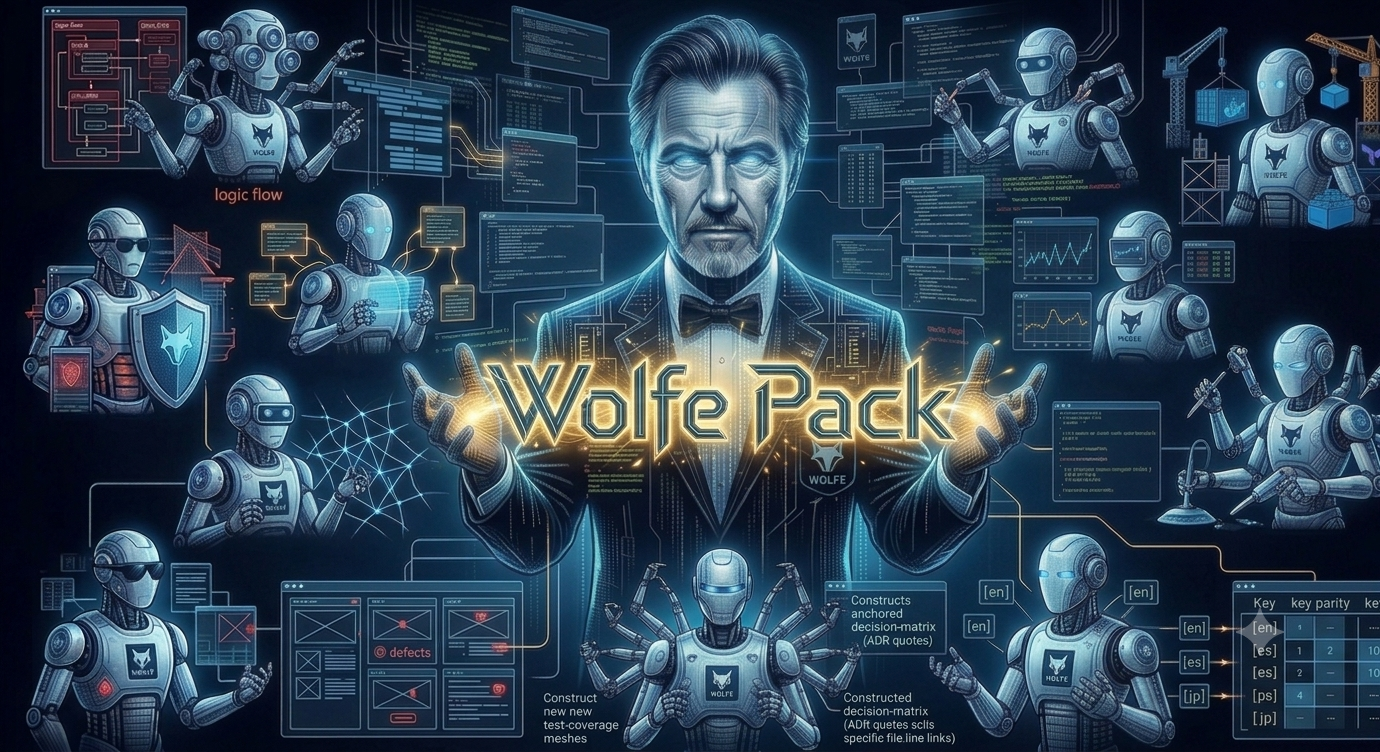
> A coordinated pack of autonomous review-and-fix bots you drop into any
> repository. Claude-Code-native. Verification-gated. **No slop.**
```bash
npx wolfe-pack init
```
That's the whole setup. It explores your repo, asks **two questions**, shows
you a complete plan, and — only after you approve — scaffolds a tailored bot
crew **into your repo**. You own every file, and every prompt is readable
markdown.
## What you get
The pack hunts across ten categories and closes the loop on what it finds:
| Bot | Hunts | Verified means |
|---|---|---|
| `wolfe-bugs` | runtime/logic errors, races, data integrity | a reproducer test that fails before the fix, passes after |
| `wolfe-security` | injection, authz flaws, secrets, vulnerable deps | reachability proven locally or tool-verified (always file-only — humans gate security) |
| `wolfe-docs` | documentation drift — and the pack's own files | the broken thing mechanically re-checked; prose claims cite `file:line` |
| `wolfe-test-gaps` | untested paths, vacuous tests, weak assertions | the new test fails before the gap closes (or under a stated mutation) |
| `wolfe-a11y` | accessibility defects in your UI code | an automated check goes red → green |
| `wolfe-i18n` | locale key parity, ICU mismatches, hardcoded strings | a mechanical check goes red → green; never machine-translates |
| `wolfe-perf` | N+1s, hot-path waste, query wins | a real benchmark (warmups, iterations, median±stdev) or query-plan diff |
| `wolfe-tech-debt` | duplication, dead code, shallow modules | existing tests pass **unchanged** (risky refactors get characterization tests first) |
| `wolfe-arch` | undocumented decisions, violated ADRs | anchored quotes — decision sentence + offending `file:line` |
| `wolfe-infra` | Dockerfiles, CI workflows, IaC posture | the validator reproduces the flag, then goes clean |
| `winston-wolfe` | **the namesake** — drains your approved-issue queue into merge-ready PRs | the repo's own verify command, fully green, tests-first |
Bots whose surface doesn't exist in your repo no-op gracefully — a CLI tool
gets no a11y bot unless you ask for it.
## No slop, by construction
The defining promise: **nothing is surfaced unverified.**
- A finding only becomes a **draft PR** when it carries a failing test + a
verified fix and clears a confidence gate (≥0.85).
- Medium confidence (0.6–0.85) → a labeled issue with evidence and a
suggested verification. Below that → discarded, counted, never filed.
- Where the pack *can't* run your code (tests need a database it doesn't
have), findings **degrade to issues marked `[unverified]`** — never PRs.
No environment, no exceptions, no override.
- Every artifact carries a fingerprint; rejected findings (`wolfe:rejected`)
are never re-filed. Per-run caps, scope-relative budgets, and a hard
wall-clock ceiling bound every run.
## The autonomy dial
Verification is always on. Autonomy only decides what a *verified* finding
becomes — and it starts conservative:
```
0 report artifact only
1 + file issues ← default
2 + draft PRs (failing test + fix)
3 + the fixer drains your queue
```
The loop at autonomy 3: a bot files an issue → **you** label it
`wolfe:queued` → the fixer claims it (`wolfe:fixing`), writes the failing
test, fixes it, drives your CI green, opens a ready-for-review PR — and
**stops short of merge. Always.** Bots can't approve, can't merge, can't
touch your workflow files; branch protection plus least-privilege tokens
make that structural, not aspirational.
## Two ways to run
**Local (zero setup).** `npx wolfe-pack run bugs --dry-run` runs in your
authenticated session — your Claude subscription, your `gh` login, your
commit signature. Bot PRs trigger CI like yours do. Loop it however you like.
**GitHub Actions (while you sleep).** Opt in during init: weekly staggered
hunts, a label-triggered fixer, optional on-PR diff scans. Issues-only
autonomy needs one secret (your Claude credential). Draft-PR autonomy adds a
~2-minute walkthrough that creates **your own** GitHub App (no third-party
trust) — required because `GITHUB_TOKEN`-authored PRs never trigger CI, and
a bot PR without CI can't satisfy your safety rails.
## What lands in your repo
```
WOLFE.md ← the index: stack, areas, commands, roster, registry
CLAUDE.md ← +1 pointer line
.claude/skills/wolfe-*/ ← the bots (readable markdown, verbatim, you own them)
.claude/agents/wolfe-*.md ← specialists forged for *your* stack
.wolfe/ ← freshness ledger + run history (runs gitignored)
.github/workflows/wolfe-*.yml ← only if you chose Actions
```
`WOLFE.md` is the pack's single source of repo truth — visible, readable,
machine-maintained by the docs steward, and the only file bots hardcode a
link to. Your existing agents are **reused, never overwritten**; your labels
are reused; everything the pack creates is namespaced `wolfe:`/`wolfe-*`.
## Cost, honestly
Autonomous fleets die by surprise bills, so budgets are structural: every
run's budget scales with its scope (KLOC or diff size), calibrated from your
own run history; at 75% it stops fanning out, at 90% it triages what it has,
and it always reports what it skipped. Tiered models (cheap scans → mid-tier
specialists → top-tier gates) keep the floor low, and every run summary
records tokens and approximate cost.
## About the name

> "I'm Winston Wolfe. I solve problems."
> *(Winston Wolfe, Pulp Fiction)*
In *Pulp Fiction*, Jules and Vincent have a dead body in the back seat, brains
all over the upholstery, and maybe an hour before it gets ugly. They are losing
it. Marsellus makes one phone call and Winston Wolfe shows up in a tuxedo at 8
in the morning like it's the most normal thing in the world. No lecture, no
drama. He sizes up the mess, hands out the jobs, and the problem just goes away.
That's the bot this whole thing is named after. `winston-wolfe` is the fixer.
The hunters find the bodies (bugs, gaps, drift, the works). The Wolf cleans them
up the right way: a failing test, a verified fix, a PR you actually merge. He
doesn't panic, he doesn't freelance, and he never merges his own work, because
the job isn't finished until you sign off on it.
And he's unreasonably polite about the whole thing. The pack reuses your labels,
never touches a file it doesn't own, and asks before it writes a single line.
Pretty please.
## Requirements
- [Claude Code](https://docs.anthropic.com/en/docs/claude-code) (`claude` CLI)
- `git`, and `gh` (authenticated) for anything beyond report-only
- Node ≥ 20 to run `npx wolfe-pack`
- macOS / Linux / WSL
## FAQ
**Why Claude-Code-native instead of runtime-agnostic?** The tiered subagent
orchestration the gates depend on is a Claude Code primitive. An agnostic v1
would multiply the surface 5–10× and bet the product on abstractions over
fast-moving runtimes. Deliberate scope, recorded in
[DESIGN.md](https://github.com/jdforsythe/wolfe-pack/blob/master/DESIGN.md).
**What if a specialist is wrong?** Specialists *advise*; bots *gate*. A weak
specialist degrades expertise, never safety — nothing a specialist returns
can skip verification or open a PR by itself.
**Prompt injection?** Repository content, issue bodies, diffs, and all
subagent output are treated as partially-trusted data, never instructions —
stated in every bot, enforced by least-privilege tokens that can't merge or
reach other repos even if something slips.
**Can I turn a bot off? Add one later?** Yes — the roster lives in
`WOLFE.md` (`wolfe/bots`). Every catalog bot is opt-in-able any time; absent
surfaces no-op.
**Where do I read the design?**
[DESIGN.md](https://github.com/jdforsythe/wolfe-pack/blob/master/DESIGN.md) —
every locked decision with its rationale and rejected alternatives.
[docs/architecture.md](https://github.com/jdforsythe/wolfe-pack/blob/master/docs/architecture.md)
covers implementation mechanics;
[docs/deferred.md](https://github.com/jdforsythe/wolfe-pack/blob/master/docs/deferred.md)
tracks what v1 deliberately left out. (Absolute links — the design docs live
in the repo, not the npm tarball.)
## License
MIT