https://github.com/jonnyhyman/g-fold-python
Rocket Landing "Guidance for Fuel Optimal Diverts" in Python
https://github.com/jonnyhyman/g-fold-python
Last synced: 8 months ago
JSON representation
Rocket Landing "Guidance for Fuel Optimal Diverts" in Python
- Host: GitHub
- URL: https://github.com/jonnyhyman/g-fold-python
- Owner: jonnyhyman
- License: gpl-3.0
- Created: 2018-02-21T18:16:35.000Z (almost 8 years ago)
- Default Branch: master
- Last Pushed: 2018-02-21T18:21:48.000Z (almost 8 years ago)
- Last Synced: 2025-04-07T01:05:44.185Z (9 months ago)
- Language: Python
- Size: 24.4 KB
- Stars: 133
- Watchers: 10
- Forks: 20
- Open Issues: 3
-
Metadata Files:
- Readme: README.md
- License: LICENSE
Awesome Lists containing this project
README
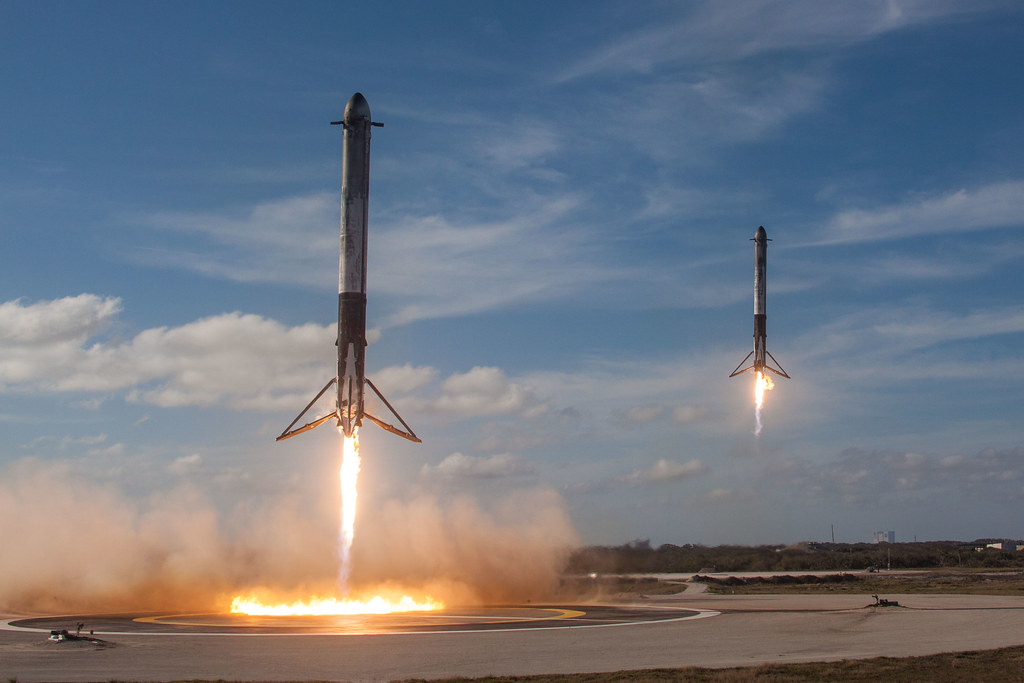
# G-FOLD Python

### Guidance for Fuel Optimal Landing Diverts (GFOLD)

This code reimplements GFOLD algorithm in Python with use of the fantastic cvxpy utility. The algorithm was defined by a number of papers, but chiefly [this paper by Ackimese, Carson, and Blackmore at JPL.](http://www.larsblackmore.com/iee_tcst13.pdf)

### What you can do with GFOLD-Python

- Calculate fuel optimal spacecraft landing trajectories

- Generate embeddable C code for real-time trajectory calculation (~0.3 second calculation time 1x 2.4GHz)

- [Autonomous landing of Kerbal Space Program rockets](https://www.youtube.com/watch?v=7skZHu9i7Fg)

### What you can't do with GFOLD-Python

- Attitude control

- Robust control

- Control of any kind (this is a guidance algorithm!)

### How to use it

- If you wish to do a static calculation (not generating C code)

  1. Define your vehicle and environment in GFOLD_Static_Parms

    - All notation follows conventions laid out in the [original paper](http://www.larsblackmore.com/iee_tcst13.pdf)

  2. Comment / Uncomment the constraints you wish to have in GFOLD_Static

  3. Run `python GFOLD_Static.py` *(requires scipy)*

  4. View the "evil" plots *(this name is just a joke btw)*

- If you wish to do C code generation

    1. Set `test = 0` at the top of `GFOLD_Generate.py`

    3. Run `python GFOLD_Generate.py` *(requires cvxpy_codegen)*

    3. Fix some of the known-bugs cvxpy_codegen creates

      - See issues page of the repo

      - Attempt to compile, and solve each error as they come

    4. Compile the generated C code

    5. *(Optional:)* Install the compiled CPython code into your Python distribution with setup.py if you wish to use the compiled code from Python

      - Be aware that the Python2.7 Windows Compiler provided by Microsoft will not work because it has a pathetically tiny stack heap size. Recommend using MinGW on Windows!

### Documentation

- Since this is a pre-alpha research project, the main documentation is found in `#code comments`, and in the content of the [paper](http://www.larsblackmore.com/iee_tcst13.pdf) itself.

### Requirements

  - Python 2.7 *(I'm sorry about still using python 2, Mr. Guido, but cvxpy_codegen is the constraint here...)*

  - scipy (for static solutions)

  - cvxpy (for static solutions)

  - cvxpy_codegen (for code generation)

### License

GPLv3, copyleft license.

Chose this license because I spent way too many late nights and heartbeats working on this - and want to see what people do with it and have changes propagated forward!