https://github.com/juliaarrays/stackviews.jl
no more 🐱🐱
https://github.com/juliaarrays/stackviews.jl
julia
Last synced: about 1 year ago
JSON representation
no more 🐱🐱
- Host: GitHub
- URL: https://github.com/juliaarrays/stackviews.jl
- Owner: JuliaArrays
- License: mit
- Created: 2021-04-08T11:03:15.000Z (about 5 years ago)
- Default Branch: master
- Last Pushed: 2024-04-01T20:12:41.000Z (about 2 years ago)
- Last Synced: 2025-04-14T22:38:44.293Z (about 1 year ago)
- Topics: julia
- Language: Julia
- Homepage:
- Size: 39.1 KB
- Stars: 19
- Watchers: 5
- Forks: 1
- Open Issues: 4
-
Metadata Files:
- Readme: README.md
- License: LICENSE
Awesome Lists containing this project
README
# StackViews
[](https://github.com/JuliaArrays/StackViews.jl/actions)
[](https://codecov.io/gh/JuliaArrays/StackViews.jl)
`StackViews` provides only one array type: `StackView`. There are multiple ways to understand `StackView`:
- inverse of `eachslice`
- `cat` variant
- view object
- lazy version of `repeat` special case
## `StackView` as the inverse of `eachslice`
`StackView` can be seen as the inverse of `eachslice`:
```julia
julia> using StackViews
julia> X = rand(100, 100);
julia> StackView(collect(eachslice(X, dims=1)), 1) == X
true
```
## `StackView` as a variant of `cat`
`StackView` works very similar to `cat` and its `vcat`/`hcat`/`hvcat` variants in Base.
```julia
julia> using StackViews
julia> A = reshape(collect(1:6), 2, 3)
2×3 Matrix{Int64}:
1 3 5
2 4 6
julia> B = reshape(collect(7:12), 2, 3)
2×3 Matrix{Int64}:
7 9 11
8 10 12
julia> StackView(A, B; dims=3) # mostly equivalent to `cat(A, B, dims=3)`
2×3×2 StackView{Int64, 3, 3, ...}:
[:, :, 1] =
1 3 5
2 4 6
[:, :, 2] =
7 9 11
8 10 12
```
Unlike `cat`s, `StackView` always creats new dimension:
```julia
julia> StackView(A, B; dims=1) # `cat(A, B, dims=1)` outputs 4×3 Matrix
2×2×3 StackView{Int64, 3, 1, ...}:
[:, :, 1] =
1 2
7 8
[:, :, 2] =
3 4
9 10
[:, :, 3] =
5 6
11 12
julia> StackView(A, B; dims=2) # `cat(A, B, dims=2)` outputs 2×6 Matrix
2×2×3 StackView{Int64, 3, 2, ...}:
[:, :, 1] =
1 7
2 8
[:, :, 2] =
3 9
4 10
[:, :, 3] =
5 11
6 12
```
## `StackView` as a view object
Without `StackView`, people use `reshape` + `cat` for the previous examples:
```julia
julia> StackView(A, B, dims=1) == cat(map(x->reshape(x, 1, axes(x)...), (A, B))...; dims=1)
true
```
but `StackView` is only a view and thus don't create any memory:
```julia
frames = [rand(1000, 1000) for _ in 1:100];
@btime StackView($frames, Val(1)); # 143.905 ns (0 allocations: 0 bytes)
@btime cat(map(x->reshape(x, 1, axes(x)...), $frames)...; dims=1); # 1.127 s (1119 allocations: 763.06 MiB)
```
Of course, since it is a view, if you modify it, original arrays get modified, too:
```julia
A = [1, 2, 3, 4]
B = [5, 6, 7, 8]
sv = StackView(A, B)
fill!(sv, -1) # A and B are modified
A == B == fill(-1, 4) # true
```
If indexed in contiguous memeory order, it has almost zero overhead for `getindex` and `setindex!`:
```julia
function arrsum_cart(A::AbstractArray)
rst = zero(eltype(A))
@inbounds for I in CartesianIndices(A)
rst += A[I]
end
return rst
end
As = StackView(frames);
Ac = cat(map(x->reshape(x, axes(x)..., 1), frames)...; dims=3);
As == Ac # true
@btime arrsum_cart($As); # 122.703 ms (0 allocations: 0 bytes)
@btime arrsum_cart($Ac); # 123.813 ms (0 allocations: 0 bytes)
```
## `StackView` as a lazy version of `repeat` special case
`StackView` allows you to stack the same array object multiple times, which makes a special
version of `repeat` when there's only one none-1 repeat count:
```julia
A = rand(1000, 1000);
n = 100;
StackView([A for _ in 1:n]) == repeat(A, ntuple(_->1, ndims(A))..., n) # true
@btime StackView([$A for _ in 1:$n]); # 403.156 ns (2 allocations: 1.75 KiB)
@btime repeat($A, ntuple(_->1, ndims($A))..., $n) # 590.043 ms (4 allocations: 762.94 MiB)
```
## More examples
When arrays are of different types and sizes, `StackView` just kills `cat`s:
```julia
julia> using StackViews, PaddedViews
julia> A = collect(reshape(1:8, 2, 4));
julia> B = collect(reshape(9:16, 4, 2));
julia> StackView(paddedviews(-1, A, B), 3)
4×4×2 StackView{Int64, 3, 3, ...}:
[:, :, 1] =
1 3 5 7
2 4 6 8
-1 -1 -1 -1
-1 -1 -1 -1
[:, :, 2] =
9 13 -1 -1
10 14 -1 -1
11 15 -1 -1
12 16 -1 -1
julia> StackView(sym_paddedviews(-1, A, B), 3)
4×4×2 StackView{Int64, 3, 3, ...):
[:, :, 1] =
-1 -1 -1 -1
1 3 5 7
2 4 6 8
-1 -1 -1 -1
[:, :, 2] =
-1 9 13 -1
-1 10 14 -1
-1 11 15 -1
-1 12 16 -1
```
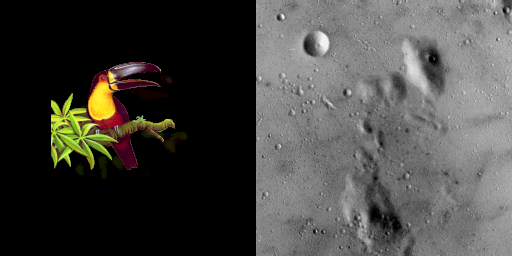
There is some mind work here but by chaining more views you can get some interesting result:
```julia
using PaddedViews, StackViews
using ImageCore, ImageShow, TestImages, ColorVectorSpace
toucan = testimage("toucan") # 150×162 RGBA image
moon = testimage("moon") # 256×256 Gray image
# equivalently, you can just use `mosaic(toucan, moon; nrow=1)`
mosaicview(StackView(sym_paddedviews(zero(RGB), toucan, moon)); nrow=1)
```
## Other similar packages
- There's a lot of overlap between this and [LazyStack.jl](https://github.com/mcabbott/LazyStack.jl); I didn't notice its existance when I wrote this.