https://github.com/junkdog/bitvector
Uncompressed, dynamically resizeable bitset for Kotlin (JS/JVM/Android)
https://github.com/junkdog/bitvector
bitset kotlin kotlin-js
Last synced: over 1 year ago
JSON representation
Uncompressed, dynamically resizeable bitset for Kotlin (JS/JVM/Android)
- Host: GitHub
- URL: https://github.com/junkdog/bitvector
- Owner: junkdog
- License: mit
- Created: 2017-06-18T22:04:44.000Z (about 9 years ago)
- Default Branch: master
- Last Pushed: 2017-07-12T14:15:56.000Z (about 9 years ago)
- Last Synced: 2025-04-23T02:48:58.189Z (over 1 year ago)
- Topics: bitset, kotlin, kotlin-js
- Language: Kotlin
- Homepage:
- Size: 109 KB
- Stars: 13
- Watchers: 4
- Forks: 1
- Open Issues: 1
-
Metadata Files:
- Readme: README.md
- Changelog: CHANGELOG.md
- License: LICENSE
Awesome Lists containing this project
README
[](https://travis-ci.org/junkdog/bitvector)
## BitVector
- Uncompressed, dynamically resizeable bitset, similar to `java.util.BitSet`
- [Fast-ish][bench] enumeration of set bits (JS not yet profiled)
- Compatible with JavaScript and JVM/Android backends
- 4 byte words, avoids [`Long` emulation][long-emu] in js
[long-emu]: https://kotlinlang.org/docs/reference/js-to-kotlin-interop.html#representing-kotlin-types-in-javascript
[bench]: https://github.com/junkdog/bitvector#jvm-benchmarks--enumerating-set-bits
## The gist
#### Constructing
```kotlin
val bv: BitVector = bitsOf(1, 2, 56, 64, 128, 129, 130, 131, 420)
```
#### Individual bits
```kotlin
val bv = BitVector()
bv[142] = true // or bv.set(142)
assert(142 in bv)
bv.clear(142) // or bv[142] = false
assert(142 !in bv)
```
#### `or`, `and`, `andNot`, `xor`
As with `java.util.BitSet`, these operations mutate the callee. Do a `copy()` if the original BitVector needs to stick around.
These functions are not infix functions, as such syntax would suggest a value copy.
```kotlin
val a = bitsOf(0, 1, 2, 3, 120, 130)
val b = bitsOf(0, 1, 2, 120, 121, 122, 123, 130)
assert(a.and(b) == bitsOf(0, 1, 2, 120, 130))
// caveat: bitvector was mutated above
assert(a == bitsOf(0, 1, 2, 120, 130))
```
#### vs other BitVectors
```kotlin
// 1, 4 contained in other
bitsOf(1, 4) in bitsOf(0, 1, 4, 5, 6)
```
#### Looping over bits: fast way
```kotlin
bitsOf(*bits).forEachBit { println("bit $it says hi") }
```
#### Looping over bits: Iterable
```kotlin
// can be combined with filter/map etc
bitsOf(*bits).forEach { println("bit $it says hi") }
```
## Getting Started
#### Maven: JVM/Android
```xml
net.onedaybeard.bitvector
bitvector-jvm
0.1.4
```
#### Maven: JavaScript
```xml
net.onedaybeard.bitvector
bitvector-js
0.1.4
```
#### Gradle: JVM/Android
```groovy
dependencies { compile "net.onedaybeard.bitvector:bitvector-jvm:0.1.4" }
```
#### Gradle: JavaScript
```groovy
dependencies { compile "net.onedaybeard.bitvector:bitvector-js:0.1.4" }
```
## JVM Benchmarks / enumerating set bits
Mapping `true` bit positions into integers, inserting each into an `IntBag` (thin wrapper around `int[]`).
[artemis-odb](https://github.com/junkdog/artemis-odb)'s `BitVector` was the basis for this implementation. The benchmark setup favors the artemis implementation, as it provides an optimized `toIntBag` method: it serves as a reference for best possible performance.
See [jmh-logs](https://github.com/junkdog/bitvector/tree/master/jmh-logs) for the full logs.
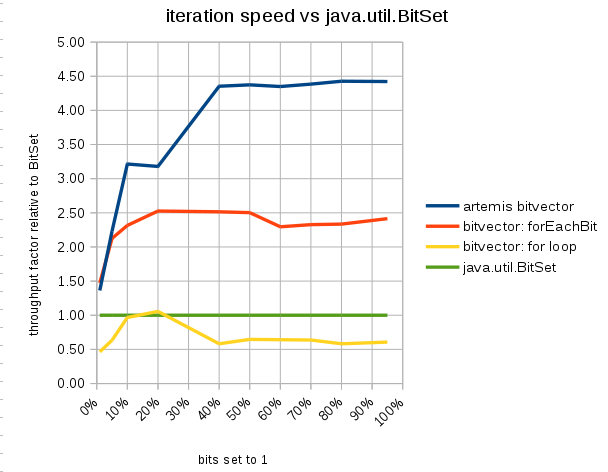
Discrepancy to artemis' `BitVector` is unwelcome. The implementation is for the most part the same, except that this implementation uses `int` for words, instead of `long`. 4 or 8 byte words did not have a significant impact on performance.
The for-loop performs poorly due to all the `Integer` boxing, extra indirection and allocation, compared to `forEachBit`.
`java.util.BitSet` suffers from not having a way of enumerating all bits at once, instead relying on repeatedly calling `nextSetBit`.
## Tests
#### Verifying platform-specific implementations
```
mvn clean install -P impltest
```
#### Running JS tests
Build project, `mvn clean install`, then point the browser to `file://$PROJECT_ROOT/js/target/test-classes/index.html`