https://github.com/kent8192/reinhardt-web
Django/DRF-inspired full-stack web framework for Rust
https://github.com/kent8192/reinhardt-web
api-framework async authentication dependency-injection django frontend-web full-stack graphql modular orm rest-api rust web-framework websockets
Last synced: about 2 months ago
JSON representation
Django/DRF-inspired full-stack web framework for Rust
- Host: GitHub
- URL: https://github.com/kent8192/reinhardt-web
- Owner: kent8192
- License: bsd-3-clause
- Created: 2025-10-06T11:54:52.000Z (10 months ago)
- Default Branch: main
- Last Pushed: 2026-04-19T15:38:53.000Z (3 months ago)
- Last Synced: 2026-04-19T16:33:41.150Z (3 months ago)
- Topics: api-framework, async, authentication, dependency-injection, django, frontend-web, full-stack, graphql, modular, orm, rest-api, rust, web-framework, websockets
- Language: Rust
- Homepage: https://reinhardt-web.dev
- Size: 36.9 MB
- Stars: 9
- Watchers: 1
- Forks: 2
- Open Issues: 28
-
Metadata Files:
- Readme: README.md
- Changelog: CHANGELOG.md
- Contributing: CONTRIBUTING.md
- License: LICENSE
- Code of conduct: CODE_OF_CONDUCT.md
- Codeowners: .github/CODEOWNERS
- Security: SECURITY.md
Awesome Lists containing this project
README

Reinhardt
🦀 Django's productivity, Rust's performance
A composable, batteries-included web framework for Rust
Build with the integrated experience of Django/DRF,
or compose only the pieces you need.
[](https://crates.io/crates/reinhardt-web)
[](https://docs.rs/reinhardt-web)
[](LICENSE)
[](https://codecov.io/gh/kent8192/reinhardt-web)
[](https://deepwiki.com/kent8192/reinhardt-web)
---
## Quick Navigation
- [Who is Reinhardt For?](#who-is-reinhardt-for)
- [Quick Start](#quick-start)
- [Why Reinhardt?](#why-reinhardt)
- [Key Features](#key-features)
- [Installation](#installation)
- [Getting Started Guide](#getting-started-guide)
- [Available Components](#available-components)
- [Ecosystem](#ecosystem)
- [API Stability](#api-stability)
## Who is Reinhardt For?
Reinhardt is designed for developers who:
- **Know Django/DRF** and want the same productivity in Rust
- **Use Axum/Actix** but miss Django's batteries (ORM, admin, auth, DI)
- **Want an integrated Rust web stack** without assembling everything from scratch
- **Want incremental adoption** -- start with just DI or ORM, grow into a full stack later
If you have written `ModelSerializer` or `Depends()` before, Reinhardt will feel like home.
## Quick Start
```bash
# Currently a pre-release: --version is required. Once 0.1.3 stable ships,
# --version becomes optional (and acts as an opt-in reproducibility pin).
cargo install reinhardt-admin-cli --version "0.1.0-rc.30"
reinhardt-admin startproject my-api && cd my-api
cargo run --bin manage runserver # Visit http://127.0.0.1:8000
```
For a full walkthrough, see the [Getting Started Guide](#getting-started-guide).
New to Reinhardt? Start with the default setup first. You can adopt a smaller custom stack later if needed.
## Why Reinhardt?
Rust web development is powerful, but it often starts with choosing and wiring together many separate libraries.
Reinhardt takes a different approach: integrated batteries when you want them, composable parts when you don't.
We call this **polylithic**: many building blocks that still feel like one coherent framework.
Reinhardt brings together the best of four worlds:
| Inspiration | What We Borrowed | What We Improved |
|--------------------|-----------------------------------------|--------------------------------------------|
| 🐍 **Django** | Batteries-included, ORM, admin | Composable feature flags, type safety |
| 🎯 **Django REST** | Serializers, ViewSets, permissions | Compile-time validation, zero-cost |
| ⚡ **FastAPI** | DI system, auto OpenAPI | Native performance, no runtime overhead |
| 🗄️ **SQLAlchemy** | QuerySet patterns, relationships | Type-safe queries, compile-time checks |
**Result**: A framework that's familiar to Python developers, but with Rust's performance and safety guarantees.
## ✨ Key Features
- **Type-Safe ORM** with compile-time validation (reinhardt-query)
- **Powerful Serializers** with automatic validation (serde + built-in validation)
- **FastAPI-Style DI** with type-safe dependency injection and caching
- **ViewSets** for rapid CRUD API development
- **Multi-Auth** (JWT, Token, Session, Basic) with BaseUser/FullUser traits
- **Admin Panel** with auto-generated model management interface
- **Management Commands** for migrations, static files, and more
- **GraphQL & WebSocket** support for real-time applications
- **Pagination, Filtering, Rate Limiting** built-in
- **Signals** for event-driven architecture
See [Available Components](#available-components) for complete list and [Getting Started](https://reinhardt-web.dev/quickstart/getting-started/) for examples.
## API Stability
Reinhardt follows a **three-phase lifecycle** for every crate:
| Phase | What to Expect |
|-------|---------------|
| **Alpha** (`0.x.0-alpha.N`) | APIs may change freely. Early adopters welcome. |
| **RC** (`0.x.0-rc.N`) | API frozen. Bug fixes only. Safe to build against. |
| **Stable** (`0.x.0`) | Full SemVer 2.0 guarantees. |
**Current status:** Reinhardt is at `0.1.3`. From `0.1.0` onward, all
public APIs follow SemVer 2.0; breaking changes ship in a future
`0.2.0-rc.N` series coordinated through the `develop/0.2.0` branch.
For per-release detail (changelog summary, upgrade notes, known issues),
see the [Release category in GitHub Discussions](https://github.com/kent8192/reinhardt-web/discussions/categories/release).
The full lifecycle policy lives in
[Stability Policy](instructions/STABILITY_POLICY.md).
## Installation
Reinhardt is a modular framework. Choose your starting point:
> **New here?** Start with the default standard setup. Use `full` if you need all features, or `minimal` for lightweight APIs.
### Default: Standard Setup (Balanced) ⚠️ Default Preset
Get a well-balanced feature set with zero configuration:
```toml
[dependencies]
# Import as 'reinhardt', published as 'reinhardt-web'
# Default enables the "standard" preset (balanced feature set)
reinhardt = { version = "0.1.3", package = "reinhardt-web" }
```
**Includes:** Core, Database (PostgreSQL), REST API (serializers, parsers, pagination, filters, throttling, versioning, metadata, content negotiation), Auth, Middleware (sessions), Pages (WASM Frontend with SSR), Signals
**Binary**: ~20-30 MB | **Compile**: Medium
Then use in your code:
```rust
use reinhardt::prelude::*;
use reinhardt::{Request, Response, StatusCode};
```
### Option 1: Full-Featured (All Batteries Included)
For projects that need every available component:
```toml
[dependencies]
reinhardt = { version = "0.1.3", package = "reinhardt-web", default-features = false, features = ["full"] }
```
**Includes:** Everything in Standard, plus Admin, GraphQL, WebSockets, Cache, i18n, Mail, Static Files, Storage, and more
**Binary**: ~50+ MB | **Compile**: Slower, but everything works out of the box
### Option 2: Microservices (Minimal Setup)
Lightweight and fast, perfect for simple APIs:
```toml
[dependencies]
reinhardt = { version = "0.1.3", package = "reinhardt-web", default-features = false, features = ["minimal"] }
```
**Includes:** HTTP, routing, DI, parameter extraction, server
**Binary**: ~5-10 MB | **Compile**: Very fast
### Option 3: Build Your Custom Stack
Install only the components you need:
```toml
[dependencies]
# Core components
reinhardt-http = "0.1.3"
reinhardt-urls = "0.1.3"
# Optional: Database
reinhardt-db = "0.1.3"
# Optional: Authentication
reinhardt-auth = "0.1.3"
# Optional: REST API features
reinhardt-rest = "0.1.3"
# Optional: Admin panel
reinhardt-admin = "0.1.3"
# Optional: Advanced features
reinhardt-graphql = "0.1.3"
reinhardt-websockets = "0.1.3"
```
**Note on Crate Naming:**
The main Reinhardt crate is published on crates.io as `reinhardt-web`, but you import it as `reinhardt` in your code using the `package` attribute.
**📖 For a complete list of available crates and feature flags, see the [Feature Flags Guide](https://reinhardt-web.dev/docs/feature-flags/).**
## Getting Started Guide
### 1. Install Reinhardt Admin Tool
While Reinhardt is on a pre-release (`-rc.*` / `-alpha.*`), `cargo install`
requires an explicit `--version` because pre-releases are not selected by
default. Once `0.1.0` stable ships, omit `--version` to pull the latest
stable (or keep `--version` as an opt-in reproducibility pin). The literal
below is auto-bumped by release-plz on each release.
```bash
cargo install reinhardt-admin-cli --version "0.1.3"
```
### 2. Create a New Project
```bash
# Create a RESTful API project (default)
reinhardt-admin startproject my-api
cd my-api
```
This generates a complete project structure:
```
my-api/
├── Cargo.toml
├── src/
│ ├── lib.rs
│ ├── config.rs
│ ├── apps.rs
│ ├── config/
│ │ ├── settings.rs
│ │ ├── settings/
│ │ │ ├── base.rs
│ │ │ ├── local.rs
│ │ │ ├── staging.rs
│ │ │ └── production.rs
│ │ ├── urls.rs
│ │ └── apps.rs
│ └── bin/
│ └── manage.rs
└── README.md
```
**Alternative: Create a reinhardt-pages Project (WASM + SSR)**
For a modern WASM-based frontend with SSR:
```bash
# Create a pages project
reinhardt-admin startproject my-app --template pages
cd my-app
# Install WASM build tools (first time only)
cargo make install-wasm-tools
# Build WASM and start development server
cargo make dev
# Visit http://127.0.0.1:8000/
```
### 3. Run the Development Server
```bash
# Using the manage command
cargo run --bin manage runserver
# Server will start at http://127.0.0.1:8000
```
**Auto-Reload Support:**
The development server reloads automatically on file changes:
```bash
cargo run --bin manage -- runserver --with-pages
```
Edit any Rust source file (server-side or wasm-side) and the bundle
plus the server are rebuilt in place. Pass `--noreload` to disable
auto-reload entirely, or `--no-wasm-rebuild` to keep server reload
but manage the wasm build yourself.
### 4. Create Your First App
```bash
# Create a RESTful API app (default)
reinhardt-admin startapp users
# Or explicitly specify type
reinhardt-admin startapp users --with-rest
# Create a Pages app (WASM + SSR)
reinhardt-admin startapp dashboard --with-pages
```
This creates an app structure — the layout depends on the template:
**RESTful app** (`--with-rest`, default):
```
users/
├── lib.rs
├── models.rs
├── models/
├── views.rs
├── views/
├── serializers.rs
├── serializers/
├── admin.rs
├── admin/
├── urls.rs
├── tests.rs
└── tests/
```
**Pages app** (`--with-pages`, WASM + SSR):
Each app owns its server-side and client-side code under `src/apps//`.
Per Rust 2024 edition module conventions, the entry point for an app is a
sibling `.rs` file next to the `/` directory — there is no inner
`lib.rs`. The same pattern applies to nested aggregators (`client.rs` is
the sibling of `client/`, `urls.rs` is the sibling of `urls/`).
```
src/
├── apps.rs # aggregator: pub mod polls; #[cfg(server)] pub use polls::PollsConfig;
├── apps/
│ ├── polls.rs # per-app entry (sibling of polls/)
│ └── polls/
│ ├── admin.rs # #[cfg(server)] admin registration
│ ├── client.rs # #[cfg(client)] aggregator: pub mod components; pub mod pages;
│ ├── client/
│ │ ├── components.rs # per-app UI (placeholder() returning Page)
│ │ └── pages.rs # per-app pages (placeholder_page wraps with_nav)
│ ├── models.rs # #[cfg(server)] models
│ ├── models/ # (.gitkeep — user adds submodules here)
│ ├── serializers.rs # #[cfg(server)] serializers
│ ├── serializers/ # (.gitkeep)
│ ├── server_fn.rs # bi-target #[server_fn] handlers (placeholder)
│ ├── tests/ # (.gitkeep)
│ ├── urls.rs # urls aggregator (cfg-gated submodules)
│ ├── urls/
│ │ ├── server_urls.rs # #[url_patterns(InstalledApp::polls, mode = server)]
│ │ └── client_router.rs # #[url_patterns(InstalledApp::polls, mode = client)]
│ └── views.rs # #[cfg(server)] views
├── bin/
│ └── manage.rs # native-only management CLI entry
├── client.rs # #[cfg(client)] aggregator: pub mod lib; pub mod components;
├── client/
│ ├── components.rs # cross-app shell: pub mod nav;
│ ├── components/
│ │ └── nav.rs # with_nav(body: Page) -> Page helper
│ └── lib.rs # #[wasm_bindgen(start)] -> ClientLauncher::router_client(...)
├── config.rs # cfg-gated config aggregator
├── config/
│ ├── apps.rs # installed_apps! { polls: "polls" }
│ ├── settings.rs # #[cfg(server)] settings
│ ├── urls.rs # #[routes(standalone)] entry
│ └── wasm.rs # #[cfg(server)] wasm tooling config
├── lib.rs # crate root (`pub mod apps;` is un-gated)
├── shared.rs # bi-target shared module
└── shared/
├── forms.rs # shared form definitions
└── types.rs # DTOs exchanged between WASM and server
```
### 5. Register Routes
Edit your app's `urls.rs`. **`urls.rs` plays two roles**: it **declares the URL
submodules** of the app (via `pub mod ...;`) and **aggregates** them into a
single `url_patterns` (or `server_url_patterns` / `unified_url_patterns`) entry
point that `src/config/urls.rs` mounts:
```rust
// users/urls.rs
//
// 1. Module declarations for sub-URL files (optional, for larger apps):
pub mod api;
pub mod views;
// 2. Aggregator — the single entry point mounted from src/config/urls.rs.
use reinhardt::url_patterns;
use reinhardt::ServerRouter;
use crate::config::apps::InstalledApp;
#[url_patterns(InstalledApp::users, mode = server)]
pub fn server_url_patterns() -> ServerRouter {
ServerRouter::new()
.endpoint(views::list_users)
.endpoint(views::get_user)
.endpoint(views::create_user)
.mount("/api/v1/", api::routes())
}
```
The `#[url_patterns]` attribute registers this router with the framework for
automatic discovery. For Pages apps, use `mode = unified` and return
`UnifiedRouter` instead (see the generated `urls/{server,client,ws}_urls.rs`
submodules).
Include in `src/config/urls.rs`:
```rust
// src/config/urls.rs
use reinhardt::prelude::*;
use reinhardt::routes;
#[routes]
pub fn routes() -> ServerRouter {
ServerRouter::new()
.mount("/api/", users::urls::url_patterns())
}
```
The `#[routes]` attribute macro automatically registers this function with the
framework for discovery via the `inventory` crate.
**Note:** The `reinhardt::prelude` includes commonly used types. Key exports include:
**Always Available:**
- Core routing and views: `Router`, `DefaultRouter`, `ServerRouter`, `View`, `ListView`, `DetailView`
- ViewSets: `ViewSet`, `ModelViewSet`, `ReadOnlyModelViewSet`
- HTTP: `StatusCode`
**Feature-Dependent:**
- **`core` feature**: `Request`, `Response`, `Handler`, `Middleware`, Signals (`post_save`, `pre_save`, etc.)
- **`database` feature**: `Model`, `DatabaseConnection`, `F`, `Q`, `Transaction`, `atomic`, Database functions (`Concat`, `Upper`, `Lower`, `Now`, `CurrentDate`), Window functions (`Window`, `RowNumber`, `Rank`, `DenseRank`), Constraints (`UniqueConstraint`, `CheckConstraint`, `ForeignKeyConstraint`)
- **`auth` feature**: `BaseUser`, `FullUser`, `PermissionsMixin`, `BaseUserManager`, `Argon2Hasher`, `GroupManager`, `CreateGroupData`, `Permission`, `ObjectPermission`, `ObjectPermissionManager`
- **`minimal`, `standard`, or `di` features**: `Body`, `Cookie`, `Header`, `Json`, `Path`, `Query`
- **`rest` feature**: Serializers, Parsers, Pagination, Throttling, Versioning
- **`admin` feature**: Admin panel components
- **`cache` feature**: `Cache`, `InMemoryCache`
- **`sessions` feature**: `Session`, `AuthenticationMiddleware`
For a complete list, see [Feature Flags Guide](https://reinhardt-web.dev/docs/feature-flags/).
For a complete step-by-step guide, see [Getting Started](https://reinhardt-web.dev/quickstart/getting-started/).
## 🎓 Learn by Example
### With Database
Configure database aliases in `settings/base.toml`:
```toml
[core]
debug = true
secret_key = "your-secret-key-for-development"
[core.databases.default]
engine = "postgresql"
name = "mydb"
user = "postgres"
password = "postgres"
host = "localhost"
port = 5432
```
Settings are automatically loaded in `src/config/settings.rs`:
```rust
// src/config/settings.rs
use reinhardt::prelude::*;
// Compose built-in settings fragments with | - field names are inferred from type names
// (e.g., CoreSettings -> core, CacheSettings -> cache, EmailSettings -> email)
#[settings(CoreSettings | CacheSettings | EmailSettings)]
pub struct ProjectSettings;
```
The `|` syntax composes settings fragments into `ProjectSettings`. Each type must be a `#[settings(fragment = true, ...)]` struct. Built-in fragments:
- **`CoreSettings`** - `base_dir`, `secret_key`, `debug`, `allowed_hosts`, `databases`, `security`, `middleware`, `root_urlconf`, and `installed_apps`
- **`CacheSettings`**, **`ContactSettings`**, **`CorsSettings`**, **`EmailSettings`**, **`I18nSettings`**, **`LoggingSettings`**, **`MediaSettings`**, **`SecuritySettings`**, **`SessionSettings`**, **`StaticSettings`**, and **`TemplateSettings`** - optional framework sections
Add project-specific fragments with explicit field names using `key: Type` syntax:
```rust
#[settings(CoreSettings | CacheSettings | mail: MailSettings)]
pub struct ProjectSettings;
```
See [Settings Documentation](https://reinhardt-web.dev/docs/settings/) for more details.
**Defining a User Model:**
Define your own user model with `#[user(...)]` + `#[model(...)]`. These two
attribute macros cooperate: `#[user]` implements the auth traits (`BaseUser`,
`PermissionsMixin`, `AuthIdentity`, and optionally `FullUser`) on top of a
normal Reinhardt model:
```rust
// users/models.rs
use reinhardt::prelude::*;
use reinhardt::Argon2Hasher;
#[user(hasher = Argon2Hasher, username_field = "username", full = true)]
#[model(app_label = "users", table_name = "users")]
pub struct User {
#[field(primary_key = true)]
pub id: Uuid,
#[field(max_length = 100)]
pub username: String,
#[field(max_length = 255)]
pub email: String,
pub password_hash: Option,
#[field(max_length = 150)]
pub first_name: String,
#[field(max_length = 150)]
pub last_name: String,
#[field(default = true)]
pub is_active: bool,
#[field(default = false)]
pub is_staff: bool,
#[field(default = false)]
pub is_superuser: bool,
pub last_login: Option>,
#[field(auto_now_add = true)]
pub date_joined: DateTime,
// Add custom fields as needed:
#[field(max_length = 50, null = true)]
pub phone_number: Option,
}
```
`#[user]` arguments:
- `hasher` (required) — password hasher type (e.g., `Argon2Hasher`)
- `username_field` (required) — name of the field used as the username
- `full = true` (optional) — also implement `FullUser` (email, first_name, last_name, is_staff, date_joined)
**Model Attribute Macro:**
The `#[model(...)]` attribute automatically generates:
- Implementation of the `Model` trait (includes `#[derive(Model)]` functionality)
- Type-safe field accessors: `User::field_email()`, `User::field_username()`, etc.
- Global model registry registration
- Support for composite primary keys
**Note:** When using `#[model(...)]`, you do NOT need to add `#[derive(Model)]` separately,
as it is automatically applied by the `#[model(...)]` attribute.
**Field Attributes:**
- `#[field(primary_key = true)]` - Mark as primary key
- `#[field(max_length = 255)]` - Set maximum length for string fields
- `#[field(default = value)]` - Set default value
- `#[field(auto_now_add = true)]` - Auto-populate timestamp on creation
- `#[field(auto_now = true)]` - Auto-update timestamp on save
- `#[field(null = true)]` - Allow NULL values
- `#[field(unique = true)]` - Enforce uniqueness constraint
For a complete list of field attributes, see the [Field Attributes Guide](https://reinhardt-web.dev/docs/field-attributes/).
The generated field accessors enable type-safe field references in queries:
```rust
// Generated by #[model(...)] for the User struct above:
impl User {
pub const fn field_id() -> FieldRef { FieldRef::new("id") }
pub const fn field_username() -> FieldRef { FieldRef::new("username") }
pub const fn field_email() -> FieldRef { FieldRef::new("email") }
pub const fn field_is_active() -> FieldRef { FieldRef::new("is_active") }
pub const fn field_is_staff() -> FieldRef { FieldRef::new("is_staff") }
pub const fn field_date_joined() -> FieldRef> { FieldRef::new("date_joined") }
// ... other fields
}
```
**Advanced Query Examples:**
```rust
use reinhardt::prelude::*;
use crate::models::User;
// Django-style F/Q object queries with type-safe field references
async fn complex_user_query() -> Result, Box> {
// Q objects for building complex conditions
let active_query = Q::new("is_active", "=", "true")
.and(Q::new("date_joined", ">=", "NOW()"));
// Database functions with type-safe field references
let email_lower = Lower::new(User::field_email().into());
let username_upper = Upper::new(User::field_username().into());
// Aggregations using field accessors
let user_count = Aggregate::count(User::field_id().into());
let latest_joined = Aggregate::max(User::field_date_joined().into());
// Window functions for ranking
let rank_by_join_date = Window::new()
.partition_by(vec![User::field_is_active().into()])
.order_by(vec![(User::field_date_joined().into(), "DESC")])
.function(RowNumber::new());
// Build and execute the query using QuerySet
let users = User::objects()
.filter(active_query)
.annotate("email_lower", email_lower)
.annotate("username_upper", username_upper)
.annotate("rank", rank_by_join_date)
.order_by(vec![("-date_joined",)])
.all()
.await?;
Ok(users)
}
// Transaction support
async fn create_user_with_transaction(
conn: &DatabaseConnection,
user_data: CreateUserRequest
) -> Result> {
// Transaction with automatic rollback on error
transaction(conn, |_tx| async move {
let user = User::create(user_data).await?;
log_user_creation(&user).await?;
Ok(user)
}).await
}
```
**Note**: Reinhardt uses reinhardt-query for SQL operations. The `#[model(...)]` attribute automatically generates Model trait implementations, type-safe field accessors, and global model registry registration.
Register in `src/config/apps.rs`:
```rust
// src/config/apps.rs
use reinhardt::installed_apps;
// The installed_apps! macro generates:
// - An enum InstalledApp with variants for each app
// - Implementation of conversion traits (From, Into, Display)
// - A registry for app configuration and discovery
//
// Note: Unlike Django's INSTALLED_APPS, this macro is for user apps only.
// Built-in framework features (auth, sessions, admin, etc.) are enabled via
// Cargo feature flags, not through installed_apps!.
//
// Example:
// [dependencies]
// reinhardt = { version = "0.1", features = ["auth", "sessions", "admin"] }
//
// This enables:
// - Automatic app discovery for migrations, admin panel, etc.
// - Type-safe app references throughout your code
// - Centralized app configuration
installed_apps! {
users: "users",
}
pub fn get_installed_apps() -> Vec {
InstalledApp::all_apps()
}
```
### With Authentication
Reinhardt provides Django-style user models and permission primitives. You
bring your own user struct (defined with `#[user(...)]` + `#[model(...)]` as
shown in the previous section); the framework layers auth traits, a
password-management workflow, groups, and object-level permissions on top.
**Two entry points for user data:**
| Need | Use |
|------|-----|
| ORM queries on users (filter/annotate/aggregate) | `User::objects()` (from `#[model]`) |
| User lifecycle: create/password-hashing/superuser | A `BaseUserManager` implementation |
| Groups | `GroupManager` |
| Object-level permissions | `ObjectPermissionManager` |
> `User::objects()` is *not* a shortcut to a manager — it is the `QuerySet`
> entry point from the `Model` trait. Manager types
> (`BaseUserManager` for the user lifecycle, `GroupManager`,
> `ObjectPermissionManager`) are constructed directly via `::new()`.
**User lifecycle example:**
For a custom user, implement `BaseUserManager` (see
`reinhardt_auth::BaseUserManager`). The signature required is:
```rust
use std::collections::HashMap;
use async_trait::async_trait;
use reinhardt::prelude::*;
use reinhardt_auth::{Argon2Hasher, BaseUserManager, PasswordHasher};
use serde_json::Value;
use crate::models::User;
pub struct UserManager {
hasher: Argon2Hasher,
}
impl UserManager {
pub fn new() -> Self {
Self { hasher: Argon2Hasher::new() }
}
}
#[async_trait]
impl BaseUserManager for UserManager {
async fn create_user(
&mut self,
username: &str,
password: Option<&str>,
extra: HashMap,
) -> Result {
let mut user = User::new(username.to_string(), /* email */ String::new());
if let Some(pw) = password {
user.set_password(pw)?;
}
// Apply extra fields (email, first_name, …) as needed …
user.save().await?;
Ok(user)
}
}
```
Then:
```rust
let mut users = UserManager::new();
let alice = users
.create_user(
"alice",
Some("secure_password"),
HashMap::from([("email".into(), serde_json::json!("alice@example.com"))]),
)
.await?;
```
**Groups and object-level permissions:**
`GroupManager` and `ObjectPermissionManager` are always available and are
instantiated directly:
```rust
use reinhardt::{CreateGroupData, GroupManager, ObjectPermissionManager};
let mut groups = GroupManager::new();
let editors = groups
.create_group(CreateGroupData { name: "editors".to_string() })
.await?;
let mut perms = ObjectPermissionManager::new();
perms.grant_permission("alice", "article:123", "edit").await;
```
Use JWT authentication in your app's `views/profile.rs`:
```rust
// users/views/profile.rs
use reinhardt::{AuthUser, Response, StatusCode, ViewResult, get};
use crate::models::User;
// JwtAuthMiddleware must be registered in urls.rs to populate AuthState in request extensions
#[get("/profile", name = "get_profile")]
pub async fn get_profile(
#[inject] AuthUser(user): AuthUser,
) -> ViewResult {
// AuthUser loads the full user model from the database using the AuthState
// set by authentication middleware. Returns an injection error if unauthenticated.
if !user.is_active() {
return Err("User account is inactive".into());
}
let json = serde_json::to_string(&user)?;
Ok(Response::new(StatusCode::OK).with_body(json))
}
```
### Dependency Injection
Reinhardt ships a FastAPI-inspired, async-first dependency injection (DI)
system in the `reinhardt-di` crate. It is type-safe, scope-aware (`singleton` /
`request` / `transient`), composable (dependencies can depend on other
dependencies), and registered at compile time via the
[`inventory`](https://crates.io/crates/inventory) crate so that there is no
runtime reflection or startup discovery cost.
Three primitives drive everyday use:
1. **`#[injectable]`** — turn a struct into an injectable service.
2. **`#[injectable_factory]`** — register an async function as a factory for
types you *cannot* annotate yourself (foreign types, trait objects,
connection handles built from settings).
3. **`#[inject]`** with **`Depends`** — receive dependencies in a handler
(or another injectable) without wiring anything by hand.
#### 1. `#[injectable]` — struct-level injection
Apply `#[injectable]` to any struct whose fields are themselves injectable.
Non-injected fields are marked with `#[no_inject]` and must implement
`Default` (or be supplied via the generated builder):
```rust
use reinhardt::di::injectable;
// `scope` is passed as a macro argument; accepted values are
// "singleton", "request", or "transient" (one literal, not an alternation).
// When omitted, `#[injectable]` defaults to `request` and
// `#[injectable_factory]` defaults to `singleton`. `Config` is registered
// as a singleton here so it matches the singleton-scoped
// `database_connection` factory below: mixing a longer-lived dependent
// with a shorter-lived dependency is not rejected by the registry, but it
// captures whichever request-scoped instance was live at first resolution
// and reuses it for the singleton's lifetime — almost never what you want.
#[injectable(scope = "singleton")]
#[derive(Clone)]
pub struct Config {
#[no_inject]
pub database_url: String,
}
```
`#[injectable]` generates an `impl Injectable for Config` and a compile-time
registration entry (via `inventory::submit!`) so the type resolves from
`InjectionContext` automatically.
#### 2. `#[injectable_factory]` — the pseudo orphan rule
Rust's orphan rule forbids `impl Injectable for SomeForeignType`. For user-owned
adapters around third-party handles, Reinhardt offers `#[injectable_factory]`.
You write an async function whose return type is the type to register; the macro
wraps it, submits an `inventory` entry, and hands the returned value to the DI
container:
```rust
use reinhardt::db::DatabaseConnection;
use reinhardt::di::{Depends, injectable_factory};
#[derive(Clone)]
pub struct AppDatabase {
pub connection: DatabaseConnection,
}
#[injectable_factory(scope = "singleton")]
async fn app_database(
#[inject] config: Depends,
) -> AppDatabase {
let connection = DatabaseConnection::connect(&config.database_url)
.await
.expect("failed to open database connection");
AppDatabase { connection }
}
```
**Every parameter of an `#[injectable_factory]` function must be annotated
with `#[inject]`.** There is no way to pass runtime arguments; factories only
compose over other injectables.
**The pseudo orphan rule.** To prevent user factories from silently shadowing
framework-owned types (e.g., `reinhardt_di::InjectionContext`, routers,
middleware bindings), Reinhardt validates every registered factory at startup.
If the return type's fully-qualified name begins with a
framework-reserved crate prefix (`reinhardt::`, `reinhardt_di::`, `reinhardt_http::`,
… 37 prefixes total), registration is rejected unless the factory itself lives
inside that crate. This emulates the orphan rule across the DI boundary: foreign
types are fair game, framework types are not. The validator lives in
[`crates/reinhardt-di/src/validation.rs`](crates/reinhardt-di/src/validation.rs)
(`check_framework_type_override`, lines 51–129).
Framework-owned types such as `DatabaseConnection` should use the injectable
implementation provided by the framework, or be wrapped in a project-owned type
like `AppDatabase` when you need project-specific construction.
#### 3. `#[inject]` + `Depends` in handlers
Use `#[inject]` on a handler parameter to have the DI container resolve it
before the handler runs. Wrap the requested type in `Depends` so that
caching and scope are honoured:
```rust
use reinhardt::{get, Response, StatusCode, ViewResult};
use reinhardt::di::Depends;
use reinhardt::db::DatabaseConnection;
use reinhardt::extractors::Path;
use crate::models::User;
#[get("/users/{id}/", name = "get_user")]
pub async fn get_user(
Path(id): Path,
#[inject] db: Depends,
) -> ViewResult {
let user = User::objects().filter(User::field_id().eq(id)).get().await?;
let body = serde_json::to_string(&user)?;
Ok(Response::new(StatusCode::OK).with_body(body))
}
```
**Caching.** Within a scope boundary, resolving the same `Depends` twice
returns the *same* instance. Opt out per-call with `#[inject(cache = false)]`:
```rust
pub async fn uncached_handler(
#[inject(cache = false)] db: Depends,
) -> ViewResult { /* always a fresh resolution within the scope */ }
```
#### Manual `impl Injectable`
When neither macro fits (generic bounds the macro cannot infer, hand-written
builders, conditional registration), implement `Injectable` directly:
```rust
use async_trait::async_trait;
use reinhardt::di::{Injectable, InjectionContext, DiResult};
#[async_trait]
impl Injectable for MyService {
async fn inject(_ctx: &InjectionContext) -> DiResult {
Ok(MyService::new())
}
}
```
For the full DI reference, see the [`reinhardt-di` crate
documentation](https://docs.rs/reinhardt-di).
### Endpoint Definition
Reinhardt uses HTTP method decorators to define endpoints:
#### HTTP Method Decorators
Use `#[get]`, `#[post]`, `#[put]`, `#[delete]` to define routes:
```rust
use reinhardt::{get, post, Response, ViewResult};
use serde_json::json;
#[get("/")]
pub async fn hello() -> ViewResult {
Ok(Response::ok().with_body("Hello, World!"))
}
#[post("/users")]
pub async fn create_user() -> ViewResult {
let body = json!({"status": "created"});
Response::ok().with_json(&body).map_err(Into::into)
}
```
**Features:**
- Compile-time path validation
- Concise syntax
- Automatic HTTP method binding
- Support for dependency injection via `#[inject]`
#### Using Dependency Injection
Combine HTTP method decorators with `#[inject]` for automatic dependency injection:
```rust
use reinhardt::{get, Response, StatusCode, ViewResult};
use reinhardt::extractors::Path;
use reinhardt::di::Depends;
use reinhardt::db::DatabaseConnection;
use crate::models::User;
#[get("/users/{id}/", name = "get_user")]
pub async fn get_user(
Path(id): Path,
#[inject] db: Depends,
) -> ViewResult {
// Path extractor parses and validates the {id} segment automatically
let user = User::objects()
.filter(User::field_id().eq(id))
.get()
.await?;
let json = serde_json::to_string(&user)?;
Ok(Response::new(StatusCode::OK).with_body(json))
}
```
**Dependency Injection Features:**
- Automatic dependency injection via `#[inject]` attribute
- Cache control with `#[inject(cache = false)]`
- FastAPI-inspired dependency injection system
- Works seamlessly with HTTP method decorators
**Result Type:**
All view functions use `ViewResult` as the return type:
```rust
use reinhardt::ViewResult; // Pre-defined result type
```
### With Parameter Extraction
In your app's `views/user.rs`:
```rust
// users/views/user.rs
use reinhardt::{Response, StatusCode, ViewResult, get};
use reinhardt::extractors::{Path, Query};
use reinhardt::di::Depends;
use reinhardt::db::DatabaseConnection;
use crate::models::User;
use serde::Deserialize;
#[derive(Deserialize)]
pub struct GetUserParams {
pub include_inactive: Option,
}
#[get("/users/{id}/", name = "get_user")]
pub async fn get_user(
Path(id): Path,
Query(params): Query,
#[inject] db: Depends,
) -> ViewResult {
let user = User::objects()
.filter(User::field_id().eq(id))
.get()
.await?;
if !params.include_inactive.unwrap_or(false) && !user.is_active {
return Err("User is inactive".into());
}
let json = serde_json::to_string(&user)?;
Ok(Response::new(StatusCode::OK).with_body(json))
}
```
Register route with path parameter in `urls.rs`:
```rust
// users/urls.rs
use reinhardt::ServerRouter;
use super::views;
pub fn url_patterns() -> ServerRouter {
ServerRouter::new()
.endpoint(views::get_user) // Path defined in #[get("/users/{id}/")]
}
```
### With Serializers and Validation
In your app's `serializers/user.rs`:
```rust
// users/serializers/user.rs
use serde::{Serialize, Deserialize};
use reinhardt::Validate;
#[derive(Serialize, Deserialize, Validate)]
pub struct CreateUserRequest {
#[validate(email)]
pub email: String,
#[validate(length(min = 3, max = 50))]
pub username: String,
#[validate(length(min = 8))]
pub password: String,
}
#[derive(Serialize, Deserialize)]
pub struct UserResponse {
pub id: i64,
pub username: String,
pub email: String,
pub is_active: bool,
}
impl From for UserResponse {
fn from(user: User) -> Self {
UserResponse {
id: user.id,
username: user.username,
email: user.email,
is_active: user.is_active,
}
}
}
```
In your app's `views/user.rs`:
```rust
// users/views/user.rs
use reinhardt::{Response, StatusCode, ViewResult, post};
use reinhardt::extractors::Json;
use reinhardt::validation::Validated;
use reinhardt::di::Depends;
use reinhardt::db::DatabaseConnection;
use crate::models::User;
use crate::serializers::{CreateUserRequest, UserResponse};
#[post("/users", name = "create_user")]
pub async fn create_user(
Json(body): Json,
Validated(create_req): Validated,
#[inject] db: Depends,
) -> ViewResult {
// Json deserializes the body; Validated runs #[validate] rules and yields the validated value
// Create user using the auto-generated new() function from #[user] + #[model]
let mut user = User::new(create_req.username, create_req.email);
// Hash and set password using BaseUser trait
user.set_password(&create_req.password)?;
// Save to database
user.save(&db).await?;
let response_data = UserResponse::from(user);
let json = serde_json::to_string(&response_data)?;
Ok(Response::new(StatusCode::CREATED).with_body(json))
}
```
## Adoption Paths
| Your Goal | Start Here |
|-----------|-----------|
| **Full-stack REST API** | [Getting Started Guide](#getting-started-guide) |
| **Full-stack with Pages (WASM + SSR)** | [Twitter Demo](examples/examples-twitter/) |
| **Lightweight DI-focused API** | [Minimal Installation](#option-2-microservices-minimal-setup) |
> **Standalone DI for existing Axum apps** is planned for a future release.
> See [Discussions](https://github.com/kent8192/reinhardt-web/discussions) for updates.
## Available Components
Reinhardt offers modular components you can mix and match:
| Component | Crate Name | Features |
|---------------------|---------------------------|---------------------------------------------|
| **Core** | | |
| Core Types | `reinhardt-core` | Core traits, types, macros (Model, endpoint)|
| HTTP & Routing | `reinhardt-http` | Request/Response, HTTP handling |
| URL Routing | `reinhardt-urls` | Function-based and class-based routes |
| Server | `reinhardt-server` | HTTP server implementation |
| Dispatch | `reinhardt-dispatch` | HTTP request dispatching, handler composition |
| Configuration | `reinhardt-conf` | Settings management, environment loading |
| Commands | `reinhardt-commands` | Management CLI tools (startproject, etc.) |
| Shortcuts | `reinhardt-shortcuts` | Common utility functions |
| **Database** | | |
| ORM | `reinhardt-db` | reinhardt-query integration |
| **Authentication** | | |
| Auth | `reinhardt-auth` | JWT, Token, Session, Basic auth, User models|
| **REST API** | | |
| Serializers | `reinhardt-rest` | built-in serialization and validation, ViewSets |
| **Forms** | | |
| Forms | `reinhardt-forms` | Form handling and validation |
| **Advanced** | | |
| Admin Panel | `reinhardt-admin` | Django-style admin interface |
| Plugin System | `reinhardt-dentdelion` | Static & WASM plugin support, CLI management|
| Background Tasks | `reinhardt-tasks` | Task queues (Redis, RabbitMQ, SQLite) |
| GraphQL | `reinhardt-graphql` | Schema generation, subscriptions |
| WebSockets | `reinhardt-websockets` | Real-time communication |
| i18n | `reinhardt-i18n` | Multi-language support |
| Mail | `reinhardt-mail` | Email sending and templating |
| gRPC | `reinhardt-grpc` | gRPC services, protobuf types |
| Deep Link | `reinhardt-deeplink` | iOS Universal Links, Android App Links |
| **Middleware** | | |
| Middleware | `reinhardt-middleware` | HTTP middleware components, CORS, security |
| **Testing** | | |
| Test Utilities | `reinhardt-test` | Testing helpers, fixtures, TestContainers |
| Test Kit | `reinhardt-testkit` | Higher-level test abstractions and utilities|
**For detailed feature flags within each crate, see the [Feature Flags Guide](https://reinhardt-web.dev/docs/feature-flags/).**
---
## Ecosystem
| Project | Status | Description |
|---------|--------|-------------|
| [reinhardt-cloud](https://github.com/kent8192/reinhardt-cloud) | WIP | Kubernetes operator & CLI for deploying Reinhardt apps |
> **Dog-fooding in progress:** We are actively developing reinhardt-cloud as the deployment infrastructure for Reinhardt applications, and using it to deploy reinhardt-web itself. As a work-in-progress project, APIs and features may change significantly.
---
## Documentation
- 📚 [Getting Started Guide](https://reinhardt-web.dev/quickstart/getting-started/) - Step-by-step tutorial for beginners
- 🎛️ [Feature Flags Guide](https://reinhardt-web.dev/docs/feature-flags/) - Optimize your build with granular feature control
- 📖 [API Reference](https://docs.rs/reinhardt-web) (Coming soon)
- 📝 [Tutorials](https://reinhardt-web.dev/quickstart/tutorials/) - Learn by building real applications
**For AI Assistants**: See [CLAUDE.md](CLAUDE.md) for project-specific coding standards, testing guidelines, and development conventions.
## 💬 Getting Help
Reinhardt is a community-driven project. Here's where you can get help:
- 💬 **Discord**: Join our Discord server for real-time chat (coming soon)
- 💭 **GitHub Discussions**: [Ask questions and share ideas](https://github.com/kent8192/reinhardt-web/discussions)
- 🐛 **Issues**: [Report bugs](https://github.com/kent8192/reinhardt-web/issues)
- 📖 **Documentation**: [Read the guides](docs/)
Before asking, please check:
- ✅ [Getting Started Guide](https://reinhardt-web.dev/quickstart/getting-started/)
- ✅ [Examples](examples/)
- ✅ Existing GitHub Issues and Discussions
## 🤝 Contributing
We love contributions! Please read our [Contributing Guide](CONTRIBUTING.md) to get started.
**Quick links**:
- [Development Setup](CONTRIBUTING.md#development-setup)
- [Testing Guidelines](CONTRIBUTING.md#testing-guidelines)
- [Commit Guidelines](CONTRIBUTING.md#commit-guidelines)
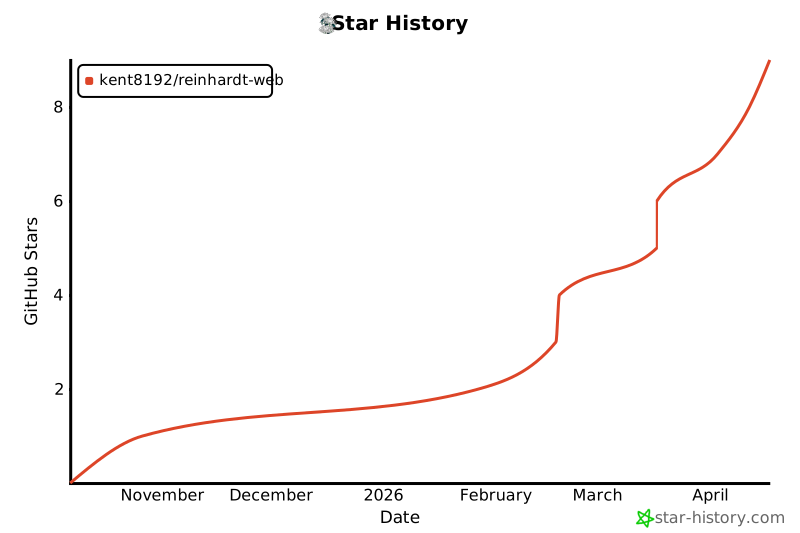
## ⭐ Star History
## Copyright
Copyright © 2026 Tachyon Inc. All rights reserved.
Developed by Tachyon Inc.
## License
This project is licensed under the [BSD 3-Clause License](LICENSE).
### Third-Party Attribution
This project is inspired by:
- [Django](https://www.djangoproject.com/) (BSD 3-Clause License)
- [Django REST Framework](https://www.django-rest-framework.org/) (BSD 3-Clause License)
- [FastAPI](https://fastapi.tiangolo.com/) (MIT License)
- [SQLAlchemy](https://www.sqlalchemy.org/) (MIT License)
See [THIRD-PARTY-NOTICES](THIRD-PARTY-NOTICES) for full attribution.
**Note:** This project is not affiliated with or endorsed by the Django Software Foundation, Encode OSS Ltd., Sebastián Ramírez (FastAPI author), or Michael Bayer (SQLAlchemy author).