https://github.com/khanlab/scattr
BIDS app for structural connectivity between targeted regions
https://github.com/khanlab/scattr
Last synced: 6 months ago
JSON representation
BIDS app for structural connectivity between targeted regions
- Host: GitHub
- URL: https://github.com/khanlab/scattr
- Owner: khanlab
- License: mit
- Created: 2022-03-10T19:12:40.000Z (over 4 years ago)
- Default Branch: main
- Last Pushed: 2025-12-10T20:28:57.000Z (8 months ago)
- Last Synced: 2025-12-11T07:38:39.047Z (8 months ago)
- Language: Python
- Homepage: https://scattr.readthedocs.io/en/stable/
- Size: 42.9 MB
- Stars: 6
- Watchers: 5
- Forks: 5
- Open Issues: 7
-
Metadata Files:
- Readme: README.md
- Contributing: docs/contributing/contributing.md
- License: LICENSE
Awesome Lists containing this project
README
# Structural Connectivity Applied To Targeted Regions (SCATTR)
[](https://scattr.readthedocs.io/en/stable/?badge=stable)


[](https://github.com/khanlab/scattr/actions/workflows/test.yml?query=branch%3Amain)

[](https://doi.org/10.5281/zenodo.7636506)
SCATTR is a BIDS App that performs a tractography processing workflow to
identify connections between targetted structures of interest (extracted from
various atlases) in the brain, using some common neuroimaging tools like
`prepdwi`, `Freesurfer`, and `Mrtrix3`.
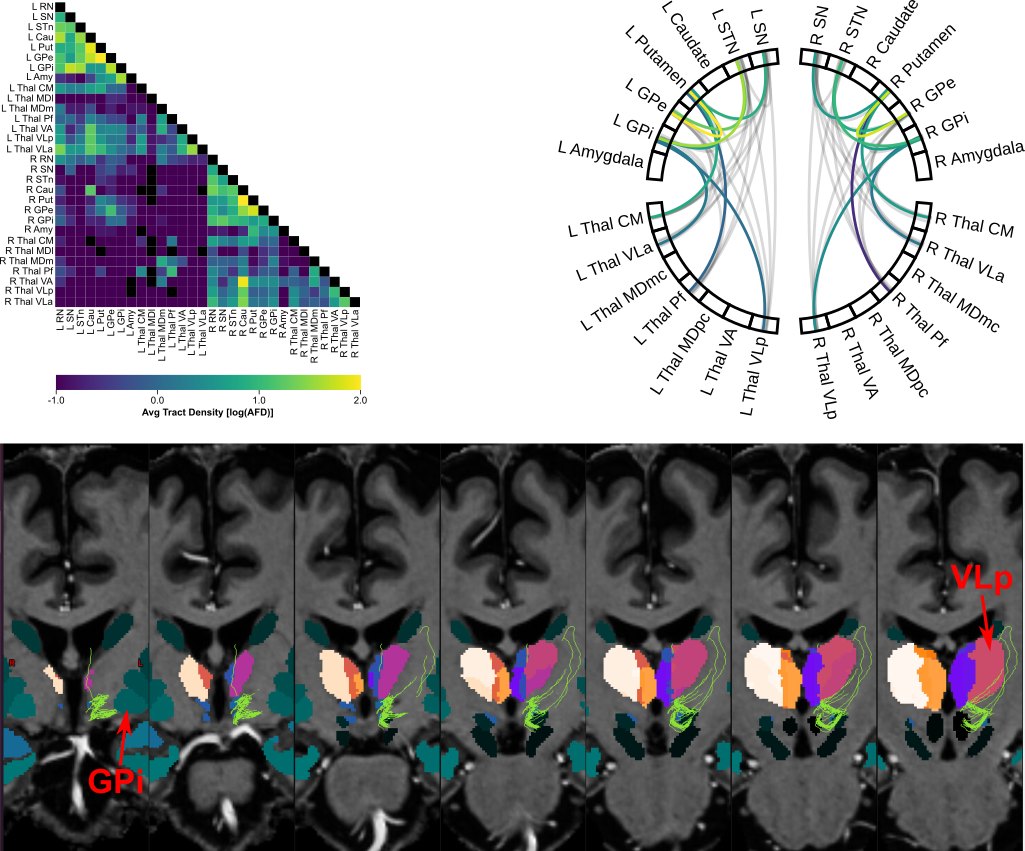
This is useful for:
* Analyzing structural connections of known brain circuits
* Examining specific connections of interest
* Comparison across different groups (e.g. controls vs patients)
## Example use of workflow
This workflow was used to process and analyze the data from
[`hcp_subcortical_repo`](https://github.com/kaitj/hcp_subcortical_repro)
(see Kai et al., 2022).
## Workflow
A brief summary of the workflow can be found below (see documentation for
a detailed summary):
_Note: The workflow assumes Freesurfer has already been run on the dataset, as
well as diffusion preprocessing (e.g. distortion correction)._
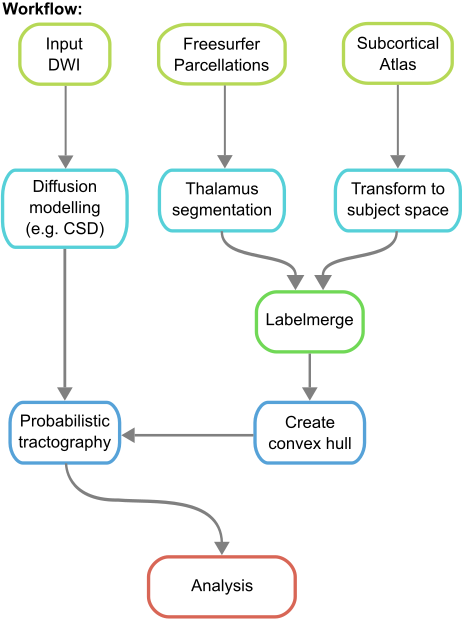
1. Merge the segmentations of structures in a standard template space from
various sources (if necessary) via
[labelmerge](https://zenodo.org/record/7636410) into a combined atlas, which is
used downstream to identify targeted connections.
1. Estimate and apply transformations from standard template space to
subject-specific space.
1. Further process the pre-processed diffusion data to enable tractography
(e.g. compute response functions, fibre orientation distribution,
normalization).
1. Perform whole-brain tractography from computed files, applying filtering
(e.g. SIFT2) to computed tractogram. Once filtered, connections between the
merged segmentations (from step 1) are identified, generating a connectome map.
1. Analysis can then be performed on the map to examine and explore the
connectome of interest.
### **Full documentation:** [here](https://scattr.readthedocs.io/en/stable/)
## Relevant Papers
* Kai, J., Khan, A.R., Haast, R.A.M., Lau, J.C. (2022).
Mapping the subcortical connectome using in vivo diffusion MRI: feasibility
and reliability. Terra incognita: diving into the human subcortex,
special issue of NeuroImage. doi:
[10.1016/j.neuroimage.2022.119553](https://doi.org/10.1016/j.neuroimage.2022.119553).