https://github.com/kinshuk-code-1729/html5-basic-mastery
This repository contains codes of some commonly used HTML tags which are used nowadays in creating modern web applications all encoded in HTML5.
https://github.com/kinshuk-code-1729/html5-basic-mastery
html html5 web-developer web-development
Last synced: 4 months ago
JSON representation
This repository contains codes of some commonly used HTML tags which are used nowadays in creating modern web applications all encoded in HTML5.
- Host: GitHub
- URL: https://github.com/kinshuk-code-1729/html5-basic-mastery
- Owner: kinshuk-code-1729
- License: apache-2.0
- Created: 2022-01-12T15:07:44.000Z (over 4 years ago)
- Default Branch: main
- Last Pushed: 2023-03-12T10:43:05.000Z (over 3 years ago)
- Last Synced: 2025-03-01T11:45:18.407Z (over 1 year ago)
- Topics: html, html5, web-developer, web-development
- Language: HTML
- Homepage:
- Size: 10.8 MB
- Stars: 2
- Watchers: 1
- Forks: 0
- Open Issues: 0
-
Metadata Files:
- Readme: README.md
- License: LICENSE
Awesome Lists containing this project
README
# HTML5 Mastery

## Brief Description About HTML5
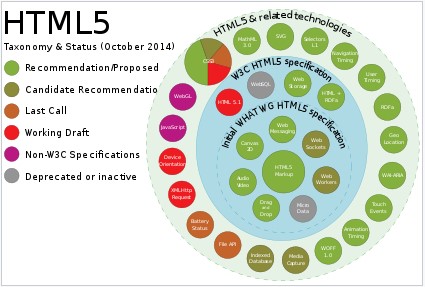
The term HTML5 is essentially a buzzword that refers to a set of modern web technologies. This includes the HTML Living Standard, along with JavaScript APIs to enhance storage, multimedia, and hardware access.
**HTML5** is a markup language used for structuring and presenting content on the World Wide Web. It is the fifth and last major HTML version that is a World Wide Web Consortium (W3C) recommendation. The current specification is known as the HTML Living Standard. It is maintained by the Web Hypertext Application Technology Working Group (WHATWG), a consortium of the major browser vendors (Apple, Google, Mozilla, and Microsoft).
HTML5 was first released in a public-facing form on 22 January 2008, with a major update and **"W3C Recommendation"** status in October 2014. Its goals were to improve the language with support for the latest multimedia and other new features; to keep the language both easily readable by humans and consistently understood by computers and devices such as web browsers, parsers, etc., without XHTML's rigidity; and to remain backward-compatible with older software. HTML5 is intended to subsume not only HTML 4 but also XHTML 1 and DOM Level 2 HTML.
HTML5 includes detailed processing models to encourage more interoperable implementations; it extends, improves, and rationalizes the markup available for documents and introduces markup and application programming interfaces (APIs) for complex web applications. For the same reasons, HTML5 is also a candidate for cross-platform mobile applications because it includes features designed with low-powered devices in mind.
## New API's
In addition to specifying markup, HTML 5 specifies scripting application programming interfaces (APIs) that can be used with JavaScript. Existing Document Object Model (DOM) interfaces are extended and de facto features documented.
## Error handling
**HTML 5** is designed so that old browsers can safely ignore new HTML 5 constructs. In contrast to HTML 4.01, the HTML 5 specification gives detailed rules for lexing and parsing, with the intent that compliant browsers will produce the same results when parsing incorrect syntax. Although HTML 5 now defines a consistent behavior for "tag soup" documents, those documents do not conform to the HTML 5 standard.
## Popularity
According to a report released on 30 September 2011, 34 of the world's top 100 Web sites were using **HTML 5** – the adoption led by search engines and social networks. Another report released in August 2013 has shown that 153 of the Fortune 500 U.S. companies implemented HTML5 on their corporate websites.
Since 2014, HTML 5 is at least partially supported by most popular layout engines.