https://github.com/kipper-lang/kipper
The Kipper programming language for Browsers and Node.js 🦊✨ Made at HTL Leonding & JKU Linz
https://github.com/kipper-lang/kipper
antlr4 cli collaborate compiler hacktoberfest javascript kipper language nodejs programming-lang typescript
Last synced: 9 months ago
JSON representation
The Kipper programming language for Browsers and Node.js 🦊✨ Made at HTL Leonding & JKU Linz
- Host: GitHub
- URL: https://github.com/kipper-lang/kipper
- Owner: Kipper-Lang
- License: gpl-3.0
- Created: 2021-09-28T11:51:43.000Z (almost 5 years ago)
- Default Branch: main
- Last Pushed: 2025-04-06T05:53:06.000Z (over 1 year ago)
- Last Synced: 2025-04-09T21:19:11.119Z (about 1 year ago)
- Topics: antlr4, cli, collaborate, compiler, hacktoberfest, javascript, kipper, language, nodejs, programming-lang, typescript
- Language: TypeScript
- Homepage: https://kipper-lang.org
- Size: 15.2 MB
- Stars: 27
- Watchers: 1
- Forks: 5
- Open Issues: 57
-
Metadata Files:
- Readme: README.md
- Changelog: CHANGELOG.md
- Contributing: CONTRIBUTING.md
- License: LICENSE
- Code of conduct: CODE_OF_CONDUCT.md
- Citation: CITATION.cff
- Security: SECURITY.md
Awesome Lists containing this project
README

# The Kipper programming language - `kipper` 🦊✨
[](https://npmjs.org/package/kipper)
[](https://github.com/Kipper-Lang/Kipper/tags)
[](https://codecov.io/gh/Kipper-Lang/Kipper)
[](https://github.com/Kipper-Lang/Kipper/issues)
[](https://github.com/Kipper-Lang/Kipper/blob/main/LICENSE)
[](https://app.fossa.com/projects/git%2Bgithub.com%2FLuna-Klatzer%2FKipper?ref=badge_shield)
[](https://zenodo.org/badge/latestdoi/411260595)
Kipper is a JavaScript-like strongly and strictly typed language with Python flavour. It aims to provide
straightforward, simple, secure and type-safe coding with better efficiency and developer satisfaction!
Integrating strict type handling, runtime types, casts, among many other features, for a safer development experience!
It compiles to both JavaScript and TypeScript, and can be set up in your terminal, Node.js or ES6+ browser. 🦊💻
_For more details, you can read more about this project in the sections ["Goals & Planned Features"](#goals--planned-features) and ["Why Kipper?"](#why-kipper-)._
## General Information
- Website: https://kipper-lang.org
- Docs: https://docs.kipper-lang.org
- Playground: https://play.kipper-lang.org
- Issue Tracker: https://issues.kipper-lang.org
- Roadmap: [View Kipper Roadmap 🦊🚧](https://github.com/Kipper-Lang/Kipper/discussions/139)
- Changelog: [View CHANGELOG.md](https://github.com/Kipper-Lang/Kipper/blob/main/CHANGELOG.md)
## Installation
To install the whole Kipper package with its CLI, run the following command:
```bash
npm i kipper
```
If you are using `pnpm` or `yarn`, use `pnpm i kipper` or `yarn add kipper`.
## Project Packages
- [`kipper`](https://www.npmjs.com/package/kipper): The Kipper compiler and API, which ships with all child packages.
- [`@kipper/core`](https://www.npmjs.com/package/@kipper/core): The core implementation of the Kipper compiler.
- [`@kipper/cli`](https://www.npmjs.com/package/@kipper/cli): The Kipper command line interface (CLI).
- [`@kipper/web`](https://www.npmjs.com/package/@kipper/web): The standalone web-module for the Kipper compiler.
- [`@kipper/target-js`](https://www.npmjs.com/package/@kipper/target-js): The JavaScript target for the Kipper
compiler.
- [`@kipper/target-ts`](https://www.npmjs.com/package/@kipper/target-ts): The TypeScript target for the Kipper
compiler.
## Goals & Planned Features
_View the current implementation state in the [Kipper Roadmap 🦊🚧](https://github.com/Kipper-Lang/Kipper/discussions/139)._
- Full compiler ensured type safety, by analysing and reporting code during compilation.
- Duck typing type checking with TypeScript-like interface types for both compile and runtime.
- Runtime type and type checking features, where original compile time type issues can be
resolved during runtime.
- Strict cast and conversion handling, so that potentially or definitely problematic usage
is detected by the compiler and ensures the developer has to handle them.
- Avoidance of `any` type issues, with ensurance of compiler checks that operations and data
access are valid.
- Runtime errors and safety checks in case of incomplete or faulty typing. This should avoid
issues, such as "TypeError: can't access property "..." of undefined".
- Null safety, by enforcing non-null types unless explicitly allowed.
- Conversion behaviour functions in classes to customise conversion behaviour.
- Operator overloading and additional customisation behaviour.
- Type Conversion Overloading to customise conversion behaviour.
- Full translation to/and integration with JavaScript and TypeScript.
- Import Support for `.ts` files, as well as `.d.ts` + `.js` files.
- Translation support for all ES versions as far as ES6 (JavaScript target specific)
## How to use Kipper?
To use Kipper you have three options:
- Run it in the browser using the CDN [`kipper-standalone.min.js`](https://cdn.jsdelivr.net/npm/@kipper/web@latest/kipper-standalone.min.js) file, which bundles the entire compiler
for your browser.
- Run it using the NodeJS CLI [`@kipper/cli`](https://www.npmjs.com/package/@kipper/cli).
- Import the package [`@kipper/core`](https://www.npmjs.com/package/@kipper/core) in NodeJS or Deno.
### In a browser with `@kipper/web` 🦊🌐
For running Kipper in the browser, you will have to include the `kipper-standalone.js` file, which
provides the Kipper Compiler for the browser and enables the compilation of Kipper code to JavaScript.
Simple example of compiling and running Kipper code in a browser:
```html
// Define your own logger and compiler, which will handle the compilation
const logger = new Kipper.KipperLogger((level, msg) => {
console.log(`[${Kipper.getLogLevelString(level)}] ${msg}`);
});
// Define your own compiler with your wanted configuration
const compiler = new Kipper.KipperCompiler(logger);
// Compile the code to JavaScript
// Top-level await ref: https://developer.mozilla.org/en-US/docs/Web/JavaScript/Reference/Operators/await#top_level_await
const result = await compiler.compile(`call print("Hello world!");`, {
target: new KipperJS.TargetJS(),
});
const jsCode = result.write();
// Finally, run your program
eval(jsCode);
```
### Locally using Node.js with `@kipper/cli` 🦊🖥️
This is to recommend way to use Kipper if you want to dive deeper into Kipper, as it allows you to locally use and run
kipper, without depending on a browser.
For example:
- Compiling a Kipper program:
```bash
kipper compile file.kip
```
- Executing a Kipper program using Node.js:
```bash
kipper run file.kip
```
This also enables the usage of Kipper files with the `.kip` extension, which can be read and compiled to TypeScript,
without having to configure anything yourself. This also allows the input of data over the
console and file-interactions, which are not supported inside a browser.
For more info go to the [`@kipper/cli` README](https://github.com/Kipper-Lang/Kipper/blob/main/kipper/cli/README.md).
### Locally in your own code with `@kipper/core` 🦊⌨️
This is the recommended way if you intend to use kipper in a workflow or write code yourself to manage
the compiler. This also allows for special handling of logging and customising the compilation process.
Simple example of using the Kipper Compiler in Node.js:
- JavaScript (CommonJS):
```js
const fs = require("fs").promises;
const kipper = require("@kipper/core");
const kipperJS = require("@kipper/target-js");
const path = "INSERT_PATH";
fs.readFile(path, "utf8").then(async (fileContent) => {
const compiler = new kipper.KipperCompiler();
// Compile the code string or stream
let result = await compiler.compile(fileContent, { target: new kipperJS.TargetJS() });
let jsCode = result.write();
// Running the Kipper program
eval(jsCode);
});
```
- TypeScript (CommonJS):
```ts
import { promises as fs } from "fs";
import { KipperCompiler } from "@kipper/core";
import { TargetJS } from "@kipper/target-js";
const path = "INSERT_PATH";
fs.readFile(path, "utf8" as BufferEncoding).then(async (fileContent: string) => {
const compiler = new KipperCompiler();
// Compile the code string or stream
let result = await compiler.compile(fileContent, { target: new TargetJS() });
let jsCode = result.write();
// Running the Kipper program
eval(jsCode);
});
```
## Why Kipper? 🦊❓
_Skip this section, if you are not interested in the details behind Kipper and this
project. It is not required knowledge for using or trying out Kipper._
The primary reason for the development of Kipper is the simplification of the development process for developers, both
in the web and server-side space, by improving on common type and non-type-related issues. Through this, the language
should help developers fix those issues more reliably and quickly.
Therefore, this programming language, like TypeScript, aims to provide more safety and functionality using, among other
things, compile-time error checking and transpilation. This primarily relies on the addition of types and type checking,
as a way to ensure that programs work as intended and that developers can discover errors before they run their code.
TypeScript already does a great job at this, so why is Kipper needed and how does it do things differently? TypeScript is
an amazing language, which is why Kipper has many of its designs and features similarly implemented. A big issue
that TypeScript can't detect and properly resolve is the issue of inconsistent or non-determined typing. This is a
fundamental issue when working with dynamic data or JavaScript code in TypeScript, where types are unknown or can't be
known before runtime. TypeScript is unable to work with this code appropriately and requires the user to make
assumptions about its types at compile-time. This leads to many issues where the compiler is unable to check for many
potential issues and is often largely turned off, as the developers themselves are required to decide what is correct
and often make serious mistakes in the process, causing code to become unpredictable and error-prone during execution.
Even with runtime-bound `instanceof` and `typeof` checks, it becomes a tedious effort that often results in more errors,
due to issues arising while trying to fix the original problems.
Kipper therefore tries to implement a standardised way to easily solve those issues, by providing consistent compile- and
runtime types, type checks, and error handling. This means the compiler will be there to assist the developer both during
compile time and runtime, extending its capabilities of ensuring code is secure and providing methods for developers to handle
them in a consistent and easy-to-understand way. This also means functionality like casts or conversions is more
strictly handled and doesn't overwrite type-checking behaviour. Even so, Kipper will always try not to be invasive,
and developers can choose during development time how to handle different cases and how Kipper should handle them during
runtime.
Using this approach, Kipper will add many features developers know from other languages, such as:
- Runtime Casting
- Runtime Type Casting
- Pattern Matching
- Consistent Typing and Compile Time Cast Checks
- Custom Runtime Types
Beyond this, there is a whole paper illustrating the design, implementation and reasons behind Kipper, which can be found at
"Kipper - Programming Language for Improved Runtime Type-Safety" (written in English,
with additional German oath and abstract).
## Contributing to Kipper
If you want to contribute to Kipper, we have a full guide explaining the structure of Kipper and how to use GitHub
issues and pull requests. Check it out [here](https://github.com/Kipper-Lang/Kipper/blob/main/CONTRIBUTING.md)!
If you have any questions or concerns, you can open up a discussion page [here](https://github.com/Kipper-Lang/Kipper/discussions)!
We appreciate any feedback or help! Kipper is open-source and free for anyone, help us make it even better! 🦊❤️
## Copyright and License

[](https://app.fossa.com/projects/git%2Bgithub.com%2FLuna-Klatzer%2FKipper?ref=badge_shield)
Copyright (C) 2021-2024 Luna Klatzer
This program is free software: you can redistribute it and/or modify it under
the terms of the GNU General Public License as published by the Free Software
Foundation, either version 3 of the License, or
(at your option) any later version.
This program is distributed in the hope that it will be useful, but WITHOUT ANY
WARRANTY; without even the implied warranty of MERCHANTABILITY or FITNESS FOR A
PARTICULAR PURPOSE. See the GNU General Public License for more details.
You should have received a copy of the GNU General Public License along with
this program. If not, see .
See the [LICENSE](https://raw.githubusercontent.com/Kipper-Lang/Kipper/main/LICENSE)
for information on terms & conditions for usage.
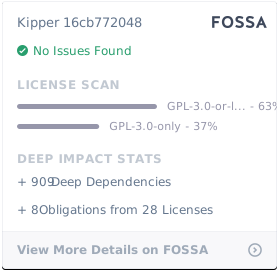
### FOSSA License Report
[](https://app.fossa.com/projects/git%2Bgithub.com%2FLuna-Klatzer%2FKipper?ref=badge_large)