https://github.com/kokoye2007/myanmar-linux-keyboards
Complete keyboard layout package for Myanmar scripts on Linux systems
https://github.com/kokoye2007/myanmar-linux-keyboards
burma i18n ibus ibus-table input-method karen keyboard-layout keymagic linux localization mon myanmar myanmar-unicode shan unicode xkb
Last synced: 4 months ago
JSON representation
Complete keyboard layout package for Myanmar scripts on Linux systems
- Host: GitHub
- URL: https://github.com/kokoye2007/myanmar-linux-keyboards
- Owner: kokoye2007
- License: mit
- Created: 2025-08-12T14:21:06.000Z (10 months ago)
- Default Branch: main
- Last Pushed: 2025-09-05T04:30:28.000Z (9 months ago)
- Last Synced: 2025-09-05T06:15:27.483Z (9 months ago)
- Topics: burma, i18n, ibus, ibus-table, input-method, karen, keyboard-layout, keymagic, linux, localization, mon, myanmar, myanmar-unicode, shan, unicode, xkb
- Language: Shell
- Homepage:
- Size: 133 KB
- Stars: 2
- Watchers: 0
- Forks: 1
- Open Issues: 0
-
Metadata Files:
- Readme: README.md
- Contributing: CONTRIBUTING.md
- License: LICENSE
Awesome Lists containing this project
README
# Myanmar Linux Keyboards
[](https://opensource.org/licenses/MIT)
[](https://github.com/kokoye2007/myanmar-linux-keyboards/releases)
[](https://github.com/kokoye2007/myanmar-linux-keyboards/issues)
[](https://github.com/kokoye2007/myanmar-linux-keyboards/stargazers)
[](https://ubuntu.com/)
[](https://getfedora.org/)
[](https://archlinux.org/)
Complete keyboard layout package for Myanmar scripts on Linux systems. Supporting all major Myanmar languages with multiple input methods.
## 🌏 Languages Supported
| Language | ISO Code | Script | Status | Keyboards |
|----------|----------|---------|---------|-----------|
| 🇲🇲 **Burmese** (Myanmar) | `my` | Myanmar | ✅ Complete | Standard, Zawgyi |
| 📜 **Mon** | `mnw` | Myanmar | ✅ Complete | Standard, A1 |
| 🏔️ **Shan** | `shn` | Myanmar | ✅ Complete | Standard, Zawgyi |
| 🌾 **Karen (Sgaw)** | `ksw` | Myanmar | ✅ Complete | Kawthoolei |
| 🌾 **Karen (Eastern Pwo)** | `kjp` | Myanmar | ✅ Complete | Unicode |
| 🌾 **Karen (Western Pwo)** | `pwo` | Myanmar | ✅ Complete | Kawthoolei |
| 🏔️ **Kayah** | `kyu` | Myanmar | 🚧 Planned | - |
## 🚀 Quick Installation
### Install All Keyboards
```bash
# Clone repository
git clone https://github.com/kokoye2007/myanmar-linux-keyboards.git
cd myanmar-linux-keyboards
# Install all XKB layouts (system-level)
sudo ./installers/install-all-xkb.sh
# Install all ibus-table input methods
sudo ./installers/install-all-ibus.sh
```
### Install Specific Language
```bash
# Install only Karen keyboards
sudo ./installers/install-specific.sh karen
# Install only Mon keyboards
sudo ./installers/install-specific.sh mon
# Install only Shan keyboards
sudo ./installers/install-specific.sh shan
```
### Interactive TUI Installer
For a guided installation experience, use our Text-based User Interface installer:
```bash
# Run the interactive TUI installer
sudo ./installers/tui-installer.sh
```
The TUI installer provides an easy-to-use menu system that allows you to:
- Choose between XKB layouts, IBus tables, or both
- Select specific languages to install
- Get real-time feedback during installation
## ⌨️ Input Methods Available
### **XKB Layouts** (System-level)
- Integrates with desktop environment
- Works across all applications
- Standard Linux keyboard layout system
- Usage: `setxkbmap mm `
### **ibus-table** (Input Method)
- Direct character mapping
- No candidate selection needed
- Windows KLC compatible behavior
- Usage: Add via Settings → Input Sources
### **KeyMagic** (Advanced)
- Automatic ligature generation
- Smart character corrections
- Context-aware input
- Usage: Install KeyMagic + load .kms files
## 🎯 Character Access Examples
### Common Patterns (All Languages)
```
Numbers: 1-9,0 → ၁-၉,၀ (Myanmar digits)
Basic: q,w,e,r,t → ဆ,တ,န,မ,အ (consonants)
Vowels: d,g,k,l → ိ,ါ,ု,ူ (vowel signs)
Marks: f,h,j → ်,့,ြ (diacritics)
```
### Language-Specific Characters
**Karen (Eastern Pwo)**:
```
P → စ, Shift+P → ၮ (nna)
[ → ဟ, Shift+[ → ၯ (ywa)
] → ☆, Shift+] → ၰ (ghwa)
```
**Karen (Western Pwo)**:
```
R → မ, Shift+R → ၩ (tone-1)
T → အ, Shift+T → ၪ (tone-2)
A → ၦ (pwa), Shift+A → ၡ (sha)
```
**Karen (Sgaw)**:
```
Q → ဆ, Shift+Q → ၡ (sha)
E → န, Shift+E → ၢ (eu)
R → မ, Shift+R → ၤ (kepho)
```
**Mon**:
```
I → ၚ (mon nga)
B → ၜ (mon bba)
```
**Shan**:
```
U → ၥ (shan tone)
Specific Shan characters and tone marks
```
## 📱 Desktop Integration
### GNOME
1. Settings → Region & Language → Input Sources
2. Click "+" → Other → Select Myanmar script
3. Choose your language variant
4. Switch: **Super + Space**
### KDE Plasma
1. System Settings → Input Devices → Keyboard → Layouts
2. Add → Myanmar → Select variant
3. Switch: **Alt + Shift**
### XFCE
1. Settings → Keyboard → Layout
2. Add → Myanmar → Select variant
3. Configure switching hotkey
## 🛠️ Development
### Building from Source
```bash
# Generate XKB layouts
cd scripts/
./build-xkb.sh
# Generate ibus-table files
./build-ibus.sh
# Test layouts
./test-layouts.sh
```
### Contributing
1. **Fork** the repository
2. **Create** feature branch: `git checkout -b feature/new-language`
3. **Commit** changes: `git commit -am 'Add new language support'`
4. **Push** branch: `git push origin feature/new-language`
5. **Submit** Pull Request
### Adding New Languages
1. Create language directory in `scripts/`
2. Add XKB symbols file
3. Create ibus-table definition
4. Add KeyMagic script (optional)
5. Update installers and documentation
## 📋 System Requirements
### Supported Distributions
- **Ubuntu** 20.04+ / **Debian** 11+
- **Fedora** 35+ / **CentOS** 8+
- **Arch Linux** / **Manjaro**
- **openSUSE** Leap 15.3+
### Required Packages
```bash
# Ubuntu/Debian
sudo apt install xkb-data ibus-table
# Fedora
sudo dnf install xkeyboard-config ibus-table
# Arch Linux
sudo pacman -S xkeyboard-config ibus-table
```
### Recommended Fonts
```bash
# Install Myanmar Unicode fonts
sudo apt install fonts-noto-myanmar fonts-myanmar # Ubuntu
sudo dnf install google-noto-sans-myanmar-fonts # Fedora
sudo pacman -S noto-fonts # Arch
```
## 🐛 Troubleshooting
### XKB Issues
```bash
# Check current layout
setxkbmap -query
# Reset to US layout
setxkbmap us
# Clear XKB cache
sudo rm -f /var/lib/xkb/*.xkm
# Restart display manager
sudo systemctl restart gdm # or sddm/lightdm
```
### ibus Issues
```bash
# Restart ibus
ibus restart
# Check available engines
ibus list-engine | grep myanmar
# Debug mode
ibus-daemon -drx
```
### Character Display Problems
1. Install Myanmar Unicode fonts
2. Check system language support
3. Verify font fallback configuration
4. Test with different applications
## 📚 Documentation
- **[Installation Guide](docs/installation.md)** - Detailed setup instructions
- **[Character Maps](docs/character-maps.md)** - Complete character reference
- **[User Guide](docs/user-guide.md)** - How to use each input method
- **[Developer Guide](docs/developer-guide.md)** - Contributing and building
- **[Troubleshooting](docs/troubleshooting.md)** - Common issues and solutions
## 🤝 Community
### Communication
- **Issues**: Bug reports and feature requests
- **Discussions**: General questions and ideas
- **Wiki**: Community documentation
- **Releases**: Stable versions and changelogs
### Contributors
- Language experts and native speakers
- Linux distribution maintainers
- Unicode and typography specialists
- Community translators
### Acknowledgments
- **Myanmar Unicode Initiative** - Standardization efforts
- **KNU (Karen National Union)** - Karen layout specifications
- **Mon Language Project** - Mon script expertise
- **Shan Digital Heritage** - Shan keyboard layouts
- **Linux Internationalization Community** - Technical foundation
## 📄 License
This project is licensed under the **MIT License** - see the [LICENSE](LICENSE) file for details.
### Font Licenses
Recommended fonts have their own licenses:
- **Noto Sans Myanmar**: SIL Open Font License
- **Myanmar3**: Custom license
- **Padauk**: SIL Open Font License
## 🌟 Star History
[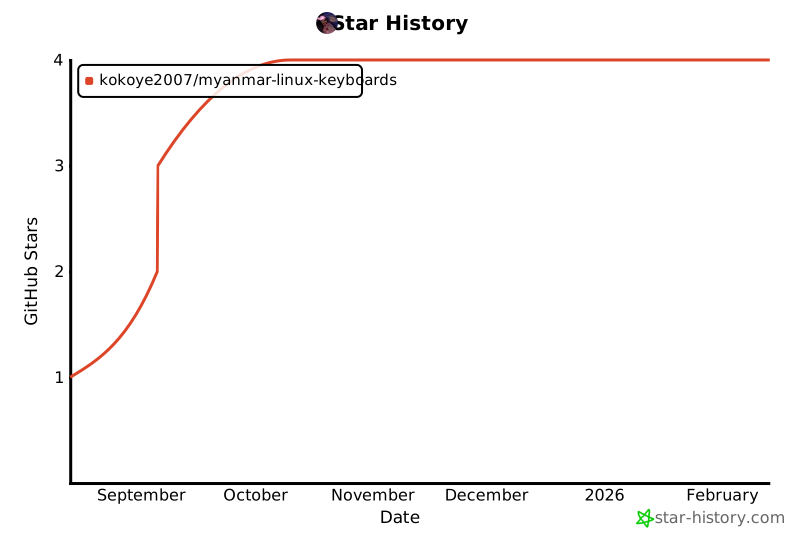](https://star-history.com/#kokoye2007/myanmar-linux-keyboards&Date)
---
**Made with ❤️ for the Myanmar digital community**
*Supporting linguistic diversity and digital inclusion across all Myanmar languages.*