https://github.com/kreshuklab/go-nuclear
Guides and code for 3D nuclear instance segmentation
https://github.com/kreshuklab/go-nuclear
bioimage-analysis instance-segmentation
Last synced: 7 months ago
JSON representation
Guides and code for 3D nuclear instance segmentation
- Host: GitHub
- URL: https://github.com/kreshuklab/go-nuclear
- Owner: kreshuklab
- License: mit
- Created: 2024-01-30T12:39:54.000Z (over 2 years ago)
- Default Branch: main
- Last Pushed: 2025-12-02T19:29:38.000Z (8 months ago)
- Last Synced: 2025-12-05T19:17:41.349Z (8 months ago)
- Topics: bioimage-analysis, instance-segmentation
- Language: Python
- Homepage: https://kreshuklab.github.io/go-nuclear/
- Size: 4.73 MB
- Stars: 22
- Watchers: 4
- Forks: 3
- Open Issues: 0
-
Metadata Files:
- Readme: README.md
- License: LICENSE
Awesome Lists containing this project
README
# Nuclear Segmentation Pipelines
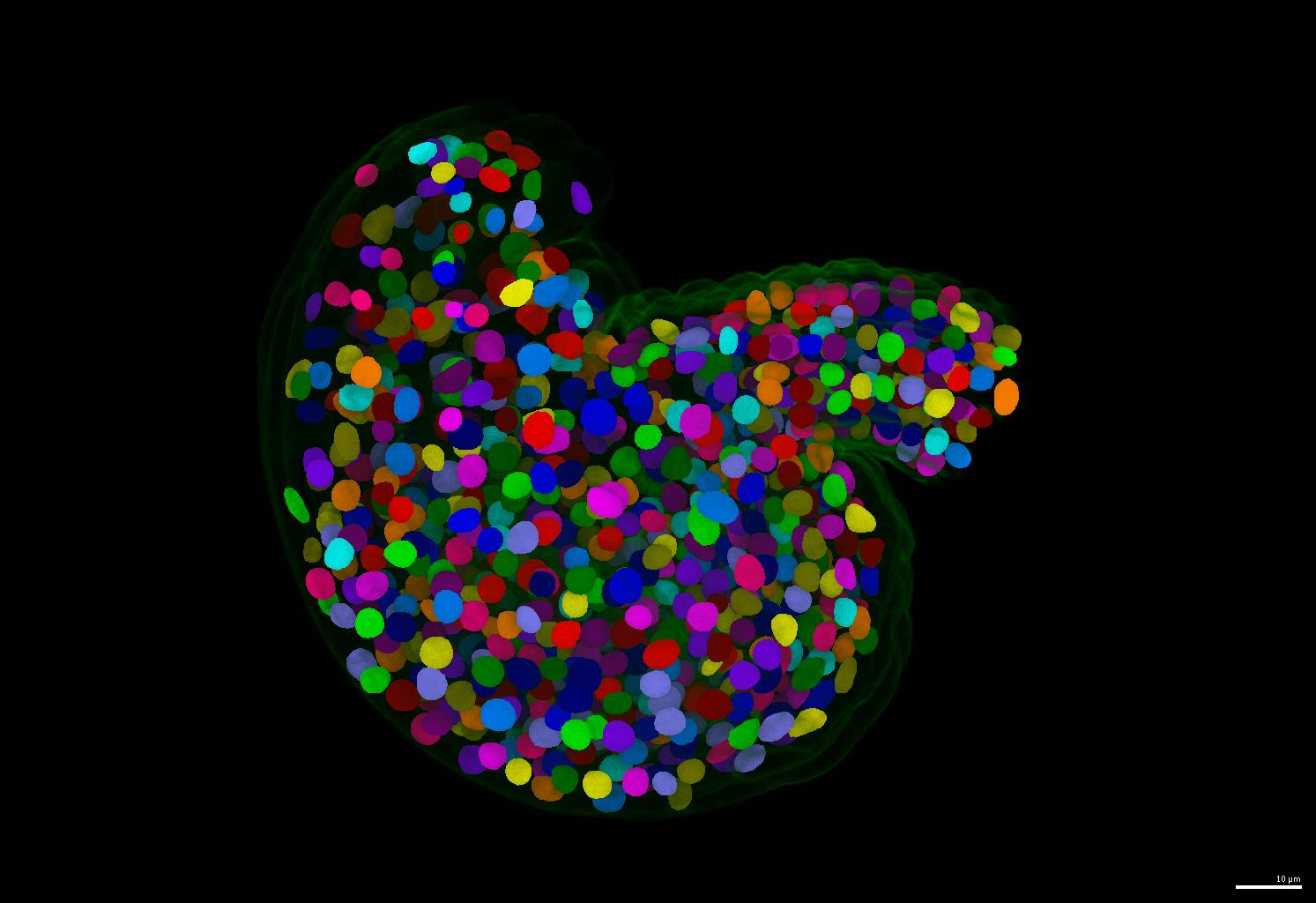
The GoNuclear repository hosts the code and guides for the pipelines used in the paper [_A deep learning-based toolkit for 3D nuclei segmentation and quantitative analysis in cellular and tissue context_](https://doi.org/10.1242/dev.202800). It is structured into four folders:
- **stardist/** contains a 3D StarDist training and inference pipeline, `run-stardist`.
- The StarDist model is automatically downloaded and can be used directly by this package.
- **plantseg/** contains configuration files for training and inference with PlantSeg.
- The PlantSeg model is included in the latest version of PlantSeg.
- **cellpose/** contains scripts for training and inference with Cellpose.
- The Cellpose model can be directly added to the Cellpose GUI or used via the command line.
- **evaluation/** contains modules for evaluating segmentation results.
These are described in detail in the [**GoNuclear documentation** :book:](https://kreshuklab.github.io/go-nuclear/).
## Data and Models
The median size of nuclei in the training data is `[16, 32, 32]` in `ZYX` order. The manuscript and documentation provide guidance on how to best segment your data with each pipeline. All three final models are available on BioImage Model Zoo:
- [StarDist model `modest-octopus`](https://bioimage.io/#/artifacts/modest-octopus)
- [PlantSeg model `efficient-chipmunk`](https://bioimage.io/#/artifacts/efficient-chipmunk)
- [Cellpose model `philosophical-panda`](https://bioimage.io/#/artifacts/philosophical-panda)
All training data and models are available on [BioImage Archive S-BIAD1026](https://www.ebi.ac.uk/biostudies/BioImages/studies/S-BIAD1026), organised in the following structure:
```bash
Training data
├── 2d/
│ ├── isotropic/
│ │ ├── gold/
│ │ └── initial/
│ └── original/
│ ├── gold/
│ └── README.txt
└── 3d_all_in_one/
├── 1135.h5
├── 1136.h5
├── 1137.h5
├── 1139.h5
└── 1170.h5
Models
├── cellpose/
│ ├── cyto2_finetune/
│ │ └── gold/
│ ├── nuclei_finetune/
│ │ ├── gold/
│ │ └── initial/
│ └── scratch_trained/
│ └── gold/
├── plantseg/
│ └── 3dunet/
│ ├── gold/
│ ├── initial/
│ ├── platinum/
│ └── train_example.yml
└── stardist/
├── resnet/
│ ├── gold/
│ ├── initial/
│ └── platinum/
├── train_example.yml
└── unet/
└── gold/
```
## Citation
If you find this work useful, please cite our paper and the respective tools' papers:
```bibtex
@article{vijayan2024deep,
title={A deep learning-based toolkit for 3D nuclei segmentation and quantitative analysis in cellular and tissue context},
author={Vijayan, Athul and Mody, Tejasvinee Atul and Yu, Qin and Wolny, Adrian and Cerrone, Lorenzo and Strauss, Soeren and Tsiantis, Miltos and Smith, Richard S and Hamprecht, Fred A and Kreshuk, Anna and others},
journal={Development},
volume={151},
number={14},
year={2024},
publisher={The Company of Biologists}
}
```