https://github.com/lazauk/machinelearning-asteroidhunting
Moonshot idea to train ML model on synthetically generated data to detect and trace real asteroids.
https://github.com/lazauk/machinelearning-asteroidhunting
asteroids machine-learning moonshot synthetic-data
Last synced: about 2 months ago
JSON representation
Moonshot idea to train ML model on synthetically generated data to detect and trace real asteroids.
- Host: GitHub
- URL: https://github.com/lazauk/machinelearning-asteroidhunting
- Owner: LazaUK
- License: gpl-3.0
- Created: 2023-03-12T20:19:00.000Z (over 3 years ago)
- Default Branch: main
- Last Pushed: 2023-03-21T14:11:55.000Z (over 3 years ago)
- Last Synced: 2025-01-12T05:11:13.138Z (over 1 year ago)
- Topics: asteroids, machine-learning, moonshot, synthetic-data
- Language: Python
- Homepage:
- Size: 2.43 MB
- Stars: 1
- Watchers: 1
- Forks: 0
- Open Issues: 0
-
Metadata Files:
- Readme: README.md
- License: LICENSE
Awesome Lists containing this project
README
# Asteroid Hunting with synthetic data
In some sitiations, data may be rare or hard to find. For example, NASA’s [discovery statistics database](https://cneos.jpl.nasa.gov/stats/totals.html) as of 10th of March 2023 contained records of 31,519 Near Earth Objects (NEO) collected over the period of 20 years. Still, none of them even closely matched characteristics of [asteroid `Oumuamua](https://solarsystem.nasa.gov/asteroids-comets-and-meteors/comets/oumuamua/in-depth), that was discovered in 2017.
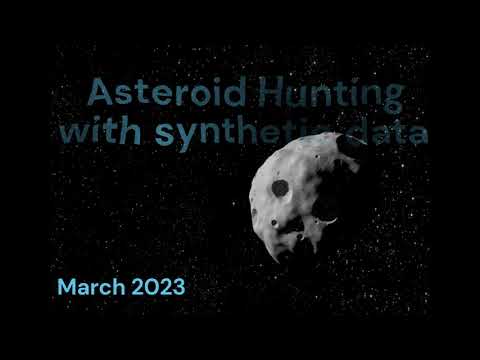
For this project, with a great help and support from my colleagues (Pedro Urbina, Shannon Monroe, Jon Hanzelka and Luke Tiday), I was able to generate synthetic asteroid images using some of the best 3D modelling platforms. The object detection model was then trained in Azure Custom Vision, before being exported into TensorFlow format. Export process also generated a template class to perform object (asteroid) detection that was then utilised in a custom ```asteroids.py``` inference code[^1].
- You can check [this YouTube video](https://youtu.be/MGzjm-F5YcA) for an output of ML model, tested on the video stream of an asteroid's fly-by.
[](https://www.youtube.com/watch?v=MGzjm-F5YcA)
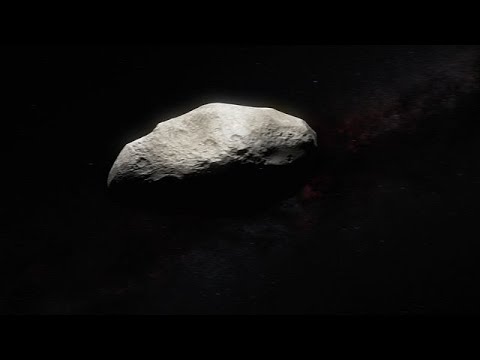
- This is link to the [original YouTube video](https://youtu.be/36XNdP4i7IA) from the European Southern Observatory (ESO)[^2].
[](https://www.youtube.com/watch?v=36XNdP4i7IA)
[^1]:This program is free software: you can redistribute it and/or modify
it under the terms of the GNU General Public License as published by
the Free Software Foundation, either version 3 of the License, or
(at your option) any later version.
This program is distributed in the hope that it will be useful,
but WITHOUT ANY WARRANTY; without even the implied warranty of
MERCHANTABILITY or FITNESS FOR A PARTICULAR PURPOSE. See the
GNU General Public License for more details.
You should have received a copy of the GNU General Public License
along with this program. If not, see .
[^2]:This short video shows an artist's impression of 2004 EW95, the first
carbon-rich asteroid confirmed to exist in the Kuiper Belt and a relic
of the primordial Solar System. The video shows a fly-by of the enigmatic
asteroid as it tumbles through the icy outer reaches of the Solar System
due to past interactions with migrating planets.
More information and download options: http://www.eso.org/public/videos/eso1.
Credit: ESO/M. Kornmesser