https://github.com/level09/neuronic
Create functions that can understand context, extract insights, and solve complex problems - all while maintaining the reliability and predictability of traditional programming. With built-in validation, type checking, and caching.
https://github.com/level09/neuronic
agentic-ai gpt llm openai python
Last synced: over 1 year ago
JSON representation
Create functions that can understand context, extract insights, and solve complex problems - all while maintaining the reliability and predictability of traditional programming. With built-in validation, type checking, and caching.
- Host: GitHub
- URL: https://github.com/level09/neuronic
- Owner: level09
- License: mit
- Created: 2024-11-20T00:01:31.000Z (over 1 year ago)
- Default Branch: main
- Last Pushed: 2025-01-13T09:07:24.000Z (over 1 year ago)
- Last Synced: 2025-04-11T23:38:07.731Z (over 1 year ago)
- Topics: agentic-ai, gpt, llm, openai, python
- Language: Python
- Homepage:
- Size: 1.74 MB
- Stars: 1
- Watchers: 1
- Forks: 0
- Open Issues: 0
-
Metadata Files:
- Readme: README.md
- License: LICENSE
Awesome Lists containing this project
README
# Neuronic 🧠

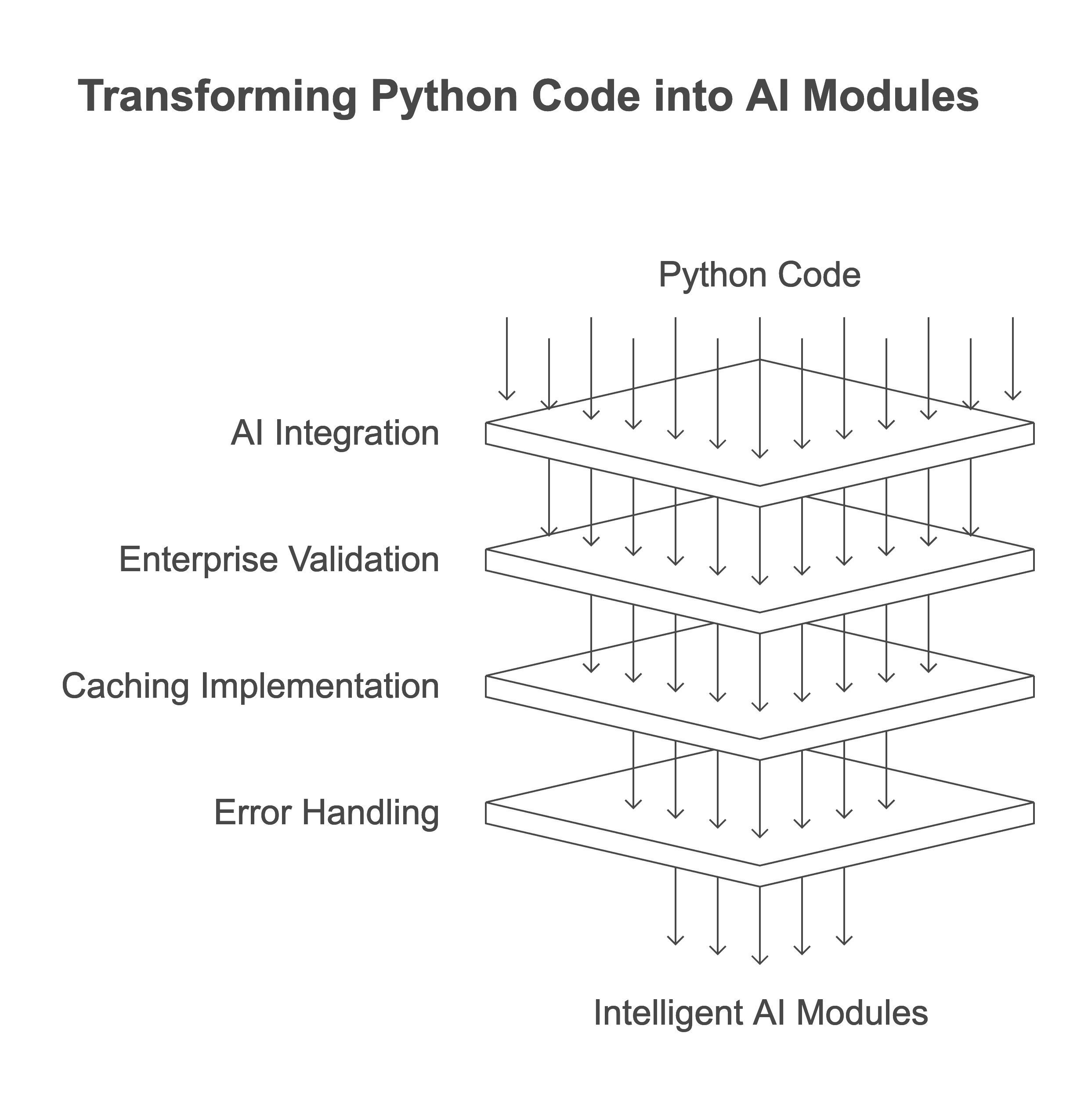
Imagine Python functions that can think, reason, and create - functions that understand natural language, analyze complex data patterns, and generate creative solutions. Welcome to Neuronic - where we transform ordinary Python code into intelligent, AI-powered modules that bring GPT's cognitive capabilities directly into your codebase, complete with enterprise-grade validation, caching, and error handling.
## ✨ Magic in Three Lines
```python
from neuronic import Neuronic
@neuronic.function(output_type="json")
def convert_to_vegetarian(recipe: str) -> dict:
"""Convert any food recipe to its vegetarian version while maintaining the flavor profile."""
pass
# That's it! Your function is now AI-powered 🌱
veggie_recipe = convert_to_vegetarian("Classic Beef Burger with bacon")
```
## 🌟 Real-Time Streaming
Watch your AI functions generate responses in real-time:
```python
@neuronic.function(output_type="string", stream=True)
def write_story(prompt: str) -> str:
"""Write a creative story based on the given prompt."""
pass
# See the story being written in real-time
for chunk in write_story("A curious robot discovers an ancient library"):
print(chunk, end="")
# Or use the transform method directly
neuronic = Neuronic()
for chunk in neuronic.transform(
data="Explain quantum computing",
instruction="Write a clear, step-by-step explanation",
stream=True
):
print(chunk, end="")
```
## 🌟 What is Neuronic?
Neuronic is your gateway to building intelligent Python applications powered by GPT-4o. Create functions that can understand context, extract insights, and solve complex problems - all while maintaining the reliability and predictability of traditional programming. With built-in validation, type checking, and caching, Neuronic makes AI as dependable as any other Python module.
## 🚀 Features
- **🎯 Smart Function Decorator:** Transform any Python function into an AI-powered one with a simple decorator
- **🧠 Real-Time Streaming:** Watch AI responses generate in real-time with built-in streaming support
- **🧠 Intelligent Understanding:** Create functions that truly understand your data, extracting meaning and insights
- **🗣️ Natural Language Processing:** Process text like a human - analyze sentiment, extract key information, and understand context
- **✍️ Creative Generation:** Generate human-quality content, from documentation to test data, tailored to your specifications
- **🔍 Pattern Recognition:** Uncover hidden patterns and relationships in your data through GPT-powered analysis
- **📦 Multiple Output Types:** Get results in any format you need - strings, numbers, JSON, lists, booleans, or Python structures
- **🏢 Enterprise Ready:** Built-in validation, type checking, and caching ensure production-ready outputs
- **⚡ Performance Optimized:** Automatic chunking for large inputs and smart caching for repeated operations
## 🛠️ Quick Start
### Installation
```bash
pip install neuronic
```
### Configuration
```python
# Option 1: Use environment variables (.env file)
OPENAI_API_KEY=your-openai-api-key-here
# Option 2: Pass API key directly
neuronic = Neuronic(api_key="your-api-key-here")
```
## 🎮 Cool Examples
### 🪄 Smart Function Decorator
Transform any Python function into an AI-powered one:
```python
@neuronic.function(output_type="string")
def generate_mini_story(character: str, setting: str, mood: str) -> str:
"""Create a three-sentence story based on the given character, setting, and mood."""
pass
story = generate_mini_story(
character="a curious robot",
setting="ancient library",
mood="mysterious"
)
```
### 🧹 Smart Data Cleaning
Clean and standardize messy data:
```python
@neuronic.function(output_type="json")
def clean_user_data(users: List[Dict]) -> List[Dict]:
"""
Clean and standardize user data:
- Properly capitalize names
- Validate and fix email addresses
- Convert age to numbers
"""
pass
clean_data = clean_user_data(messy_data)
```
### 🎨 Creative Generation
Generate emoji-based character profiles:
```python
emoji_personas = neuronic.generate(
spec="""Create unique emoji-based character profiles with:
- Emoji combination for appearance
- Personality trait
- Favorite hobby
- Life motto""",
n=3
)
```
### 📊 Smart Analysis
Analyze text with context and reasoning:
```python
analysis = neuronic.analyze(
data=movie_review,
question="What aspects of the movie did the reviewer focus on?"
)
print(f"Answer: {analysis['answer']}")
print(f"Confidence: {analysis['confidence']}")
print(f"Reasoning: {analysis['reasoning']}")
```
## 🎯 Perfect For
- **🔄 Data Processing:** Format conversion, cleaning, normalization
- **📝 Content Creation:** Documentation, test data, sample content
- **📊 Analysis:** Pattern recognition, sentiment analysis, trend detection
- **🛠️ Development:** Code transformation, API handling, validation
## 🧰 API Reference
### Core Methods
```python
# Transform data with streaming
result = neuronic.transform(
data=input_data, # What to transform
instruction="your instruction", # How to transform it
output_type="string", # What format you want
stream=True, # Enable streaming
example=None, # Optional example
context=None # Optional context
)
for chunk in result:
print(chunk, end="")
# Analyze data
insights = neuronic.analyze(
data=your_data, # What to analyze
question="your question" # What to find out
)
# Generate data
new_data = neuronic.generate(
spec="what to generate", # What you want
n=1 # How many items
)
```
### Streaming Functions
```python
# Create streaming functions for long-form content
@neuronic.function(output_type="string", stream=True)
def write_blog_post(topic: str, style: str) -> str:
"""Write a detailed blog post in the specified style."""
pass
# Watch the blog post being written in real-time
for chunk in write_blog_post(
topic="The Future of AI",
style="conversational"
):
print(chunk, end="")
# Stream JSON responses
@neuronic.function(output_type="json", stream=True)
def analyze_text_stream(text: str) -> dict:
"""Analyze text and return structured data with streaming."""
pass
# Note: JSON streaming ensures valid JSON output
for chunk in analyze_text_stream("Your text here"):
print(chunk, end="")
```
## 🎓 Best Practices
1. **🔐 Security First**
- Keep API keys in environment variables
- Never commit sensitive data
2. **⚡ Performance Tips**
- Use caching for repeated operations
- Enable streaming for long-running operations
- Batch similar requests when possible
- Be mindful of token limits when streaming
3. **🛡️ Error Handling**
- Always handle exceptions gracefully
- Validate outputs match expected formats
- Handle streaming interruptions properly
4. **🔄 Streaming Guidelines**
- Use streaming for long-form content generation
- Handle partial outputs appropriately
- Consider disabling streaming for small, quick operations
- Remember streaming bypasses caching
## 📜 License
MIT License - feel free to use in your own projects!
## 🤝 Contributing
Got ideas? Found a bug? Contributions are welcome! Feel free to:
- Open an issue
- Submit a pull request
- Share your cool use cases
## 🌟 Star Us!
If you find Neuronic useful, give us a star! It helps others discover the project.