https://github.com/liamvinberg/pi-secrets
Pi extension: agent requests secrets via a masked prompt. Env var delivery, never in model context, redacted from output
https://github.com/liamvinberg/pi-secrets
coding-agent extension pi pi-coding-agent pi-package secrets security tui
Last synced: about 1 month ago
JSON representation
Pi extension: agent requests secrets via a masked prompt. Env var delivery, never in model context, redacted from output
- Host: GitHub
- URL: https://github.com/liamvinberg/pi-secrets
- Owner: liamvinberg
- License: mit
- Created: 2026-06-11T19:24:26.000Z (about 1 month ago)
- Default Branch: main
- Last Pushed: 2026-06-11T20:17:42.000Z (about 1 month ago)
- Last Synced: 2026-06-11T21:16:00.585Z (about 1 month ago)
- Topics: coding-agent, extension, pi, pi-coding-agent, pi-package, secrets, security, tui
- Language: TypeScript
- Size: 271 KB
- Stars: 0
- Watchers: 0
- Forks: 0
- Open Issues: 0
-
Metadata Files:
- Readme: README.md
- License: LICENSE
Awesome Lists containing this project
README
# pi-secrets
[](https://github.com/liamvinberg/pi-secrets/actions/workflows/ci.yml)
[](https://www.npmjs.com/package/pi-secrets)
[](LICENSE)
A [pi](https://github.com/badlogic/pi-mono) extension for handing secrets to the agent without them ever entering the model's context window.
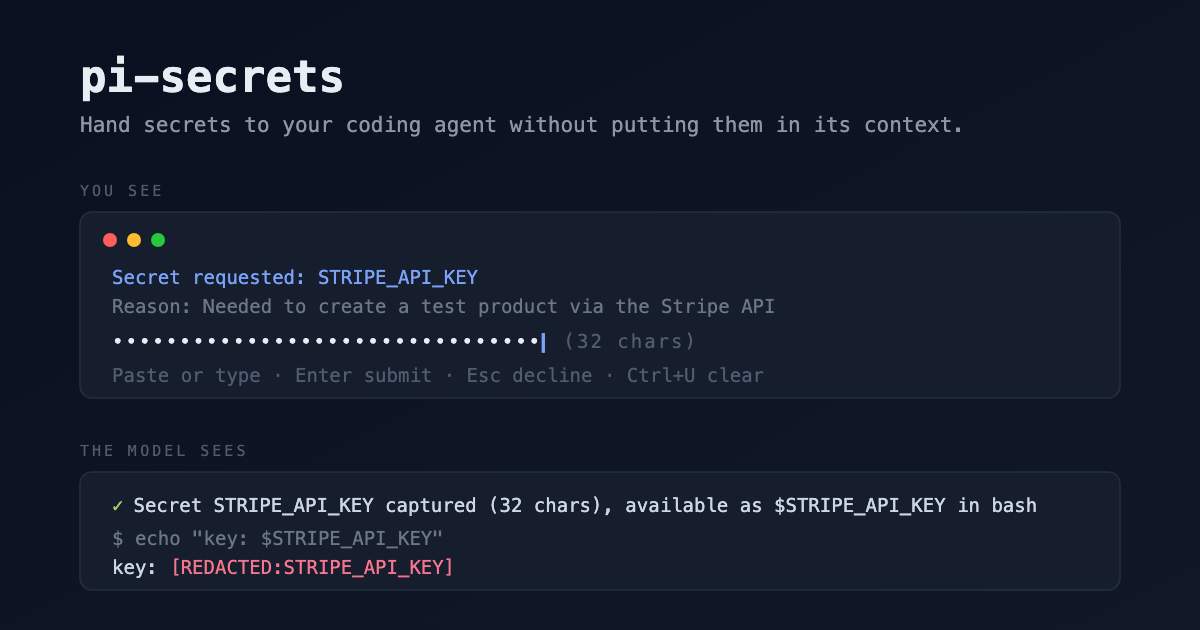
When a task needs an API key, token, or password, the model calls the `request_secret` tool. You get a **masked prompt** in the TUI, paste the value, and the model only learns the secret's *name* and *length*. The value itself becomes an environment variable available to every subsequent `bash` command, and a redaction layer scrubs the value from all tool output as a backstop.
## Install
```bash
pi install npm:pi-secrets
```
Or try it ephemerally: `pi -e npm:pi-secrets`
## How it works
1. **Capture**: `request_secret({ name, reason })` pops a masked single-line input. The value goes straight into the agent process's memory; nothing is written to disk, chat, or session files.
2. **Delivery**: pi's bash tool builds its child environment from the agent's `process.env`, so the captured value is available as `$NAME` in every subsequent command. Need it in a file? The model runs `echo "NAME=$NAME" >> .env`, still without seeing the value.
3. **Redaction**: every tool result (and `!` user-bash output) is scrubbed before it reaches the model or the session file: the exact value plus its base64 and URL-encoded variants are replaced with `[REDACTED:NAME]`. If the model runs `echo $NAME`, it sees the redaction marker, not the secret.
4. **Subagents**: child pi processes inherit the environment. `PI_SECRETS_NAMES` carries the *names* (never values), so a child running this extension rebuilds its own redaction map.
### Reuse rules
| Situation | Behavior |
|---|---|
| Name already captured this process | Silent reuse; the model is told it's available |
| Name in your shell environment at pi startup | Confirm dialog; allowing also registers the value for redaction |
| Name in environment, headless (`pi -p`) | Silent reuse + redaction (the model could read the env there anyway) |
| Nothing anywhere, headless | Tool errors with guidance to export the variable or run interactively |
| You press Esc / decline | Tool errors telling the model not to re-ask |
### Lifetime
Secrets live for the **pi process lifetime**: they survive session switches (`/new`), and vanish when pi exits. Nothing persists to disk. After a restart the model simply asks again.
## Commands
- `/secrets`: list held secrets (name · source · length), interactively clear one or all
- `/secrets clear `: clear directly
Clearing a *captured* secret also removes it from the agent environment; clearing an *inherited* one only stops tracking/redaction.
## Security model (read this)
This is **cooperative, not adversarial** (see [ADR-0002](docs/adr/0002-cooperative-security-model.md)). It protects against *accidental* disclosure: secrets pasted into chat, echoed by commands, or persisted in session transcripts. It does **not** defend against a malicious model: one that can run bash can exfiltrate anything the process can reach. Known gaps, accepted by design:
- Transformations beyond exact/base64/URL-encoded (hex, JWTs signed with the secret, etc.) are not caught.
- Values shorter than 4 chars are rejected at capture; 4 to 7 chars are accepted with a warning (short values risk redaction over-matching).
- Multi-line secrets (PEM keys, service-account JSON) are rejected; point the agent at a file path instead. Planned for a later version.
- MCP servers spawned at pi startup never see secrets captured later ([ADR-0001](docs/adr/0001-env-var-injection-over-file-relay.md)).
## Claude Code?
This extension is pi-native on purpose ([ADR-0003](docs/adr/0003-pi-native-over-mcp-broker.md)). The equivalent for Claude Code is a different build: an MCP server using **elicitation** (responses stay server-side), env delivery via a `CLAUDE_ENV_FILE` SessionStart/hook, and a PostToolUse redaction hook. Same design, different code. Contributions welcome.
## Development
```bash
npm install
npm run check # tsc --noEmit
npm test # bun test (pure logic: validation, scrubbing, seeding)
pi -e . # try the extension in an ephemeral pi run
```
## License
MIT