https://github.com/linghuiluo/multiskipgraph
This is a simulator implemented in Java for evaluating and demonstrating the MultiSkipGraph protocol and its extended version MultiSkipGraph*.
https://github.com/linghuiluo/multiskipgraph
java overlay-network simulation
Last synced: 10 months ago
JSON representation
This is a simulator implemented in Java for evaluating and demonstrating the MultiSkipGraph protocol and its extended version MultiSkipGraph*.
- Host: GitHub
- URL: https://github.com/linghuiluo/multiskipgraph
- Owner: linghuiluo
- License: gpl-3.0
- Created: 2018-10-06T19:08:56.000Z (almost 8 years ago)
- Default Branch: master
- Last Pushed: 2018-10-31T10:13:37.000Z (over 7 years ago)
- Last Synced: 2024-12-27T03:12:46.801Z (over 1 year ago)
- Topics: java, overlay-network, simulation
- Language: HTML
- Homepage:
- Size: 14.5 MB
- Stars: 0
- Watchers: 2
- Forks: 0
- Open Issues: 0
-
Metadata Files:
- Readme: README.md
- License: LICENSE
Awesome Lists containing this project
README
# MultiSkipGraph - A Self-stabilizing Overlay Network that Maintains Monotonic Searchability
This is a simulator implemented in Java for evaluating and demonstrating the MultiSkipGraph protocol and its extended version MultiSkipGraph*. A detailed version of the submission to IPDPS 2019 can be found [here](https://github.com/linghui2016/MultiSkipGraph/blob/master/paper/multiSkipGraph_verbose.pdf).
## Watch a demo
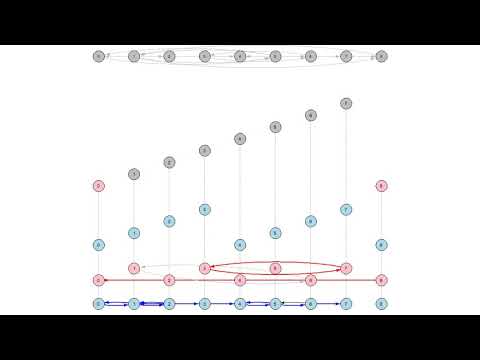
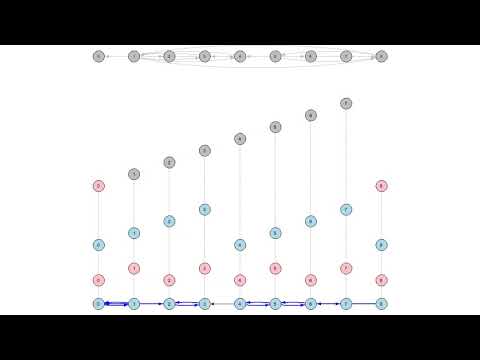
In the visualization, nodes on even levels are blue, on odd levels are red and marked as "unknown" are gray at the top.
- Click to see a demo of simulating a self-stabilizing overlay network with 9 nodes using the MultiSkipGraph protocol.
[](http://www.youtube.com/watch?v=S8yd7fApSfk)
- Click to see a demo of simulating a self-stabilizing overlay network with 9 nodes using the MultiSkipGraph* protocol.
[](http://www.youtube.com/watch?v=keOdsxxjWwU)
## How to run it?
- You can
- run the executable jar [multiSkipGraph.jar](https://github.com/linghui2016/MultiSkipGraph/releases/download/IPDPS/multiSkipGraph.jar) from the [release page](https://github.com/linghui2016/MultiSkipGraph/releases) or
- or import this project as Java Project into Eclipse. Simo.java is the main class to start the program, run it
- You will see a window with two modes to be chosen:
- ``Single-Test-Mode`` is for simulation with a fixed network size.
- In this mode the simulation will be visualized:
- nodes on even levels are blue
- nodes on odd levels are red
- nodes marked as unknown are gray (at the top)
- User can select if the test data will be saved
in your local working repository.
- User can select if the simulation should be filmed and
saved in folder "movies"(Number of Tests must be 1).
- ``Multi-Tests-Mode`` is for simulation with variable network size
- Test data will be written into csv files
- Minimum: the starting network size
- Step value: network size increment
- Maximum: the ending network size
- For searches: the user can give
- an absoulte number (terminate when all searches are processed and the network is staiblized)
- a relative number to network size (terminate when all searches are processed and the network is staiblized)
- a batch size (terminate when the network is stabilized)
- Click the ``Single-Test-Mode`` button, choose ``Both for comparision``, and then ``Simulate`` button to run a simulation by the default setting.
- You will see the simulation running first the MultiSkipGraph protocol and then the MultiSkipGraph* protocol.
For example, you should see the convergent states for system with 16 nodes as in the following screenshot.

## Contact
Please e-mail linghui.luo@upb.de if you have any questions.