https://github.com/lovesaroha/lnn
This is a generalized neural network package with clean and transparent API for the Go language.
https://github.com/lovesaroha/lnn
golang golang-package gradient-descent machine-learning neural-network sequential-models tensor
Last synced: 29 days ago
JSON representation
This is a generalized neural network package with clean and transparent API for the Go language.
- Host: GitHub
- URL: https://github.com/lovesaroha/lnn
- Owner: lovesaroha
- License: gpl-3.0
- Created: 2021-09-18T18:11:46.000Z (almost 5 years ago)
- Default Branch: main
- Last Pushed: 2021-09-26T12:23:13.000Z (almost 5 years ago)
- Last Synced: 2025-01-12T19:23:23.438Z (over 1 year ago)
- Topics: golang, golang-package, gradient-descent, machine-learning, neural-network, sequential-models, tensor
- Language: Go
- Homepage:
- Size: 23.4 KB
- Stars: 0
- Watchers: 1
- Forks: 0
- Open Issues: 0
-
Metadata Files:
- Readme: README.md
- License: LICENSE
Awesome Lists containing this project
README
# lnn
This is a generalized neural network package with clean and transparent API for the Go language. Also available for javascript [github/lovesaroha/lnn.js](https://github.com/lovesaroha/lnn.js)
## Features
- Lightweight and Fast.
- Native Go implementation.
- Tensor Operations.
- Sequential Models.
- Support loss functions like (Mean Square Error).
- Opitmization algorithms like (Gradient Descent).
## Requirements
- Go 1.9 or higher. We aim to support the 3 latest versions of Go.
## Installation
Simple install the package to your [$GOPATH](https://github.com/golang/go/wiki/GOPATH "GOPATH") with the [go tool](https://golang.org/cmd/go/ "go command") from shell:
```bash
go get -u github.com/lovesaroha/lnn
```
Make sure [Git is installed](https://git-scm.com/downloads) on your machine and in your system's `PATH`.
## Tensor Usage
### Create Tensor
```Golang
// Create tensor of given shape.
tensor := lnn.Tensor([]int{3, 4})
// Print values.
tensor.Print()
```

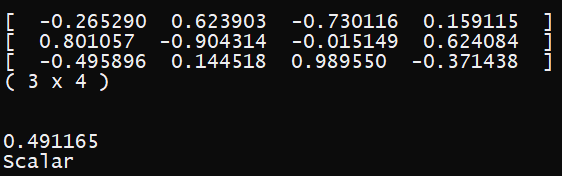
### Random Tensor
```Golang
// Create tensor of given shape and (minimum, maximum).
tensor := lnn.Tensor([]int{3, 4} , -1 , 1)
// Print values.
tensor.Print()
// Scalar tensor.
stensor := lnn.Tensor([]int{} , -1 , 1)
// Print values.
stensor.Print()
```
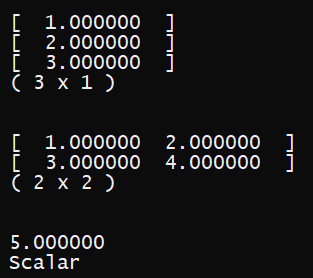
### Convert Slice Or Values Into Tensor
```Golang
// Slice of int to tensor and print values.
lnn.ToTensor([]int{1, 2, 3}).Print()
// 2d slice of int to tensor and print values.
lnn.ToTensor([][]int{[]int{1, 2},[]int{3, 4}}).Print()
// Value to tensor and print values.
lnn.ToTensor(5).Print()
```
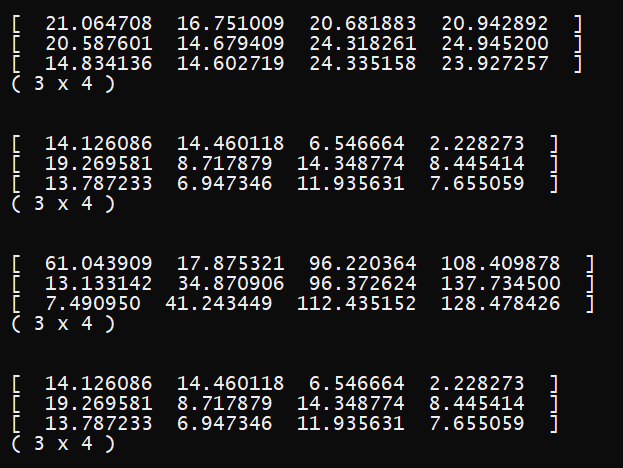
### Tensor Element Wise Operations (Add, Subtract, Multiply, Divide)
```Golang
// Create a random tensor.
tensor := lnn.Tensor([]int{3, 4} , 10 , 20)
tensorB := lnn.Tensor([]int{3, 4} , 0 , 10)
// Add and print values.
tensor.Add(tensorB).Print()
// Subtract and print values.
tensor.Sub(tensorB).Print()
// Multiply and print values.
tensor.Mul(tensorB).Print()
// Divide and print values.
tensor.Sub(tensorB).Print()
```
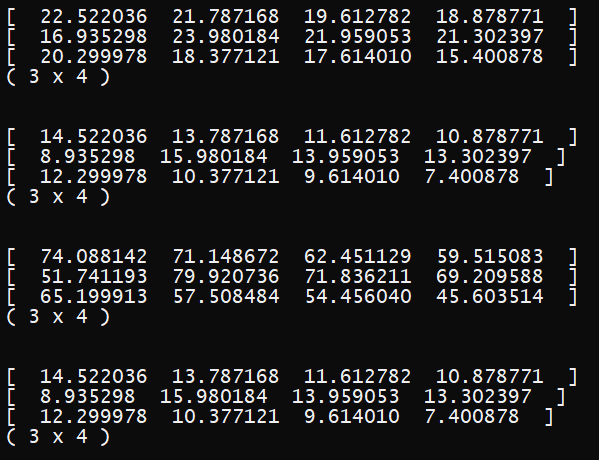
### Tensor Element Wise Operations With Scalar Value (Add, Subtract, Multiply, Divide)
```Golang
// Create a random tensor.
tensor := lnn.Tensor([]int{3, 4} , 10 , 20)
tensorB := lnn.ToTensor(4)
// Add and print values.
tensor.Add(tensorB).Print()
// Subtract and print values.
tensor.Sub(tensorB).Print()
// Multiply and print values.
tensor.Mul(tensorB).Print()
// Divide and print values.
tensor.Sub(tensorB).Print()
```
### Tensor Dot Product
```Golang
// Create a random tensor.
tensor := lnn.Tensor([]int{3, 4} , 10 , 20)
tensorB := lnn.Tensor([]int{4, 3} , 0 , 10)
// Dot product and print values.
tensor.Dot(tensorB).Print()
```

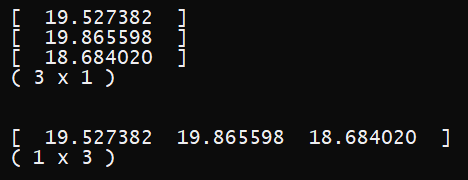
### Tensor Transpose
```Golang
// Create a random tensor.
tensor := lnn.Tensor([]int{3, 1} , 10 , 20)
// Print values.
tensor.Print()
// Transpose and print values.
tensor.Transpose().Print()
```
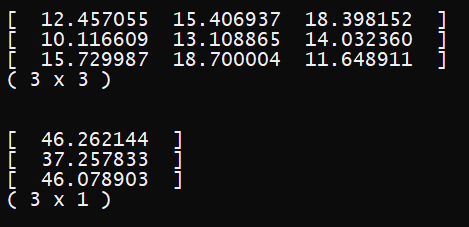
### Add All Column Values
```Golang
// Create a random tensor.
tensor := lnn.Tensor([]int{3, 3} , 10 , 20)
// Print values.
tensor.Print()
// Add columns and print values.
tensor.AddCols().Print()
```
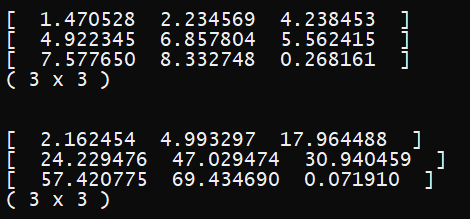
### Change Tensor Values (Map)
```Golang
// Create a random tensor.
tensor := lnn.Tensor([]int{3, 3} , 0, 10)
// Print values.
tensor.Print()
// Square and print values.
tensor.Map(func (value float64) float64 {
return value * value
}).Print()
```
## Model Usage
### Create Model
```golang
// Create a model.
model := lnn.Model()
```
### Add Layers In Model
```golang
// Add layer to model with 4 units , Input shape (2) and activation function relu.
model.AddLayer(lnn.LayerConfig{InputShape: []int{2}, Units: 4, Activation: "relu"})
// Add another layer to model with 1 unit and activation function sigmoid.
model.AddLayer(lnn.LayerConfig{Units: 1})
```
### Model Configuration
```golang
// Makes the model with given values of loss function , optimizer and learning rate.
model.Make(lnn.ModelConfig{Loss: "meanSquareError", Optimizer: "sgd", LearningRate: 0.2})
```
### Train Model
```golang
// Trains the model with given configuration.
model.Train(inputs, outputs, lnn.TrainConfig{Epochs: 1000, BatchSize: 4, Shuffle: true})
```
### Predict Output
```golang
model.Predict(inputs)
```
## Examples
### XOR Gate Model Training
```golang
// Create a model.
model := lnn.Model()
// Add layer to model with 4 units , Input shape (2) and activation function relu.
model.AddLayer(lnn.LayerConfig{InputShape: []int{2}, Units: 4, Activation: "relu"})
// Add another layer to model with 1 unit and activation function sigmoid.
model.AddLayer(lnn.LayerConfig{Units: 1})
// Makes the model with given values of loss function , optimizer and learning rate.
model.Make(lnn.ModelConfig{Loss: "meanSquareError", Optimizer: "sgd", LearningRate: 0.2})
// Inputs and outputs as a tensor object.
inputs := lnn.ToTensor([][]float64{[]float64{1, 1, 0, 0}, []float64{1, 0, 1, 0}})
outputs := lnn.ToTensor([][]float64{[]float64{0, 1, 1, 0}})
// Trains the model with given configuration.
model.Train(inputs, outputs, lnn.TrainConfig{Epochs: 5000, BatchSize: 4, Shuffle: true})
// Print values.
model.Predict(inputs).Print()
```

### Logistic Regression (OR Gate) With Tensor
```Golang
// Learning rate.
learningRate := lnn.ToTensor(0.2)
size := lnn.ToTensor(4)
// Inputs and outputs as a tensor object.
inputs := lnn.ToTensor([][]float64{[]float64{1, 1, 0, 0}, []float64{1, 0, 1, 0}})
outputs := lnn.ToTensor([][]float64{[]float64{1, 1, 1, 0}})
// Weights and bias.
weights := lnn.Tensor([]int{2, 1} , -1, 1)
bias := lnn.Tensor([]int{}, -1, 1)
// Train weights and bias (epochs 1000).
for i := 0; i < 1000; i++ {
// Use lmath package for Sigmoid(wx + b).
prediction := weights.Transpose().Dot(inputs).Add(bias).Map(lmath.Sigmoid)
dZ := prediction.Sub(outputs)
weights = weights.Sub(inputs.Dot(dZ.Transpose()).Divide(size).Mul(learningRate))
bias = bias.Sub(dZ.AddCols().Divide(size).Mul(learningRate))
}
// Show prediction.
weights.Transpose().Dot(inputs).Add(bias).Map(lmath.Sigmoid).Print()
```
