https://github.com/machinefi/trio-retina
Model-agnostic state layer for world models — turn any detector (YOLO · VLM · DINO) into one standard, queryable stream of events + latent state. numpy-only, runs on CPU at the edge.
https://github.com/machinefi/trio-retina
computer-vision edge-ai event-stream object-detection object-tracking perception python rtsp video-analytics vlm world-models yolo
Last synced: 3 days ago
JSON representation
Model-agnostic state layer for world models — turn any detector (YOLO · VLM · DINO) into one standard, queryable stream of events + latent state. numpy-only, runs on CPU at the edge.
- Host: GitHub
- URL: https://github.com/machinefi/trio-retina
- Owner: machinefi
- License: apache-2.0
- Created: 2026-06-15T20:13:33.000Z (24 days ago)
- Default Branch: main
- Last Pushed: 2026-06-17T16:44:56.000Z (22 days ago)
- Last Synced: 2026-06-17T16:49:19.788Z (22 days ago)
- Topics: computer-vision, edge-ai, event-stream, object-detection, object-tracking, perception, python, rtsp, video-analytics, vlm, world-models, yolo
- Language: Python
- Homepage: https://machinefi.github.io/trio-retina/
- Size: 17 MB
- Stars: 1
- Watchers: 0
- Forks: 0
- Open Issues: 0
-
Metadata Files:
- Readme: README.md
- Changelog: CHANGELOG.md
- Contributing: CONTRIBUTING.md
- License: LICENSE
- Code of conduct: CODE_OF_CONDUCT.md
- Citation: CITATION.cff
- Security: SECURITY.md
Awesome Lists containing this project
README
# Trio Retina
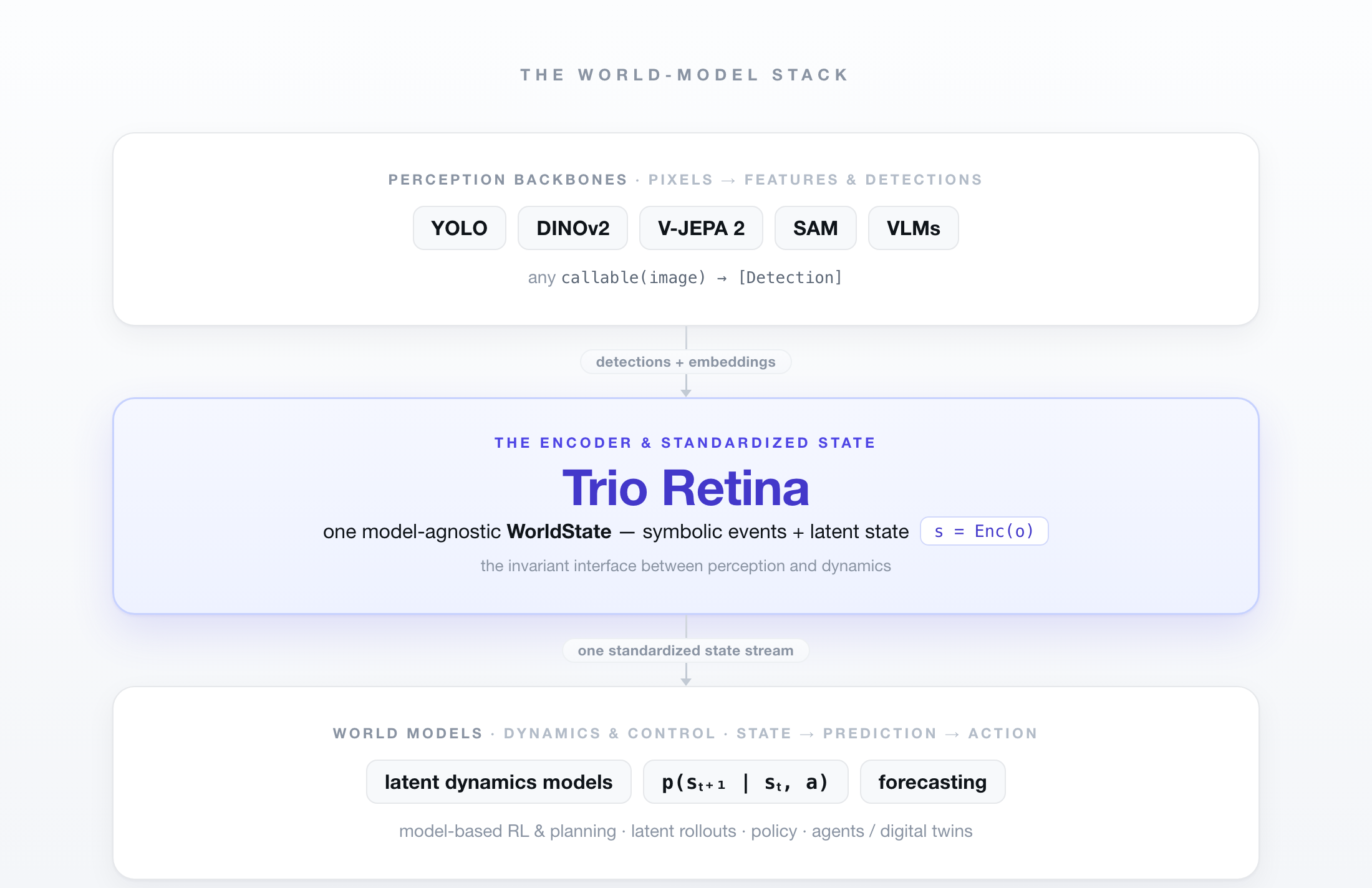
**The state layer of the world-model stack** — bring any perception model on top, get one standard, model-agnostic `WorldState`, build any dynamics underneath. Swap the model or the dynamics; **Retina is the constant in the middle.**
[](https://github.com/machinefi/trio-retina/actions/workflows/ci.yml) [](https://pypi.org/project/trio-retina/) [](https://machinefi.github.io/trio-retina/) [](LICENSE) [](https://www.python.org/)
**[docs](https://machinefi.github.io/trio-retina/)** · **[quickstart](#-quickstart)** · **[the world-model stack](#-the-world-model-stack)** · **[benchmark](BENCHMARK.md)** · **[examples](examples/)** · **[notebooks](notebooks/)**
*A lightweight, model-agnostic **computer-vision pipeline** for **object detection & tracking** that emits structured **events** — zone intrusion, line-crossing, dwell, people-counting — from **YOLO**, **VLM**, or **Grounding DINO** detectors over video, files, or **RTSP**. Runs on CPU at the **edge**; feeds **digital twins**, dynamics models, and LLMs.*
> Just want camera events (zone intrusion, line-crossing) pushed to a webhook? → jump to the [5-line quickstart](#-quickstart), or copy [`examples/rtsp_to_webhook.py`](examples/rtsp_to_webhook.py).
## 👋 hello
**Trio Retina** (Retina for short) turns raw signals — video, sensor — into a **queryable world-state**: readable **events** (`zone.enter`, `dwell`, `line.cross`) *plus* a standardized **latent** `vec` channel on the same records, on one small model-agnostic standard. The latent channel is a real, serializable interface (attach your own embedding — see [`examples/latent_vec.py`](examples/latent_vec.py)), and the automatic *producers* now ship: `DinoV2Embedder` fills per-object `entity.vec` and `VJepa2Embedder` fills the scene latent `ws.scene`. Bring any model (YOLO, V-JEPA, DINO, a VLM, or none); Retina assembles its output into state a dynamics model, rule engine, or LLM can consume — and a small example dynamics model [imagines the future off that state](#-the-world-model-stack).
Think **OpenTelemetry for perception** — it doesn't build the sensors, it normalizes any of them into one state. In world-model terms it's the **encoder** (`s = Enc(x)`), and *only* the encoder; dynamics and policy build on top. Retina isn't trying to win a vertical — driving, games, and robotics each already have their own stack — it's the **neutral state standard those structured, multi-sensor world models can share**. → see [`DESIGN.md`](DESIGN.md).
## 💻 install
```bash
pip install trio-retina # core: numpy only
pip install 'trio-retina[yolo]' # + Ultralytics YOLO adapter
pip install 'trio-retina[video]' # + OpenCV frame source (files / RTSP / webcam)
pip install 'trio-retina[all]' # everything
```
Then try the CLI — `retina demo` runs a synthetic dock scene and prints the `retina.event` stream (numpy only, no model/GPU/video):
```bash
pip install trio-retina && retina demo # instant event stream, no model
retina validate events.jsonl # check a JSONL stream against the spec
retina --version # also: retina run / retina bench
```
## 🔥 quickstart
Runs on a bare `pip install trio-retina` (numpy only) — no model, no GPU, no video file. A stand-in detector walks one "person" across a dock zone; Retina emits the real `retina.event` stream:
```python
import numpy as np
from retina import CountRule, IoUTracker, Retina, Zone, ZoneRule
from retina.detect import Detection
class ScriptedDetector:
"""A stand-in model: one 'person' walking across a dock zone."""
def __init__(self):
self._xs = list(range(0, 102, 6))
def __call__(self, frame):
x = self._xs.pop(0) if self._xs else 100
return [Detection(label="person", bbox=(x - 10, 40, x + 10, 60), confidence=0.9)]
dock = Zone("dock", [(40, 0), (60, 0), (60, 100), (40, 100)])
cam = Retina(
source_id="cam_01",
detector=ScriptedDetector(),
tracker=IoUTracker(min_hits=2),
rules=[
ZoneRule(dock, classes={"person"}, dwell_s=2.0),
CountRule(1, classes={"person"}),
],
)
frames = [(np.zeros((100, 100, 3), dtype=np.uint8), float(i)) for i in range(18)]
for event in cam.run(frames):
print(event.to_json())
# {"type":"count.threshold","t":1.0,"src":"cam_01","n":1,"frame":1,...}
# {"type":"zone.enter","t":7.0,"src":"cam_01","id":1,"label":"person",...}
# {"type":"zone.dwell","t":7.0,...,"zone":"dock","dur":2.0,...}
# {"type":"zone.exit","t":7.0,...,"zone":"dock","dur":3.0,...}
```
**▶ with a real model + video** — `pip install 'trio-retina[yolo]'` (add `[video]` for the frame source), then point it at your clip:
```python
from retina import Retina, Zone, ZoneRule, YoloDetector
from retina.sources import video_frames
dock = Zone("dock", [(0.3, 0.2), (0.7, 0.2), (0.7, 0.9), (0.3, 0.9)], normalized=True)
cam = Retina(
source_id="cam_01",
detector=YoloDetector("yolo11n.pt", classes={"person"}),
rules=[ZoneRule(dock, classes={"person"}, dwell_s=30)],
)
for event in cam.run(video_frames("your.mp4")):
print(event.to_json())
# {"type":"zone.dwell","t":1718254799.8,"src":"cam_01","id":42,
# "label":"person","zone":"dock","dur":31.0,"conf":0.91}
```
More no-model examples ship with the source (not the wheel) — `git clone` the repo and run `python examples/quickstart.py` (the forecast / video demos need `[video]` + a clip).
**▶️ Or run it in your browser — no install:**
| notebook | what it shows |
|---|---|
| [](https://colab.research.google.com/github/machinefi/trio-retina/blob/main/notebooks/01_quickstart_events.ipynb) | **quickstart** — detector → `zone` / `line` / `count` / `dwell` events + `validate()` |
| [](https://colab.research.google.com/github/machinefi/trio-retina/blob/main/notebooks/02_camera_to_webhook.ipynb) | **camera → webhook** — a restricted-zone alert pushed to your endpoint |
| [](https://colab.research.google.com/github/machinefi/trio-retina/blob/main/notebooks/03_from_supervision.ipynb) | **from Supervision** — pipe your existing `sv.Detections` straight in |
### compose models with `|`
Wire models like n8n / LangChain, no GUI. Add a cheap gate and a VLM enricher anywhere in the chain:
```python
from retina import MotionGate, GateNode, YoloDetector, IoUTracker, EnricherNode, ZoneRule, JsonlSink
pipe = (
GateNode(MotionGate()) # skip static frames (cut model calls)
| YoloDetector("yolo11n.pt", classes={"person", "forklift"})
| IoUTracker()
| EnricherNode(my_vlm_describe) # attach a VLM read to frame.user
| ZoneRule(dock, dwell_s=30)
| JsonlSink("events.jsonl")
)
```
Two more ways to wire it (explicit list · declarative JSON) + the node catalog
```python
# explicit node list
from retina import Pipeline, DetectorNode, TrackerNode, RuleNode
pipe = Pipeline([DetectorNode(yolo), TrackerNode(), RuleNode(ZoneRule(dock))])
# declarative workflow file (shareable, no code)
pipe = Pipeline.from_json("workflow.json") # see examples/workflow.json
```
| node | what it does | wraps |
|---|---|---|
| `DetectorNode` | image → detections | any `callable(image)->[Detection]` |
| `TrackerNode` | detections → tracks | `IoUTracker` / `NorfairTracker` |
| `RuleNode` | tracks → events | `ZoneRule` / `LineRule` / `CountRule` |
| `GateNode` | drop uninteresting frames | any `callable(image,t)->bool` (e.g. `MotionGate`) |
| `EnricherNode` | attach context to `frame.user` | any `callable(frame)->dict` (VLM / V-JEPA) |
| `SinkNode` | emit events | `JsonlSink` / `WebhookSink` |
Register your own for `from_json` with `register_node("my_type", builder)`.
## 🎛️ supported models
Retina imports no model — **any** detector plugs in, and out comes one standard event stream. That seam *is* the point:
| plug in any detector… | → | …out comes one `retina.event` stream |
|---|:---:|---|
| **YOLO** (Ultralytics: v5–v12, RT-DETR) | → | `{"type":"zone.enter", "id":42, "label":"person", …}` |
| **any VLM** (GPT-4o · Qwen-VL · Gemini · Claude) | → | `{"type":"line.cross", "dir":"a_to_b", …}` |
| **Grounding DINO** (open-vocab, no training) | → | `{"type":"zone.dwell", "dur":31.0, …}` |
| your existing **`sv.Detections`** (Supervision) | → | `{"type":"count.threshold", "n":12, …}` |
| any **`callable(image) -> [Detection]`** | → | …+ an optional latent `vec` on the same record |
Supervision gives you boxes on a screen; Retina turns *any* of those into a serializable state + event stream the next layer (dynamics, twin, agent) can consume. Batteries-included adapters:
- **YOLO family** — `YoloDetector(".pt")` (Ultralytics): YOLOv5/8/9/10/11/12, RT-DETR. Open-vocab via YOLO-World.
- **Open-vocab from text** — `GroundingDinoDetector(["forklift", "hard hat"])`, no training.
- **Any VLM** — `VlmDetector(client, prompt)` (Qwen-VL / Gemini / GPT-4o / Claude / local), as a detector or an event-source enricher.
- **Supervision interop** — `Detection.from_supervision(sv_detections)` ingests a Roboflow `sv.Detections`, so anything that already converts to Supervision pipes straight into Retina's event layer.
- **Latent producers (shipped)** — `DinoV2Embedder()` fills per-object `entity.vec` (frozen DINOv2, `pip install 'trio-retina[dino]'`); `VJepa2Embedder()` fills the scene latent `ws.scene` from a rolling clip (frozen V-JEPA 2 video encoder, `pip install 'trio-retina[vjepa]'`). Swap either underneath the same fixed state schema — see [`examples/world_model/multi_encoder.py`](examples/world_model/multi_encoder.py).
Trackers are pluggable too: `IoUTracker` (pure-Python default) or `NorfairTracker`.
## 📦 the event format
The `retina.event` standard is tiny, like a JWT — three required fields, everything else optional and omitted when absent. Full spec in [`SPEC.md`](SPEC.md).
```json
{"type":"zone.dwell","t":1718254799.8,"src":"cam_01","id":42,"label":"person","zone":"dock","dur":31.0}
```
```python
from retina import validate
validate(event) # -> [] if valid, else a list of problems (pure-Python, ships a JSON Schema)
```
## 🌍 the world-model stack
Retina is the **encoder** (`s = Enc(x)`) in a world model. It doesn't try to win
any one vertical — driving, games, and robotics each already have their own
stack; it's the **neutral state layer those structured, multi-sensor world models
plug into**, in four ways:
- **One contract for many sensors.** A camera embedding, a radar return, an IMU stream, a WiFi CSI latent — heterogeneous encoders all land in the *same* `WorldState`, fused on a model-tagged `vec` and a typed `locus` / `scene`. Retina doesn't build the sensors; it normalizes any of them into one state.
- **Swap the front or the back, never both.** Encoder and dynamics meet on a frozen state contract — change the perception model without retraining the dynamics, or change the dynamics without touching perception. The seam is the product.
- **A state you can read, log, and verify.** Small, serializable, half-symbolic — the state doubles as the world model's observability layer: eval it against ground truth, stream it to a digital twin, alert on a `retina.event`, even when the dynamics itself is a black box.
- **Cheap at the edge.** The encode-to-state step runs on CPU; the heavy dynamics lives wherever you like. Retina is the lightweight front door that turns raw signals into state before the expensive layer sees them.
The scope is deliberate — Retina is for world models that **reason over
structured, multi-sensor state**, not monolithic pixel-to-pixel video generators.
With the latent producers shipped, that seam is now demonstrable end to end — on a
synthetic scene, as a small but honest proof of concept ([`examples/world_model/`](examples/world_model/)):
**1 · swap the encoder, the state is constant.** The same pipeline, run three
ways — symbolic-only, `+ DinoV2Embedder` (per-object `entity.vec`), and
`+ VJepa2Embedder` (scene-level `ws.scene`) — yields the *identical* WorldState
schema; only which model filled the latent changes. → [`multi_encoder.py`](examples/world_model/multi_encoder.py)
**2 · a dynamics model imagines the future off that state.** A small transformer
trained offline on recorded `WorldState` sequences predicts where each entity is
headed, and rolls out *imagination* trajectories inside the learned model. The
honest ablation — does Retina's appearance latent actually help? — on **held-out**
data with **real DINOv2** vecs (Mac Studio, MPS), mean held-out 7-step position
error (px, lower is better):
| dynamics input | 7-step error |
|---|---|
| constant-velocity baseline | 7.68 px |
| learned, pos-only | 1.45 px |
| **learned, pos + appearance latent** | **1.33 px** |
**The latent channel measurably improves prediction: +83% over constant-velocity,
+8% over pos-only at horizon 7** — and the edge *widens with the horizon*, because
that's where local velocity runs out and object *type* (legible only from
appearance) decides the future. → [`dynamics.py`](examples/world_model/dynamics.py), full grid in [`BENCHMARK.md`](BENCHMARK.md)
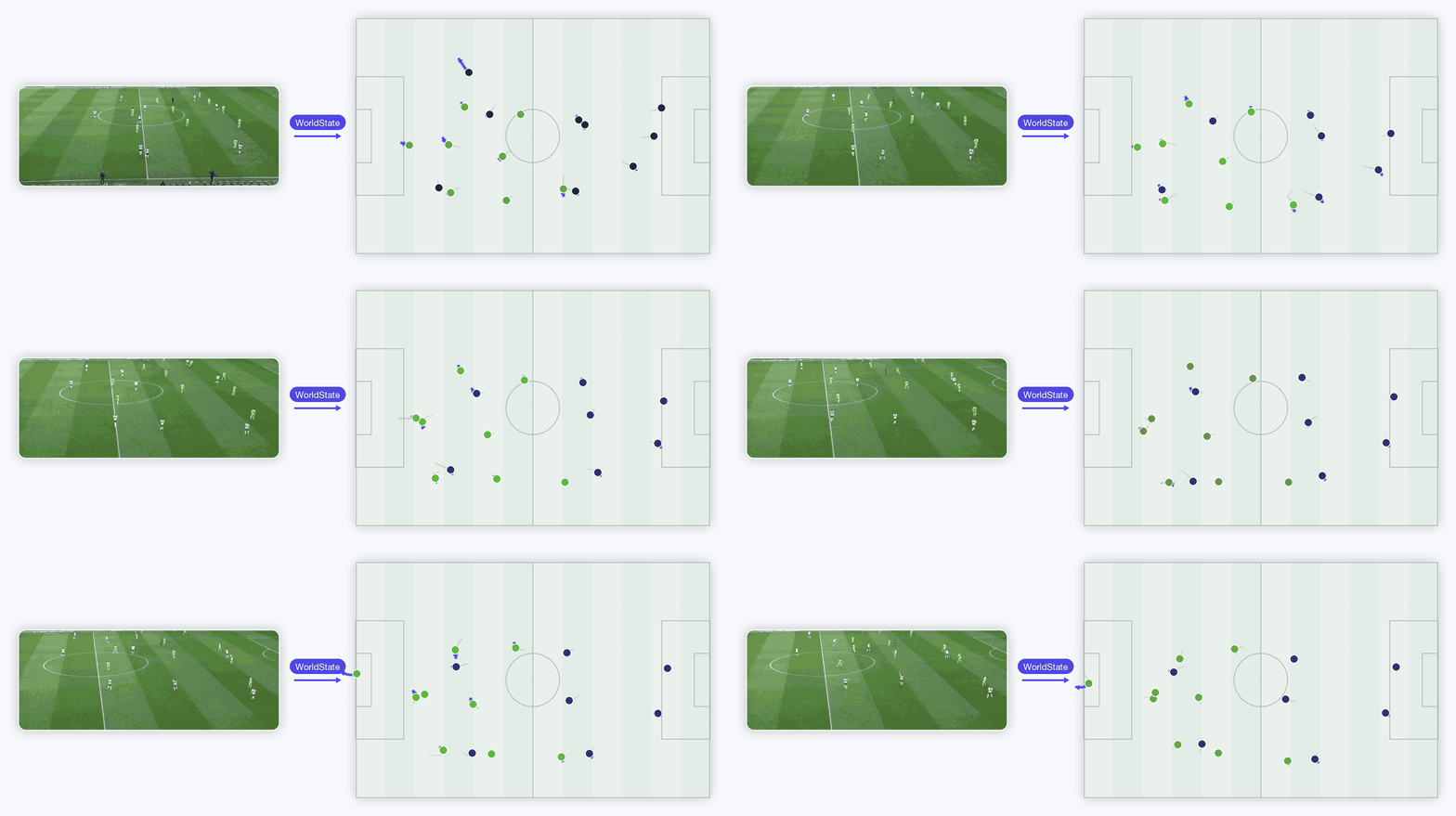
> **Raw video → one standardized Retina `WorldState` → predicted player runs.** Left is a real broadcast clip (Roboflow's MIT-licensed [`sports`](https://github.com/roboflow/sports) sample, originally DFL Bundesliga). It goes through a real YOLO detector + tracker and a frozen DINOv2-small appearance encoder, and comes out as one model-agnostic `WorldState`; the right panel renders that state as a **top-down tactical radar**, and the small dynamics transformer — trained offline on those sequences — draws each player's **predicted next run** ahead in brand indigo (faint gray = where they came from). Teams are coloured by clustering the players' DINOv2 appearance vectors into two groups — the latent knows who's who. The radar is a stylized perspective top-down (no Roboflow pitch-keypoint weights on this host, so a fixed homography from the clip's pitch landmarks, not per-frame). Honest by design: player motion is stochastic, so at this short horizon the learned model roughly *ties* a constant-velocity baseline on held-out error — the appearance latent's *measurable* win lives in the cleaner synthetic ablation above, not on free-running humans. Real pipeline, end to end — [`examples/world_model/soccer/`](examples/world_model/soccer/). The synthetic car rollout (held-out, where the latent earns its keep) lives in [`make_demo_gif.py`](examples/world_model/make_demo_gif.py) · [`media/rollout.png`](examples/world_model/media/rollout.png).
**3 · the state layer is signal-agnostic — the same schema carries a WiFi CSI world model.** The `WorldState`/`Vec` that carried DINOv2 *appearance* above also carries a **WiFi CSI channel latent**, with **zero core schema change** to express an RF world model: the global channel latent drops into `ws.scene`, and the subject's metric room position rides the typed `Entity.locus` (metres, distinct from the pixel `bbox`). On **synthetic CSI** (a documented forward model, fully offline) we reproduce the *recipe* of two CSI world-model papers — a JEPA that predicts the next latent ([arXiv:2409.10045](https://arxiv.org/abs/2409.10045)) under an action-conditioned homomorphic transition ([arXiv:2603.20048](https://arxiv.org/abs/2603.20048)) — and route it through Retina's state layer. Real numbers from one run (seed 0, CPU): action-conditioning improves next-latent prediction **+72.9%** over an action-blind ablation; the latent self-organizes into a **metric room map (~0.33 m** probe error in a 6×5 m room); and the imagination rollout **beats a constant-velocity baseline by ~22%** over a 14-step horizon, with the edge *growing* past ~7 steps. Honest scope: those papers are channel/comms-side world models trained on **real** CSI; **our** contribution is showing the *recipe runs through a signal-agnostic state layer* — this is a synthetic-CSI proof of concept, **not** a real-WiFi result. → [`examples/world_model/csi/`](examples/world_model/csi/)
**4 · front + back compose through one standard.** Any encoder in front, any
dynamics behind, meeting on one serializable state — a pip-installable world-model
seam you can run in one script. → [`end_to_end.py`](examples/world_model/end_to_end.py)
```bash
pip install 'trio-retina[dynamics,dino]'
python examples/world_model/dataset.py --n 12 --len 24 --out examples/world_model/data/sequences.json
python examples/world_model/end_to_end.py # encoder → WorldState → dynamics → imagined rollout
```
> Honest scope: a synthetic scene, a tiny model, reproducible on MPS with
> run-to-run variance. The *producers* ship; the *trained dynamics* is a small
> example, not a product. The point is the seam — that front and back compose
> through one standardized state.
## 🎬 demos
Two more ways Retina's state feeds the next layer — same standard, different consumers:
**Forecast — the dynamics layer on Retina**
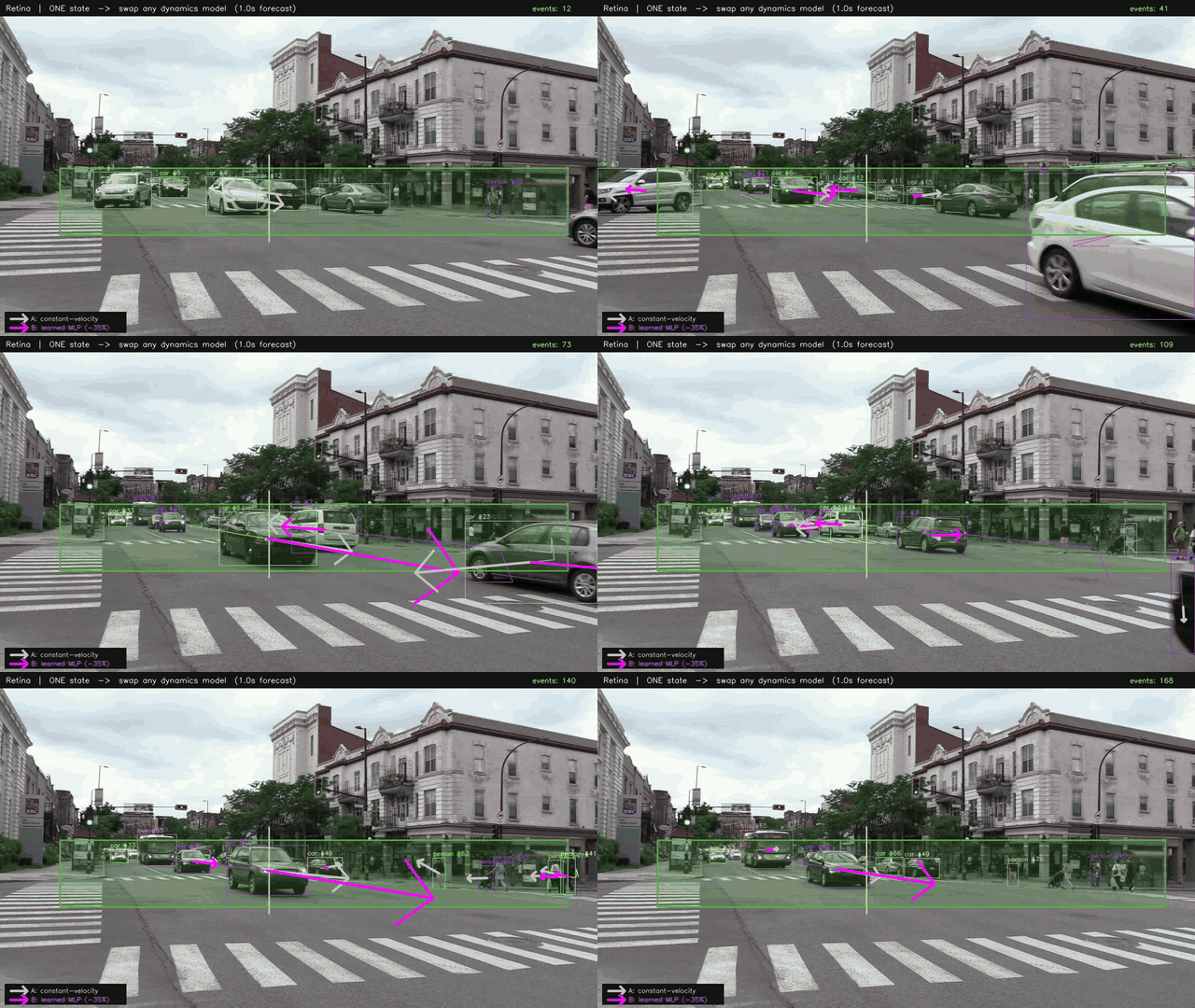
One world-state → **two dynamics models forecast** where each entity is headed off the *same* state (gray = constant-velocity, magenta = learned). A dynamics model eats structured **state**, not pixels. → [`examples/forecast/`](examples/forecast/)
**iTwin.js — a live, predictive digital twin**
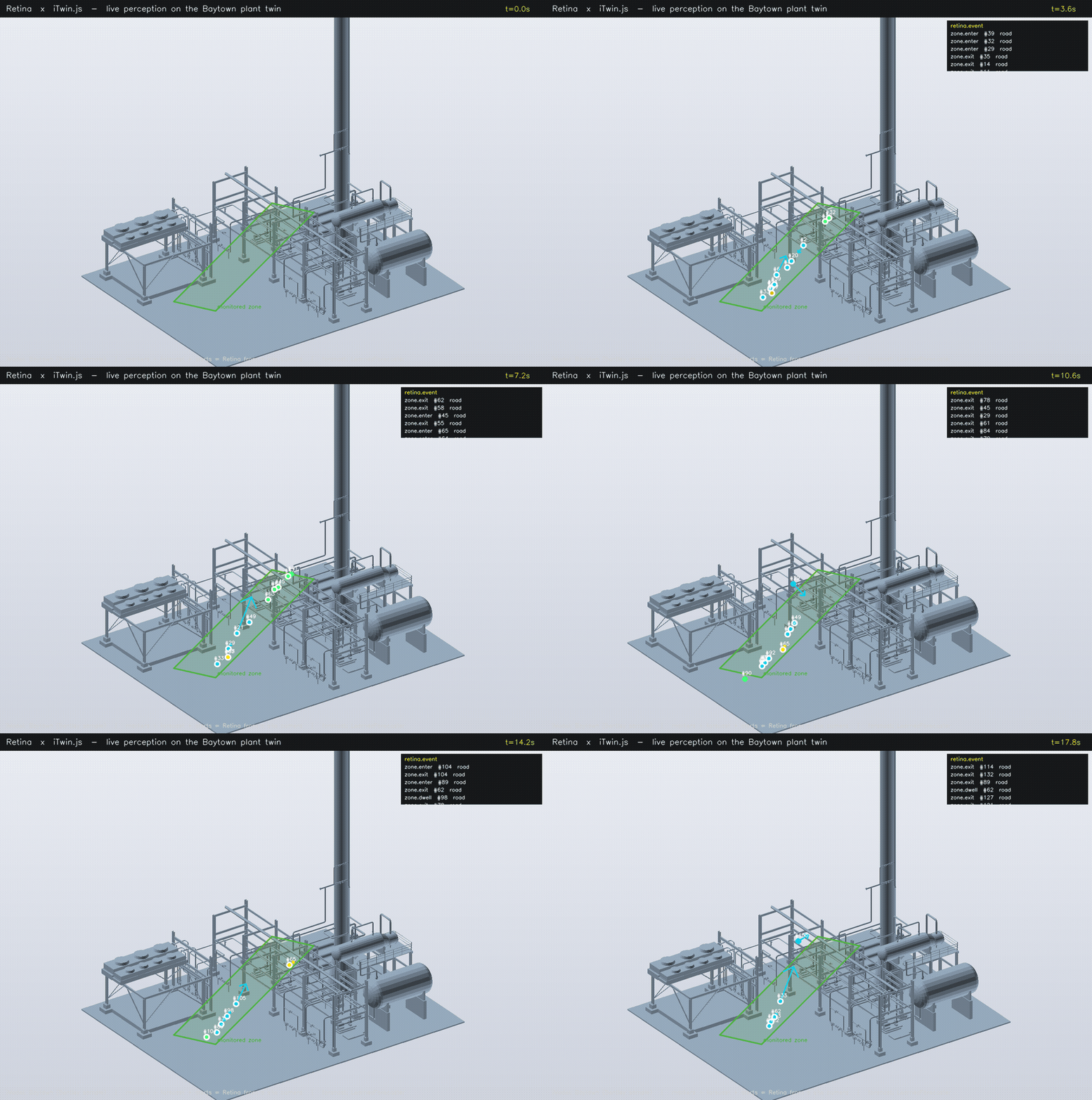
Retina's entities, forecast arrows, and `retina.event` alerts on a real Bentley **iTwin.js** iModel (Baytown), one neutral JSON contract, fully headless — it gives the twin *live eyes*. → [`examples/itwin/`](examples/itwin/)
All examples
The examples live in this repo (not in the installed wheel) — `git clone` to run them. The top-level quickstarts run with **no model and no GPU** (synthetic detections):
```bash
python examples/quickstart.py # zone / line / count / dwell events
python examples/three_apps.py # one stream -> security, retail, safety
python examples/any_model.py # swap the detector, rest unchanged
python examples/gate_savings.py # a cheap gate cuts detector calls 100 -> 23
python examples/pipeline_compose.py # compose with | (n8n without a GUI)
python examples/rtsp_to_webhook.py # camera -> restricted-zone alert -> webhook
python examples/from_supervision.py # ingest a Roboflow sv.Detections pipeline
python examples/latent_vec.py # populate the latent vec channel by hand
python examples/dino_embeddings.py # REAL DINOv2 per-object vecs (needs [dino])
```
Real-footage / dynamics demos need a clip and the extras — `pip install 'trio-retina[all]'`:
```bash
python examples/yolo_video.py v.mp4 # YOLO on a video file
examples/forecast/ # dynamics layer on the WorldState stream (needs [video] + a clip)
examples/itwin/ # events + forecasts on a Bentley iTwin.js iModel
```
The **world-model stack** lives in [`examples/world_model/`](examples/world_model/) (needs `[dynamics]`, plus `[dino]`/`[vjepa]` for real encoders):
```bash
python examples/world_model/multi_encoder.py # swap encoder, state schema stays constant
python examples/world_model/dynamics.py # train + the honest appearance ablation
python examples/world_model/benchmark.py # the front/back-end benchmark grid → BENCHMARK.md
python examples/world_model/end_to_end.py # encoder → WorldState → dynamics → imagined rollout
```
**Send events anywhere.** `WebhookSink(url)` POSTs each event as JSON (stdlib urllib, no `requests`); `JsonlSink(path)` streams to a file. For a live camera, `video_frames(src, live=True)` reads RTSP / HLS / webcam with wall-clock timestamps — see [`examples/rtsp_to_webhook.py`](examples/rtsp_to_webhook.py).
## 🎯 use cases
One state layer, many domains — the *same* `retina.event` stream, read differently above:
- **Security & intrusion detection** — `zone.enter` / `line.cross` on cameras and RTSP feeds.
- **Retail analytics & people-counting** — footfall, queue dwell, zone occupancy from any detector.
- **Workplace safety** — PPE, forklift, and restricted-zone alerts via open-vocab detectors.
- **Smart city & traffic monitoring** — vehicle/pedestrian counting and crossings at the edge.
- **Industrial digital twins** — feed live entities + forecasts into a twin ([iTwin.js demo](examples/itwin/)).
## 🧠 how it works
Everything flows through one append-only data unit, the **`Frame`**. Each stage *enriches* it and never overwrites upstream fields:
```
┌──────────────── Frame (append-only) ───────────────┐
frame ─► Detector ─► │ .detections ─► Tracker ─► .tracks ─► Rule ─► .events │ ─► Sink
▲ ▲ │ ▲ ▲ │ ▲
source any model │ Gate (skip?) tracker zone/line/count/dwell │ jsonl/
│ Enricher (VLM / V-JEPA → .user) │ webhook
└─────────────────────────────────────────────────────┘
```
- The **detector** is the model-agnostic seam: any `callable(image) -> [Detection]`.
- The **tracker** gives objects identity over time; **rules** turn tracks into **events**; **enrichers** attach context; **gates** skip work; **sinks** push out.
- Output is **dual**: a readable symbolic stream *and* an optional model-tagged latent channel — never collapsed.
Why "encoder", the dual state, and how it compares to DeepStream / Supervision
**Two senses of "encoder."** Foundation backbones (V-JEPA, DINO, SAM, YOLO) turn pixels into features — that race is theirs, and Retina rides it. Retina is the encoder *layer* on top: it **fuses** many models into one record, gives objects **persistent identity**, **structures** it into entities + relations + events, carries the **dual** symbolic + latent channels, as an **event-sourced stream** — one small, serializable, model-agnostic standard.
**Dual state.** The same entities on two linked channels: *symbolic* (readable `events` / entity records, for rules / LLMs / dashboards) and *latent* (optional model-tagged embeddings, for a downstream dynamics model). Symbols you can read; vectors a model can predict on. The latent channel is a standardized, serializable interface — populate `entity.vec` with your own embedding ([`examples/latent_vec.py`](examples/latent_vec.py)), or let a built-in producer fill it: `DinoV2Embedder` (per-object) and `VJepa2Embedder` (scene-level) both ship today.
**vs DeepStream / Holoscan** — same good ideas (event semantics, metadata model, composable graph), none of the weight:
| | DeepStream / Holoscan | **Retina** |
|---|---|---|
| Install | CUDA + TensorRT + containers | `pip install trio-retina` |
| Hardware | NVIDIA / Jetson locked | any machine — CPU is fine |
| Model | tied to the NV stack | **bring any model** (or none) |
| Shape | a platform you build *inside* | a library you `import` |
| Core deps | a lot | **numpy** |
**vs Supervision** — Supervision turns a model's output into detections + overlays (great toolbox, ends at the screen). Retina is a level up: it emits a serializable **state + event stream** that the *next* layer (dynamics, twin, agent) consumes. We compose Supervision / detectors, not compete with them.
Full rationale, references, and the world-model stack: [`DESIGN.md`](DESIGN.md).
## 🗺️ roadmap
Early but real (`v0.3.0`). Stable: the event layer + JSON Schema/validator, the composable pipeline (`|` / list / JSON), YOLO + open-vocab + VLM detectors (plus `from_supervision` interop), IoU + Norfair trackers, and jitter-robust rules (`exit_grace_s` · `anchor` · `min_frames`).
Next: ByteTrack / OC-SORT · `proximity` / `anomaly` events · VLM-as-event-source · Kafka / MQTT sinks · **more encoders** behind the latent channel · **model-based RL / latent-rollout imagination** on the learned state · growing the [front/back-end benchmark](BENCHMARK.md). See [`CHANGELOG.md`](CHANGELOG.md).
Retina is the open **perception encoder** extracted from [Trio](https://machinefi.com); the layers above (dynamics, policy / judgment) are Trio's commercial platform. Retina is, and stays, model-agnostic and free.
## 🤝 contributing
Contributions that keep Retina small and beautiful are very welcome — see [`CONTRIBUTING.md`](CONTRIBUTING.md) for dev setup and how to add a detector / tracker / rule / sink. By participating you agree to the [Code of Conduct](CODE_OF_CONDUCT.md); to report a vulnerability see [`SECURITY.md`](SECURITY.md).
## license
[Apache-2.0](LICENSE).