https://github.com/malekadjeb-ai/opsroom
Local-first operator console: fuses your AI agent sessions (Claude Code, Codex CLI, ChatGPT), git repos, and markdown notes into one dashboard that tells you what to do next.
https://github.com/malekadjeb-ai/opsroom
ai-agents chatgpt claude-code codex dashboard developer-tools local-first productivity sqlite
Last synced: about 10 hours ago
JSON representation
Local-first operator console: fuses your AI agent sessions (Claude Code, Codex CLI, ChatGPT), git repos, and markdown notes into one dashboard that tells you what to do next.
- Host: GitHub
- URL: https://github.com/malekadjeb-ai/opsroom
- Owner: malekadjeb-ai
- License: mit
- Created: 2026-07-17T07:41:40.000Z (9 days ago)
- Default Branch: main
- Last Pushed: 2026-07-23T03:02:06.000Z (4 days ago)
- Last Synced: 2026-07-25T06:00:01.159Z (1 day ago)
- Topics: ai-agents, chatgpt, claude-code, codex, dashboard, developer-tools, local-first, productivity, sqlite
- Language: Python
- Homepage: https://pypi.org/project/opsroom-console/
- Size: 4.26 MB
- Stars: 0
- Watchers: 0
- Forks: 0
- Open Issues: 1
-
Metadata Files:
- Readme: README.md
- Contributing: CONTRIBUTING.md
- License: LICENSE
Awesome Lists containing this project
README
# ⚡ opsroom




**Your AI agents write code all day. opsroom shows you whether any of it pays — then closes the loop: agents propose, you approve, the ledger moves.**

One console for **every AI coding agent you run** — Claude Code, OpenAI Codex CLI, ChatGPT, Claude web — plus your **git repos** and your **markdown notes** (Obsidian or plain folders), fused into one local dashboard that answers the only question that matters:
> *What should I do right now to make money?*
No cloud. No accounts. No dependencies. One Python package, one SQLite file on your disk, one HTML file as your console.
```
pipx install opsroom-console # or: pip install opsroom-console / uv tool install opsroom-console
opsroom demo # a fully loaded LIVE console in 10 seconds (fictional data)
opsroom serve # your console: live, writable, auto-refreshing
opsroom connect # wire your agent CLI (claude/codex/gemini) — one confirm
```
A fresh install's console opens with an on-page **SET UP YOUR ROOM** card — name the goal and your ventures right there and start operating; no config files. (`opsroom init` is the terminal equivalent, and config.toml stays yours to refine.)
**Wiring in your AI** is one terminal command — `opsroom connect` finds your agent CLI, shows you exactly what it resolved, and writes the `[agent]` block only on your explicit yes (a second yes turns on the autonomous daily briefing). Deliberately terminal-only: the browser-facing console can never grant itself the power to launch a CLI. The equivalent by hand:
```toml
[agent]
enabled = true
command = ["claude", "-p"] # any agent CLI — the brief is appended as ONE argument
advise = "daily" # autonomous briefings: "off" | "daily" | hours (2..168)
```
Something quiet? `opsroom doctor` checks the config, DB permissions, whether your agent command actually resolves (including under launchd's bare PATH), and prints the advisor's last error breadcrumb — read-only, exit 1 on any real failure.
## What you get
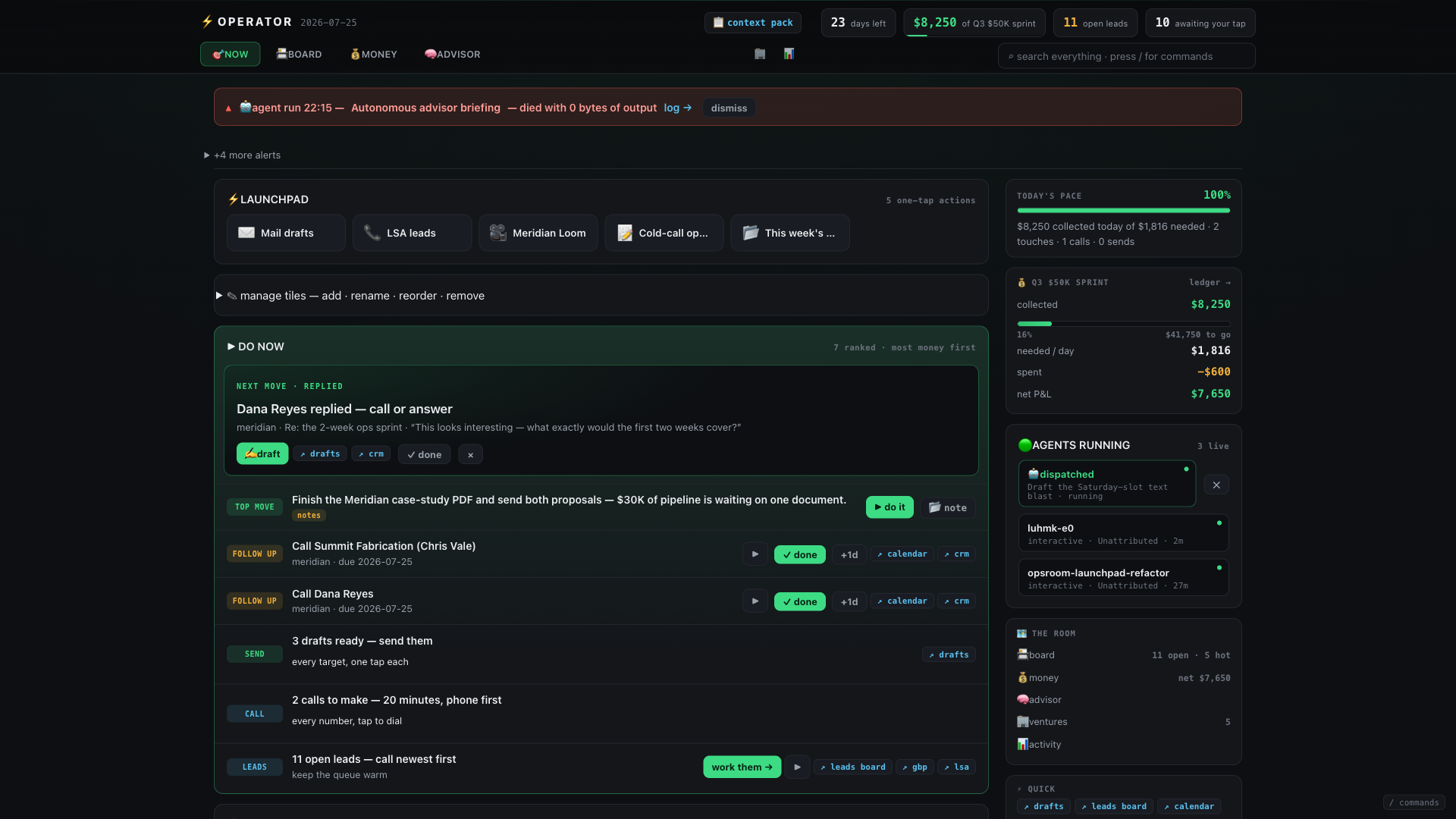
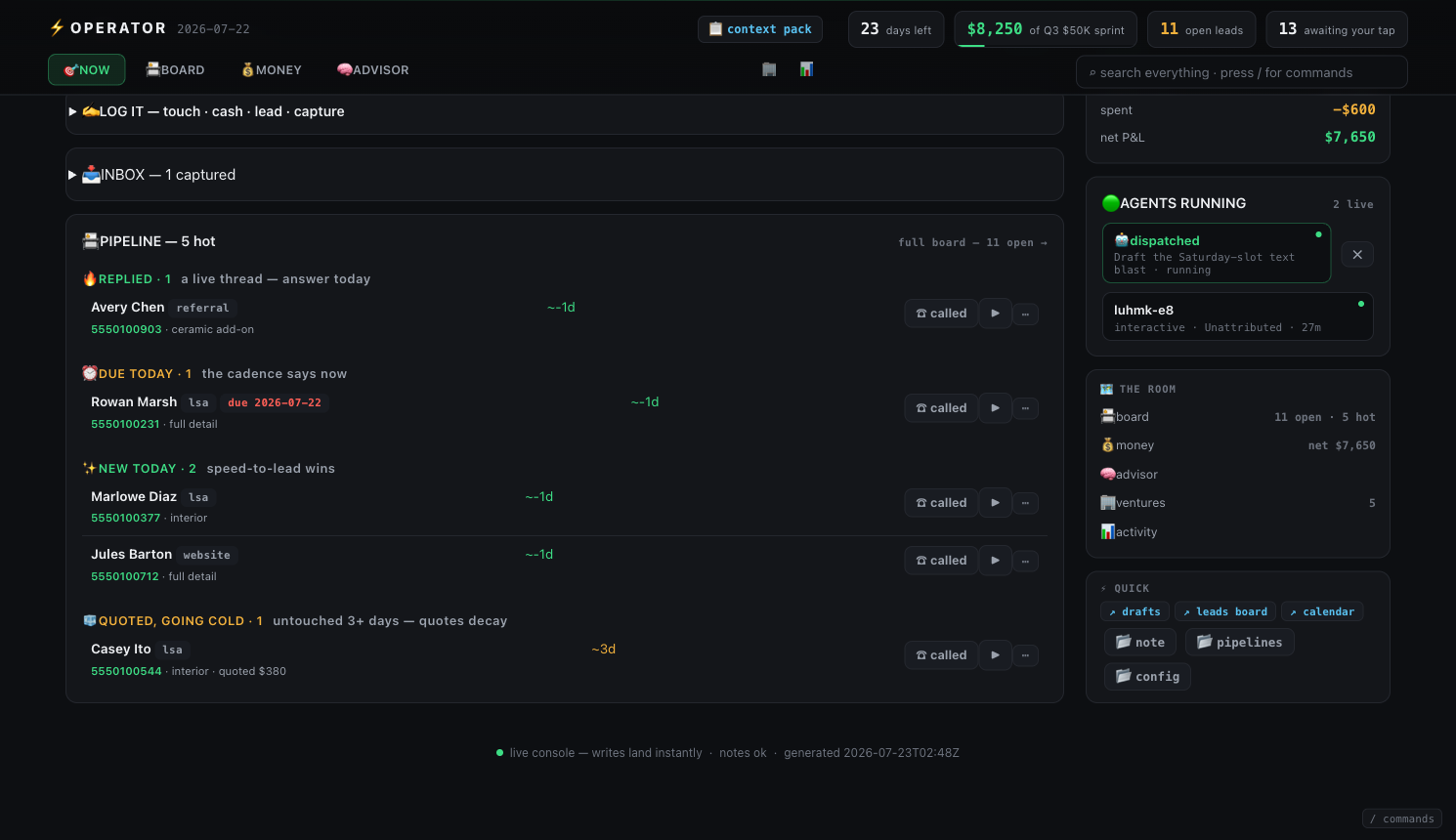
**🎯 NOW — the whole operation on one surface.** Everything worth doing — a live reply, a due follow-up, the top move, staged drafts, phone-first targets, an agent's staged promise — collapses into a single money-ranked list, and the pipeline's **hot lanes** (🔥 REPLIED · ⏰ DUE TODAY · ✨ NEW TODAY · 🧊 QUOTED-going-cold) render right below it, every row with its inline actions. The daily loop never leaves the page; the full BOARD stays one level down for deep sessions. Above it: today's pace and a live view of which AI agents are running right now.
**⌨ COMMAND PALETTE — the whole board from the keyboard.** Press `/` (or `k`) anywhere on the console: jump to any surface, open any hot lead, mark a follow-up done, apply an agent proposal, dispatch the top move. Plain stdlib JS; every action fires through the same CSRF-gated write path as the buttons.
**🏢 VENTURES — every project, with a brief.** Click any venture: an ordered **DO NEXT** list generated from live pipeline state ("UNBLOCK FIRST: …" when your notes say something's blocking), a **DONE** timeline auto-pulled from your decisions log, live numbers, and every researched target as a searchable click-to-open card — pain hypothesis, decision-makers, phones linked.
**💰 MONEY — a real P&L, not a vanity meter.** Collected vs goal, days left, needed per day — plus a **spend ledger** (money out), **net**, and per-venture in/out/net so you see where the money actually comes from. A client-side **path-to-goal simulator** with knobs built from your own ventures answers "what combination of closes gets me there" without anything leaving the page. Cash counts only when collected, not quoted.
**⌕ SEARCH — one box over everything.** Type once in the live console and hit sessions, commits, decisions, leads, touches, and your inbox in the same result list. Full-text search over the activity ledger, literal match over the operator ledgers, all local.
**✍ DRAFT — the reply, written for you, on your rails.** Paste an inbound message and get a rails-correct draft built from the one-line `offer` you set per venture in config. Deterministic and local — no LLM call, and the drafter never quotes a number from the inbound message, only your canon prices. Edit, copy, log the send in one tap (which schedules the day-3 follow-up).
**🟢 AGENTS RUNNING — see your live sessions, cowork and all.** opsroom reads which Claude Code sessions are alive right now (interactive, cowork, background), attributes each to a venture, and flags the cowork/background ones — so you can see an agent working for you on a venture as it happens, not just after the fact in the rollup.
**▶ DO IT — every action becomes a hand-off, and your agents close the loop.** opsroom reads what your AI agents did all day; now it writes back. Every queued action — the top cash move, a DO NEXT step, a due follow-up, a staged promise — gets a ▶ button that opens the full work brief: the task, your config rails, and the live operator context (which now *leads with LEDGER TRUTH* — your real goal and collected/net, so an agent can never invent the numbers). Copy it into any AI chat, or opt in (`[agent] enabled = true` in config) and one tap launches your local agent CLI (e.g. `claude -p`) on the brief, detached, logged locally. The command comes only from your config, the brief is passed as a single argument (or piped with `input = "stdin"` for CLIs that don't take argv prompts), and it's off by default.
**🧾 A RUNS LEDGER, NOT VIBES — every agent run ends in a recorded exit code.** Each launch lands in the ledger with pid, exit code, duration, output size, and a scrubbed log tail; a run that dies silently (0 bytes) or fails turns the console **red** — task, accounting, log link, one-tap dismiss — instead of vanishing into a 0-byte log.
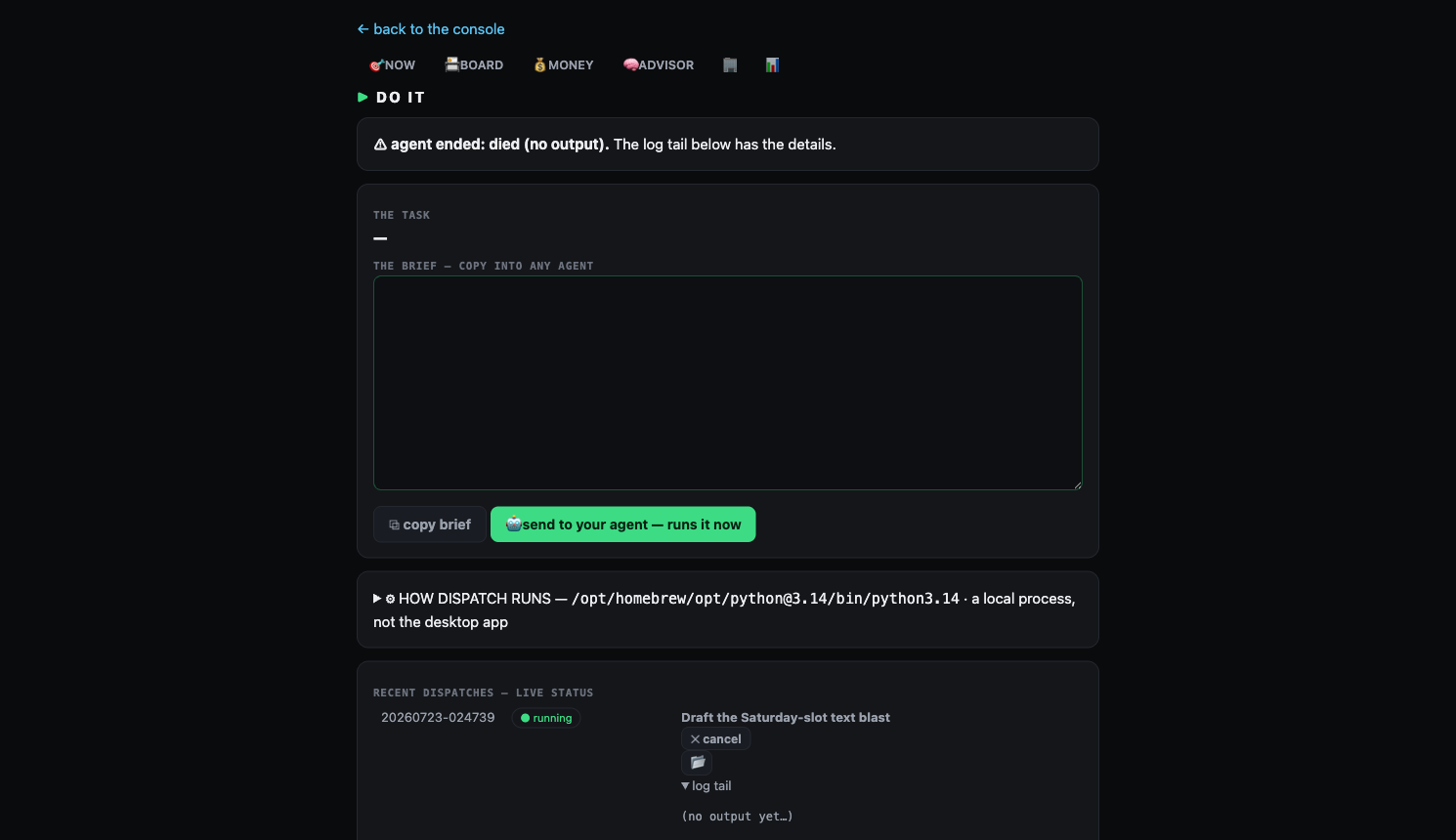 A watchdog (`[agent] timeout_minutes`) kills and records hung runs, the unattended advisor run auto-retries exactly once, a running dispatch gets a live growing log tail and a ✕ cancel, and `opsroom doctor --fire` proves the whole loop through your real configured command on demand: `[PASS] fire: exit 0 · 41.2s · 1,824 bytes`. If the always-on console is running older code than what's on disk, it says so and tells you the restart command.
**🧠 ASK YOUR BOARD ANYTHING — and it thinks while you sleep.** Type a question on the NOW tab ("what should I do about the aged quotes?") and it's dispatched to your agent CLI with your whole live board as context; the answer comes back as a rendered card with a ▶-dispatchable plan, not a log tail. Turn on the advisor (`[agent] advise = "daily"` or an hour interval — a second opt-in beyond `enabled`) and opsroom launches the agent on its own schedule to assess the board and surface plays *beyond* the derived queue: you open the console to a 🧠 TODAY'S BRIEFING it thought up while you were away. Agent prose is treated as untrusted input — escaped-first rendering, no links ever, 16KB caps, and answers are only read from runs opsroom itself registered.
**🤖 AGENT PROPOSES — the operator loop.** The return leg of dispatch: when an agent finishes a run, opsroom parses its output for fenced ` ```opsroom ` JSON blocks — "record $380 collected", "schedule the day-2 follow-up", "here's a new lead", "run this next" — and stages them as **pending proposals** on the console. Nothing applies automatically, ever: each proposal is one tap to apply (through the same write path as your own buttons) or dismiss, with a provenance link to the raw log. The verbs are a strict whitelist of things you could already do by hand; everything is scrubbed, size-capped, and double-tap-safe. Your agents work, propose, and wait for your tap — the ledger only moves when you say so.
**⏳ WORK QUEUE — dispatches chain.** Fire a second dispatch while an agent is running and it queues, auto-firing FIFO when the runner finishes. An agent can even propose its own next run; your tap chains it. Queued work shows as chips in AGENTS RUNNING with one-tap dismiss.
**📇 BOARD — every lead in a real stage, not a blob.** The BOARD is a stage-segmented view over every lead you've ever captured: **new → contacted → talking → quoted → won/lost**, with live counts, source pills (LSA/website/referral), age rendered as temperature, and a due-date that floats overdue work to the top. Every action is inline — call, quote, collect, move stage, draft — and lands you back on the board. Imports keep their provenance (source, first-seen date, reply flag) as structured fields, so a lead that replied arrives already in *talking* with the call due today. Agents can propose stage moves too (`lead_stage` — whitelisted, one-tap gated like everything else), and each lead's ▶ dispatches an agent with that lead's id, contact, quote and touch history baked into the brief.
**🔥 REPLIED + LEADS — the hot list, fed by anything.** Drop a small JSON file (from an AI agent session reading your mail, a CRM export, a webhook you pipe to disk) and opsroom merges it: new leads dedup by phone into the register, and a reply from someone you pitched hits the top of NOW as a call-these-first block with a one-tap drafted answer. Replies schedule the call for **today**, not the day-3 cadence — a live reply is the hottest thing on the board. The drop file is the boundary: opsroom itself never touches the network.
**📊 ACTIVITY — where your time actually went, by agent.** A **BY AGENT** table (Claude vs Codex vs ChatGPT: sessions, active hours, top venture), sessions per venture, commits, and the two features that hurt (in a good way):
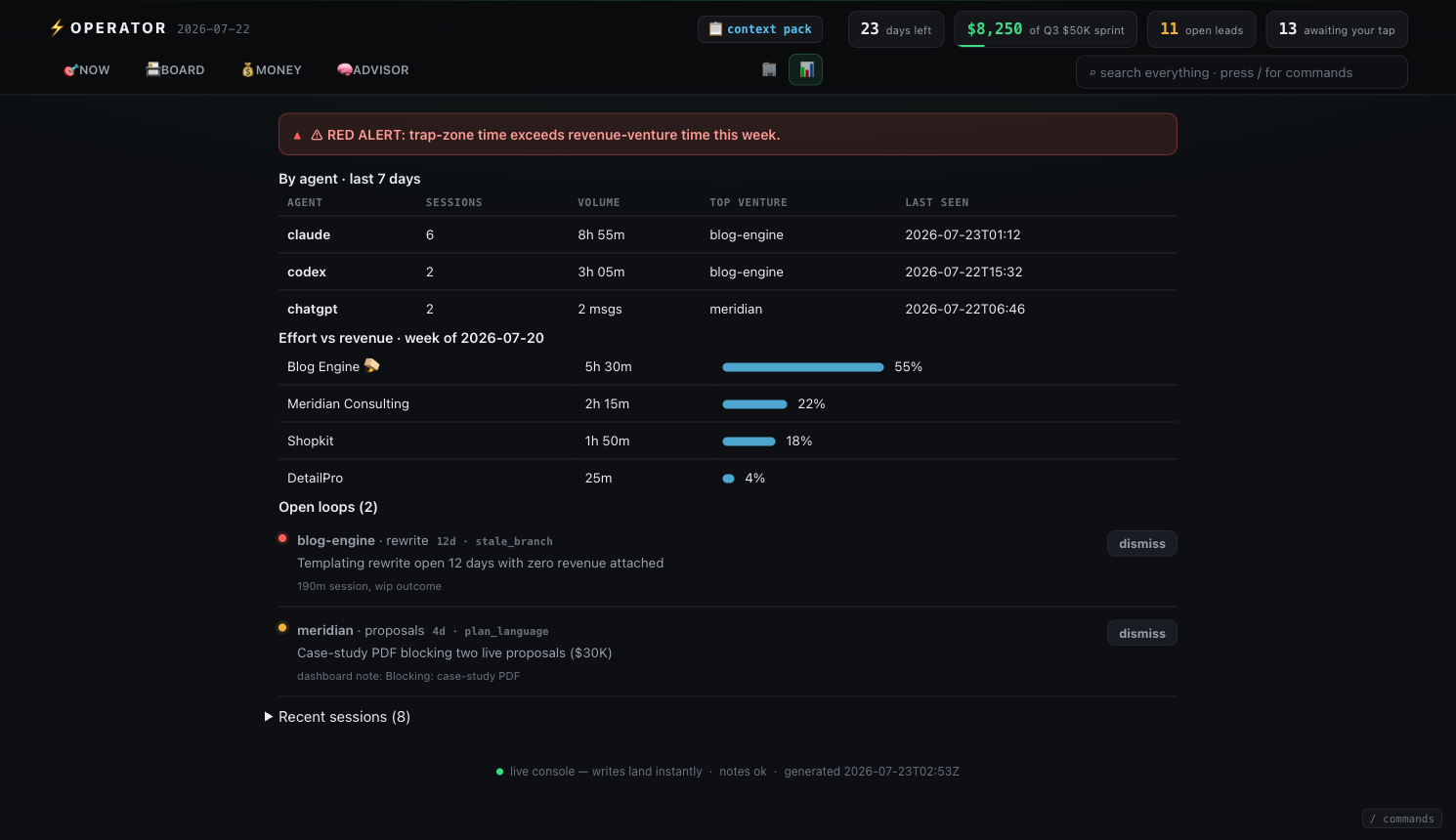
- **Trap-zone drift**: time spent in $0-revenue builds vs revenue ventures, with a red alert when building beats selling this week. The engineer's trap, made visible.
- **Open loops**: things you started and silently dropped — plan language in AI transcripts with no follow-up commit, stale branches, uncommitted work, in-progress notes going stale.
## The sitrep
```
$ opsroom sitrep
SITREP · 2026-07-16
- DATE / DAYS TO GOAL: 2026-07-16 / 19d
- CASH COLLECTED vs Q3 $50K sprint: $8,250 collected
- OPEN LEADS: ~14 aged ~8d
- LIVE PIPELINE: Meridian: 2 proposals out ($12K + $18K) · 2 drafted, 1 sent, 2 call sheet
- TOP LEAK RIGHT NOW: ~14 open leads aged ~8d — paid-for money rotting uncalled
- SINGLE HIGHEST CASH ACTION TODAY: Finish the case-study PDF and send both proposals
```
Six lines, every morning, from live data. `--write` appends it to a daily note.
## How it works
Read-only collectors, one local SQLite ledger, deterministic rendering:
| Source | What it reads |
|---|---|
| `cli` | Claude Code session logs (`~/.claude/projects`) — prompts, duration, outcomes |
| `codex` | OpenAI Codex CLI session logs (`~/.codex/sessions`) — same treatment, same attribution |
| `git` | every repo under your scan roots — commits, branches, uncommitted work |
| `fs` | mtime scan for non-git work |
| `notes` | your markdown roots — frontmatter, staleness, your dashboard note's `## Live state` table |
| `chat` | manual drop of a chat export — **both** Claude (Anthropic) and ChatGPT (OpenAI) exports, sniffed by shape |
Attribution is by path: work done in `~/code/acme` counts toward venture `acme`. Sessions are gap-capped active minutes, not wall clock.
### Your notes are the API
opsroom doesn't make you adopt a system — it reads simple markdown conventions you can start using in five minutes:
- A dashboard note with a `## Live state` table (`| Metric | Value | As of |`) — rows are matched by key words (`days to goal`, `cash`, anything with `lead`), never by position, so reformatting won't break it. Ages keep ticking: "aged ~6 days" as-of last week reads correctly today.
- A `## Today's one move` section → the console's hero action.
- Pipeline trackers with `## Totals` lines and `## TOUCH LOG` tables (`Target | Channel | Status | Next`) → your send/call queues. Any wide table in the same file → your searchable target list.
- A `Decisions Log.md` with `- **YYYY-MM-DD** — …` bullets → per-venture DONE timelines.
## Security posture
This tool reads your terminal history and notes, so it's built paranoid:
- **Fail-closed secret redaction** — every event passes a redactor *before* touching the DB (API keys, AWS/GitHub/Slack/Stripe/Google tokens, JWTs, DB URIs, private keys, high-entropy `KEY=value`). If redaction errors, the event is dropped, never written.
- **No network egress. Ever.** Nothing phones home; the console HTML loads zero external resources. The only URLs are ones *you* configured as buttons.
- **Local only** — SQLite at `~/.local/share/opsroom` with `600` perms, refuses to live under a cloud-sync root (iCloud/Dropbox/OneDrive).
- **Read-only on all sources** — your notes are never written; the only writes are the ledger and an optional append-only daily note.
- **Agent output is untrusted input** — proposals never auto-apply. They're parsed fail-closed (strict verb whitelist onto existing write actions, size caps, redaction, idempotent staging) and every one waits for your CSRF-gated tap. A hostile or prompt-injected agent log can at worst put a visible pending row on your board, with a link to the log that produced it.
- `opsroom purge --source=X` / `--before=DATE` to shrink the blast radius any time.
## Philosophy
Built during a 23-day cash sprint by an operator running eight ventures, out of one frustration: every productivity tool tracks *activity*; none of them track *whether the activity pays*. The rules encoded here are blunt:
1. Cash counts when **collected** — not quoted, not booked, not "basically closed".
2. Building instead of selling is a **trap** — visible on the board, hours counted.
3. Everything you start and drop is a **loop** — it stays on the board until closed or dismissed.
4. The console must answer *"what do I do next"* with names, numbers, and buttons — or it's just letters on a screen.
## FAQ
**Do I need Claude Code / Codex / Obsidian?** No. Every source is optional and degrades gracefully. Git repos alone give you drift + loops + sessions; add notes when you want the money features.
**Which AI agents are supported?** Claude Code, OpenAI Codex CLI, Gemini CLI, Cursor, Aider, and OpenCode are read live from their local logs. ChatGPT and Claude web/desktop ingest via each vendor's data-export file dropped in a folder. Collectors are ~100-line files with one `collect(con)` entry point, PRs welcome for anything else.
**macOS says the notes are unreadable.** Grant your terminal Full Disk Access. If access drops mid-session, opsroom serves the last cached snapshot and says so.
**Windows?** WSL works. Native Windows path/permission handling has been hardened (sync-root detection, project-path derivation, and 600/700 perm enforcement all previously assumed `/`-separated POSIX paths and hard-failed on chmod), but it still hasn't been run end-to-end on a real Windows box — CI only covers ubuntu + macos. If you can, run the test gates and `opsroom demo` on native Windows and open an issue with what breaks.
## Development
```
git clone https://github.com/malekadjeb-ai/opsroom && cd opsroom
for t in tests/test_*.py; do python3 "$t" || break; done # every gate must exit 0
python3 -m opsroom.cli demo
```
Stdlib only — there is nothing to `pip install` for development. MIT license.
Want to add a collector for your agent (Gemini CLI, Cursor, Aider, ...)? It's a ~100-line file — see [CONTRIBUTING.md](https://github.com/malekadjeb-ai/opsroom/blob/main/CONTRIBUTING.md) for the recipe and the open [good first issues](https://github.com/malekadjeb-ai/opsroom/issues?q=is%3Aissue+is%3Aopen+label%3A%22good+first+issue%22).