https://github.com/marckrenn/places-env
Secure version control of environment files
https://github.com/marckrenn/places-env
environment-variables environments
Last synced: 5 months ago
JSON representation
Secure version control of environment files
- Host: GitHub
- URL: https://github.com/marckrenn/places-env
- Owner: marckrenn
- License: mit
- Created: 2024-12-08T21:58:19.000Z (over 1 year ago)
- Default Branch: develop
- Last Pushed: 2025-06-16T18:47:40.000Z (about 1 year ago)
- Last Synced: 2025-09-25T09:00:03.130Z (9 months ago)
- Topics: environment-variables, environments
- Language: Python
- Homepage: https://pypi.org/project/places-env/
- Size: 7.78 MB
- Stars: 8
- Watchers: 3
- Forks: 0
- Open Issues: 4
-
Metadata Files:
- Readme: README.md
- License: LICENSE
Awesome Lists containing this project
README
)
)
[](https://pypi.org/project/places-env/)

# places-env: secure version control of environment files
> **Note:**
> _places-env_ is currently a proof of concept (PoC) and is **not ready for use in public projects or production environments**. Use it cautiously and only with private repositories.
> If you appreciate the ideas behind _places-env_, consider contributing by submitting pull requests!
## Motivation / The heck is _places-env_?
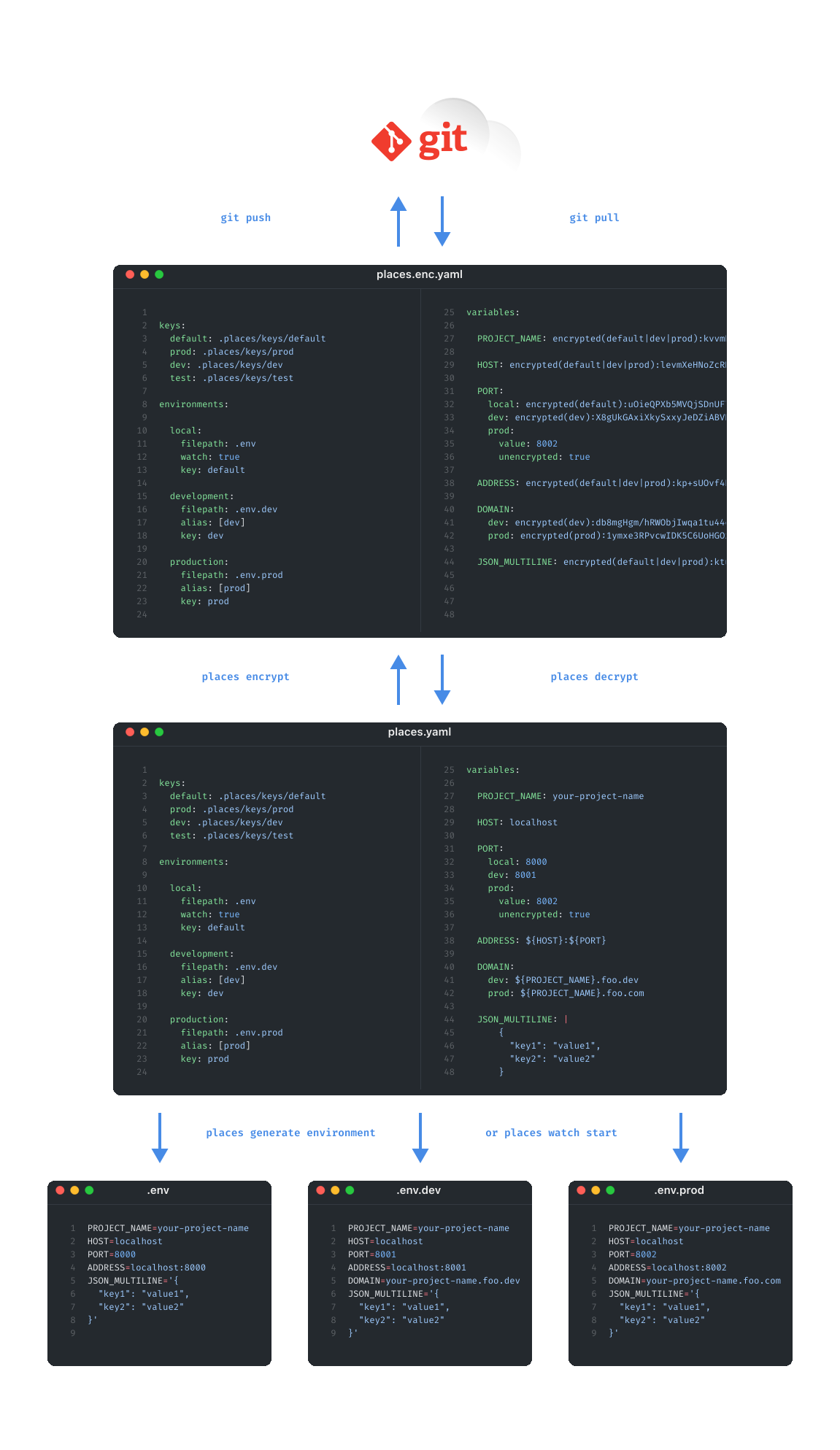
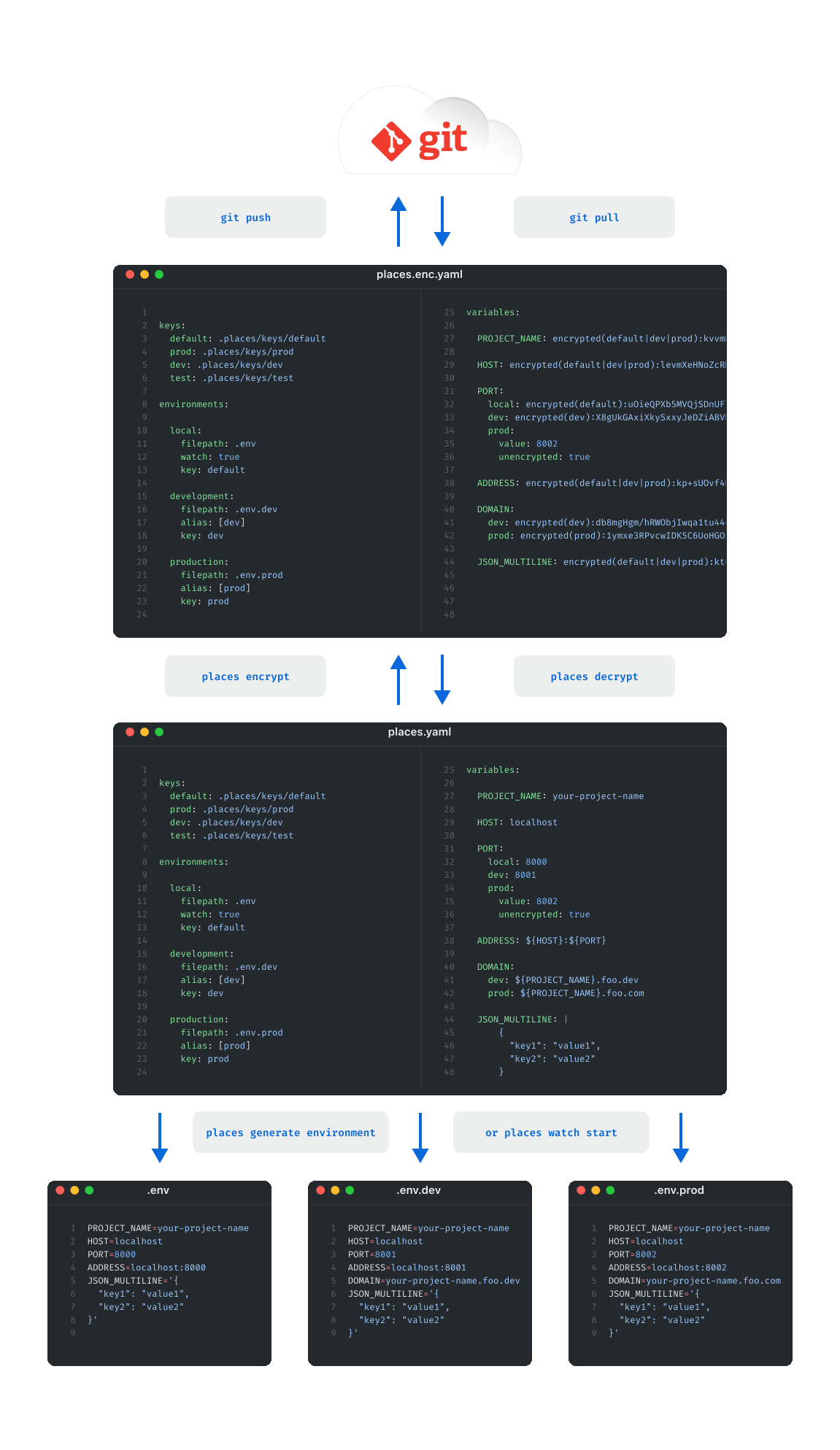
- _places-env_ is a self-contained, completely free open-source (FOSS) alternative to [HashiCorp Vault](https://www.hashicorp.com/products/vault), [Infisical](https://infisical.com/), [dotenv-vault](https://github.com/dotenv-org/dotenv-vault) and [sops](https://github.com/getsops/sops).
- Leverages a single source of truth (SSOT) [`places.yaml`](#placesyaml) for deriving multiple environment files.
- Similar to [sops](https://github.com/getsops/sops), _places-env_ encrypts only the values in [`places.yaml`](#placesyaml), resulting in [`places.enc.yaml`](#placesencyaml), which can be securely checked into git:
- Congrats, your SSOT is now version-controlled 🎉
- Always synchronized with collaborators
- Fully in-sync with the rest of your code, branches and tags (try doing that with [Infisical](https://infisical.com/) & co. 😉)
- Changes remain 'human-trackable' — even when values are encrypted
- Contrary to [sops](https://github.com/getsops/sops), encryption keys can be assigned either per environment or on a per-value basis
- Provides a [straightforward setup](#getting-started) with no dependency on external services or libraries.
- [`places watch start`](#watch-start) (persistently) tracks changes in [`places.yaml`](#placesyaml)/[`places.enc.yaml`](#placesencyaml) and automatically handles [encryption](#encrypt), [decryption](#decrypt), [keeps `.gitignore` up-to-date](#sync-gitignore), and [auto-updates](#generate-environment) environment files. So it's essentially _set and forget_.
Fallback Image (for Github Mobile users)

## Getting started
1. **Install _places-env_:**
- via [pypi](https://pypi.org/project/places-env/):
`pip install places-env`
2. **Init project:** In terminal
- `cd` into your project
- Run one of the following commands:
- [`places init`](#init): Creates an empty [`places.yaml`](#placesyaml), generates a default crypto key at `.places/keys/default`
- [`places init --template min`](#init): Initializes with a minimal template ([view content](src/places/templates/min.yaml)).
- [`places init --tutorial`](#init): Initializes with a tutorial template ([view content](src/places/templates/tutorial.yaml)).
3. **Modify [`places.yaml`](#placesyaml)**:
- Use your preferred text editor
- Or modify it using the [_places-env_ CLI](#places-cli-documentation)
4. **Track changes:**
- Use [`places watch start (optionally: --daemon, --service)`](#watch-start) (recommended)
- Alternatively, use [`places encrypt`](#encrypt) and [`places sync gitignore`](#sync-gitignore). This will automatically add all necessary entries to `.gitignore`.
5. **Generate environment files:**
- If [`places watch start`](#watch-start) is already running, environments with property `watch: true` will be (re)generated whenever [`places.yaml`](#placesyaml) is updated.
- Or use [`places generate environment --all`](#generate-environment) to manually regenerate all environment files.
6. **Commit [`places.enc.yaml`](#placesencyaml)**
7. **Decrypt after switching to another branch**:
- If [`places watch start`](#watch-start) is already running, [`places.enc.yaml`](#placesencyaml) will automatically be decrypted into [`places.yaml`](#placesyaml) after switching branches.
- Otherwise, run [`places decrypt`](#decrypt) to manually derive [`places.yaml`](#placesyaml) from [`places.enc.yaml`](#placesencyaml).
8. **Key exchange:**
- If you're working with collaborators, **securely** share your crypto keys located in `.places/keys` with them.
- Recommended methods include shared password managers like [Bitwarden](https://bitwarden.com/), secure one-time sharing services, or dedicated tools such as [Amazon KMS](https://aws.amazon.com/kms/).
- Collaborators without the necessary decryption keys can still add and edit new secrets but are restricted from reading existing ones.
## Example / Demo
A "live" example / demo project can be found [here](https://github.com/marckrenn/places-env-example).
## CI/CD
_places-env_ has a companion GitHub Action you can find on the GitHub Marketplace [here](https://github.com/marketplace/actions/places-env). It installs _places-env_, injects crypto keys and generates environment files so that they can be used downstream in your CI/CD workflow.
## Documentation
### `places.yaml`
#### Examples
1. [Minimal example](src/places/templates/min.yaml):
```yaml
key: .places/keys/default
environments:
local:
filepath: .env
watch: true
variables:
PROJECT_NAME: your-project-name
```
[`places generate environment local`](#generate-environment) or [`places watch start`](#watch-start) will generate this `.env` for environment `local`:
```
PROJECT_NAME=your-project-name
```
2. Closer-to-live example based on the [tutorial template](src/places/templates/tutorial.yaml):
```yaml
keys:
default: .places/keys/default
prod: .places/keys/prod
dev: .places/keys/dev
test: .places/keys/test
environments:
local:
filepath: .env
watch: true
key: default
development:
filepath: .env.dev
alias: [dev]
key: dev
production:
filepath: .env.prod
alias: [prod]
key: prod
variables:
PROJECT_NAME: your-project-name
HOST: localhost
PORT:
local: 8000
dev: 8001
prod:
value: 8002
unencrypted: true
ADDRESS: ${HOST}:${PORT}
DOMAIN:
dev: ${PROJECT_NAME}.foo.dev
prod: ${PROJECT_NAME}.foo.com
JSON_MULTILINE: |
{
"key1": "value1",
"key2": "value2"
}
```
[`places generate environment --all`](#generate-environment) or [`places watch start`](#watch-start) will generate
* this `.env` for environment `local`:
```
PROJECT_NAME=your-project-name
HOST=localhost
PORT=8000
ADDRESS=localhost:8000
JSON_MULTILINE='{
"key1": "value1",
"key2": "value2"
}'
```
* this `.env.dev` for environment `development`:
```
PROJECT_NAME=your-project-name
HOST=localhost
PORT=8001
ADDRESS=localhost:8001
DOMAIN=your-project-name.foo.dev
JSON_MULTILINE='{
"key1": "value1",
"key2": "value2"
}'
```
* and this `.env.prod` for environment `production`:
```
PROJECT_NAME=your-project-name
HOST=localhost
PORT=8002
ADDRESS=localhost:8002
DOMAIN=your-project-name.foo.com
JSON_MULTILINE='{
"key1": "value1",
"key2": "value2"
}'
```
CLI commands:
- Encrypt the values in [`places.yaml`](#placesyaml) and saves the encrypted data to [`.places/places.enc.yaml`](#placesencyaml):
[`places encrypt`](#encrypt)
#### Sections
All sections are case-sensitive!
**Required sections:**
- [`key` / `keys`](#key--keys)
- [`environments`](#environments)
- [`variables`](#variables)
**Optional section:**
- [`settings`](#settings)
##### `key` / `keys`
Encryption/decryption key or keys that can be referenced in [`environments`](#environments).
The `default` key is required as it serves as a fallback when no other key is specified.
**Examples:**
```yaml
key: .places/keys/default # shorthand for keys: default: .places/keys/default
```
```yaml
keys:
default: .places/keys/default
dev: .places/keys/dev
prod: .places/keys/prod
topsecret: .places/keys/topsecret
```
CLI commands:
- Generate key, add it to `.places/keys/` and optionally add key to [`places.yaml`](#placesyaml):
[`places generate key`](#generate-key)
- Add a key from string to `.places/keys/` and optionally add the key to [`places.yaml`](#placesyaml):
[`places add key_from_string`](#add-key_from_string)
- Add existing key to [`places.yaml`](#placesyaml):
[`places add key`](#add-key)
##### `environments`
`environments` define what environment file(s) should be generated.
**Example:**
```yaml
environments:
local:
filepath: .env
watch: true
development:
filepath: .env.dev
watch: true
alias: [dev, stage]
key: dev
production:
filepath: .env.prod
watch: true
alias: [prod]
key: prod
```
**Options**:
| Option | Type | Default | Required | Description |
|--------|------|---------|:--------:|-------------|
| `filepath` | `String` | `None` | ✅ | filepath of environment file to generate relative to root |
| `key` | `Bool` | `default` | ❌ | Key to encrypt / decrypt variables of this environment. Refers to keys defined in [keys](#key--keys) |
| `alias` | `[String]` | `None` | ❌ |Alias(es) that can be used for this environment|
| `watch` | `Bool` | `false` | ❌ | If `true` and [`places watch start`](#watch-start) is running, this environment will be auto-(re)generated on filechange of [`places.yaml`](#placesyaml) |
CLI commands:
- Add or modify environment in [`places.yaml`](#placesyaml):
[`places add environment`](#add-environment)
##### `variables`
Key-value pairs to save to environment file(s). Keys should contain only uppercase alphanumerics and underscores; otherwise, a warning is printed.
**Example:**
```yaml
variables:
PROJECT_NAME: your-project-name
HOST: localhost
PORT:
local: 8000
dev: 8001
prod:
value: 8002
unencrypted: true
ADDRESS: ${HOST}:${PORT}
DOMAIN:
dev: ${PROJECT_NAME}.foo.dev
prod: ${PROJECT_NAME}.foo.com
JSON: |
{
'key1': 'value1',
'key2': 'value2'
}
```
**Syntax**:
- Shorthand: Set a key-value for all [environments](#environments). **Note: This will encrypt the value separately with the keys of all environments. Any of these keys will be able to decrypt it!**
```yaml
VARIABLE_NAME: value
```
- Set specific value per [environment](#environments)
```yaml
PORT:
local: 8000
dev: 8001
prod: 8002
```
- Set specific encryption key per value [environment](#environments)
```yaml
SECRET:
local:
value: This won't be encrypted # in places.enc.yaml
unencrypted: true
prod:
value: Dirty secret # will be encrypted with 'topsecret' key
key: topsecret # must be defined in keys section
```
- Multiline strings (must start with `|`):
```yaml
JSON: |
{
'key1': 'value1',
'key2': 'value2'
}
```
- Single-line dicts must be explicitly wrapped into quotes:
```yaml
JSON: "{'key1': 'value1', 'key2': 'value2'}"
```
- Value interpolation:
```yaml
HOST: localhost
PORT:
local: 8000
dev: 8001
prod: 8002
ADDRESS: ${HOST}:${PORT} # .env = localhost:8000, .env.dev = localhost:8001, etc.
```
- Lists/arrays with square brackets (**Note:** yaml-multiline arrays are currently NOT supported, see [Known Issues](#known-issues--limitations)!)
```yaml
ARRAY: [1,2,3,4]
```
- Combination of all syntaxes above.
**Options**:
| Option | Type | Default | Required | Description |
|--------|------|---------|:--------:|-------------|
| `value` | `Any` | `None` | ✅ | value of Key |
| `key` | `String` | `key set in` [environments](#environments) `> default key` | ❌ | encryption / decryption key used for this particular value |
| `unencrypted` | `Bool` | `False` | ❌ | If `true` explicitly not encrypt value |
CLI commands:
- Add variable to [`places.yaml`](#placesyaml):
[`places add variable`](#add-variable)
##### `settings`
Allows for configuration of project parameters, primarily related to cryptography.
**Examples:**
```yaml
settings:
sync-gitingore: false
cryptography:
hash-function: sha265
iterations: 120000
dklen: 32
salt:
mode: from-file
filepath: version.txt
```
**Options:**
| Option | Type | Default | Required | Description |
|--------|------|---------|:--------:|-------------|
| `sync-gitignore` | `Bool` | `True` | ❌ | If `true` makes sure that all `.envs`, [`places.yaml`](#placesyaml) and `.places` are in `.gitignore` |
| `cryptography`:`hash-function` | `String` | `sha512` | ❌ | Hash function to encrypt / decrypt (`sha256` or `sha512`) |
| `cryptography`:`iterations` | `Int` | `600000` (`sha265`), `210000` (`sha512`) | ❌ | Hash function to encrypt / decrypt (`sha256` or `sha512`) |
| `cryptography`:`dklen` | `Int` | `32` | ❌ | Derived key length |
| `cryptography`:`salt`:`mode` | `String` | `deterministic` | ❌ | Available modes: `deterministic`[^1], `custom`[^2], `from-file`[^3], `git-project`[^4], `git-branch`[^5], `git-project-branch`[^6] |
[^1]: By default, _places-env_ intentionally uses a deterministic salt. While this allows for some statistical attacks, it enables tracking of value changes.
[^2]: Set a custom salt using `cryptography`:`salt`:`value`.
[^3]: Use the content of `cryptography`:`salt`:`filepath` as the salt (e.g., salting with `version.txt`).
[^4]: Use the Git project name as the salt.
[^5]: Use the Git branch as the salt (encrypted values will differ for each branch).
[^6]: Combine the Git project name and branch as the salt.
CLI commands:
- Add settings to [`places.yaml`](#placesyaml):
[`places add setting`](#add-setting)
### `places.enc.yaml`
The encrypted version of [`places.yaml`](#placesyaml), which is safe to check into Git.
**Example:**
```yaml
keys:
default: .places/keys/default
prod: .places/keys/prod
dev: .places/keys/dev
test: .places/keys/test
environments:
local:
filepath: .env
watch: true
key: default
development:
filepath: .env.dev
alias: [dev]
key: dev
production:
filepath: .env.prod
alias: [prod]
key: prod
variables:
PROJECT_NAME: encrypted(default|dev|prod):kvvmBtvz6I8QadAG5hoDyEZ8kzbfJ2IrGwpNlqD70CWIpWfSlzR6TA==|ddts1k4JhTNmP9f9zrfCyfM6dcth5eP86y9UoCQwGvqmrCW02Y4jwg==|1037LUJgxus4CsF35VtwZ/FjFuioG/PGwzaMuJwGI4GRdKA+eiH0gQ==
HOST: encrypted(default|dev|prod):levmXeHNoZcRN6dHdvE5GZTG8TpBCqD8IxpjtA==|cstsjXQ3zCtnYaC8IPmbMqGVIeONE5EA4QIVyw==|0F37dnhej/M5VLY2xqHJWGrwGUBGg9KWVYPSXA==
PORT:
local: encrypted(default):uOieQPXb5MVQjSDnUF7EXkVfEKHRC2aJ
dev: encrypted(dev):X8gUkGAxiXkySxxyJeDZiABVBFr7JbGD
prod:
value: 8002
unencrypted: true
ADDRESS: encrypted(default|dev|prod):kp+sUOvf4KwlR6tO2hk9z29S5A/pQX1DgBN1LLeFNKwB2DNSnVulEsGPSuE=|db8mgH4ljRBTEay18rT8ztoUAvJXg/yU2hEhXMxD1DlIKFauN2tO6uCKsNU=|1ymxe3JMzsgNJLo/2VhOYNhNYdGefeyuzEl4GkNBfe4rss/5PfZpdaUCf9Y=
DOMAIN:
dev: encrypted(dev):db8mgHgm/hRWObjIwqa1tu44ceVK+of43zRKE0pthsnU3U7da7gqjvX5ZbqKjOdHZHPAfA==
prod: encrypted(prod):1ymxe3RPvcwIDK5C6UoHGOxhEsaDBJfCyWwTVUA1GneBv+DzLbWmIphZPaAPZOd8xM6yYg==
JSON_MULTILINE: encrypted(default|dev|prod):ktuwUPHZk4opXIIP9Scin0NF/DbfOGF6hAgNZjOVzfH5hckrOvVBaL80vB6mdBXPrfFFDYAbk7NXLdeQzHBuv9+lqoi4qetM|dfs6gGQj/jZfCoX03YrjnvYDGsth+uCt3gpZFmt98sXH6GOMmolif4Wj2Zz3KyUGhEiioMYmbHKq2o77duYEKxY+woyWEKFA|122te2hKve4BP5N+9mZRMPRaeeioBPCXyFIAUGElbnqq4KSiQIxsoqc6ZQpj1FexDm9Ya7iPKKkjOcl8JqtuUEtYmQWfu9uX
```
CLI commands:
- Decrypts and derives [`places.yaml`](#placesyaml) from [`places.enc.yaml`](#placesencyaml):
[`places decrypt`](#decrypt)
## FAQ
- **The hell is this? Do you have _any_ idea what you're doing?**
> No. Consider this a toy, a conversation starter. If this gains traction, those who truly know how things should be done will need to take over.
> This is my first public Python project/package, and it's full of firsts for me, so please keep that in mind. Also, I don't consider myself a professional programmer and have no formal education in this domain.
- **Why?**
> This started as a Hackathon project, and I felt the urge to complete and release something for once. Additionally, I'm preparing a tech stack I’d like to work with, and I wasn’t satisfied with the existing workflows for managing and syncing secrets (see below).
- **Is this for me/my project?**
> Again, consider this a toy. For now, use it only for private repositories and only with people you trust.
- **What happens if a collaborator doesn't have all the crypto keys defined in [`places.yaml`](#placesyaml)?**
> - **For per-environment values (e.g., `PORT: local: 8000`)**:
If a collaborator lacks the required keys, [`places decrypt`](#decrypt) will fail to decrypt the encrypted value. In this case, the unencrypted value will remain in [`places.yaml`](#placesyaml) as-is. When re-encrypting with [`places encrypt`](#encrypt), the existing encrypted value will be written to [`places.enc.yaml`](#placesencyaml) unchanged.
> - **For shorthand/compound values (e.g., `PROJECT_NAME: your-project-name`) that use multi/compound keys**:
If the user possesses any of the required keys (e.g. `default` and `dev` out of `encrypted(default|dev|prod):kvvmBt…`), [`places decrypt`](#decrypt) will successfully decrypt the value. When encrypting with [`places encrypt`](#encrypt), all keys (e.g. `default` and `dev`) available to the user will be used to encrypt the value.
> - **Important Consideration**:
Compound values should only be used for non-sensitive information. For sensitive values, define them explicitly per environment.
- **Is _places-env_ secure?**
> Arguably, yes—especially when used in private repositories and among trusted collaborators. In general, _places-env_ exposes encrypted data to others (collaborators or the public), meaning that with enough time, effort and ressources, encrypted values could eventually be cracked. However, _places-env_ was designed to make this unlikely within reasonable boundaries. For instance:
> - [`places sync gitignore`](#sync-gitignore) is executed automatically by default, which should help prevent unencrypted data from being committed.
> - [`places generate key`](#generate-key) generates cryptographic keys with appropriate length and entropy.
> - Per default `AES-512-GCM` with 210,000 iterations (per [OWASP recommendations](https://cheatsheetseries.owasp.org/cheatsheets/Password_Storage_Cheat_Sheet.html)) is used for cryptographic opersions (see [settings options](#settings) for more details).
>
> That said, some design decisions have been made that may weaken security:
> - By default, a deterministic salt is used to allow for deterministic tracking of changes, which introduces some potential attack vectors. If security is critical, you can choose alternative salting strategies in [settings options](#settings).
> - The cryptographic key exchange between collaborators is manual, so it’s your responsibility to ensure it happens securely.
> - When using the shorthand to define a variable for multiple environment files, any encryption key can decrypt the encrypted value.
> - **If you identify any inherent security flaws in _places-env_, please let me know ASAP. Thank you!**
- **Instead of _places-env_ why not just use …**
- … [sops](https://github.com/getsops/sops)?
> To be honest, I was overwhelmed at first glance and didn’t even try it. It’s almost certainly better and more secure in every regard than _places-env_, but at the same time, it looks cumbersome to set up.
> Additionally, I didn’t like how it seems to require (or strongly encourage) the use of another (potentially overkill) service for key management. Also, it appears to focus on file-based encryption rather than allowing for easy value-based encryption.
- … [dotenv-vault](https://github.com/dotenv-org/dotenv-vault)?
> Similar to [sops](https://github.com/getsops/sops), it looks great and might be a better solution for your use case. It’s also the closest alternative to _places-env_, so you may want to check it out.
> What I prefer about _places-env_ is that it doesn't lock you into the [dotenv.org](https://www.dotenv.org/)-ecosystem and that multiple environment files are derived from a single source of truth ([`places.yaml`](#placesyaml)). Additionally, [`places watch start`](#watch-start) persistently tracks changes in [`places.yaml`](#placesyaml) and automatically manages [encryption](#encrypt), [decryption](#decrypt), and [`auto-updates`](#generate-environment) for your environment files.
- … [Infisical](https://infisical.com/)?
> I genuinely wanted to like it, but their documentation is currently a mess. It took me over half an hour to locate their current Python library, which wasn’t even referenced in the documentation. I ultimately gave up, frustrated, when attempting to align secrets with my version tags.
- … [HashiCorp Vault](https://www.hashicorp.com/products/vault)?
> Yeah, [no](https://www.hashicorp.com/products/vault/pricing).
- … git hooks?
> Glad you asked! This project actually started as Git hooks, and you can find a very basic MVP in [places-mini](places-mini). It uses a single key to encrypt local environment files but lacks many of the convenient features of _places-env_. For example, you’ll need to manually ensure that all the appropriate entries are added to `.gitignore`, among other things. Also, it uses a naughty hack to track changes and force encryption. Don't use it.
- **Why is the code so bad?**
> As I mentioned above, I’m neither a professional coder nor experienced with the Python ecosystem. Additionally, I’ve made some questionable decisions along the way.
- **Why can’t the generated environment files be styled, structured, or annotated?**
> It's on the [roadmap](#roadmap) below.
## Roadmap (unordered)
* **Hombrew:** Distribute _places-env_ also via [Homebrew](https://brew.sh/)
* **Comments in environment files**: Add `comment`property to variables
* **Layouting in environment files**: Add "meta-variables" (eg. `places.section`) that add sections and linebreaks at gen-time.
## Known issues / Limitations
* _places-env_ does not adhere to the [YAML specifications](https://yaml.org/).
* Only arrays/lists in square brackets are supported, block style arrays aren't (yet).
* Single-line KV/JSON needs to be wrapped in quotes.
***
***
# places CLI Documentation
## add environment
Add a new environment configuration.
```shell
places add environment NAME [OPTIONS]
```
***
Options & Arguments
**Options**
| Short | Long Option | Description |
|-------|-------------|-------------|
| `-f` | `--filepath ` | Path to environment file. |
| `-w` | `--watch ` | Enable file watching. |
| `-a` | `--alias ` | Environment aliases. |
| `-k` | `--key ` | Key to use for encryption. |
**Arguments**
| Argument | Required |
|----------|----------|
| `NAME` | ❌ |
***
## add key
Add an existing key file reference to places.yaml
```shell
places add key NAME [OPTIONS]
```
***
Options & Arguments
**Options**
| Short | Long Option | Description |
|-------|-------------|-------------|
| `-a` | `--add` | Add key reference to places.yaml |
**Arguments**
| Argument | Required |
|----------|----------|
| `NAME` | ❌ |
***
## add key_from_string
Add a key from a provided string with the specified name.
```shell
places add key_from_string NAME KEY_STRING [OPTIONS]
```
***
Options & Arguments
**Options**
| Short | Long Option | Description |
|-------|-------------|-------------|
| `-a` | `--add` | Add key to places.yaml |
| `-f` | `--force-overwrite` | Force overwrite without safety checks. |
**Arguments**
| Argument | Required |
|----------|----------|
| `NAME` | ❌ |
| `KEY_STRING` | ❌ |
***
## add setting
Add or update settings configuration.
```shell
places add setting [OPTIONS]
```
***
Options
**Options**
| Short | Long Option | Description |
|-------|-------------|-------------|
| `-sg` | `--sync-gitignore ` | Enable/disable .gitignore sync. |
| `-i` | `--iterations ` | Number of iterations for cryptography. |
| `-hf` | `--hash-function ` | Hash function for cryptography. |
| `-sm` | `--salt-mode ` | Salt mode for cryptography. |
| `-sf` | `--salt-filepath ` | Salt filepath for cryptography. |
| `-sv` | `--salt-value ` | Salt value for cryptography. |
***
## add variable
Add a new variable configuration.
```shell
places add variable NAME [OPTIONS]
```
***
Options & Arguments
**Options**
| Short | Long Option | Description |
|-------|-------------|-------------|
| `-v` | `--value ` | Value of variable / secret. |
| `-k` | `--key ` | Key to use for encryption. |
| `-u` | `--unencrypt ` | Mark value as unencrypted. |
| `-e` | `--environment ` | Target environment(s). |
**Arguments**
| Argument | Required |
|----------|----------|
| `NAME` | ❌ |
***
## decrypt
Decrypts `.places/places.enc.yaml` into `places.yaml` file.
```shell
places decrypt [OPTIONS]
```
## encrypt
Encrypts `places.yaml` into `.places/places.enc.yaml` file.
```shell
places encrypt [OPTIONS]
```
## generate environment
Generate .env files for specified environments or all environments defined in `places.yaml`
This generally follows [https://dotenv-linter.github.io/](https://dotenv-linter.github.io/) rules, with the exception of alphabetical ordering.
```shell
places generate environment [ENVIRONMENT]... [OPTIONS]
```
***
Options & Arguments
**Options**
| Short | Long Option | Description |
|-------|-------------|-------------|
| `-a` | `--all` | Generate .env files for all environments. |
**Arguments**
| Argument | Required |
|----------|----------|
| `ENVIRONMENT` | ❌ |
***
## generate key
Generate a new encryption key with the specified name.
```shell
places generate key [NAME] [OPTIONS]
```
***
Options & Arguments
**Options**
| Short | Long Option | Description |
|-------|-------------|-------------|
| `-l` | `--length ` | Custom length for generated key in bytes. |
| `-a` | `--add` | Add key to places.yaml |
**Arguments**
| Argument | Required |
|----------|----------|
| `NAME` | ❌ |
***
## init
Initialize a new places project.
Also generates a new default encryption key and adds it to `.places/keys/`.
```shell
places init [OPTIONS]
```
***
Options
**Options**
| Short | Long Option | Description |
|-------|-------------|-------------|
| `-t` | `--template ` | Template to use for initialization |
| `--list-templates` | `--list-templates` | List available templates |
***
## run test
Run tests.
Currently supported tests: e2e, cli.
Specify test names or use –all flag.
```shell
places run test [TESTS]... [OPTIONS]
```
***
Options & Arguments
**Options**
| Short | Long Option | Description |
|-------|-------------|-------------|
| `-a` | `--all` | Run all tests. |
**Arguments**
| Argument | Required |
|----------|----------|
| `TESTS` | ❌ |
***
## sync gitignore
Sync .gitignore with Places entries.
```shell
places sync gitignore [OPTIONS]
```
## watch start
Start watching for changes.
```shell
places watch start [OPTIONS]
```
***
Options
**Options**
| Short | Long Option | Description |
|-------|-------------|-------------|
| `-s` | `--service` | Run watcher as a persistent system service. |
| `-d` | `--daemon` | Run watcher as a background daemon. |
***
## watch stop
Stop watching for changes.
```shell
places watch stop [OPTIONS]
```
***
Options
**Options**
| Short | Long Option | Description |
|-------|-------------|-------------|
| `-s` | `--service` | Stop and remove persistent system service. |
| `-d` | `--daemon` | Stop daemon process. |
***