https://github.com/mbari-org/fastapi-tator
RESTful API for bulk operations on a Tator annotation database on clustered, labeled, localization data. It uses the Python web framework FastAPI.
https://github.com/mbari-org/fastapi-tator
annotation-processing fastapi tator
Last synced: about 2 months ago
JSON representation
RESTful API for bulk operations on a Tator annotation database on clustered, labeled, localization data. It uses the Python web framework FastAPI.
- Host: GitHub
- URL: https://github.com/mbari-org/fastapi-tator
- Owner: mbari-org
- License: apache-2.0
- Created: 2024-07-30T19:11:01.000Z (almost 2 years ago)
- Default Branch: main
- Last Pushed: 2025-12-11T23:12:31.000Z (7 months ago)
- Last Synced: 2025-12-13T04:49:00.528Z (6 months ago)
- Topics: annotation-processing, fastapi, tator
- Language: Python
- Homepage:
- Size: 1.24 MB
- Stars: 1
- Watchers: 3
- Forks: 0
- Open Issues: 0
-
Metadata Files:
- Readme: README.md
- Changelog: CHANGELOG.md
- License: LICENSE
Awesome Lists containing this project
README
[](http://www.mbari.org)
[](https://github.com/semantic-release/semantic-release)
[](https://opensource.org/licenses/Apache-2.0)
[](https://www.python.org/downloads/)
**fastapi-tator** A RESTful API for bulk operations on a Tator database on clustered, labeled, localization data.
It uses the Python web framework [FastAPI](https://fastapi.tiangolo.com/).
This accelerates machine learning workflows that use clustered, labeled, localization data
It is currently live at http://mantis.shore.mbari.org:8001/docs.
Features
- Get a list of all unique labels for a given project
- Change a localization label in a given [sdcat](https://github.com/mbari-org/sdcat) generated cluster by query criteria, e.g. media (partial) name, model version
- Delete localizations with low saliency scores in a given project
- Report how many localizations for a given project are flagged for deletion
- Delete all localizations flagged for deletion in a given project
- Change a localization label for a particular database id
---
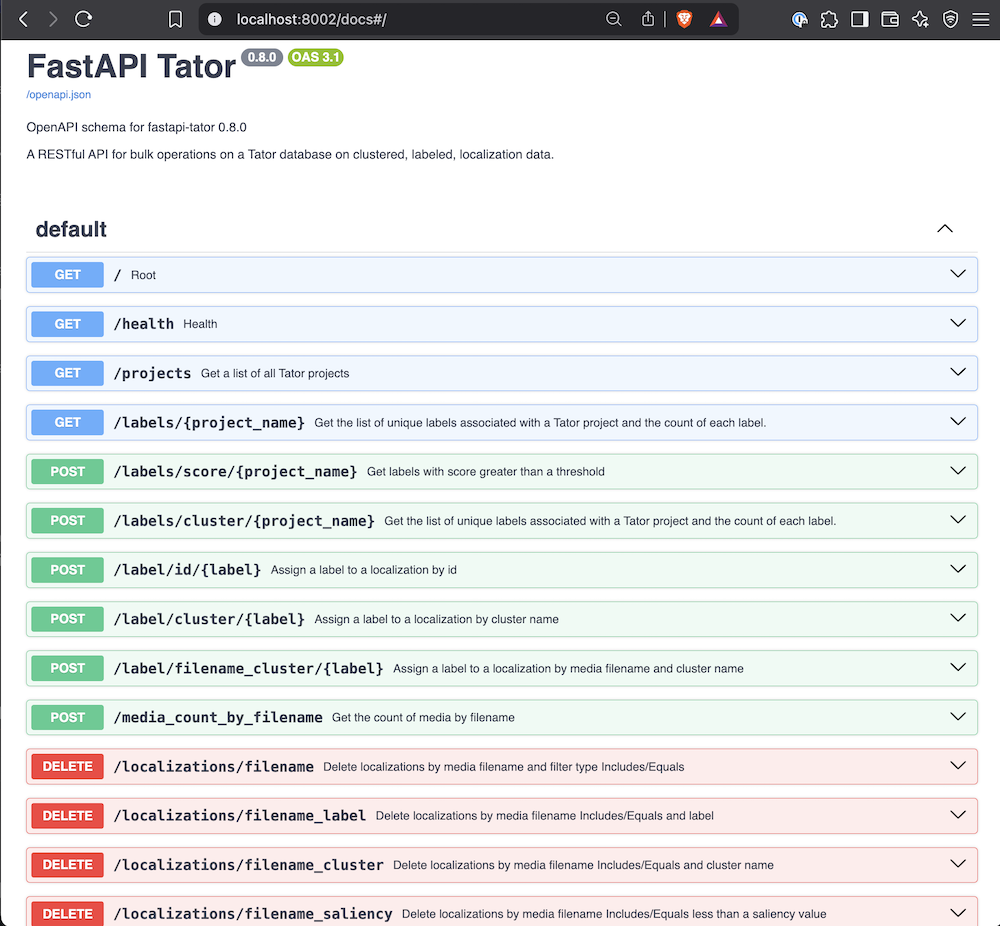
---
# Requirements
For deployment, you will need:
- [Docker](https://docs.docker.com/get-docker/)
- [Docker Compose](https://docs.docker.com/compose/install/)
For development, you will need:
- [Python >=3.12](https://www.python.org/downloads/)
- [Anaconda](https://www.anaconda.com/)
- [Docker](https://docs.docker.com/get-docker/)
- [Docker Compose](https://docs.docker.com/compose/install/)
- [Tator](http://github.com/mbari-org/tator)
# Deployment
## Clone the repository and run the docker compose file
```shell
git clone --recurse-submodules https://github.com/mbari-org/fastapi-tator
cd fastapi-tator
cp example-env .env
make tator
make superuser
```
## Fetch your API key for Tator
Create an API token for a user with full admin and set that in the .env file
along with the Tator server URL.
```shell
echo "TATOR_API_HOST=http://localhost" > .env
echo "TATOR_API_TOKEN=15a0f486cde0f09329b09f3274de1b962c2273a4" >> .env
```

## Build and start the docker containers
```shell
./bin/docker_build.sh
./bin/run_prod.sh
```
Optionally, set the environment variable `TATOR_DEFAULT_PROJECT` to the value of the project you would like to default to.
```shell
export TATOR_DEFAULT_PROJECT="901103-biodiversity"
```
Your server is now running at `http://localhost:8000/docs`
## Try it out
Open the browser to http://localhost:8000/docs to see the API documentation.
### Health Check
Check the health of the server by going to `http://localhost:8000/health`. You should see the following response:
```json
{"status":"ok"}
```
## Related work
* https://github.com/mbari-org/sdcat [Sliced Detection and Clustering Analysis Toolkit]