https://github.com/medialabuniovi/iot_lora_template
https://github.com/medialabuniovi/iot_lora_template
Last synced: over 1 year ago
JSON representation
- Host: GitHub
- URL: https://github.com/medialabuniovi/iot_lora_template
- Owner: MediaLabUniovi
- Created: 2024-02-12T12:14:44.000Z (over 2 years ago)
- Default Branch: main
- Last Pushed: 2025-02-17T14:39:37.000Z (over 1 year ago)
- Last Synced: 2025-02-17T15:34:01.844Z (over 1 year ago)
- Language: C++
- Size: 36.1 KB
- Stars: 0
- Watchers: 1
- Forks: 0
- Open Issues: 0
-
Metadata Files:
- Readme: README.md
Awesome Lists containing this project
README
[](./README.md) | [](./README_ES.md)
# Lora Template
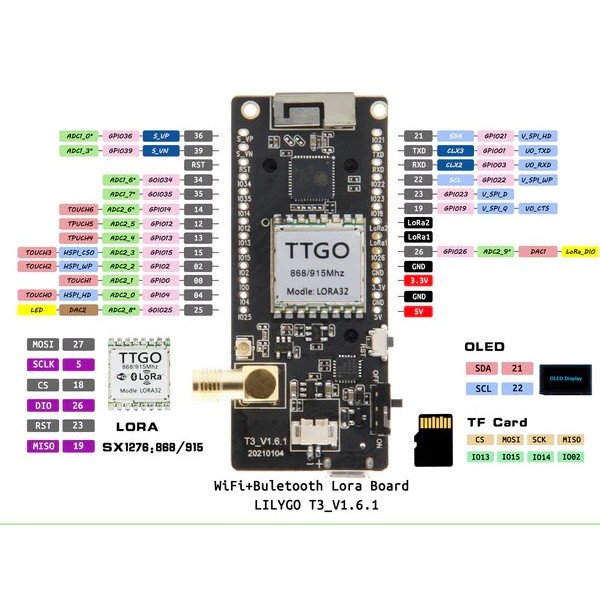
This repository contains a template code designed for the **LilyGO T3 V1.6.1** board. The purpose of this project is to establish communication using **LoRa** technology to send sensor readings through a LoRa network.
This template was developed by **MediaLab Uniovi**, a university laboratory of technology and design that emerged in 2018 from a collaboration between the **City Council of Gijón**, **Gijón Impulsa**, and the **University of Oviedo**. MediaLab is headquartered at the **School of Engineering of Gijón**, and its main objective is to bring new technologies and project creation methodologies closer to people.
## Features
- Compatible with the **LilyGO T3 V1.6.1** board
- Support for **LoRa** communication
- Modular and easy-to-customize template for adding new sensors
- Efficient sensor data reading and transmission
- Reliable communication with other stations in a LoRa network
## Hardware Requirements
- **LilyGO T3 V1.6.1**
- **LoRa SX1276/78** module (integrated on the LilyGO board)
- Compatible sensors (you can add your own)
## Software Requirements
- **Arduino IDE** (or any other compatible IDE for ESP32 platforms)
- Required libraries:
- Arduino-Lmic: Library to manage LoRa communication
- `Wire.h`: Library for I2C communication with sensors
- `SPI.h`: Library for SPI communication (LoRa)
- Additional libraries depending on the sensors you use
## Installation
1. **Clone the repository**:
Clone this repository to your local machine using:
```bash
git clone https://github.com/MediaLabUniovi/IOT_Lora_Template.git
```
2. **Set up the environment**:
Open the project in **Arduino IDE** or your preferred IDE and ensure you have installed the necessary libraries mentioned above.
3. **Connect your hardware**:
- Connect the **LilyGO T3 V1.6.1** to your computer using a USB cable.
- Add the required sensors according to your application and connect them to the corresponding pins.
4. **Configure TTN credentials**:
In the credentials code file (usually `credentials.h`), adjust the LoRa parameters such as **APPEUI**, **DEVEUI**, and **APPKEY** according to your TTN application:
```cpp
static const u1_t PROGMEM APPEUI[8] = {}; // INTRODUCE EN LSB
static const u1_t PROGMEM DEVEUI[8] = {}; // INTRODUCE EN LSB
static const u1_t PROGMEM APPKEY[16] = {}; // INTRODUCE EN MSB
```
5. **Upload the code**:
Select the **TTGO LoRa 32-OLED** board from the tools menu and upload the code to the board.
## Usage
1. **Power up the board**:
Once the code is uploaded, the board will start reading data from the connected sensors and send them over the LoRa network.
2. **Data reception**:
The sensor data sent can be received and visualized on another LoRa-compatible device within the network range.
3. **Modification and Customization**:
You can add new sensors by simply importing the required libraries and adding the code in the appropriate section of the template.
## About MediaLab Uniovi

**MediaLab Uniovi** is a university laboratory of technology and design that was created in 2018 as a result of a collaboration between the **City Council of Gijón**, **Gijón Impulsa**, and the **University of Oviedo**. Its mission is to bring new technologies and project creation methodologies closer to people. MediaLab is based at the **School of Engineering of Gijón** and works to foster technological innovation and creativity.
## Contributions
Contributions are welcome. If you want to improve this project or add new features, feel free to open a **pull request** or create an **issue** in this repository.
## License
This project is licensed under the [MIT License](LICENSE).