https://github.com/michael2012z/rust-vmm-glue
A simple Rust-VMM based hypervisor.
https://github.com/michael2012z/rust-vmm-glue
hypervisor kvm rust
Last synced: 11 months ago
JSON representation
A simple Rust-VMM based hypervisor.
- Host: GitHub
- URL: https://github.com/michael2012z/rust-vmm-glue
- Owner: michael2012z
- Created: 2019-12-31T05:42:06.000Z (over 6 years ago)
- Default Branch: master
- Last Pushed: 2020-01-23T02:46:52.000Z (over 6 years ago)
- Last Synced: 2025-04-03T11:38:32.616Z (about 1 year ago)
- Topics: hypervisor, kvm, rust
- Language: Rust
- Homepage:
- Size: 66.4 KB
- Stars: 5
- Watchers: 2
- Forks: 0
- Open Issues: 0
-
Metadata Files:
- Readme: README.md
Awesome Lists containing this project
README
# rust-vmm-glue
Rust-VMM reference implementation prototype.
## Short Description
The reference implementation bears 2 major targets:
* An example to show how to use Rust-VMM.
* Rust-VMM components integration test.
### Design
#### Principles of the design
- Simple
- The architecture of the reference implementation should be simple. It should be easy for people to understand how rust-vmm components are connected to build a hypervisor.
- A good reference is kvmtool (https://git.kernel.org/pub/scm/linux/kernel/git/will/kvmtool.git), it is "a clean, from-scratch, lightweight KVM host tool". This reference shares the same goal.
- To keep simple, the reference program is not designed in centerlization mode: no daemon, no API server.
- General purposed
- The main consuming projects of rust-vmm (Firecracker and Clould-Hypervisor now, CrosVM may in future) each has its own character and focus. But this reference implementation should be general purposed, it should cover variant use cases. For example, it should support devices commonly used as many as possible.
- Integrate all functional components (crates).
#### Practical Design
- Prototype
- I am making a prototype of the design at: https://github.com/michael2012z/rust-vmm-glue
- Binary
- The reference implementation was built into a single binary file. I assume the binary is named as "glue" (means glue of rust-vmm components) in following description.
- Subcommands
- The reference implementation works in the way of subcommands. The command format looks like:
- > ``` glue [FLAGS] [subcommand] [OPTIONS] ```
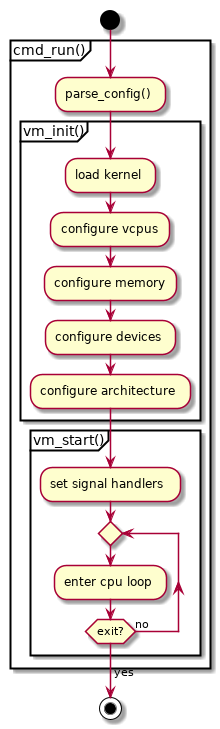
- Process diagram of RUN subcommand
- 
- Usage examples
HELP subcommand
```
$ ./target/debug/glue --help
glue 0.1
Rust-VMM based hypervisor.
USAGE:
glue [FLAGS] [SUBCOMMAND]
FLAGS:
-h, --help Prints help information
-V, --version Prints version information
-v, --verbose Sets the level of verbosity
SUBCOMMANDS:
help Prints this message or the help of the given subcommand(s)
pause Pause the virtual machine
resume Resume the virtual machine
run Start the virtual machine
stop Stop the virtual machine
list List all virtual machines
```
RUN subcommand
```
$ ./target/debug/glue run --help
glue-run
Start the virtual machine
USAGE:
glue run [OPTIONS]
FLAGS:
-h, --help Prints help information
-V, --version Prints version information
OPTIONS:
-c, --cpus Number of CPUs [default: 1]
-d, --disk Disk image
-k, --kernel Kernel to boot
-m, --mem Memory size in MB [default: 512]
-n, --name A name for the VM
-p, --params Kernel command line arguments
```
PAUSE subcommand
```
$ ./target/debug/glue pause --help
glue-pause
Pause the virtual machine
USAGE:
glue pause [OPTIONS]
FLAGS:
-h, --help Prints help information
-V, --version Prints version information
OPTIONS:
-n, --name Name of the VM
```
### Integration test
#### Cover as many use cases as possible
- Build - Customize hypervisor (glue) by specifying testing manifest file (it's Cargo.toml by default) with different features/components and build.
- > ``` cargo build --manifest-path ./tests/build/example.toml ```
- Basic - Basic functions of VM.
- Lifecycle
- Kernel load
- Kernel command line
- RootFS load
- vcpus
- Memory
- ...
- Devices - Device integration tests.
- PCI
- GPU
- Combinations
- ...
- Features - Features of rust-vmm components and their combinations.
- To be scoped.
- Performance - Performance tests, typically:
- Boot time
- Process start time
- Device IO time
- ...
#### Test framework candidates
This is to be discussed. Should we use Pytest like Firecracker do or use Rust test?
- Pytest (I prefer this)
- "Fixture" is a powerful feature of Pytest, which makes it easy to prepare a VM instance with proper capability (like netowrk, network, etc) for test case.
- Firecraker has a good test codebase writen in Pytest for reference.
- Python is easy to use and to integrate in CI.
- Rust
- Using Rust native test is an alternative solution.
- Align the test code with function code looks good.
- We need to implement a test framework from scratch. I didn't know much about popular Rust test framework. If there is, things could be different.