https://github.com/mljs/spectra-fitting
https://github.com/mljs/spectra-fitting
hacktoberfest
Last synced: about 1 year ago
JSON representation
- Host: GitHub
- URL: https://github.com/mljs/spectra-fitting
- Owner: mljs
- License: mit
- Created: 2015-08-31T14:26:01.000Z (almost 11 years ago)
- Default Branch: main
- Last Pushed: 2024-09-26T12:55:05.000Z (almost 2 years ago)
- Last Synced: 2024-10-13T23:47:14.472Z (over 1 year ago)
- Topics: hacktoberfest
- Language: TypeScript
- Homepage: http://mljs.github.io/spectra-fitting/
- Size: 1.66 MB
- Stars: 4
- Watchers: 11
- Forks: 3
- Open Issues: 5
-
Metadata Files:
- Readme: README.md
- Changelog: CHANGELOG.md
- License: LICENSE
Awesome Lists containing this project
README
# ml-spectra-fitting
[![NPM version][npm-image]][npm-url]
[![build status][ci-image]][ci-url]
[![npm download][download-image]][download-url]
This is a spectra fitting package to optimize the position (x), max intensity (y), full width at half maximum (FWHM = width) and the ratio of gaussian contribution (mu) if it's required. It supports three kind of shapes:
| Name | Equation |
| ------------ | :-------------------------------------------------------------------------------------------------------------------------------------------------------------------------------------------------------------------------------------------------------------: |
| Gaussian | 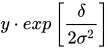 |
|
| Lorentzian |  |
|
| Pseudo Voigt | %20%5Ccdot%20%5Cfrac%7B%5Cgamma%7D%7B%5Cdelta%20%2B%20%5Cgamma%7D%20%5Cright%5D%0A) |
|
where
| %5E2%0A) |
| %7D%7D) |
| %5E2) |
|
| --------------------------------------------------------------------------------------------- | :------------------------------------------------------------------------------------------------------------------: | :------------------------------------------------------------------------------ |
It is a wrapper of [ml-levenberg-marquardt](https://github.com/mljs/levenberg-marquardt)
## [API Documentation](https://mljs.github.io/spectra-fitting/)
## Installation
`$ npm install ml-spectra-fitting`
## Example
```js
import { optimize } from 'ml-spectra-fitting';
import { SpectrumGenerator } from 'spectrum-generator';
const generator = new SpectrumGenerator({
nbPoints: 101,
from: -1,
to: 1,
});
// by default the kind of shape is gaussian;
generator.addPeak({ x: 0.5, y: 0.2 }, { fwhm: 0.2 });
generator.addPeak(
{ x: -0.5, y: 0.2 },
{
shape: {
kind: 'lorentzian',
fwhm: 0.1,
},
},
);
//points to fit {x, y};
let data = generator.getSpectrum();
console.log(JSON.stringify({ x: Array.from(data.x), y: Array.from(data.y) }));
//the approximate values to be optimized, It could coming from a peak picking with ml-gsd
let peaks = [
{
x: -0.5,
y: 0.22,
shape: {
kind: 'gaussian',
fwhm: 0.25,
},
},
{
x: 0.52,
y: 0.18,
shape: {
kind: 'gaussian',
fwhm: 0.18,
},
},
];
// the function receive an array of peak with {x, y, fwhm} as a guess
// and return a list of objects
let fittedParams = optimize(data, peaks, { shape: { kind: 'pseudoVoigt' } });
console.log(fittedParams);
const result = {
error: 0.12361588652854476,
iterations: 100,
peaks: [
{
x: -0.5000014532421942,
y: 0.19995307937326137,
shape: {
kind: 'pseudoVoigt',
fwhm: 0.10007670374735196,
mu: 0.004731136777288483,
},
},
{
x: 0.5001051783652894,
y: 0.19960010175400406,
shape: {
kind: 'pseudoVoigt',
fwhm: 0.19935932346969124,
mu: 1,
},
},
],
};
```
For data with and combination of signals with shapes between gaussian and lorentzians, we could use the kind pseudovoigt to fit the data.
```js
import { optimize } from 'ml-spectra-fitting';
import { SpectrumGenerator } from 'spectrum-generator';
const generator = new SpectrumGenerator({
nbPoints: 101,
from: -1,
to: 1,
});
// by default the kind of shape is gaussian;
generator.addPeak({ x: 0.5, y: 0.2 }, { fwhm: 0.2 });
generator.addPeak(
{ x: -0.5, y: 0.2 },
{
shape: {
kind: 'lorentzian',
fwhm: 0.1,
},
},
);
//points to fit {x, y};
let data = generator.getSpectrum();
console.log(JSON.stringify({ x: Array.from(data.x), y: Array.from(data.y) }));
//the approximate values to be optimized, It could coming from a peak picking with ml-gsd
let peaks = [
{
x: -0.5,
y: 0.22,
shape: {
kind: 'gaussian',
fwhm: 0.25,
},
},
{
x: 0.52,
y: 0.18,
shape: {
kind: 'gaussian',
fwhm: 0.18,
},
},
];
// the function receive an array of peak with {x, y, fwhm} as a guess
// and return a list of objects
let fittedParams = optimize(data, peaks, { shape: { kind: 'pseudoVoigt' } });
console.log(fittedParams);
const result = {
error: 0.12361588652854476,
iterations: 100,
peaks: [
{
x: -0.5000014532421942,
y: 0.19995307937326137,
shape: {
kind: 'pseudoVoigt',
fwhm: 0.10007670374735196,
mu: 0.004731136777288483,
},
},
{
x: 0.5001051783652894,
y: 0.19960010175400406,
shape: {
kind: 'pseudoVoigt',
fwhm: 0.19935932346969124,
mu: 1,
},
},
],
};
```
## License
[MIT](./LICENSE)
[npm-image]: https://img.shields.io/npm/v/ml-spectra-fitting.svg
[npm-url]: https://npmjs.org/package/ml-spectra-fitting
[ci-image]: https://github.com/mljs/spectra-fitting/workflows/Node.js%20CI/badge.svg?branch=main
[ci-url]: https://github.com/mljs/spectra-fitting/actions?query=workflow%3A%22Node.js+CI%22
[download-image]: https://img.shields.io/npm/dm/ml-spectra-fitting.svg
[download-url]: https://npmjs.org/package/ml-spectra-fitting