https://github.com/mschauer/goldensequences.jl
Generalized golden sequences, a form of low discrepancy sequence or quasi random numbers
https://github.com/mschauer/goldensequences.jl
Last synced: 9 months ago
JSON representation
Generalized golden sequences, a form of low discrepancy sequence or quasi random numbers
- Host: GitHub
- URL: https://github.com/mschauer/goldensequences.jl
- Owner: mschauer
- License: mit
- Created: 2019-10-08T10:13:55.000Z (over 6 years ago)
- Default Branch: master
- Last Pushed: 2022-06-14T08:55:03.000Z (about 4 years ago)
- Last Synced: 2024-10-19T17:47:52.287Z (over 1 year ago)
- Language: Julia
- Size: 1.14 MB
- Stars: 18
- Watchers: 3
- Forks: 3
- Open Issues: 3
-
Metadata Files:
- Readme: README.md
- License: LICENSE
Awesome Lists containing this project
README
# GoldenSequences.jl
Generalized golden sequences, a form of low discrepancy sequence or quasi random numbers
See [Martin Roberts: The Unreasonable Effectiveness
of Quasirandom Sequences](http://extremelearning.com.au/unreasonable-effectiveness-of-quasirandom-sequences/) for background.
The `d`-dimensional sequence follows
```
x[i] = (x[i-1] .+ z) .% true, x[0] = x0
```
where
```
z = [ϕ[k]^(-i) for i in 1:d]
```
and `ϕ[k]` solves `ϕ[k]^(d+1) = ϕ[k] + 1` (with `ϕ[1]` the golden mean.)
Golden sequence
===============
```
julia> GoldenSequence(0.0)[1]
0.6180339887498949
```
Shifted golden sequence starting in 0.5
```
julia> GoldenSequence(0.5)[0]
0.5
julia> GoldenSequence(0.5)[1]
0.1180339887498949
```
`GoldenSequence` returns an infinite iterator:
```
julia> collect(take(GoldenSequence(0.0), 10))
10-element Array{Float64,1}:
0.0
0.6180339887498949
0.2360679774997898
0.8541019662496847
0.4721359549995796
0.09016994374947451
0.7082039324993694
0.3262379212492643
0.9442719099991592
0.5623058987490541
```
Random colors: Low discrepancy series are good choice for (quasi-) random colors
```
using Colors
n = 20
c = map(x->RGB(x...), (take(GoldenSequence(3), n))) # perfect for random colors
```

2D golden sequence
==================
```
julia> GoldenSequence(2)[1]
(0.7548776662466927, 0.5698402909980532)
```
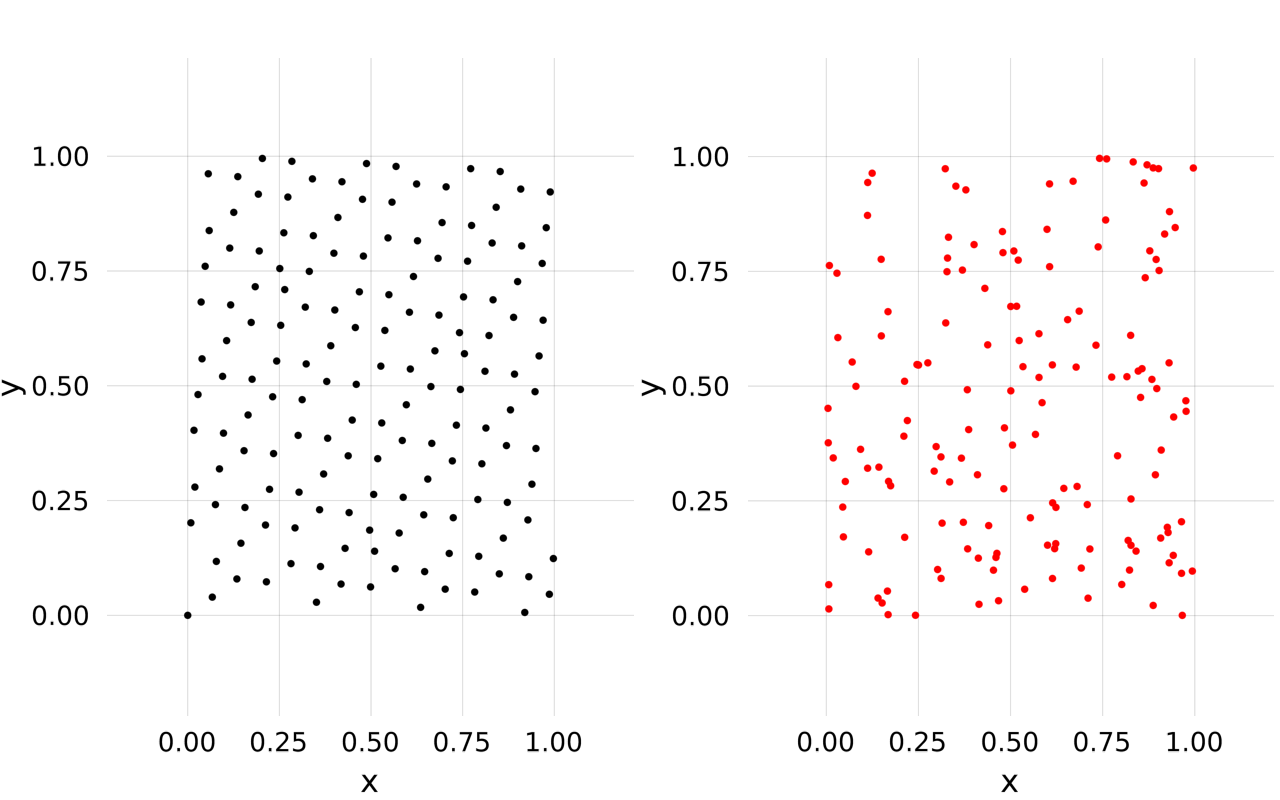
As low discrepancy series these number are well distributed (left), better than random numbers (right):
```julia
using Makie
n = 155
x = collect(Iterators.take(GoldenSequence(2), n))
p1 = scatter(x, markersize=0.02)
y = [(rand(),rand()) for i in 1:n]
p2 = scatter(y, markersize=0.02, color=:red)
vbox(p1, p2)
```
Cartesian Golden Sequence
=========================
With a bit of effort, one can use Golden Sequences to generate spacefilling quasirandom sequences of cartesian indices.
For example `GoldenCartesianSequence((m[1], m[2]))` will create a 2D Cartesian sequence corresponding to (approximate) samples of the Golden sequence in `1:m[1]` x `1:m[2]`.
For that, `GoldenCartesianSequence((m[1], ..., m[d]))` will create full period linear congruential generators (LCG) `x[i+1] = (x[i] + c[k]) % m[k]` approximating `phi[d]^[-k]` by `c[k]/m[k]` such that `c[k]` and `m[k]` are coprime.
If `m[1], ..., m[d]` are coprime themselves, these `LCG` will have together period `prod(m)` and the sequence will be space filling, that is `sort(collect(take(GoldenCartesianSequence(m), prod(m)))) == CartesianIndices(m)[:]`.
This means that if `m[k]` is the denominator of a good rational approximation `c[k]//m[k] ≈ ϕ[d]^(-k)`, then the indices will be well distributed even for large `i`.
For example if `m = (2819, 3508)`:
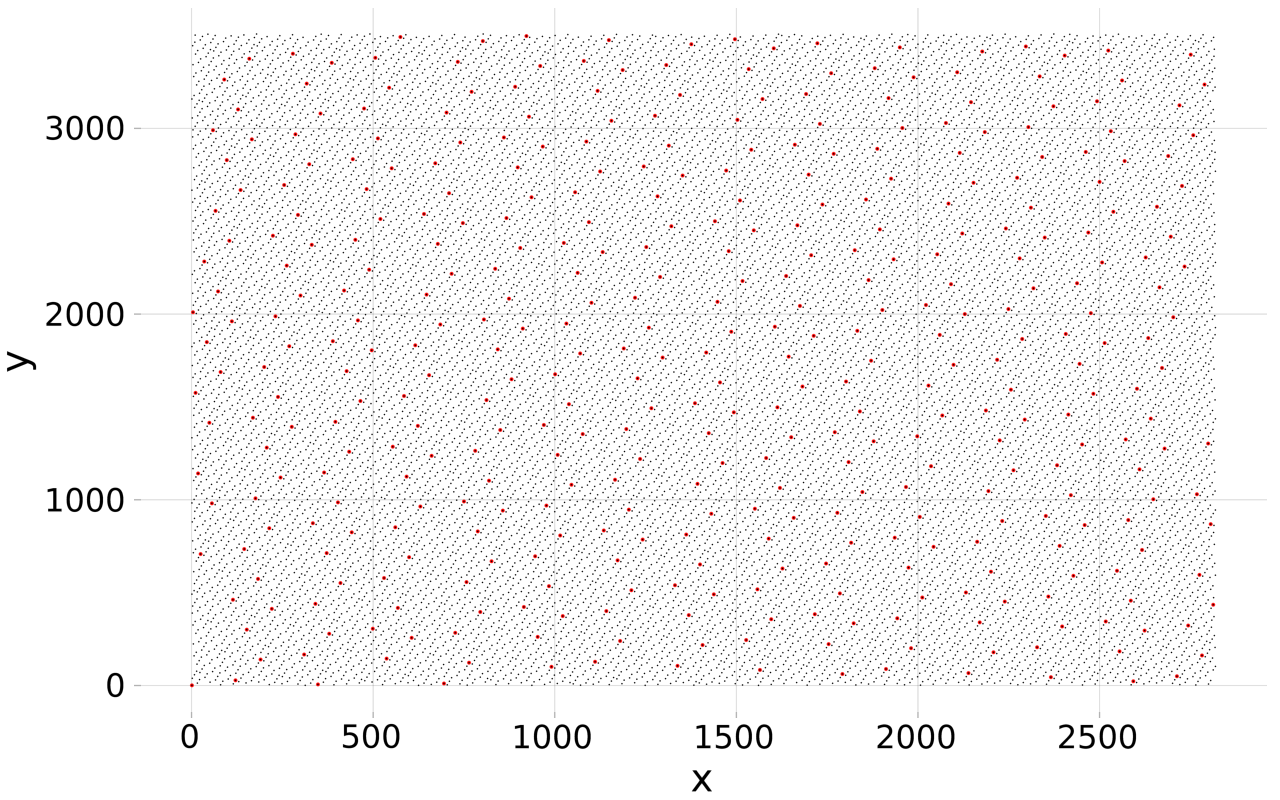
The image shows the fraction of the first 0.00005 (red) and the first 0.002 indices (black) in the `GoldenCartesianSequence((2819, 3508))`.
In short, good `m` are coprime denominators of fractions given by the function `rationalize`
```julia
d = 2
m = @. denominator(rationalize(GoldenSequences.phis[d]^(-(1:d)), tol=0.0000001))
```
```
julia> m
2-element Array{Int64,1}:
2819
3508
julia> gcd(m[1], m[2])
1
```
There are some connections here to Knuth's multiplicative hashing method
```julia
hash(i) = mod(i*2654435769, 2^32)
```
where `2654435769` is approximately `2^32*ϕ`.
Interface
=========
```
GoldenSequence(n::Int) # Float64 n-dimensional golden sequence
GoldenSequence(x0::Number) # 1-d golden sequence shifted by `x0`
GoldenSequence(x0) # length(x)-d golden sequence shifted/starting in 'x0'
```
A flower
========
Flower petals grow in spots not covering older petals, the new spot is at an angle given by the golden sequence.
```
using Colors
using Makie
n = 20
c = map(x->RGB(x...), (take(GoldenSequence(3), n))) # perfect for random colors
x = collect(take(GoldenSequence(0.0), n))
petals = [(i*cos(2pi*x), i*sin(2pi*x)) for (i,x) in enumerate(x)]
scatter(reverse(petals), color=c, markersize=10*(n:-1:1))
```