https://github.com/ndugram/fastvk
Async VK bot framework with FastAPI-style decorators and aiogram-style FSM
https://github.com/ndugram/fastvk
aiohttp api framework pydantic pydantic-v2 python python3 vk vkontakte
Last synced: about 22 hours ago
JSON representation
Async VK bot framework with FastAPI-style decorators and aiogram-style FSM
- Host: GitHub
- URL: https://github.com/ndugram/fastvk
- Owner: ndugram
- License: mit
- Created: 2026-06-08T14:58:06.000Z (27 days ago)
- Default Branch: master
- Last Pushed: 2026-06-27T11:36:45.000Z (8 days ago)
- Last Synced: 2026-06-27T12:21:22.643Z (8 days ago)
- Topics: aiohttp, api, framework, pydantic, pydantic-v2, python, python3, vk, vkontakte
- Language: Python
- Homepage: http://fastvk.ndugram.dev
- Size: 900 KB
- Stars: 16
- Watchers: 0
- Forks: 0
- Open Issues: 1
-
Metadata Files:
- Readme: README.md
- Contributing: CONTRIBUTING.md
- License: LICENSE
- Code of conduct: CODE_OF_CONDUCT.md
- Security: SECURITY.md
Awesome Lists containing this project
README

Async VK bot framework with FastAPI-style decorators and aiogram-style FSM.




---
**Source Code**: https://github.com/ndugram/fastvk
---
FastVK is a modern **async VK bot framework** for Python. It brings a decorator-based handler API — similar to FastAPI and aiogram, but for VK — with FSM, middleware, filters, keyboard builder, and a real-time dashboard out of the box.
Key features:
- **Familiar** — if you know FastAPI or aiogram, you already know FastVK. Same patterns, same ergonomics.
- **CallbackData** — typed callback data factory with `pack()` / `unpack()` — inspired by aiogram.
- **Auto-retry** — built-in exponential backoff for VK API calls (network errors, flood control).
- **Auto-pagination** — `bot.collect()` iterates paginated methods (members, posts, history) with no manual loops.
- **Async** — built on aiohttp with full async/await support from top to bottom.
- **FSM** — built-in Finite State Machine with `State`, `StatesGroup`, and pluggable storage: Memory, Redis, SQLite.
- **Filters** — `Command`, `Text`, `StateFilter`, `FromUser`, `IsChat` and custom filters via any callable.
- **Keyboard** — fluent keyboard builder with text, callback, link, location, and VK Pay buttons.
- **Injection** — handler parameters injected by type: `message`, `state`, `bot`, `update` — no manual wiring.
- **Routers** — split handlers across multiple `Router` instances and include them into the main bot.
- **Middleware** — intercept every update before and after handlers with `BaseMiddleware`.
- **Webhook** — built-in Callback API server via `run_webhook()`, no extra setup needed.
- **Dashboard** — real-time monitoring UI with live stats, activity feed, and handler search.
- **Logging** — colored, structured terminal output with per-logger colors and event highlighting.
- **Typed** — full type annotations throughout; works great with mypy and pyright.
## Requirements
Python 3.10+
FastVK depends on:
- aiohttp — async HTTP transport for Long Poll, Webhook, and VK API calls.
- pydantic — typed data models for VK event objects.
## Installation
```console
$ pip install fastvk
---> 100%
```
## Example
### Create it
Create a file `main.py`:
```python
from fastvk import FastVK
from fastvk.filters import Command
from fastvk.types import Message
bot = FastVK(token="vk1.a.YOUR_TOKEN")
@bot.message(Command("start"))
async def start(message: Message) -> None:
await message.answer("Привет! Я FastVK бот.")
if __name__ == "__main__":
bot.run_polling()
```
### Run it
```console
$ python main.py
```
### Check it
You will see colored output like:
```
10:35:42 INFO fastvk FastVK started (group_id=123456789)
10:35:44 INFO fastvk ← message_new → start() [Иван id=123]
```
Send `/start` to your bot — it replies instantly.
### Upgrade the example
With FSM (multi-step forms)...
Use `StatesGroup` and `State` to collect data across multiple messages:
```python
from fastvk import FastVK
from fastvk.filters import Command, StateFilter
from fastvk.fsm import FSMContext, State, StatesGroup
from fastvk.types import Message
bot = FastVK(token="vk1.a.YOUR_TOKEN")
class Form(StatesGroup):
waiting_name = State()
waiting_age = State()
@bot.message(Command("start"))
async def cmd_start(message: Message, state: FSMContext) -> None:
await state.set_state(Form.waiting_name)
await message.answer("Как тебя зовут?")
@bot.message(StateFilter(Form.waiting_name))
async def got_name(message: Message, state: FSMContext) -> None:
await state.update_data(name=message.text)
await state.set_state(Form.waiting_age)
await message.answer(f"Отлично, {message.text}! Сколько тебе лет?")
@bot.message(StateFilter(Form.waiting_age))
async def got_age(message: Message, state: FSMContext) -> None:
data = await state.update_data(age=message.text)
await state.clear()
await message.answer(f"Готово!\nИмя: {data['name']}\nВозраст: {data['age']}")
if __name__ == "__main__":
bot.run_polling()
```
With persistent FSM storage (SQLite)...
FSM state survives restarts — no Redis required:
```python
from fastvk import FastVK
from fastvk.fsm import SQLiteStorage
bot = FastVK(
token="vk1.a.YOUR_TOKEN",
storage=SQLiteStorage("bot.db"),
)
```
Install the optional dependency first:
```console
$ pip install fastvk[sqlite]
```
For Redis:
```python
from fastvk.fsm import RedisStorage
bot = FastVK(..., storage=RedisStorage("redis://localhost:6379/0"))
```
```console
$ pip install fastvk[redis]
```
With keyboard buttons...
Build keyboards with a fluent API:
```python
from fastvk import FastVK
from fastvk.filters import Command
from fastvk.keyboard import Button, Keyboard
from fastvk.enums import Color
from fastvk.types import Message
bot = FastVK(token="vk1.a.YOUR_TOKEN")
@bot.message(Command("menu"))
async def menu(message: Message) -> None:
kb = (
Keyboard(one_time=True)
.row(
Button.text("Да", color=Color.POSITIVE),
Button.text("Нет", color=Color.NEGATIVE),
)
.row(Button.text("Отмена"))
)
await message.answer("Выберите:", keyboard=kb)
@bot.message(Command("pay"))
async def pay(message: Message) -> None:
kb = (
Keyboard(inline=True)
.row(Button.vkpay(action="pay-to-group", group_id=123456789, amount=100, description="Донат"))
)
await message.answer("Поддержать проект:", keyboard=kb)
```
With inline buttons (callback)...
Handle button clicks from inline keyboards:
```python
from fastvk import FastVK
from fastvk.filters import Command
from fastvk.keyboard import Button, Keyboard
from fastvk.types import CallbackQuery, Message
bot = FastVK(token="vk1.a.YOUR_TOKEN")
@bot.message(Command("vote"))
async def vote(message: Message) -> None:
kb = (
Keyboard(inline=True)
.row(
Button.callback("👍 За", payload={"v": "yes"}),
Button.callback("👎 Против", payload={"v": "no"}),
)
)
await message.answer("Голосование:", keyboard=kb)
@bot.callback()
async def on_vote(cb: CallbackQuery) -> None:
choice = cb.payload.get("v")
await cb.answer(f"Вы проголосовали: {'за' if choice == 'yes' else 'против'}")
```
With CallbackData (typed payloads)...
Use typed callback data instead of raw dicts — inspired by aiogram's `CallbackData`:
```python
from typing import ClassVar
from fastvk import FastVK, CallbackData
from fastvk.filters import Command
from fastvk.keyboard import Button, Keyboard
from fastvk.types import CallbackQuery, Message
class ProductCallback(CallbackData):
prefix: ClassVar[str] = "product"
product_id: int
action: str = "view"
bot = FastVK(token="vk1.a.YOUR_TOKEN")
@bot.message(Command("shop"))
async def shop(message: Message) -> None:
kb = (
Keyboard(inline=True)
.row(
Button.callback("Товар 1", payload=ProductCallback(product_id=1).pack()),
Button.callback("Товар 2", payload=ProductCallback(product_id=2).pack()),
)
)
await message.answer("Каталог:", keyboard=kb)
@bot.callback()
async def on_product(callback: CallbackQuery) -> None:
cb = ProductCallback.unpack(callback.payload)
await callback.answer(f"Товар #{cb.product_id}: {cb.action}")
```
```python
# Compact payload format: product:{"product_id":1,"action":"view"}
```
With routers...
Split handlers into separate modules and include them into the bot:
```python
# shop.py
from fastvk import Router
from fastvk.filters import Command, Text
from fastvk.types import Message
router = Router()
@router.message(Command("catalog"))
async def catalog(message: Message) -> None:
await message.answer("Наш каталог: ...")
@router.message(Text("цена", contains=True, ignore_case=True))
async def price_mention(message: Message) -> None:
await message.answer("Цены начинаются от 99₽")
```
```python
# main.py
from fastvk import FastVK
from shop import router
bot = FastVK(token="vk1.a.YOUR_TOKEN")
bot.include_router(router)
if __name__ == "__main__":
bot.run_polling()
```
With middleware...
Intercept every incoming update to add logging, rate limiting, or custom data:
```python
from collections.abc import Awaitable, Callable
from typing import Any
from fastvk import FastVK
from fastvk.middleware import BaseMiddleware
from fastvk.filters import Command
from fastvk.types import Message
class LoggingMiddleware(BaseMiddleware):
async def __call__(
self,
handler: Callable[[Any, dict], Awaitable[Any]],
event: Any,
data: dict,
) -> Any:
print(f"incoming: {type(event).__name__}")
result = await handler(event, data)
print("handled")
return result
bot = FastVK(
token="vk1.a.YOUR_TOKEN",
middleware=[LoggingMiddleware()],
)
```
With error handlers...
Catch exceptions raised inside handlers — by type, with full context injection:
```python
from fastvk import FastVK
from fastvk.exceptions import VKAPIError
from fastvk.filters import Command
from fastvk.types import Message
bot = FastVK(token="vk1.a.YOUR_TOKEN")
@bot.message(Command("risky"))
async def risky(message: Message) -> None:
raise ValueError("что-то пошло не так")
@bot.exception_handler(VKAPIError)
async def on_vk_error(error: VKAPIError, message: Message) -> None:
await message.answer("VK API недоступен, попробуй позже.")
@bot.exception_handler()
async def on_any_error(error: Exception, message: Message) -> None:
await message.answer(f"Ошибка: {error}")
if __name__ == "__main__":
bot.run_polling()
```
With webhook...
Receive updates via VK Callback API instead of Long Poll:
```python
from fastvk import FastVK
from fastvk.filters import Command
from fastvk.types import Message
bot = FastVK(token="vk1.a.YOUR_TOKEN")
@bot.message(Command("start"))
async def start(message: Message) -> None:
await message.answer("Привет через webhook!")
if __name__ == "__main__":
bot.run_webhook(
confirmation_token="abc123def", # from VK group settings
host="0.0.0.0",
port=8080,
path="/vk",
secret="my_secret", # optional
)
```
With filters...
Combine built-in and custom filters on any handler:
```python
from fastvk import FastVK
from fastvk.filters import Command, FromUser, IsChat, Text
from fastvk.types import Message
ADMIN_ID = 123456789
bot = FastVK(token="vk1.a.YOUR_TOKEN")
@bot.message(Command("ban"), FromUser(ADMIN_ID))
async def admin_ban(message: Message) -> None:
await message.answer("Пользователь заблокирован.")
@bot.message(IsChat("private"), Text("помощь", contains=True, ignore_case=True))
async def help_in_pm(message: Message) -> None:
await message.answer("Список команд: /start, /help")
def is_long_message(message: Message, data: dict) -> bool:
return len(message.text or "") > 200
@bot.message(is_long_message)
async def long_message(message: Message) -> None:
await message.answer("Это очень длинное сообщение!")
```
With raw VK API calls...
Access the full VK API via the injected `bot` parameter:
```python
from fastvk import Bot, FastVK
from fastvk.filters import Command
from fastvk.types import Message
bot = FastVK(token="vk1.a.YOUR_TOKEN")
@bot.message(Command("me"))
async def cmd_me(message: Message, bot: Bot) -> None:
users = await bot.users.get(user_ids=message.from_id, fields="photo_200")
name = f"{users[0]['first_name']} {users[0]['last_name']}"
await message.answer(f"Ты: {name}")
@bot.message(Command("members"))
async def cmd_members(message: Message, bot: Bot) -> None:
data = await bot.groups.getMembers(group_id=123456789, count=1)
await message.answer(f"Участников: {data['count']}")
```
With event handlers...
Handle any VK event type — not just messages:
```python
from fastvk import Bot, FastVK
from fastvk.types import GroupJoinEvent, GroupLeaveEvent, Update, User, WallPostEvent
bot = FastVK(token="vk1.a.YOUR_TOKEN")
@bot.group_join()
async def on_join(event: GroupJoinEvent, user: User, bot: Bot) -> None:
await bot.messages.send(
peer_id=event.user_id,
message=f"Добро пожаловать, {user.first_name}!",
random_id=0,
)
@bot.group_leave()
async def on_leave(event: GroupLeaveEvent) -> None:
action = "сам покинул" if event.is_self else "был исключён из"
print(f"Пользователь {event.user_id} {action} группы.")
@bot.wall_post_new()
async def on_new_post(event: WallPostEvent) -> None:
print(f"Новый пост #{event.id}: {event.text[:80]!r}")
@bot.on("photo_new")
async def on_photo(update: Update) -> None:
print(f"Новое фото: {update.object}")
```
## Dashboard
Enable the real-time monitoring dashboard by passing a `BaseDashboard` instance:
```python
from fastvk import FastVK
from fastvk.dashboard import BaseDashboard, DashboardConfig
class MyDashboard(BaseDashboard):
config = DashboardConfig(
dashboard_host="127.0.0.1",
dashboard_port=8080,
)
bot = FastVK(
token="vk1.a.YOUR_TOKEN",
dashboard=MyDashboard(),
)
```
Open http://127.0.0.1:8080 in your browser.
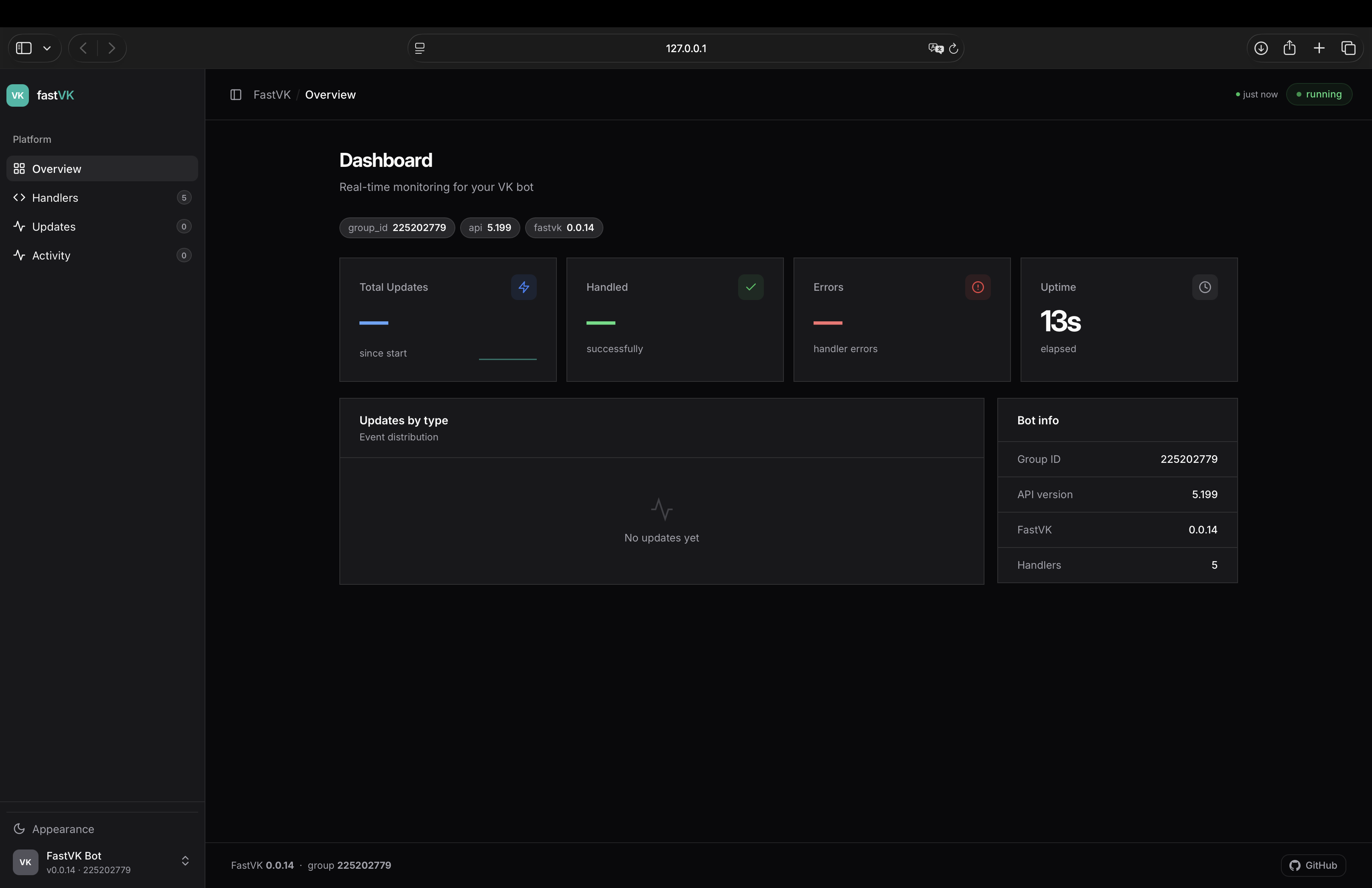
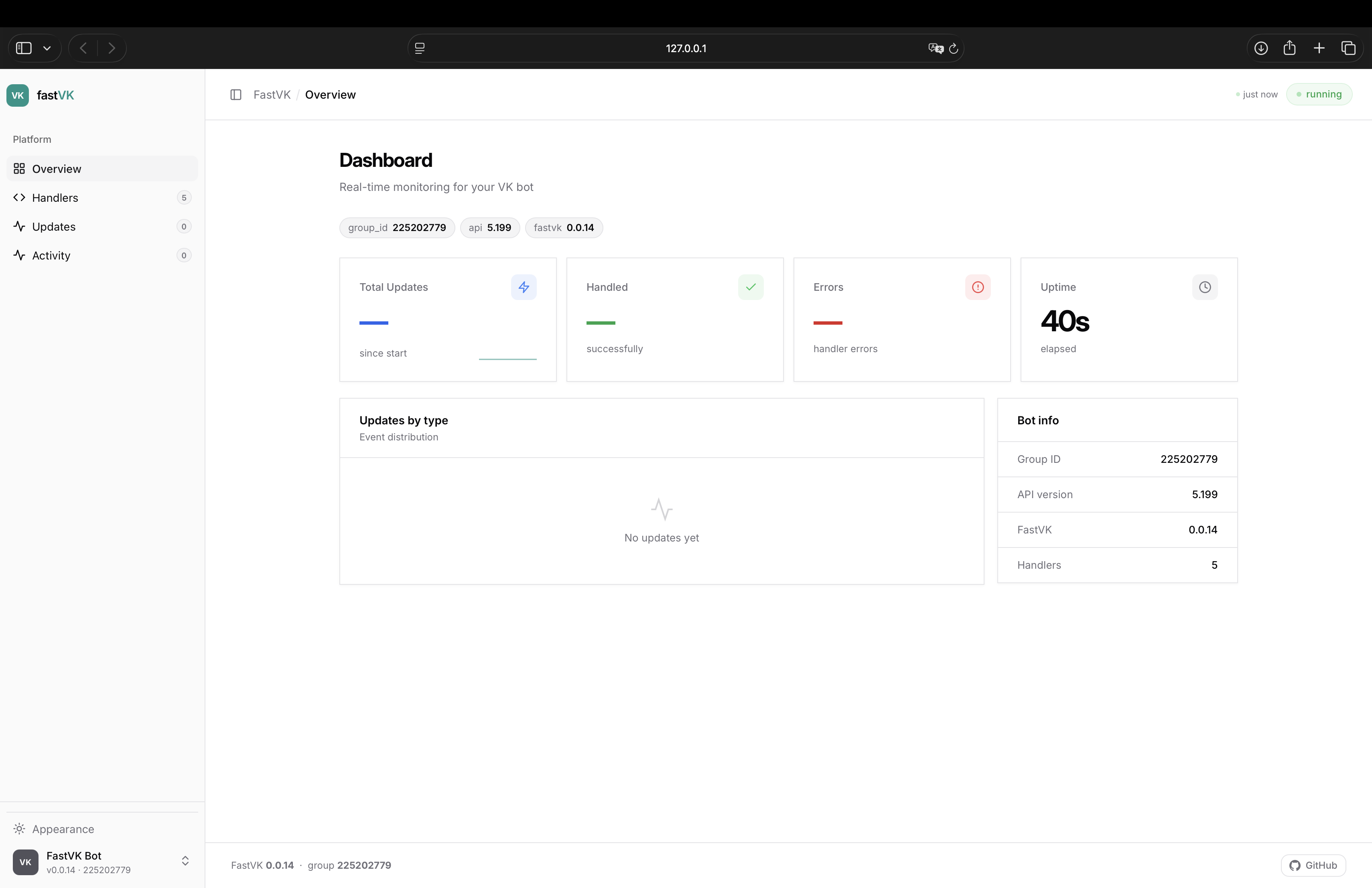
The dashboard shows:
- **Overview** — total updates, handled, errors, uptime, sparkline, updates/min, event distribution
- **Handlers** — registered handlers with filters, searchable
- **Updates** — live event type breakdown with percentages
- **Activity** — real-time event feed with timestamps, last 200 events
## Dependency injection
Handler parameters are injected **by type** — declare what you need, the framework provides it:
| Type | What you get |
|---|---|
| `Message` | Parsed incoming message (`message_new` events) |
| `CallbackQuery` | Inline button click payload (`message_event` events) |
| `FSMContext` | FSM state accessor for the current user |
| `Bot` | VK API client |
| `Update` | Full raw update object |
| `BackgroundTasks` | Fire-and-forget background tasks |
| Your `CallbackData` subclass | Unpacked callback payload (when using `CallbackDataFilter`) |
```python
@router.message()
async def handler(
message: Message,
state: FSMContext,
bot: Bot,
) -> None:
...
```
## Optional dependencies
| Extra | Installs | Use |
|---|---|---|
| `fastvk[sqlite]` | `aiosqlite` | `SQLiteStorage` — persistent FSM without Redis |
| `fastvk[redis]` | `redis` | `RedisStorage` — Redis-backed FSM storage |
```console
$ pip install fastvk[sqlite]
$ pip install fastvk[redis]
```
## Contributing
Contributions are welcome! Please open an issue before submitting a pull request.
Found a bug? Open an issue on GitHub.
## License
This project is licensed under the terms of the MIT license.