https://github.com/nevespl/netarchtest.enhancededition
A fluent API for .Net that can enforce architectural rules in unit tests.
https://github.com/nevespl/netarchtest.enhancededition
archtest archunit cecil netarchtest
Last synced: 6 months ago
JSON representation
A fluent API for .Net that can enforce architectural rules in unit tests.
- Host: GitHub
- URL: https://github.com/nevespl/netarchtest.enhancededition
- Owner: NeVeSpl
- License: mit
- Created: 2022-09-30T05:54:17.000Z (almost 4 years ago)
- Default Branch: main
- Last Pushed: 2025-06-04T19:09:51.000Z (about 1 year ago)
- Last Synced: 2025-09-23T15:54:51.114Z (10 months ago)
- Topics: archtest, archunit, cecil, netarchtest
- Language: C#
- Homepage:
- Size: 610 KB
- Stars: 46
- Watchers: 4
- Forks: 4
- Open Issues: 1
-
Metadata Files:
- Readme: README.md
- License: license.md
Awesome Lists containing this project
README
[](https://github.com/NeVeSpl/NetArchTest.eNhancedEdition/actions/workflows/net-workflow.yml)
[](https://www.nuget.org/packages/NetArchTest.eNhancedEdition)
# NetArchTest.eNhancedEdition
A fluent API for .Net Standard that can enforce architectural rules in unit tests and create a *self-testing architecture*. Inspired by the [ArchUnit](https://www.archunit.org/) library for Java.
NetArchTest.eNhancedEdition is based on [NetArchTest v1.3.2](https://github.com/BenMorris/NetArchTest). If you are not familiar with NetArchTest, you should start by reading [introduction on Ben's blog](https://www.ben-morris.com/writing-archunit-style-tests-for-net-and-c-for-self-testing-architectures).
### Rationale
NetArchTest is a well-established mature library, but to push things forward, a few breaking changes had to be made, and that is how **eNhancedEdition** was born. eNhancedEdition uses almost identical Fluent API as a base library, but it is not 100% backwards compatible, and it will never be.
What **eNhancedEdition** has to offer, that is not available in the NetArchTest v1.3.2:
- fixed all known bugs present in v1.3.2 :
- BenMorris/NetArchTest#98,
- BenMorris/NetArchTest#101,
- BenMorris/NetArchTest#120,
- NeVeSpl/NetArchTest.eNhancedEdition#3
- corrected design mistakes:
- BenMorris/NetArchTest#119 - fixed nulls for Success result
- BenMorris/NetArchTest#130 - for generic type, number of type parameters (e.g. `1) is no longer considered as a part of its name
- added new features:
- [Slices](#slices)
- BenMorris/NetArchTest#67 - added rules: AreOfType, AreNotOfType
- BenMorris/NetArchTest#97 - added rules: HaveSourceFileNameMatchingName, HaveSourceFilePathMatchingNamespace
- BenMorris/NetArchTest#100 - added rules: AreImmutable, AreImmutableExternally, AreStateless
- BenMorris/NetArchTest#104 - added rule: HaveMatchingTypeWithName
- BenMorris/NetArchTest#105 - dependency search functions: HaveDependencyOnAny/OnlyHaveDependencyOn explain why a type fails test through [IType.Explanation](documentation/api.md#itypeexplanation)
- BenMorris/NetArchTest#126 - added rules for structs, enums and delegates
- BenMorris/NetArchTest#131 - added rules for all access modifiers: public, internal, private, protected, private protected, protected internal
- BenMorris/NetArchTest#133 - added rules: AreInheritedByAnyType, AreNotInheritedByAnyType
- added rules: AreUsedByAny, AreNotUsedByAny
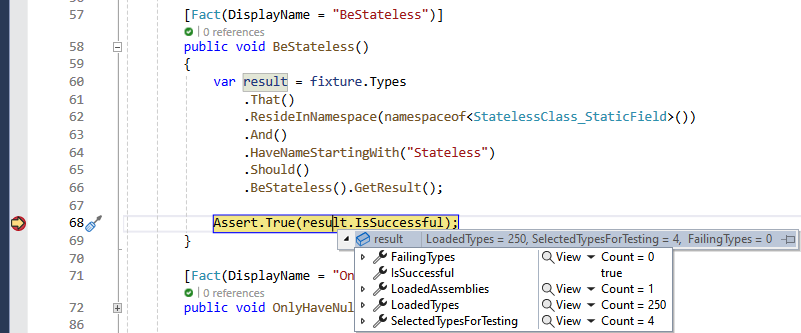
- at the end, you get more information which should make reasoning about tests easier:
## Index
* [Getting started](#getting-started)
* [Examples](#examples)
* [Writing rules](#writing-rules)
* [Rules for dependency analysis](#rules-for-dependency-analysis)
* [Rules for assessing design and architectural principles](#rules-for-assessing-design-and-architectural-principles)
* [Slices](#slices)
* [Custom rules](#custom-rules)
* [Options](#options)
* [Limitations](#limitations)
* API
* [Types](https://github.com/NeVeSpl/NetArchTest.eNhancedEdition/blob/main/documentation/api.md#types)
* [Predicate](https://github.com/NeVeSpl/NetArchTest.eNhancedEdition/blob/main/documentation/api.md#predicate)
* [PredicateList](https://github.com/NeVeSpl/NetArchTest.eNhancedEdition/blob/main/documentation/api.md#predicateList)
* [Condition](https://github.com/NeVeSpl/NetArchTest.eNhancedEdition/blob/main/documentation/api.md#condition)
* [ConditionList](https://github.com/NeVeSpl/NetArchTest.eNhancedEdition/blob/main/documentation/api.md#conditionList)
* [TestResult](https://github.com/NeVeSpl/NetArchTest.eNhancedEdition/blob/main/documentation/api.md#testResult)
* [IType](https://github.com/NeVeSpl/NetArchTest.eNhancedEdition/blob/main/documentation/api.md#itype)
* [Options](https://github.com/NeVeSpl/NetArchTest.eNhancedEdition/blob/main/documentation/api.md#options)
## Getting started
The library is available as a package on NuGet: [NetArchTest.eNhancedEdition](https://www.nuget.org/packages/NetArchTest.eNhancedEdition/).
### Examples
```csharp
[TestClass]
public class SampleApp_ModuleAlpha_Tests
{
static readonly Assembly AssemblyUnderTest = typeof(TestUtils).Assembly;
[TestMethod]
public void PersistenceIsNotAccessibleFromOutsideOfModuleExceptOfDbContext()
{
var result = Types.InAssembly(AssemblyUnderTest)
.That()
.ResideInNamespace("SampleApp.ModuleAlpha.Persistence")
.And()
.DoNotHaveNameEndingWith("DbContext")
.Should()
.NotBePublic()
.GetResult();
Assert.IsTrue(result.IsSuccessful);
}
[TestMethod]
public void DomainIsIndependent()
{
var result = Types.InAssembly(AssemblyUnderTest)
.That()
.ResideInNamespace("SampleApp.ModuleAlpha.Domain")
.ShouldNot()
.HaveDependencyOtherThan(
"System",
"SampleApp.ModuleAlpha.Domain",
"SampleApp.SharedKernel.Domain",
"SampleApp.BuildingBlocks.Domain"
)
.GetResult();
Assert.IsTrue(result.IsSuccessful, "Domain has lost its independence!");
}
}
[TestClass]
public class SampleApp_ModuleOmega_Tests
{
static readonly Assembly AssemblyUnderTest = typeof(TestUtils).Assembly;
[TestMethod]
public void RequestHandlersShouldBeSealed()
{
var result = Types.InAssembly(AssemblyUnderTest)
.That()
.ImplementInterface(typeof(IRequestHandler<,>))
.Should()
.BeSealed()
.GetResult();
Assert.IsTrue(result.IsSuccessful);
}
}
```
### Writing rules
The fluent API should direct you in building up a rule, based on a combination of [predicates](documentation/api.md#predicate), [conditions](documentation/api.md#condition) and conjunctions.
The starting point for any rule is one of the static methods on [`Types`](documentation/api.md#types) class, where you load a set of types from an assembly, domain or path.
```csharp
var types = Types.InAssembly(typeof(MyClass).Assembly);
```
Once you have loaded the types, you can filter them using one or more predicates. These can be chained together using `And()` or `Or()` conjunctions:
```csharp
types.That().ResideInNamespace("MyProject.Data");
```
Once the set of types has been filtered, you can apply a set of conditions using the `Should()` or `ShouldNot()` methods, e.g.
```csharp
types.That().ResideInNamespace("MyProject.Data").Should().BeSealed();
```
Finally, you obtain a result from the rule by using an executor, i.e. use `GetTypes()` to return the types that match the rule or `GetResult()` to determine whether the rule has been met.
Note that `GetResult()` returns [`TestResult`](documentation/api.md#testresult) which contains a few lists of types:
- `LoadedTypes` - all types loaded by [`Types`](documentation/api.md#types)
- `SelectedTypesForTesting` - types that passed [predicates](documentation/api.md#predicate)
- `FailingTypes`- types that failed to meet the [conditions](documentation/api.md#condition)
```csharp
var result = types.That().ResideInNamespace("MyProject.Data").Should().BeSealed().GetResult();
var isValid = result.IsSuccessful;
var types = result.FailingTypes;
```
> **Tip**
Loading types is time-consuming, since `Type` class is immutable, its instance can be shared between tests.
## Rules for dependency analysis
Dependency matrix:
| type\has dependency on | D1 | D2 | D3 |
|---|----|----|----|
| a | | | |
| b | | | x |
| c | | x | |
| d | | x | x |
| e | x | | |
| f | x | | x |
| g | x | x | |
| h | x | x | x |
#### Dependency search:
| | Rule | number
of required
dependencies
from the list | type can have
a dependency
that is not
on the list | passing types | failing types |
|---|---|---|---|---|---|
| 1 | [HaveDependencyOnAny(D1, D2)](documentation/api.md#conditionhavedependencyonany) | at least 1 | yes | c, d, e, f, g, h, | a, b |
| 2 | [HaveDependencyOnAll(D1, D2)](documentation/api.md#conditionhavedependencyonall) | all | yes | g, h | a, b, c, d, e, f |
| 3 | [OnlyHaveDependencyOn(D1, D2)](documentation/api.md#conditiononlyhavedependencyon) | >=0 | no | a, c, e, g | b, d, f, h |
| 1N | [NotHaveDependencyOnAny(D1, D2)](documentation/api.md#conditionnothavedependencyonany) | none | yes | a, b | c, d, e, f, g, h, |
| 2N | [NotHaveDependencyOnAll(D1, D2)](documentation/api.md#conditionnothavedependencyonall) | not all | yes | a, b, c, d, e, f | g, h |
| 3N | [HaveDependencyOtherThan(D1, D2)](documentation/api.md#conditionhavedependencyotherthan) | >=0 | yes | b, d, f, h, | a, c, e, g |
An explanation of why a type fails the dependency search test is available on the failing type: [IType.Explanation](documentation/api.md#itypeexplanation)
#### Reverse dependency search
| | Predicate | number
of required
dependencies
from the list | type can use
a type
that is not
on the list | passing types | failing types |
|---|---|---|---|---|---|
| R1 | [AreUsedByAny(c, d)](documentation/api.md#predicateareusedbyany) | at least 1 | yes | D2, D3 | D1 |
| R1N | [AreNotUsedByAny(c, d)](documentation/api.md#predicatearenotusedbyany) | none | yes | D1 | D2, D3 |
## Rules for assessing design and architectural principles
#### BeImmutable
A Type is considered as immutable when all its state (instance and static, fields, properties and events) cannot be changed after creation. Shallow immutability.
#### BeImmutableExternally
A Type is considered as externally immutable when its state (instance and static, fields, properties and events) with a public access modifier cannot be changed from the outside of the type. Shallow immutability.
#### BeStateless
A Type is considered as stateless when it does not have an instance state (fields, properties and events).
#### BeStaticless
A Type is considered as stateless when it does not have a static state.
#### HaveParameterlessConstructor
A type should have a parameterless instance constructor.
#### DoNotHavePublicConstructor
A type should not have any instance public constructors.
#### HaveSourceFileNameMatchingName
#### HaveSourceFilePathMatchingNamespace
#### HaveMatchingTypeWithName
## Slices
```csharp
var result = Types.InAssembly(typeof(ExampleDependency).Assembly)
.Slice()
.ByNamespacePrefix("MyApp.Features")
.Should()
.NotHaveDependenciesBetweenSlices()
.GetResult();
```
There is only one way, at least for now, to divide types into slices `ByNamespacePrefix(string prefix)` and it works as follows:
1) Select types which namespace starts with a given prefix, rest of the types are ignored.
2) Slices are defined by the first part of the namespace that comes right after the prefix:
`namespacePrefix.(sliceName).restOfNamespace`
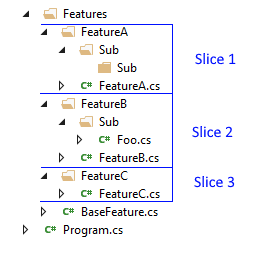
3) Types with the same `sliceName` part will be placed in the same slice. If `sliceName` is empty for a given type, the type will also be ignored (`BaseFeature` class from the following image)
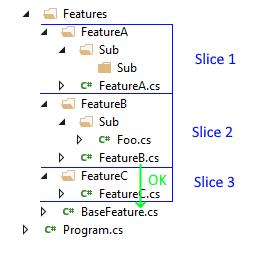
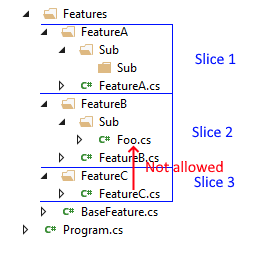
When our types are divided into slices, we can apply the condition: `NotHaveDependenciesBetweenSlices()`. As the name suggests it detects if any dependency exists between slices. Dependency from slice to type that is not part of any other slice is allowed.
passing | failing
--|---
|
## Custom rules
You can extend the library by writing custom rules that implement the `ICustomRule` interface. These can be applied as both predicates and conditions using a `MeetsCustomRule()` method, e.g.
```csharp
var myRule = new CustomRule();
// Write your own custom rules that can be used as both predicates and conditions
var result = Types.InCurrentDomain()
.That()
.AreClasses()
.Should()
.MeetCustomRule(myRule)
.GetResult()
.IsSuccessful;
```
## Options
User [Options](documentation/api.md#options-1) allows to configure how NetArchTest engine works.
```csharp
var result = Types.InCurrentDomain()
.That()
.ResideInNamespace("NetArchTest.TestStructure.NameMatching.Namespace3")
.Should()
.HaveNameStartingWith("Some")
.GetResult(Options.Default with { Comparer = StringComparison.Ordinal});
Assert.True(result.IsSuccessful);
```
Available options:
- [Comparer](documentation/api.md#optionscomparer) - allows to specify how strings will be compared, default: InvariantCultureIgnoreCase (it only affects: Predicate.HaveName, Predicate.HaveNameStartingWith, Predicate.HaveNameEndingWith, Predicate.ResideInNamespace)
- [SerachForDependencyInFieldConstant](documentation/api.md#optionsserachfordependencyinfieldconstant) - determines if dependency analysis should look for dependency in string field constant, default: false
## Limitations
NetArchTest is built on top of [jbevain/cecil](https://github.com/jbevain/cecil) thus it works on CIL level. Unfortunately, not every feature of C# language is represented in CIL, thus some things will never be available in NetArchTest, e.g.:
- BenMorris/NetArchTest#81 - NetArchTest ignores a nameof expression