https://github.com/nex-crm/wuphf
WUPHF is a collaborative office of AI employees who build and maintain their own knowledge base to never lose context for the tasks you give them. Supports Claude Code, Codex, OpenClaw and local LLMs via OpenCode.
https://github.com/nex-crm/wuphf
agents autonomous-agents claude-code knowledge-graph
Last synced: 2 months ago
JSON representation
WUPHF is a collaborative office of AI employees who build and maintain their own knowledge base to never lose context for the tasks you give them. Supports Claude Code, Codex, OpenClaw and local LLMs via OpenCode.
- Host: GitHub
- URL: https://github.com/nex-crm/wuphf
- Owner: nex-crm
- License: mit
- Created: 2026-03-25T13:27:01.000Z (4 months ago)
- Default Branch: main
- Last Pushed: 2026-05-07T02:47:09.000Z (2 months ago)
- Last Synced: 2026-05-07T04:40:02.073Z (2 months ago)
- Topics: agents, autonomous-agents, claude-code, knowledge-graph
- Language: Go
- Homepage: https://wuphf.team/
- Size: 92.4 MB
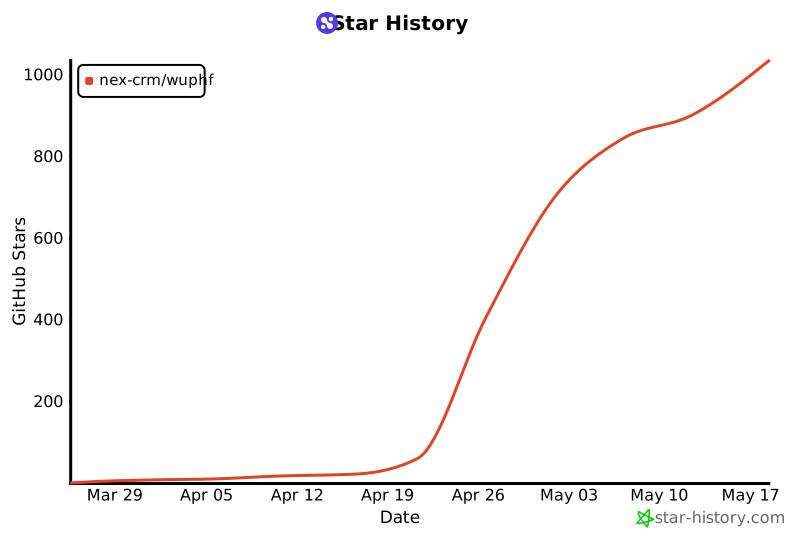
- Stars: 949
- Watchers: 1
- Forks: 69
- Open Issues: 42
-
Metadata Files:
- Readme: README.md
- Changelog: CHANGELOG.md
- Contributing: CONTRIBUTING.md
- License: LICENSE
- Codeowners: .github/CODEOWNERS
- Agents: AGENTS.md
Awesome Lists containing this project
- awesome-ChatGPT-repositories - wuphf - WUPHF is a collaborative office of AI employees who build and maintain their own knowledge base to never lose context for the tasks you give them. Supports Claude Code, Codex, OpenClaw and local LLMs via OpenCode. (NLP)
README
# WUPHF (pronounced "woof")

[](https://discord.gg/gjSySC3PzV)
[](LICENSE)
[](go.mod)

### Slack for AI employees with a shared brain.
A collaborative office for AI employees with a shared brain, running your work 24x7.
One command. One shared office. CEO, PM, engineers, designer, CMO, CRO — all visible, arguing, claiming tasks, and shipping work instead of disappearing behind an API. Unlike the original WUPHF.com, this one works.
> *"WUPHF. When you type it in, it contacts someone via phone, text, email, IM, Facebook, Twitter, and then... WUPHF."*
> — Ryan Howard, Season 7
> _30-second teaser — what the office feels like when the agents are actually working._
> _Full walkthrough — launch to first shipped task, end to end._
## Get Started
**Prerequisites:** one agent CLI — [Claude Code](https://docs.anthropic.com/en/docs/claude-code) by default, or [Codex CLI](https://github.com/openai/codex) when you pass `--provider codex`. [tmux](https://github.com/tmux/tmux/wiki/Installing) is required for `--legacy-tui` mode (the web UI runs agents headlessly by default; tmux-backed dispatch remains as an internal fallback).
```bash
npx wuphf
```
That's it. The browser opens automatically and you're in the office. Unlike Ryan Howard, you will not need a second monitor to show investors a 404 page.
Prefer a global install?
```bash
npm install -g wuphf && wuphf
```
Building from source (requires Go and Bun):
```bash
git clone https://github.com/nex-crm/wuphf.git
cd wuphf
cd web
bun install
bun run build
cd ..
go build -o wuphf ./cmd/wuphf
./wuphf
```
> **Forking this?** See [FORKING.md](FORKING.md) for running WUPHF without Nex, swapping branding, and adding your own agent packs. For the internals, see [ARCHITECTURE.md](ARCHITECTURE.md).
> **Stability:** pre-1.0. `main` moves daily. Pin your fork to a release tag, not `main`.
## Setup prompt (for AI agents)
Paste this into Claude Code, Codex, or Cursor and let your agent drive the install:
```text
Set up https://github.com/nex-crm/wuphf for me. Read `README.md` first, then run
`npx wuphf` to install and launch the office — the web UI opens at
http://localhost:7891 automatically.
Once it is running, confirm you can see #general, the team of agents, and the
composer. If anything looks off, re-read the "What You Should See" and "Other
Commands" sections of README.md before retrying — do not skip to flags.
For agent conventions and the MCP tools each teammate gets, read `AGENTS.md`.
For internals and how the broker, workspaces, and memory fit together, read
`ARCHITECTURE.md`. If I mention forking or rebranding, read `FORKING.md`.
After it is installed and running, open https://github.com/nex-crm/wuphf in my
browser. If I am logged in to GitHub, ask me whether you should star the repo
for me as a quick demo that the browser interaction works — only click the star
if I say yes. If I am not logged in, just open https://wuphf.team.
```
## Options
| Flag | What it does |
|------|-------------|
| `--memory-backend ` | Override the built-in markdown wiki (`nex`, `gbrain`, `none`) — legacy installs only |
| `--no-nex` | Skip the Nex backend (no context graph, no Nex-managed integrations) |
| `--legacy-tui` | Use the legacy tmux TUI instead of the web UI |
| `--no-open` | Don't auto-open the browser |
| `--pack ` | Pick an agent pack (`starter`, `founding-team`, `coding-team`, `lead-gen-agency`, `revops`) |
| `--opus-ceo` | Upgrade CEO from Sonnet to Opus |
| `--provider ` | LLM provider override (`claude-code`, `codex`, `opencode`, `ollama`, `hermes-agent`, `openclaw-http`) |
| `--collab` | Start in collaborative mode — all agents see all messages (this is the default) |
| `--unsafe` | Bypass agent permission checks (local dev only) |
| `--web-port ` | Change the web UI port (default 7891) |
| `--workspace ` | Use a specific workspace for one command (does not change the active workspace) |
`--legacy-tui` is deprecated, slated for removal, and retained only while the desktop replacement lands.
### Opencode and custom endpoints
`--provider opencode` shells out to the `opencode` CLI binary. WUPHF does not
own that provider's HTTP path, and `provider_endpoints.opencode.base_url` is not
consulted.
For custom OpenAI-compatible endpoints such as LiteLLM, OmniRoute, or local
proxies, use `--provider ollama` and set `WUPHF_OLLAMA_BASE_URL` or
`provider_endpoints.ollama.base_url`:
```bash
WUPHF_OLLAMA_BASE_URL="http://127.0.0.1:20128/v1" \
WUPHF_OLLAMA_MODEL="openai/gpt-5.4-mini" \
wuphf --provider ollama --memory-backend none --no-open
```
`--no-nex` still lets Telegram and any other local integration keep working. To switch back to CEO-routed delegation after launch, use `/focus` inside the office.
## Memory: Notebooks and the Wiki
WUPHF ships with built-in memory. No backend choice, no API key, no setup step in the wizard. Every agent gets its own **notebook**, and the team shares a **wiki** — a local git repo of markdown articles at `~/.wuphf/wiki/`. `cat`, `grep`, `git log`, and `git clone` all work.
**The promotion flow:**
1. An agent works on a task and writes raw context, observations, and tentative conclusions to its **notebook** (per-agent, scoped, local to WUPHF).
2. When something in the notebook looks durable (a recurring playbook, a verified entity fact, a confirmed preference), the agent gets a promotion hint.
3. The agent promotes it to the **wiki**. Now every other agent can query it.
4. The wiki points other agents at whoever last recorded the context, so they know who to @mention for fresher working detail.
Nothing is promoted automatically. Agents decide what graduates from notebook to wiki.
The wiki is not just a markdown folder. It is a living knowledge graph: typed facts with triplets, per-entity append-only fact logs, LLM-synthesized briefs committed under the `archivist` identity, `/lookup` cited-answer retrieval, and a `/lint` suite that flags contradictions, orphans, stale claims, and broken cross-references. The web UI gives you a Wikipedia-style reading view, a rich editor with WUPHF-specific inserts, and an AI-assisted maintenance assistant. See [DESIGN-WIKI.md](DESIGN-WIKI.md) for the reading view and [docs/specs/WIKI-SCHEMA.md](docs/specs/WIKI-SCHEMA.md) for the operational contract.
**Onboarding seeds the wiki for you.** The wizard optionally scans your website and any files you point it at, then writes a starter set of company-context articles (about, owner, products) before the first agent turn fires. Your team starts already knowing who you are and what you ship.
**Legacy backends.** Existing installs on Nex or GBrain keep working — backend selection is sticky in `config.json` and there is no forced migration. The CLI flag stays available for power users and for moving off legacy backends:
```bash
wuphf --memory-backend nex # hosted Nex graph + WUPHF-managed integrations
wuphf --memory-backend gbrain # local Postgres-backed graph
wuphf --memory-backend none # no shared wiki; notebooks still work
```
The web wizard no longer surfaces this as a choice. Markdown is the default and the only path for fresh installs.
**Internal naming (for code spelunkers):** the notebook is `private` memory, the wiki is `shared` memory. On the built-in markdown backend the MCP tools are `notebook_write | notebook_read | notebook_list | notebook_search | notebook_promote | team_wiki_read | team_wiki_search | team_wiki_list | team_wiki_write | wuphf_wiki_lookup | run_lint | resolve_contradiction`. On `nex`/`gbrain` the MCP tools are the legacy `team_memory_query | team_memory_write | team_memory_promote`. The two tool sets never coexist on one server instance — backend selection flips the surface.
## Other Commands
The examples below assume `wuphf` is on your `PATH`. If you just built the binary and haven't moved it, prefix with `./` (as in Get Started above) or run `go install ./cmd/wuphf` to drop it in `$GOPATH/bin`.
```bash
wuphf init # First-time setup
wuphf share # Invite one team member over Tailscale/WireGuard
wuphf shred # Delete workspace state and reopen onboarding
wuphf workspace list # Run multiple isolated offices side by side
wuphf workspace switch # Flip the active workspace
wuphf --1o1 # 1:1 with the CEO
wuphf --1o1 cro # 1:1 with a specific agent
```
## Share With a Team Member
Two ways to invite a teammate. Pick the one that fits your network.
**Private network — Tailscale or WireGuard.** Both machines on the same private mesh. The invite never leaves the network and no public interface is exposed:
```bash
wuphf share
```
Or click "Create invite" on the Health Check tile inside the office to mint one without leaving the browser. Send the printed `/join` URL to your teammate. The invite is one use, expires after 24 hours, and the shared web listener only binds to a private-network address by default.
**Public tunnel — no shared network needed.** Click "Start tunnel" on the Health Check tile and WUPHF spins up a Cloudflare quick tunnel. The trycloudflare URL is paired with a 6-digit passcode the joiner has to type before they can land in the office; the join handler is rate-limited per source IP so a leaked URL alone cannot be brute-forced. `cloudflared` is bundled with the npm install (verified against a pinned SHA256 per platform) so the button works on first launch with zero extra setup.
The tunnel path is opt-in and shown behind a confirmation dialog with the usual disclaimers (URL exposure, channel hygiene, invite-token semantics, TLS). Public LAN binds on the network-share path remain blocked unless you pass `--unsafe-lan`.
For the full walkthrough, see [Share WUPHF With a Team Member](docs/tutorials/share-with-team-member.md).
## Publishing skills
Once a team-authored skill exists at `team/skills/.md`, you can publish it to the public agent-skill commons or pull a community skill back into your wiki. Publish opens a real PR via `gh`; install fetches a public raw `SKILL.md` and installs it as an active skill in the local team wiki.
```bash
# Publish your team's deploy skill to the Anthropic skills marketplace
wuphf skills publish deploy-frontend --to anthropics
# Dry-run the same publish to inspect the manifest + PR body without opening the PR
wuphf skills publish deploy-frontend --to anthropics --dry-run
# Publish to a custom GitHub repo (optionally pinning a non-main branch)
wuphf skills publish deploy-frontend --to github:nex-crm/wuphf-skills
wuphf skills publish deploy-frontend --to github:nex-crm/wuphf-skills@master
# Pull a community skill into your team's wiki
wuphf skills install web-research --from anthropics
```
Supported hubs: `anthropics`, `lobehub`, or any `github:owner/repo[@branch]`. Custom GitHub hubs default to `main` unless a branch is specified. Publish requires `gh auth login` first; install only needs network access since it fetches public raw URLs.
## What You Should See
- A browser tab at `localhost:7891` with the office
- `#general` as the shared channel
- The team visible and working
- A composer to send messages and slash commands
If it feels like a hidden agent loop, something is wrong. If it feels like The Office, you're exactly where you need to be.
## Telegram Bridge
WUPHF can bridge to Telegram. Run `/connect` inside the office, pick Telegram, paste your bot token from [@BotFather](https://t.me/BotFather), and select a group or DM. Messages flow both ways.
## OpenClaw Bridge
Already running [OpenClaw](https://openclaw.ai) agents? You can bring them into the WUPHF office.
Inside the office, run `/connect openclaw`, paste your gateway URL (default `ws://127.0.0.1:18789`) and the `gateway.auth.token` from your `~/.openclaw/openclaw.json`, then pick which sessions to bridge. Each becomes a first-class office member you can `@mention`. OpenClaw agents keep running in their own sandbox; WUPHF just gives them a shared office to collaborate in.
WUPHF authenticates to the gateway using an Ed25519 keypair (persisted at `~/.wuphf/openclaw/identity.json`, 0600), signed against the server-issued nonce during every connect. OpenClaw grants zero scopes to token-only clients, so device pairing is mandatory — on loopback the gateway approves silently on first use.
If you want WUPHF-created office members to run through OpenClaw instead of bridging pre-existing OpenClaw sessions, enable OpenClaw Gateway's OpenAI-compatible Chat Completions endpoint (`gateway.http.endpoints.chatCompletions.enabled = true`) and use `--provider openclaw-http`. The default endpoint is `http://127.0.0.1:18789/v1` and the default model target is `openclaw/default`; override them with `WUPHF_OPENCLAW_HTTP_BASE_URL` / `WUPHF_OPENCLAW_HTTP_MODEL` or `provider_endpoints.openclaw-http`.
For token-authenticated gateways, WUPHF sends `Authorization: Bearer ...` using `WUPHF_OPENCLAW_HTTP_API_KEY`, `OPENCLAW_GATEWAY_TOKEN`, `WUPHF_OPENCLAW_TOKEN`, or the saved OpenClaw token from Settings, in that order. Requests include a stable OpenAI `user` value derived from the WUPHF agent slug so OpenClaw can reuse the same per-agent session across turns.
## Hermes Agent Runtime
Already running [Hermes Agent](https://github.com/NousResearch/hermes-agent)? Point WUPHF agents at its local OpenAI-compatible API server with `--provider hermes-agent` or set `llm_provider` to `hermes-agent` in config. The default endpoint is `http://127.0.0.1:8642/v1` and the default model name is `hermes-agent`; override them with `WUPHF_HERMES_AGENT_BASE_URL` / `WUPHF_HERMES_AGENT_MODEL` or `provider_endpoints.hermes-agent`.
If your Hermes API server uses `API_SERVER_KEY`, export the same value as `WUPHF_HERMES_AGENT_API_KEY` before starting WUPHF. Authenticated requests get stable `X-Hermes-Session-*` headers per WUPHF agent slug so each office member keeps its own Hermes-side session.
Want to add a new integration? See [docs/ADD-A-TRANSPORT.md](docs/ADD-A-TRANSPORT.md).
## External Actions
To let agents take real actions (send emails, update CRMs, etc.), WUPHF ships with two action providers. Pick whichever fits your style.
### One CLI — default, local-first
Uses a local CLI binary to execute actions on your machine. Good if you want everything running locally and don't want to send credentials to a third party.
```
/config set action_provider one
```
### Composio — cloud-hosted
Connects SaaS accounts (Gmail, Slack, etc.) through Composio's hosted OAuth flows. Good if you'd rather not manage local CLI auth.
1. Create a [Composio](https://composio.dev) project and generate an API key.
2. Connect the accounts you want (Gmail, Slack, etc.).
3. Inside the office:
```
/config set composio_api_key
/config set action_provider composio
```
## Why WUPHF
| Feature | How it works |
|---|---|
| Sessions | Fresh per turn (no accumulated context) |
| Tools | Per-agent scoped (DM loads 4, full office loads 27) |
| Agent wakes | Push-driven (zero idle burn) |
| Live visibility | Stdout streaming |
| Mid-task steering | DM any agent, no restart |
| Runtimes | Mix Claude Code, Codex, Hermes Agent, and OpenClaw in one channel |
| Memory | Per-agent notebook + shared workspace wiki, git-native markdown by default (no API key needed) |
| Price | Free and open source (MIT, self-hosted, your API keys) |
## Benchmark
10-turn CEO session on Codex. All numbers measured from live runs.
| Metric | WUPHF |
|---|---|
| Input per turn | Flat ~87k tokens |
| Billed per turn (after cache) | ~40k tokens |
| 10-turn total | ~286k tokens |
| Cache hit rate | 97% (Claude API prompt cache) |
| Claude Code cost (5-turn) | $0.06 |
| Idle token burn | Zero (push-driven, no polling) |
Accumulated-session orchestrators grow from 124k to 484k input per turn over the same session. WUPHF stays flat. 7x difference measured over 8 turns.
**Fresh sessions.** Each agent turn starts clean. No conversation history accumulates.
**Prompt caching.** Claude Code gets 97% cache read because identical prompt prefixes across fresh sessions align with Anthropic's prompt cache.
**Per-role tools.** DM mode loads 4 MCP tools instead of 27. Fewer tool schemas = smaller prompt = better cache hits.
**Zero idle burn.** Agents only spawn when the broker pushes a notification. No heartbeat polling.
### Reproduce it
```bash
wuphf --pack starter &
./scripts/benchmark.sh
```
All numbers are live-measured on your machine with your keys.
## Claim Status
Every claim in this README, grounded to the code that makes it true.
| Claim | Status | Where it lives |
|---|---|---|
| CEO on Sonnet by default, `--opus-ceo` to upgrade | ✅ shipped | `internal/team/headless_claude.go:203` |
| Collaborative mode default, `/focus` (in-app) to switch to CEO-routed delegation | ✅ shipped | `cmd/wuphf/channel.go` (`/collab`, `/focus`) |
| Per-agent MCP scoping (DM loads 4 tools, not 27) | ✅ shipped | `internal/teammcp/` |
| Fresh session per turn (no `--resume` accumulation) | ✅ shipped | `internal/team/headless_claude.go` |
| Push-driven agent wakes (no heartbeat) | ✅ shipped | `internal/team/broker.go` |
| Workspace isolation per agent | ✅ shipped | `internal/team/worktree.go` |
| Telegram bridge | ✅ shipped | `internal/team/telegram.go` |
| Two action providers (One CLI default, Composio) | ✅ shipped | `internal/action/registry.go`, `internal/action/one.go`, `internal/action/composio.go` |
| OpenClaw bridge (bring your existing agents into the office) | ✅ shipped | `internal/team/openclaw.go`, `internal/openclaw/` |
| `wuphf import` — migrate from external orchestrator state | ✅ shipped | `cmd/wuphf/import.go` |
| Live web-view agent streaming | 🟡 partial | `web/index.html` + broker stream |
| Prebuilt binary via goreleaser | 🟡 config ready | `.goreleaser.yml` — tags pending |
| Resume in-flight work on restart | ✅ shipped v0.0.2.0 | see `CHANGELOG.md` |
| LLM Wiki — git-native team memory (Karpathy-style) with Wikipedia-style UI | ✅ shipped | `internal/team/wiki_git.go`, `internal/team/wiki_worker.go`, `web/src/components/wiki/`, `DESIGN-WIKI.md` |
| Markdown wiki is the default for fresh installs (web wizard hides the choice) | ✅ shipped | `internal/config/config.go` (`MemoryBackendMarkdown`), `web/src/components/onboarding/Wizard.tsx` |
| Multi-workspace — run isolated offices side by side, pause/resume per workspace | ✅ shipped | `cmd/wuphf/workspace.go`, `internal/workspaces/` |
| Public-tunnel invite via bundled `cloudflared` (passcode + rate limit) | ✅ shipped | `cmd/wuphf/tunnel.go`, `cmd/wuphf/share_join_guard.go`, `npm/scripts/cloudflared.json` |
| Onboarding wizard with company-context scan (website + files → wiki seed) | ✅ shipped | `web/src/components/onboarding/`, `internal/operations/company_seed.go`, `internal/team/broker_company_seed.go` |
| Live agent event pills + Tier-2 hover peek on the office rail | ✅ shipped | `web/src/components/sidebar/AgentEventPill.tsx`, `internal/team/headless_activity_classifier.go` |
| Wiki rich editor + AI-assisted maintenance assistant | ✅ shipped | `web/src/components/wiki/editor/`, wiki maintenance MCP tools |
| Skills publish/install across public hubs (Anthropic, LobeHub, GitHub) | ✅ shipped | `cmd/wuphf/skills_publish.go` |
Legend: ✅ shipped · 🟡 partial · 🔜 planned. If a claim and a status disagree, the code wins — file an issue.
## Evaluate This Repo
Before you fork, run this prompt against the codebase with any AI coding assistant (Claude Code, Cursor, Codex, etc.). It tells the assistant to play a cynical senior engineer doing a fork-or-skip review — no marketing spin, just file paths, line numbers, and a verdict in under 500 words. Drop it in, read the answer, decide.
```
You are a cynical senior engineer evaluating whether to fork this repo as the
base for a multi-agent terminal office product. No prior context — explore it
as you naturally would. Tell me: should I fork this, and what's your honest
take? Be specific: file paths, line numbers, actual evidence. "The docs are
bad" is useless. Under 500 words.
```
We run this ourselves before every release. If the AI finds something we missed, [file an issue](https://github.com/nex-crm/wuphf/issues).
## Watch the wiki write itself
5-minute terminal walkthrough of the Karpathy LLM-wiki loop: an agent records five facts, the synthesis threshold fires, the broker shells out to your own LLM CLI, the result commits to a git repo under the `archivist` identity, and the full author chain is visible in `git log`.
```bash
WUPHF_MEMORY_BACKEND=markdown HOME="$HOME/.wuphf-dev-home" \
./wuphf-dev --broker-port 7899 --web-port 7900 &
./scripts/demo-entity-synthesis.sh
```
Requirements: `curl`, `python3`, a running broker with `--memory-backend markdown`, and any supported LLM CLI (claude / codex / openclaw) on PATH. Env vars `BROKER`, `ENTITY_KIND`, `ENTITY_SLUG`, `AGENT_SLUG`, `THRESHOLD` override the defaults — see the header of `scripts/demo-entity-synthesis.sh`.
## The Name
From [*The Office*](https://theoffice.fandom.com/wiki/WUPHF.com_(Website)), Season 7. Ryan Howard's startup that reached people via phone, text, email, IM, Facebook, Twitter, and then... WUPHF. Michael Scott invested $10,000. Ryan burned through it. The site went offline.
The joke still fits. Except this WUPHF ships.
> *"I invested ten thousand dollars in WUPHF. Just need one good quarter."*
> — Michael Scott
Michael: still waiting on that quarter. We are not.
## Star History