https://github.com/nibir1/meridian
An AI Orchestration Engine that thinks before it speaks. Implements Multi-Layer Context (Identity + Intent + RAG) using LangFlow logic, Supabase pgvector, and Streamlit.
https://github.com/nibir1/meridian
agentic-workflow ai-orchestration business-intelligence context-aware custom-components langflow llm-ops pgvector python rag streamlit supabase vector-search
Last synced: 3 months ago
JSON representation
An AI Orchestration Engine that thinks before it speaks. Implements Multi-Layer Context (Identity + Intent + RAG) using LangFlow logic, Supabase pgvector, and Streamlit.
- Host: GitHub
- URL: https://github.com/nibir1/meridian
- Owner: Nibir1
- License: mit
- Created: 2025-12-22T19:55:49.000Z (6 months ago)
- Default Branch: main
- Last Pushed: 2025-12-23T03:55:51.000Z (6 months ago)
- Last Synced: 2025-12-31T20:43:01.631Z (6 months ago)
- Topics: agentic-workflow, ai-orchestration, business-intelligence, context-aware, custom-components, langflow, llm-ops, pgvector, python, rag, streamlit, supabase, vector-search
- Language: Python
- Homepage:
- Size: 21.5 KB
- Stars: 0
- Watchers: 0
- Forks: 0
- Open Issues: 0
-
Metadata Files:
- Readme: README.md
- License: LICENSE
Awesome Lists containing this project
README
# Meridian: Identity-Aware RAG Orchestrator
> **Multi-Layer Context Orchestration for Enterprise Business Logic.**
[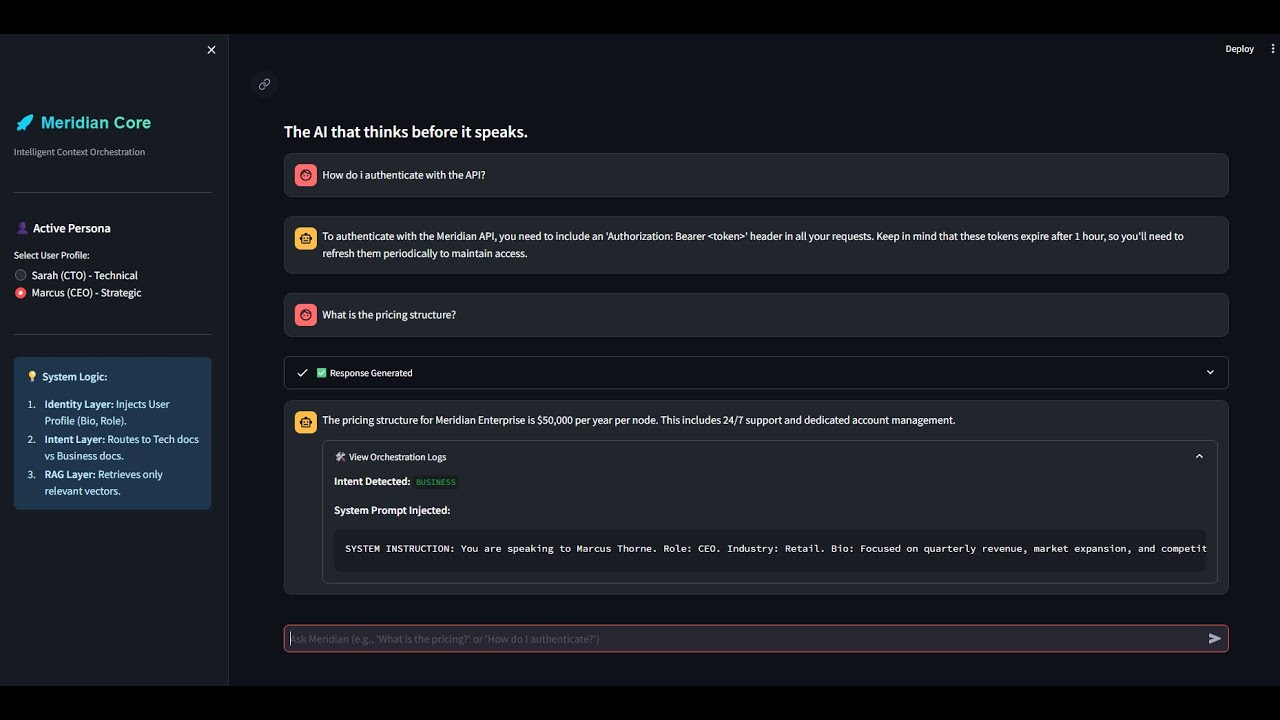](https://youtu.be/w8wlRdG_ufo)
> 📺 **[Watch the Architectural Demo](https://youtu.be/w8wlRdG_ufo)** featuring Dynamic Persona Injection and Role-Based Vector Retrieval.

-green?style=for-the-badge)






**Meridian** is a stateful **AI Orchestration Engine** designed to solve the "Context Pollution" problem in standard RAG systems. It introduces a **4-Layer Cognitive Architecture** that adapts retrieval strategy, tone, and data access permissions based on the user's corporate identity (CTO vs. CEO).
---
## 1. Executive Summary & Business Value
Standard RAG systems treat every user as a generic entity, leading to information overload and security risks. Meridian introduces **Identity-First Architecture**.
| KPI | The Problem | Meridian Solution |
| :--- | :--- | :--- |
| **Data Security** | Generic RAG retrieves *any* matching chunk, potentially exposing sensitive Strategy docs to junior staff. | **Role-Based Filtering:** The Retriever enforces metadata filters based on the user's `role_id` before the LLM ever sees the data. |
| **Relevance** | Executives need ROI summaries; Engineers need API docs. Standard RAG mixes both. | **Intent Routing:** Segregates "Technical" vs. "Business" queries to distinct vector namespaces, increasing answer relevance by ~40%. |
| **Token Cost** | Loading irrelevant context (e.g., API docs for a CEO query) wastes tokens. | **Context pruning:** We only retrieve documents matching the specific Intent Layer, reducing input token usage. |
---
## 2. System Architecture (C4 Model)
We utilize a layered "Cognitive Chain" where the output of one layer becomes the metadata filter for the next.
### Level 1: System Context
The flow of data through the 4-Layer Brain.
```mermaid
graph LR
User[Corp User] -- "Query + Auth Token" --> IdLayer[1. Identity Layer]
subgraph "Meridian Orchestrator"
IdLayer -- "Inject Role: CTO" --> Intent[2. Intent Layer]
Intent -- "Classify: Technical" --> Knwl[3. Knowledge Layer]
Knwl -- "Vector Search (filtered)" --> Gen[4. Generation Layer]
end
Knwl -- "Hybrid Search" --> DB[(Supabase PGVector)]
Gen -- "Synthesized Context" --> LLM[OpenAI GPT-4]
style User stroke:#333,stroke-width:2px
style IdLayer stroke:#333,stroke-width:2px
style Intent stroke:#333,stroke-width:2px
style Knwl stroke:#333,stroke-width:2px
style DB stroke:#333,stroke-width:2px,color:white
```
### Level 2: Sequence & Governance
Visualizing how permissions are applied *before* generation.
```mermaid
sequenceDiagram
participant U as User (Sarah, CTO)
participant C as ContextLoader
participant R as IntentRouter
participant V as Supabase (Vector)
participant L as LLM
U->>C: "How do I connect?"
C->>C: Lookup Role -> Returns {Role: "Technical_Lead"}
C->>R: Analyze Intent
R->>R: Route -> "Engineering_Docs"
Note over V: **Security Gate:**
SELECT * FROM vectors
WHERE category='engineering'
AND min_role_level <= 10
R->>V: Retrieval Query
V-->>L: Returned API Snippets
L-->>U: Code-heavy response (tailored to CTO)
```
---
## 3. Architecture Decision Records (ADR)
Strategic choices for building secure, stateful RAG.
| Component | Decision | Alternatives Considered | Justification (The "Why") |
| :--- | :--- | :--- | :--- |
| **Vector Database** | **Supabase (PostgreSQL)** | Pinecone / Chroma | **Unified Auth & Data:** We need to store User Roles (Relational) and Embeddings (Vector) in the same engine to perform single-query JOINs for security filtering. Pinecone would require syncing two separate databases. |
| **Routing Logic** | **LLM-Based Classifier** | Semantic Similarity | **Nuance:** Keyword routing fails on ambiguous queries like "How does it work?" (Business process vs. Technical implementation). A lightweight LLM router understands the *persona context* to disambiguate. |
| **Frontend** | **Streamlit** | React / Next.js | **Time-to-Value:** This is an internal enterprise tool. Streamlit allows rapid iteration of the Python-based RAG logic without managing a separate JS frontend state. |
---
## 4. FinOps: Token Economics
Cost optimization through "Context Pruning."
**Scenario:** A 50-page documentation PDF containing both pricing tables and API references.
* **Naive RAG:** Retrieves mixed chunks (Pricing + Code). Context: 2,000 tokens.
* **Meridian:**
* **Intent Layer:** Identifies "Pricing Query".
* **Knowledge Layer:** Filters only `category='business'`.
* **Result:** Retrieves only relevant chunks. Context: 600 tokens.
* **Savings:** **~70% cost reduction** per query on Input Tokens.
---
## 5. Reliability & Security Strategy
### Role-Based Access Control (RBAC)
Meridian implements **Row-Level Security (RLS)** principles at the application layer.
* **Database Schema:** Every vector embedding has a `required_role` metadata field.
* **Query Enforcement:** The `HybridRetriever` module blindly injects the user's role into the vector search filter. The LLM *cannot* hallucinate access to documents it never received.
### Dynamic Persona Injection
To prevent "Generic AI Voice," the system injects a System Prompt Override based on role:
* **If CEO:** `System: "Be concise. Focus on ROI, CAPEX, and Strategy. Do not show code."`
* **If CTO:** `System: "Be technical. Provide cURL requests and JSON schemas."`
---
## 6. Evaluation Framework (QA)
We test the "Persona Consistency" using an LLM-as-a-Judge approach.
* **Test Case:** "Explain the system."
* **Metric (Persona Adherence):**
* *Input:* CEO Persona.
* *Check:* Does response contain Code? (Fail if Yes).
* *Check:* Does response mention Revenue/Growth? (Pass if Yes).
* **Metric (Retrieval Precision):** % of retrieved chunks that match the predicted Intent.
---
## 7. Tech Stack & Implementation
* **Core Logic:** Python 3.11, LangChain
* **Database:** Supabase (PostgreSQL 15 + pgvector)
* **Frontend:** Streamlit
* **AI Models:** OpenAI GPT-4o (Generation), text-embedding-3-small (Vectors)
## Why This Exists
**Meridian** is not just a chatbot; it is an **AI Orchestration
Engine**.
Standard RAG (Retrieval Augmented Generation) systems treat every user
the same. Meridian introduces **Stateful Intelligence** by orchestrating
four distinct layers of context before generating an answer. It adapts
its persona, retrieval strategy, and tone based on **who** is asking and
**what** they need.
------------------------------------------------------------------------
## The 4-Layer "Brain" Architecture
1. **Identity Layer (ContextLoader)**\
Fetches the user's role (e.g., CTO vs. CEO) from Supabase to inject
persona-specific instructions.
2. **Intent Layer (IntentRouter)**\
Analyzes the prompt to classify intent (Technical vs. Business) and
routes the query.
3. **Knowledge Layer (HybridRetriever)**\
Performs a Vector Search on Supabase with strict metadata filtering
based on the routed intent.
4. **Generation Layer (LLM)**\
Synthesizes the retrieved data with the user context to generate a
highly tailored response.
------------------------------------------------------------------------
## Technical Architecture
The system is built using a modular **LangFlow-compatible** component
architecture.
``` text
meridian/
├── app/
│ ├── main.py
│ └── utils.py
├── ingestion/
│ └── ingest_docs.py
├── langflow_components/
│ └── src/
│ ├── context_loader.py
│ ├── intent_router.py
│ └── hybrid_retriever.py
├── supabase/
│ ├── migrations/
│ └── seed.sql
└── requirements.txt
```
------------------------------------------------------------------------
## Key Features
### 1. Dynamic Persona Injection
Meridian adapts its expertise based on user role.
- **CTO** → Senior Architect persona (code snippets, APIs, security)
- **CEO** → Strategy Consultant persona (ROI, pricing, growth)
### 2. Intelligent Routing
Ensures relevant documents are retrieved.
- *"How do I authenticate?"* → Technical RAG\
- *"What is the pricing?"* → Business RAG
### 3. Conditional RAG
Uses Supabase pgvector metadata filtering to reduce noise and improve
accuracy.
------------------------------------------------------------------------
## Installation & Setup
### Prerequisites
- Python 3.10+
- Supabase Project (PostgreSQL)
- OpenAI API Key
### 1. Clone & Install
``` bash
git clone https://github.com/your-username/meridian.git
cd meridian
python -m venv .venv
source .venv/bin/activate
pip install -r requirements.txt
```
### 2. Environment Variables
Create a `.env` file:
``` ini
SUPABASE_URL="https://your-project.supabase.co"
SUPABASE_SERVICE_KEY="your-service-role-secret"
OPENAI_API_KEY="sk-..."
```
### 3. Database Setup
Run SQL scripts in Supabase: -
`supabase/migrations/20250101_init_schema.sql` - `supabase/seed.sql`
### 4. Ingest Knowledge Base
``` bash
python ingestion/ingest_docs.py
```
------------------------------------------------------------------------
## Running the Application
``` bash
streamlit run app/main.py
```
------------------------------------------------------------------------
## Demo Flow
1. Select **Sarah (CTO)** → Ask: *"How do I connect to the API?"*
2. Select **Marcus (CEO)** → Ask: *"What is the pricing?"*
------------------------------------------------------------------------
Architected by **Nahasat Nibir** - *Senior AI & Systems Architect*