https://github.com/nonrational/short-sheet
Synchronize Shortcut ←→ Google Sheets
https://github.com/nonrational/short-sheet
google-sheets productivity project-management repl ruby shortcut
Last synced: 12 months ago
JSON representation
Synchronize Shortcut ←→ Google Sheets
- Host: GitHub
- URL: https://github.com/nonrational/short-sheet
- Owner: nonrational
- Created: 2023-03-06T19:34:27.000Z (over 3 years ago)
- Default Branch: main
- Last Pushed: 2025-02-27T05:06:08.000Z (over 1 year ago)
- Last Synced: 2025-02-27T06:20:17.400Z (over 1 year ago)
- Topics: google-sheets, productivity, project-management, repl, ruby, shortcut
- Language: Ruby
- Homepage:
- Size: 216 KB
- Stars: 1
- Watchers: 3
- Forks: 0
- Open Issues: 0
-
Metadata Files:
- Readme: README.md
Awesome Lists containing this project
README
# ShortSheet
A REPL environment and Rake tasks to synchronize [Shortcut](https://shortcut.com/) and [Google Sheets](https://workspace.google.com/) to enhance Shortcut's capabilities and facilitate low-friction planning.
## Feature Overview
- REPL with ActiveRecord-esque models for interacting with Shortcut & Sheets
- Bi-directional sync between Shortcut Epics and Google Sheets
- Automatic creation of canonically named Bi-Monthly Iterations
- [Prioritization of iteration "Ready" stories](https://github.com/nonrational/short-sheet/blob/main/lib/tasks/iteration_ready_sort.rb#L34-L41) based on epic sort order, priority, product area, blocked status, due date, etc.
- Template-based Shortcut Epic creation for things like Monthly Chores
- Local Sinatra-based OAuth2 authorize endpoints to create Google OAuth Access Tokens 🐐
- Bulk creation of stories from CSV
- Migrate deprecated "Project" field values to Custom Field values
- ~~Automatically move all incomplete stories from the previous iteration to the current iteration~~ 🎉 Now supported natively in Shortcut
## Why Google Sheets?
This project provides customization and automation that sits on top of Shortcut to provide a more flexible and powerful planning experience. Google Sheets is familiar and flexible. A central "planning sheet" can then be a staging area to prioritize and organize initiatives before they're pushed into Shortcut.
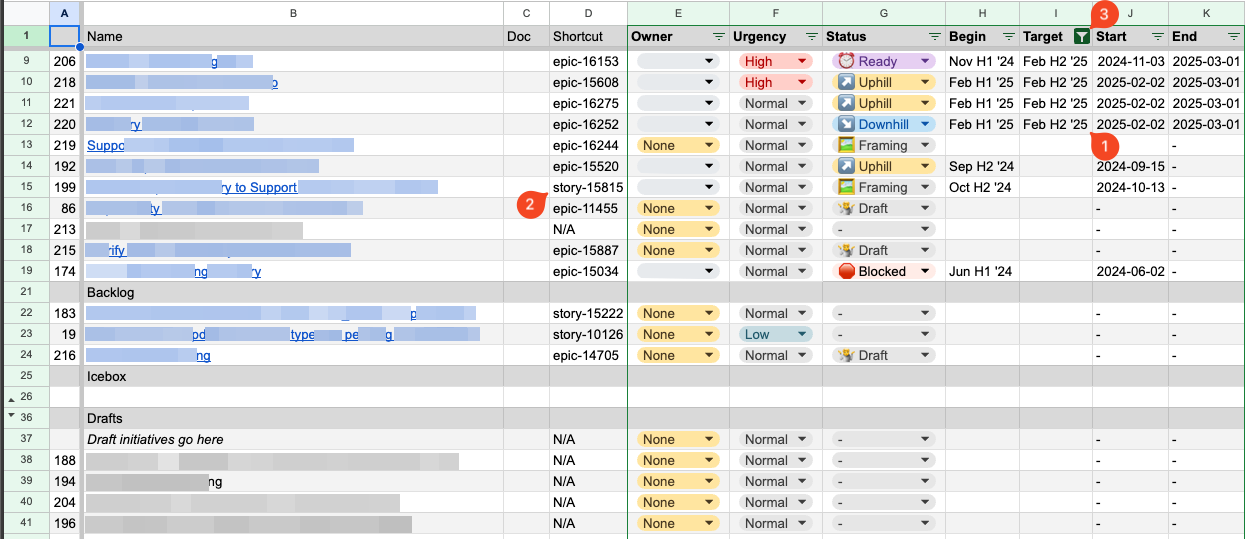
### ① Iteration-Bound Delivery
Rather than needing to think in target _dates_, we've found it helpful to think in target _iterations_. Our planning sheet automatically translates canonical iteration names with start/end dates, so we can plan talking about iterations, then push the resulting dates into Shortcut epics.
### ② Story to Epic Evolution
When we consider a new initiative, it usually starts as a "Scoping" story in Shortcut. That story represents discovery and definition of the initiative. After scoping is complete, we'll make a go/no-go decision. If we decide not to proceed right now, having an Epic sitting in the hopper is confusing. So, the Sheet view allows us to prioritize Epics _alongside Stories_. The Sheet order can then be pushed into Shortcut.
### ③ Obvious Filtering
Using Google Sheet's column filtering criteria is more intuitive for those less familiar with Shortcut.
## Automation
### Task Summary
```
$ rake -T
rake config:check # Check config is valid
rake config:export # Export the config.yml file as a base64 encoded string
rake monthly_chores:create_current # Create the next monthly chores epic
rake monthly_chores:create_next # Create the next monthly chores epic
rake planning:prioritize_shortcut # Sort epics by sheet order and ready stories by priority
rake planning:review # Interactively review any out-of-sync initiatives and choose whether to update shortcut or the sheet
rake planning:update_sheet # Fetch information from shortcut and update the sheet with it
rake shortcut:iteration:create_next # Create the next iteration
rake shortcut:project_sync:run # Ensure that all stories with a project have the correct product area set
```
### Scheduling
Once you've got everything configured in `config.yml`, run `rake config:export` to produce a base64'd version suitable to drop into ENV to trigger actions via GitHub Actions or another crotab-like provider.
## Development
```shell
asdf plugin add ruby
asdf install
gem install bundler
bundle
```
## Configuration
See `config.yml.example`
### Shortcut Credentials
Set `shortcut-api-token` in `config.yml` or `SHORTCUT_API_TOKEN` in `.env`.
### Google Workspace Credentials
1. Generate an OAuth2 Client at https://console.cloud.google.com/apis/credentials with the required scopes and permissions to access the Drive and Sheets APIs.
1. Download its JSON config to `client_secrets.json`.
1. Run `make serve` and visit http://localhost:4567 to fetch access and refresh tokens, saving them to `google_credentials.json`.
1. The refresh token will then automatically be used to refresh your credentials as necessary.
## Rake Completion via Homebrew
Tab completion for `rake` is really handy.
```sh
brew install bash bash-completion
curl -o "$(brew --prefix)/etc/bash_completion.d/rake" \
"https://raw.githubusercontent.com/ai/rake-completion/e46866ebf5d2e0d5b8cb3f03bae6ff98f22a2899/rake"
```