https://github.com/normalhuman01/elclaustro-strapi
https://github.com/normalhuman01/elclaustro-strapi
Last synced: over 1 year ago
JSON representation
- Host: GitHub
- URL: https://github.com/normalhuman01/elclaustro-strapi
- Owner: normalhuman01
- License: mit
- Created: 2023-12-16T21:40:49.000Z (over 2 years ago)
- Default Branch: main
- Last Pushed: 2023-12-16T21:42:59.000Z (over 2 years ago)
- Last Synced: 2025-02-01T12:45:32.436Z (over 1 year ago)
- Language: TypeScript
- Size: 22.9 MB
- Stars: 0
- Watchers: 1
- Forks: 0
- Open Issues: 0
-
Metadata Files:
- Readme: README.md
- License: LICENSE
Awesome Lists containing this project
README
# Strapi Starter Next 13, Tailwind, Typescript and Strapi
note: This project was started with love by [Trecia](https://github.com/TreciaKS), [Daniel](https://github.com/malgamves) and [Paul](https://github.com/PaulBratslavsky). We were all new to Next 13 and Typescript. If you find any bugs or improvements feel free to create an issue. Thank you all for your support and participation.

## Getting Started
1. Clone the repository locally:
```bash
git clone https://github.com/strapi/nextjs-corporate-starter.git
or
gh repo clone strapi/nextjs-corporate-starter
```
2. Run `setup` command to setup frontend and backend dependencies:
```bash
yarn setup
```
3. Next Set up your `.env` file. You can use use the `.env.example` file as reference:
```bash
HOST=localhost
PORT=1337
APP_KEYS="toBeModified1,toBeModified2"
API_TOKEN_SALT=tobemodified
ADMIN_JWT_SECRET=tobemodified
JWT_SECRET=tobemodified
TRANSFER_TOKEN_SALT=tobemodified
```
4. Start Your Project by running the following command:
```bash
yarn build
yarn develop
```
You will be prompted to create your first admin user.

Great. You now have your project running. Let's add some data.
## Seeding The Data
We are going to use our DEITS feature which will alow to easily import data into your project.
You can learn more about it in our documentation. <-- need link to docs -->
In the root of our project we have our `seed-data.tar.gz` file. We will use it to seed our data.
1. Open up your terminal and make sure you are still in you `backend` folder.
2. Run the following command to seed your data:
```bash
yarn strapi import -f ../seed-data.tar.gz
```

This will import your data locally. Log back into your admin panel to see the newly imported data.
## Setting Up The Frontend
Next we need to create our `.env` file and paste in the following.
```bash
NEXT_PUBLIC_STRAPI_API_TOKEN=your-api-token
NEXT_PUBLIC_PAGE_LIMIT=6
NEXT_STRAPI_FORM_SUBMISSION_TOKEN=your-form-submission-token
NEXT_STRAPI_API_URL=http://localhost:1337
```
Before starting our Next JS app we need to go inside our Strapi Admin and create two tokens that we will be using for **form submission** and displaying our **content**.
Inside your Strapi Admin Panel navigate to Settings -> API Tokens and click on the `Create new API Token`.
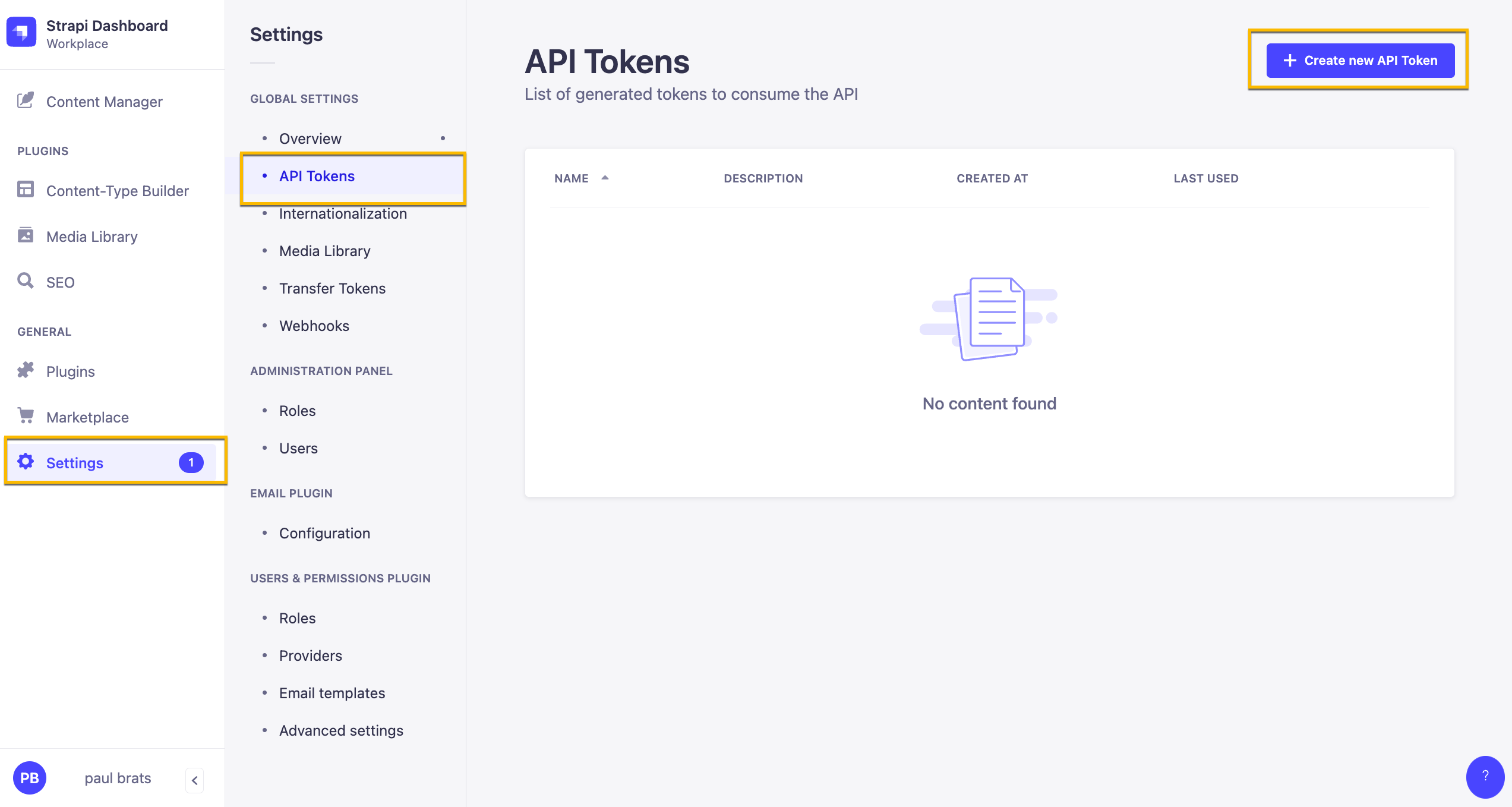
Here are our Token Settings
Name: Public API Token Content
Description: Access to public content.
Token duration: Unlimited
Token type: Custom
In Permissions lets give the following access.
| Content | Permissions |
| --------------- | :--------------: |
| Article | find and findOne |
| Author | find and findOne |
| Category | find and findOne |
| Global | find |
| Page | find and findOne |
| Product-feature | find and findOne |

Once you have your token add it to your `NEXT_STRAPI_API_TOKEN` variable name in the `.env` file.
**Alternatively:** you can create a READ only Token that will give READ permission to all your endpoints.
In this particular project this is not an issue. Although the above is the recommended way, just wanted to show you this option here as well.
When creating a Token, just select the `Read-only` option from token type drop down.

Next create a token that will allow us to submit our form.
Name: Public API Form Submit
Description: Form Submission.
Token duration: Unlimited
Token type: Custom
In Permissions lets give the following access.
| Content | Permissions |
| -------------------- | :---------: |
| Lead-Form-Submission | create |
Add your token to your `NEXT_STRAPI_FORM_SUBMISSION_TOKEN` variable name in the `.env` file.
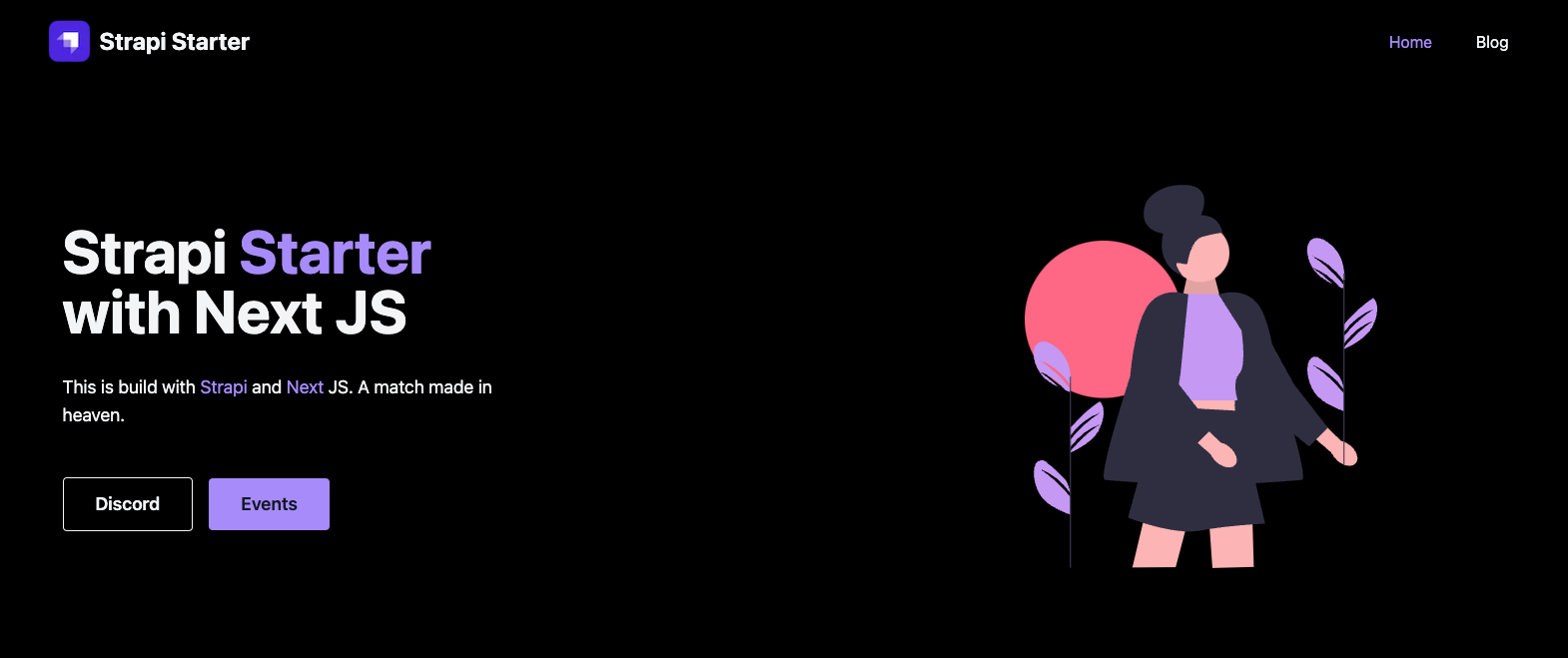
Once your environment variables are set you can start your frontend application by running `yarn dev`.
You should now see your Next JS frontend.
## Start Both Projects Concurrently
We can also start both projects with one command using the `concurrently` package.
You can find the setting inside the `package.json` file inside the root folder.
```json
{
"scripts": {
"frontend": "yarn dev --prefix ../frontend/",
"backend": "yarn dev --prefix ../backend/",
"clear": "cd frontend && rm -rf .next && rm -rf cache",
"init:frontend": "cd frontend && yarn",
"init:backend": "cd backend && yarn",
"setup": "yarn install && yarn init:frontend && yarn init:backend",
"dev": "yarn clear && concurrently \"cd frontend && yarn dev\" \"cd backend && yarn develop\""
},
"dependencies": {
"concurrently": "^7.6.0"
}
}
```
You can start both apps by running `yarn dev`.
## Conclusion
Hope you find this starter useful, it is a bare-bone example to help you get started quickly.
Would love to hear what you will build using it.
If you find bugs or have suggestions feel free to create issues.
Thank you and stay awesome.