https://github.com/notyusheng/tracepcap
Self-hosted LLM network packet analysis tool. Visualize network traffic patterns, analyze packet flows, generate intelligent filters, and gain insights through AI-powered analysis. Perfect for network troubleshooting, security analysis, protocol debugging, or educational purposes.
https://github.com/notyusheng/tracepcap
ai blue-team cyber-defense cybersecurity data-visualization llm ndpi network-forensics network-monitoring network-visualization packet-analysis pcap pcap-analyzer pcap4j protocol-analysis self-hosted sgds soc tshark wireshark
Last synced: 3 months ago
JSON representation
Self-hosted LLM network packet analysis tool. Visualize network traffic patterns, analyze packet flows, generate intelligent filters, and gain insights through AI-powered analysis. Perfect for network troubleshooting, security analysis, protocol debugging, or educational purposes.
- Host: GitHub
- URL: https://github.com/notyusheng/tracepcap
- Owner: NotYuSheng
- License: mit
- Created: 2026-01-31T11:53:19.000Z (5 months ago)
- Default Branch: main
- Last Pushed: 2026-04-04T04:01:58.000Z (3 months ago)
- Last Synced: 2026-04-04T04:26:58.461Z (3 months ago)
- Topics: ai, blue-team, cyber-defense, cybersecurity, data-visualization, llm, ndpi, network-forensics, network-monitoring, network-visualization, packet-analysis, pcap, pcap-analyzer, pcap4j, protocol-analysis, self-hosted, sgds, soc, tshark, wireshark
- Language: Java
- Homepage:
- Size: 7.86 MB
- Stars: 5
- Watchers: 1
- Forks: 0
- Open Issues: 9
-
Metadata Files:
- Readme: README.md
- License: LICENSE
Awesome Lists containing this project
README
TracePcap
Intelligent PCAP file analysis with AI-powered insights and interactive network visualization
Features •
Quick Start •
Usage •
Documentation


---
A comprehensive network packet analysis tool that runs entirely self-hosted. Upload PCAP files to visualize network traffic patterns, analyze packet flows, generate intelligent filters, and gain insights through AI-powered analysis. Perfect for network troubleshooting, security analysis, protocol debugging, or educational purposes.
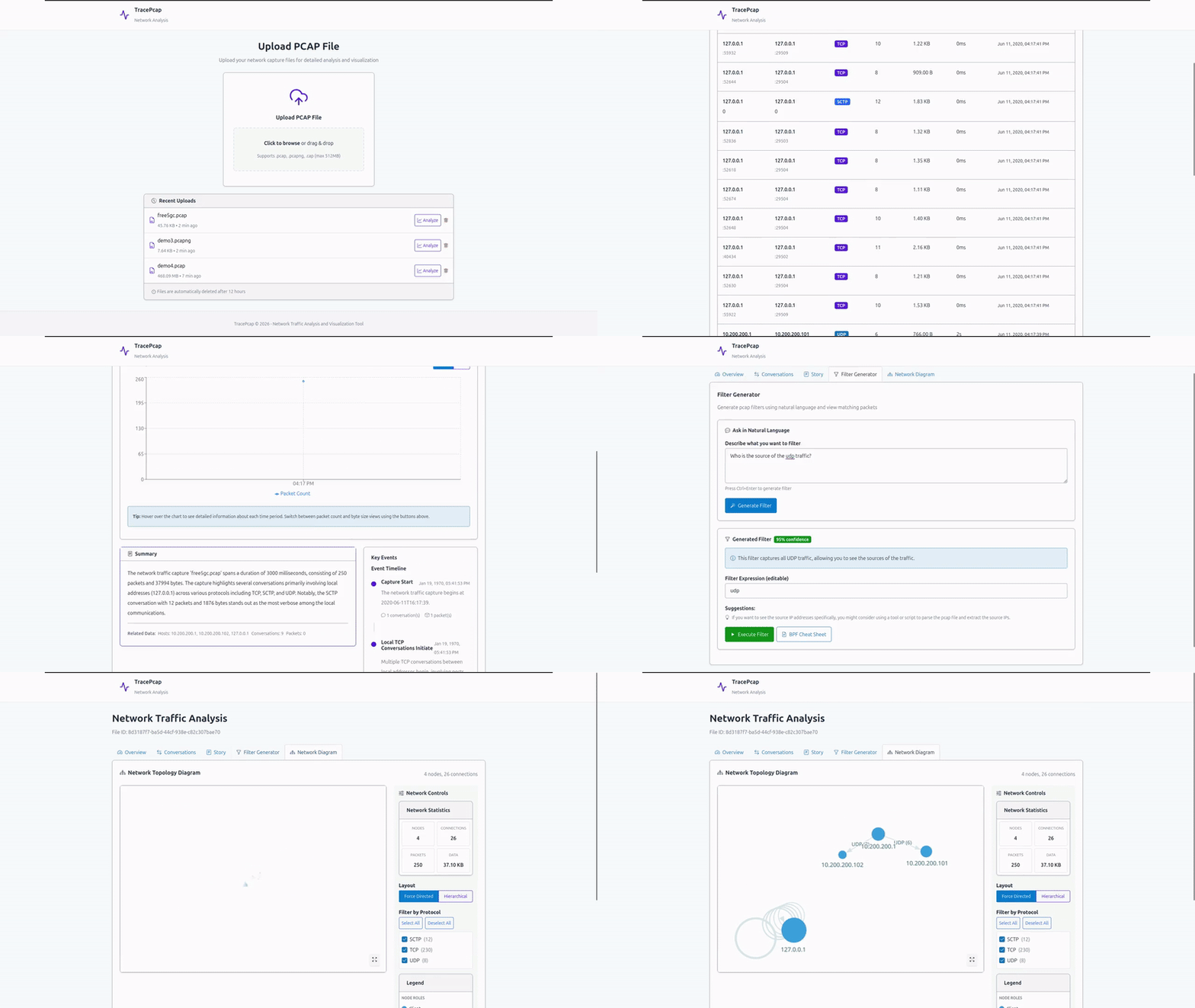
## Features
| Feature | Description |
|---------|-------------|
| **PCAP Upload & Management** | Upload and manage PCAP/PCAPNG/CAP files (max 512MB) with MinIO object storage; duplicate detection and configurable upload limits |
| **Network Visualization** | Interactive network topology using React Flow + ELK layout with a rich filter panel (IP, port, device type, protocol, risk), fullscreen toggle, layout controls, and clickable node detail panel |
| **nDPI Security Detection** | Deep packet inspection via nDPI v5: application identification, traffic categories, risk/alert flags, JA3/JA3S TLS fingerprints, SNI extraction, and TLS certificate metadata per conversation |
| **Conversation Tracking** | Paginated conversation list with advanced filtering (IP, port, protocol, app, risk, custom rules, device type, country, payload pattern), multi-column sorting, column picker, and bulk PCAP export |
| **Session Reconstruction** | TCP/UDP application-layer payload decoding with a hex+ASCII viewer for inspecting raw packet payloads |
| **File Extraction** | HTTP object extraction and raw TCP/UDP stream extraction via Aho-Corasick; automatic MIME type detection; bulk download |
| **Geolocation & Device Classification** | Country/ASN enrichment for external IPs; automatic device-type prediction (Router, Server, IoT, Mobile, Laptop/Desktop) across all views |
| **MAC Manufacturer Lookup** | Wireshark OUI database integration for vendor identification from MAC addresses |
| **Timeline Analysis** | Chronological traffic visualization with configurable time granularity (auto or manual) and protocol breakdown |
| **AI Filter Generator** | LLM-powered Wireshark/tcpdump filter generation from natural language queries with confidence scores and packet-level results |
| **Story Mode** | AI-generated narrative reconstruction of network activities with an interactive LLM Q&A chat, custom context input, and story timeline |
| **Custom Signature Rules** | YAML-based detection rules matched against IP, CIDR, port, JA3, hostname, app, and protocol fields; live-reloaded without restart |
| **Export Options** | PDF report (with live topology capture), per-conversation PCAP, bulk PCAP export, and CSV export |
| **Real-time Processing** | Asynchronous analysis with detailed progress tracking |
| **Multi-protocol Support** | TCP, UDP, ICMP, and application-layer protocols including TLS, HTTP, DNS, QUIC, and L2 protocols (ARP, STP, LLDP, CDP) |
## Quick Start
### Prerequisites
| Software | Version | Purpose |
|----------|---------|---------|
| Docker | Latest | Container runtime |
| Docker Compose | Latest | Multi-container orchestration |
| LLM Server | Any OpenAI-compatible API | AI filter generation (e.g., LM Studio, Ollama, OpenAI) |
**Minimum Hardware:**
- RAM: 4GB (8GB+ recommended)
- Storage: 10GB (for database, PCAP files, and object storage)
### Installation
**1. Clone and setup:**
```bash
git clone https://github.com/NotYuSheng/TracePcap.git
cd TracePcap
cp .env.example .env
```
**2. Configure `.env`:**
```env
# Upload Configuration
MAX_UPLOAD_SIZE_BYTES=536870912 # 512MB default
# Nginx Port Configuration
NGINX_PORT=80 # Change if port 80 is already in use
# LLM Configuration (Local LLM Server)
LLM_API_BASE_URL=http://localhost:1234/v1
LLM_API_KEY=
LLM_MODEL=Qwen2.5-14B-Coder-Instruct
LLM_TEMPERATURE=0.7
LLM_MAX_TOKENS=2000
```
**3. Start the application:**
```bash
docker compose up -d
```
**4. Access TracePcap:**
Open **http://localhost:80** in your browser.
> **Note**: The application includes PostgreSQL for metadata storage and MinIO for PCAP file storage. First startup may take a few minutes while containers initialize.
## Usage
### Basic Workflow
1. **Upload** — Drag-and-drop a PCAP/PCAPNG file; optionally enable nDPI analysis and file extraction before uploading
2. **Analyze** — File is processed asynchronously with a detailed progress view
3. **Overview** — Review detected applications, protocols, risk alerts, and custom signature matches
4. **Visualize** — Explore the interactive network topology with filters, layout controls, and node detail panels
5. **Conversations** — Review flows with advanced filtering, session reconstruction, and payload inspection
6. **Story Mode** — Read the AI-generated narrative and ask follow-up questions via LLM chat
7. **Extracted Files** — Browse and download files recovered from HTTP responses and raw streams
8. **Generate Filters** — Use AI to create Wireshark/tcpdump filters from natural language (e.g., "show all TLS traffic to external IPs")
9. **Export** — Download a PDF report, per-conversation or bulk PCAP, or CSV
### Supported File Formats
PCAP, PCAPNG, CAP (max 512MB default, configurable via `MAX_UPLOAD_SIZE_BYTES`)
## Tech Stack
| Component | Technology |
|-----------|------------|
| **Backend** | Spring Boot 3.2.1, Java 21, Maven, Lombok, MapStruct |
| **Architecture** | Layered architecture (Controller → Service → Repository → Database) |
| **Frontend** | React 19, Vite, TypeScript, Lucide Icons, SGDS React |
| **Visualization** | React Flow + ELK (network topology), Recharts, D3.js |
| **Reverse Proxy** | Nginx |
| **Packet Parsing** | tshark / Wireshark, nDPI v5 (deep packet inspection) |
| **Database** | PostgreSQL 15 with Flyway migrations |
| **Object Storage** | MinIO (S3-compatible) |
| **Containerization** | Docker, Docker Compose |
| **API Documentation** | SpringDoc OpenAPI (Swagger UI) |
## Documentation
Comprehensive documentation is available in the [`docs/`](docs/) directory:
| Document | Description |
|----------|-------------|
| **[API Endpoints](docs/API_ENDPOINTS.md)** | Complete REST API documentation with request/response examples |
| **[Backend Structure](docs/BACKEND_STRUCTURE.md)** | Backend architecture, package organization, and design patterns |
## Common Tasks
### View Logs
```bash
# All services
docker compose logs -f
# Specific service
docker compose logs -f tracepcap-backend
docker compose logs -f postgres
docker compose logs -f minio
```
### Restart Services
```bash
# Restart all
docker compose restart
# Restart backend only
docker compose restart tracepcap-backend
```
### Backup Data
```bash
# Backup database
docker exec tracepcap-postgres pg_dump -U tracepcap_user tracepcap > backup.sql
# Backup MinIO data (PCAP files)
docker exec tracepcap-minio mc mirror minio/tracepcap-files ./backup-pcaps/
# Backup all volumes
sudo tar -czf tracepcap_backup.tar.gz /var/lib/docker/volumes/tracepcap_*
```
### Access Database
```bash
docker exec -it tracepcap-postgres psql -U tracepcap_user tracepcap
```
### Access MinIO Console
Navigate to **http://localhost:9001** and login with:
- Username: `minioadmin`
- Password: `minioadmin`
### Access Swagger API Documentation
Navigate to **http://localhost:80/swagger-ui.html** to explore the API interactively.
## Deployment
TracePcap is designed for self-hosted deployment:
- **Development**: Use built-in configuration with exposed ports
- **Production**:
- Change default MinIO credentials in `docker-compose.yml`
- Update PostgreSQL password
- Configure reverse proxy with SSL/TLS
- Adjust `MAX_UPLOAD_SIZE_BYTES` based on your needs
- Set appropriate LLM configuration for your infrastructure
## Security
- **Local Processing**: PCAP analysis runs entirely on your server
- **Data Privacy**: Network captures never leave your infrastructure (except LLM filter generation)
- **Object Storage**: MinIO provides S3-compatible secure file storage
- **Database**: PostgreSQL not exposed outside Docker network by default
- **No Authentication**: Add authentication layer for multi-user deployments
- **LLM Privacy**: Use local LLM servers (LM Studio, Ollama) to keep filter queries private
## Performance
- **Async Processing**: File analysis runs asynchronously to prevent blocking
- **Object Storage**: MinIO provides scalable storage for large PCAP files
- **Database Indexing**: Optimized queries with proper indexing for fast lookups
- **Connection Pooling**: Efficient database connection management
- **File Size Limits**: Configurable upload limits to prevent resource exhaustion
## Architecture Highlights
- **Layered Architecture**: Clean separation of concerns (API → Service → Repository → Database)
- **DTO Pattern**: MapStruct for efficient object mapping between layers
- **Database Migrations**: Flyway for version-controlled schema management
- **Health Checks**: Built-in health checks for all services
- **API-First Design**: OpenAPI specification with Swagger UI
## Custom Signature Rules
TracePcap supports user-defined detection rules that are matched against every conversation after nDPI analysis. Matched rule names appear as color-coded badges in the Conversations tab and Overview, alongside nDPI's built-in detections.
### How it works
Rules live inside a Docker named volume (`config_data`) at `/app/config/signatures.yml` inside the backend container. The file is reloaded on every analysis run — no restart required after editing.
Click **Custom Detection Rules** in the navbar to open the built-in YAML editor. Changes are saved immediately — no restart required.
> **`signatures.sample.yml`** in the repo root is a reference template with demo rules covering every match field. Paste it into the browser editor to get started.
### Rule format
```yaml
signatures:
- name: rule_name_shown_in_ui # shown as a badge (use underscores, no spaces)
description: Human-readable description
severity: low # low | medium | high | critical
match:
ip: "203.0.113.42" # exact match against srcIp OR dstIp
```
A rule fires when **all** specified match fields are satisfied. All fields are optional — mix and match as needed.
### Match fields
| Field | Type | Description | Example |
|-------|------|-------------|---------|
| `ip` | string | Exact match against srcIp or dstIp | `"203.0.113.42"` |
| `cidr` | string | CIDR range match against srcIp or dstIp | `"10.0.0.0/8"` |
| `srcPort` | number | Exact source port | `67` |
| `dstPort` | number | Exact destination port | `4444` |
| `ja3` | string | Exact JA3S fingerprint hash (nDPI 5.x) | `"82f0d8a75fa483d1cfe4b7085b784d7e"` |
| `hostname` | string | Exact or wildcard SNI hostname — `*.evil.com` matches any subdomain at any depth | `"*.evil.com"` |
| `app` | string | Case-insensitive nDPI application name | `"Telegram"`, `"TOR"`, `"SIP"`, `"RTP"` |
| `protocol` | string | Case-insensitive transport protocol | `"TCP"`, `"UDP"`, `"ICMP"` |
### Severity colors
| Severity | Color |
|----------|-------|
| `critical` | Red |
| `high` | Orange |
| `medium` | Yellow |
| `low` | Purple |
### Examples
```yaml
signatures:
# Flag a known C2 IP
- name: known_c2_ip
description: Known command-and-control server
severity: high
match:
ip: "203.0.113.42"
# Flag all traffic to a suspicious subnet
- name: flagged_subnet
severity: medium
match:
cidr: "198.51.100.0/24"
# Detect DNS over TCP (possible zone transfer or tunnelling)
- name: dns_over_tcp
severity: medium
match:
app: "DNS"
protocol: TCP
# Wildcard hostname match
- name: blocked_domain
severity: high
match:
hostname: "*.malware.example.com"
# JA3S fingerprint from a threat-intel feed
- name: suspicious_tls_fingerprint
severity: critical
match:
ja3: "a0e9f5d64349fb13191bc781f81f42e1"
```
A full set of 12 demo rules covering every match field type is available in [`signatures.sample.yml`](signatures.sample.yml). The script [`sample-files/gen_demo.py`](sample-files/gen_demo.py) generates a PCAP file that triggers all 12 rules at once.
## Sample Files
The [`sample-files/`](sample-files/) directory contains example PCAP files:
- `atm_capture1.cap` - ATM network traffic sample
- `free5gc.pcap` - 5G core network traffic sample
- `demo_all_rules.pcap` - Triggers all 12 custom signature demo rules (generated by `gen_demo.py`)
These files can be used to test the application's analysis capabilities.
## License
This project is licensed under the MIT License. See [LICENSE](LICENSE) for details.