https://github.com/olehdutchenko/gulp-happiness
Gulp plugin for happiness
https://github.com/olehdutchenko/gulp-happiness
code-style gulp-plugin happiness javascript linter
Last synced: 11 months ago
JSON representation
Gulp plugin for happiness
- Host: GitHub
- URL: https://github.com/olehdutchenko/gulp-happiness
- Owner: OlehDutchenko
- License: mit
- Created: 2017-05-15T20:46:45.000Z (about 9 years ago)
- Default Branch: master
- Last Pushed: 2017-11-18T07:31:06.000Z (over 8 years ago)
- Last Synced: 2025-05-31T07:07:32.748Z (about 1 year ago)
- Topics: code-style, gulp-plugin, happiness, javascript, linter
- Language: JavaScript
- Homepage:
- Size: 144 KB
- Stars: 1
- Watchers: 1
- Forks: 0
- Open Issues: 0
-
Metadata Files:
- Readme: README.md
- Changelog: CHANGELOG.md
- Contributing: CONTRIBUTING.md
- License: LICENSE
Awesome Lists containing this project
README
# gulp-happiness

[-blue.svg)](https://nodejs.org/en/docs/es6/)
[](https://github.com/dutchenkoOleg/gulp-happiness/blob/master/LICENSE)
[](https://travis-ci.org/dutchenkoOleg/gulp-happiness)
[](https://www.versioneye.com/user/projects/592bb907a8a056006137f481?child=summary)
> _Gulp plugin for [happiness](https://www.npmjs.com/package/happiness)_
[](https://github.com/JedWatson/happiness)
---
## Installing
```shell
npm install --save gulp-happiness
# or using yarn cli
yarn add gulp-happiness
```
## Usage
Check out files with [happiness](https://www.npmjs.com/package/happiness) linter
```js
const gulp = require('gulp');
const gulpHappiness = require('gulp-happiness');
gulp.task('lint', function () {
return gulp.src(['**/*.js','!node_modules/**'])
// Attaches the lint data to the "eslint" property
// of the file object so it can be used by other modules.
// By default it will skip files with empty content
// and if filename starts with _ (underscore)
.pipe(gulpHappiness())
// eslint.format() outputs the lint results to the console.
.pipe(gulpHappiness.format())
// Look after checking all the streamed files,
// and if at least one of them has errors it will fail.
// Note! This method does not transfer files further to the stream!
.pipe(gulpHappiness.failAfterError());
});
```
Lint files, fix and transfer
```js
const gulp = require('gulp');
const gulpHappiness = require('gulp-happiness');
gulp.task('lint', function () {
return gulp.src('./src/scripts/**/*.js')
// Enable fixing - fix: true.
// If auto fixing cannot be done,
// you will see message in console about it
.pipe(gulpHappiness({
fix: true
}))
// Show in console happy files ;)
.pipe(gulpHappiness.format({
showHappyFiles: true
}))
// Failing if file has eslint errors,
// it will break task immediately.
// Current file and all next not will be transferred
.pipe(gulpHappiness.failOnError())
// transfer files
.pipe(gulp.dest('./dist/assets/js/'));
});
```
---
## API
- [gulpHappiness()](#gulphappiness)
- [gulpHappiness(options)](#gulphappinessoptions)
- [gulpHappiness.format()](#gulphappinessformat)
- [gulpHappiness.format(formatterName)](#gulphappinessformatformattername)
- [gulpHappiness.format(formatterFunction)](#gulphappinessformatformatterfunction)
- [gulpHappiness.format(formatterName/formatterFunction, options)](#gulphappinessformatformatternameformatterfunction-options)
- [gulpHappiness.failOnError()](#gulphappinessfailonerror)
- [gulpHappiness.failOnError(options)](#gulphappinessfailonerroroptions)
- [gulpHappiness.failAfterError()](#gulphappinessfailaftererror)
- [gulpHappiness.failAfterError(options)](#gulphappinessfailaftererroroptions)
### gulpHappiness()
_No explicit configuration._
Linting with default options.
Attaches the lint data to the "eslint" property of the file object so it can be used by other modules.
### gulpHappiness(options)
#### options.fix
type `boolean` /
default `undefined`
Fix most issues automatically if set `true`.
*__Note!__ It will not fix original files in your fs.
It will fix files in stream and you must save them where you need by using `gulp.dest()` after linting*
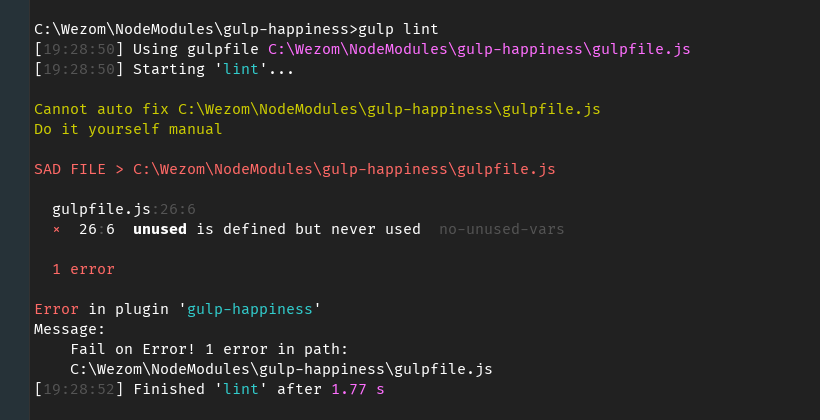
*__Note!__ If auto fixing cannot be done - you will see message in console about it.*
_Example of log:_
#### options.linterOptions
type `Object` /
default `undefined`
Options for [happiness](https://www.npmjs.com/package/happiness) linter
#### options.linterOptions.globals
type `Array.` /
default `undefined`
Custom global variables to declare (e.g. `['jquery', '$']`)
#### options.linterOptions.plugins
type `Array.` /
default `undefined`
Custom eslint plugins
#### options.linterOptions.envs
type `Array.` /
default `undefined`
Custom eslint environment
#### options.linterOptions.parser
type `string` /
default `undefined`
Custom js parser (e.g. `'babel-eslint'`)
#### options.noUnderscore
type `boolean` /
default `true`
File which name starts with _ (underscore) will be skipped and not using in stream next.
_You will receive message in console if it happens._
_Example of log:_

#### options.noEmpty
type `boolean` /
default `true`
File with empty content will be skipped and not using in stream next.
_**Note!** Spaces, tabs and newlines will be treated as empty content._
_You will receive message in console if it happens._
_Example of log:_

#### options.silent
type `boolean` /
default `undefined`
No logs about `noEmpty` and `noUnderscore` files
### gulpHappiness.format()
_No explicit configuration._
Outputs the lint results to the console.
Default formatter is [`eslint-formatter-pretty`](https://www.npmjs.com/package/eslint-formatter-pretty)
### gulpHappiness.format(formatterName)
#### formatterName
type `string`
You can use formatter by default
`gulpHappiness.format('default')` - same as `gulpHappiness.format()`
or use one of the [ESLint-provided formatters](https://github.com/eslint/eslint/tree/master/lib/formatters),
for example `gulpHappiness.format('stylish')`
or use some else formatter which you can install from npm [https://www.npmjs.com/search?q=eslint+formatter](https://www.npmjs.com/search?q=eslint+formatter)
_Example_
```shell
npm i --save eslint-friendly-formatter
```
```js
const gulp = require('gulp');
const gulpHappiness = require('gulp-happiness');
gulp.task('lint', function () {
return gulp.src(['**/*.js','!node_modules/**'])
.pipe(gulpHappiness())
.pipe(gulpHappiness.format('eslint-friendly-formatter'))
});
```
### gulpHappiness.format(formatterFunction)
#### formatterFunction(results[, formatterOptions])
type `function`
_Parameters:_
Name | Data type | Description
--- | --- | ---
`results` | `Array` | Results of eslint
`formatterOptions` | `Object/undefined` | Options for formatter
You can use own function or existing formatters as function [https://www.npmjs.com/search?q=eslint+formatter](https://www.npmjs.com/search?q=eslint+formatter)
___Note!___ Function will receive results array from eslint data for formatting.
And it is must return output as string if has problems in received results for console or some negative value, e.g. `null | undefined | false | '' `.
_Example with custom formatter function_
```js
const gulp = require('gulp');
const gulpHappiness = require('gulp-happiness');
gulp.task('lint', function () {
return gulp.src(['**/*.js','!node_modules/**'])
.pipe(gulpHappiness())
.pipe(gulpHappiness.format(function(results, formatterOptions={}) {
// process results and options
// ...
let output = myOwnMethodForTransformResults(results, transformOptions);
return output;
}))
});
```
_Example with installed formatter function_
```shell
npm i --save eslint-friendly-formatter
```
```js
const gulp = require('gulp');
const gulpHappiness = require('gulp-happiness');
const eslintFriendlyFormatter = require('eslint-friendly-formatter');
gulp.task('lint', function () {
return gulp.src(['**/*.js','!node_modules/**'])
.pipe(gulpHappiness())
.pipe(gulpHappiness.format(eslintFriendlyFormatter))
});
```
### gulpHappiness.format(formatterName/formatterFunction, options)
#### formatterName/formatterFunction
see above [formatterName](#formattername) and [formatterFunction](#formatterfunctionresults-formatteroptions)
#### options.formatterOptions
type `Object` /
default `undefined`
Options for the chosen formatter
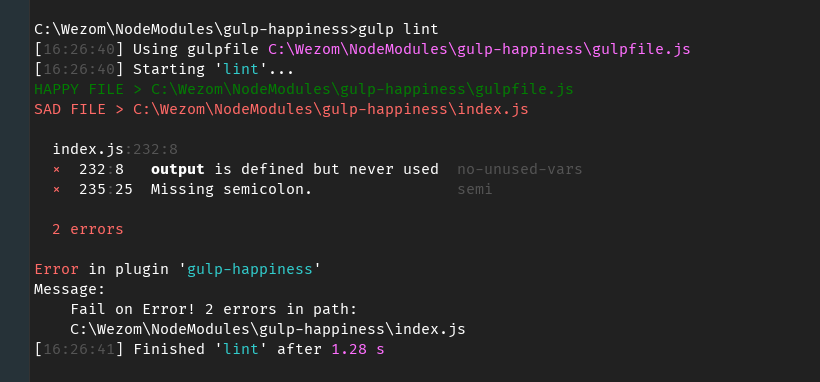
#### options.showHappyFiles
type `boolean` /
default `undefined`
Show files without problems in console
_Example of log:_
#### options.noUnderscore
Same as [gulpHappiness(options) → options.noUnderscore](#optionsnounderscore)
#### options.noEmpty
Same as [gulpHappiness(options) → options.noEmpty](#optionsnoempty)
#### options.silent
Same as [gulpHappiness(options) → options.silent](#optionssilent)
### gulpHappiness.failOnError()
_No explicit configuration._
### gulpHappiness.failOnError(options)
#### options.disabled
type `boolean` /
default `undefined`
Not fail on errors
#### options.onEnd(errorMsg, eslintData)
type `fucnction` /
default `undefined`
_Parameters:_
Name | Data type | Description
--- | --- | ---
`errorMsg` | `null/string` | Is `null` if no errors were found and is `string` if errors were found. String contains a short message about errors
`eslintData` | `Object` | eslint data from file
Its call will be before ending of pipe. So you don't need apply no callbacks or return some values.
You can use it for own custom actions, e.g rewrite some globals.
___Note!___ Even if `options.disabled` - is `true` - this function will be called
#### options.noUnderscore
Same as [gulpHappiness(options) → options.noUnderscore](#optionsnounderscore)
#### options.noEmpty
Same as [gulpHappiness(options) → options.noEmpty](#optionsnoempty)
#### options.silent
Same as [gulpHappiness(options) → options.silent](#optionssilent)
### gulpHappiness.failAfterError()
_No explicit configuration._
### gulpHappiness.failAfterError(options)
#### options.disabled
Same as [gulpHappiness.failOnError(options) → options.disabled](#optionsdisabled)
#### options.onEnd(errorMsg, errorFilesPaths, allErrorsCount)
type `fucnction` /
default `undefined`
_Parameters:_
Name | Data type | Description
--- | --- | ---
`errorMsg` | `null/string` | Is `null` if no errors were found and is `string` if errors were found. String contains a short message about errors
`errorFilesPaths` | `Array` | Array of files with errors. It will an empty if no files.
`allErrorsCount` | `number` | Count of all errors. Will be 0 if no errors
Its call will be before ending of pipe. So you don't need apply no callbacks or return some values.
You can use it for own custom actions, e.g rewrite some globals.
___Note!___ Even if `options.disabled` - is `true` - this function will be called
#### options.noUnderscore
Same as [gulpHappiness(options) → options.noUnderscore](#optionsnounderscore)
#### options.noEmpty
Same as [gulpHappiness(options) → options.noEmpty](#optionsnoempty)
#### options.silent
Same as [gulpHappiness(options) → options.silent](#optionssilent)
## Tests
1. `npm test` for testing code style and run mocha tests
1. `npm run happiness-fix` for automatically fix most of problems with code style
## Changelog
Please read [CHANGELOG.md](https://github.com/dutchenkoOleg/gulp-happiness/blob/master/CHANGELOG.md)
## Contributing
Please read [CONTRIBUTING.md](https://github.com/dutchenkoOleg/gulp-happiness/blob/master/CONTRIBUTING.md)