https://github.com/open-gitagent/computeragent
Run any AI agent — Claude Code, GAP, LangGraph DeepAgents — in a hermetic sandbox. Reference implementation of the Harness Protocol.
https://github.com/open-gitagent/computeragent
agent-framework agent-runtime agents ai-agents anthropic bwrap claude-agent-sdk claude-code deepagents gap gitagent harness langgraph sandbox typescript
Last synced: about 1 month ago
JSON representation
Run any AI agent — Claude Code, GAP, LangGraph DeepAgents — in a hermetic sandbox. Reference implementation of the Harness Protocol.
- Host: GitHub
- URL: https://github.com/open-gitagent/computeragent
- Owner: open-gitagent
- License: mit
- Created: 2026-05-09T01:19:21.000Z (3 months ago)
- Default Branch: main
- Last Pushed: 2026-06-22T22:22:43.000Z (about 2 months ago)
- Last Synced: 2026-06-23T00:15:49.103Z (about 2 months ago)
- Topics: agent-framework, agent-runtime, agents, ai-agents, anthropic, bwrap, claude-agent-sdk, claude-code, deepagents, gap, gitagent, harness, langgraph, sandbox, typescript
- Language: JavaScript
- Homepage: https://computeragent.sh
- Size: 25.5 MB
- Stars: 16
- Watchers: 0
- Forks: 3
- Open Issues: 2
-
Metadata Files:
- Readme: README.md
- Changelog: CHANGELOG.md
- Contributing: CONTRIBUTING.md
- License: LICENSE
- Security: SECURITY.md
Awesome Lists containing this project
README

# ComputerAgent
[](https://github.com/open-gitagent/ComputerAgent/actions/workflows/ci.yml)
[](./LICENSE)
[](#status)
[](#packages)
[](https://github.com/open-gitagent/ComputerAgent/discussions)
[](https://github.com/open-gitagent/ComputerAgent/stargazers)
> **Run any AI agent, anywhere, with any loop, and any memory backend.**
>
> Think Docker for AI agents — a portable agent definition (any format), a swappable engine, a swappable host, a swappable memory store. One SDK call, four orthogonal axes.
```bash
npx create-computeragent my-agent
cd my-agent && npm install
ANTHROPIC_API_KEY=sk-ant-... npm start
```
That's it. 60 seconds to a running agent.
A reference implementation of the **Harness Protocol** — a framework-agnostic standard for executing AI agents over HTTP+SSE, with a complete agent workspace exposed through the same surface.
## Why ComputerAgent
- **Portable agents** — agents are git repos (or inline manifests), not framework-specific Python objects. Move them between machines, between teams, between models without rewriting.
- **Swappable everything** — the four ports (engine / identity / substrate / memory) are independently pluggable. Run the same agent on your laptop today and in an E2B sandbox tomorrow with a one-line change.
- **Boring tech** — Hono on Bun/Node, Zod, vitest, MIT. No experimental frameworks. The protocol is plain HTTP+SSE; `curl` can drive it.
- **Production-shaped failure semantics** — explicit, documented contracts: `AuditSink` is fire-and-forget, `SessionStore` is fail-loud, sibling sessions never share blast radius. Validated by an adversarial conformance suite.
- **Live-tested** — every substrate × every engine × every memory backend verified end-to-end against the real Anthropic API.
ComputerAgent decomposes the agent stack into **four orthogonal axes** — any combination works through the same SDK call:
- **WHAT** — agent identity. Default loader: [GitAgentProtocol](https://github.com/open-gitagent/gitagent-protocol). Add your own with an `IdentityLoader`.
- **HOW** — the agentic loop. Two engines today: `@anthropic-ai/claude-agent-sdk` and `gitclaw` (gitagent). Add your own with an `EngineDriver`.
- **WHERE** — the substrate. Three today: local subprocess, [E2B](https://e2b.dev) cloud sandbox, and [VZVirtualMachine via Tart](https://tart.run/). Add your own with a `Substrate`.
- **REMEMBER** — session storage. Three today: in-memory, file (JSONL), MongoDB. Add your own with a `SessionStore`.
275 tests across 13 packages, all green. End-to-end live demos verified against the real Anthropic API across all three substrates AND all three session stores, for both engines.
## 60-second getting started
Two ways. Either scaffolds a runnable project; pick one.
**Fastest — `npx create-computeragent`:**
```bash
npx create-computeragent my-agent
cd my-agent && npm install
ANTHROPIC_API_KEY=sk-ant-... npm start
```
**Or wire it up yourself:**
```bash
npm install computeragent
```
```ts
// my-first-agent.ts
import { runTask, LocalSubstrate } from "computeragent";
const result = await runTask({
source: {
type: "inline",
manifest: { name: "hello", version: "0.1.0" },
files: {
"agent.yaml": [
'spec_version: "0.1.0"',
"name: hello",
"version: 0.1.0",
"model: { preferred: claude-haiku-4-5-20251001 }",
"runtime: { max_turns: 2 }",
].join("\n"),
"SOUL.md": "Respond in one short sentence.",
},
},
harness: "claude-agent-sdk",
envs: { ANTHROPIC_API_KEY: process.env.ANTHROPIC_API_KEY! },
runtime: new LocalSubstrate(),
message: "Say hi.",
});
console.log(result.ended.reason); // "complete"
```
```bash
ANTHROPIC_API_KEY=sk-... node --experimental-strip-types my-first-agent.ts
```
That's it. No harness server to boot, no session lifecycle to manage — `runTask` handles everything and tears the substrate down before returning.
The `computeragent` umbrella package gives you the SDK + `LocalSubstrate` in one install. For other substrates / engines / memory backends, install the scoped packages alongside (see [Packages](#packages)).
## Swap the substrate. Same code.
```ts
import { E2BSubstrate } from "@computeragent/runtime-e2b";
import { VZVMSubstrate } from "@computeragent/runtime-vzvm";
import { LocalSubstrate } from "@computeragent/runtime-local";
runtime: new LocalSubstrate(), // host process
runtime: new E2BSubstrate({ apiKey: process.env.E2B_API_KEY! }), // cloud sandbox
runtime: new VZVMSubstrate({ // Apple Silicon VM
baseImage: "ghcr.io/cirruslabs/ubuntu:latest",
sshUser: "admin", sshPassword: "admin",
}),
```
## Swap the memory. Same agent, different backend.
```ts
// In-process memory (default — no setup):
sessionStore: { kind: "memory" }
// JSONL on disk:
sessionStore: { kind: "file", options: { root: "./sessions" } }
// MongoDB — survives across processes / hosts:
sessionStore: { kind: "mongo" }
// ^ resolved server-side via createHarnessServer({
// sessionStores: { mongo: mongoSessionStoreBuilder({ url: process.env.MONGO_URL! }) }
// })
```
Pass `sessionId: ""` to a fresh `runTask` and the agent picks up the conversation from the store — proven for all three engines × backends. See [`examples/wedge16-mongo-resume-demo.ts`](./examples/wedge16-mongo-resume-demo.ts) and [`examples/wedge16-gitagent-mongo-demo.ts`](./examples/wedge16-gitagent-mongo-demo.ts).
## Swap the engine. Same SDK call.
```ts
harness: "claude-agent-sdk", // wraps @anthropic-ai/claude-agent-sdk
harness: "gitagent", // wraps gitclaw (open-gitagent/gitagent)
```
## Curl works too
The protocol is plain HTTP+SSE. Anything that speaks HTTP can drive it:
```bash
bun run examples/wedge1-server.ts &
bash examples/wedge1-curl.sh
bash examples/wedge1-fs-tour.sh # agent writes a file; curl /fs/* to inspect
```
## CLI
```bash
computeragent health
computeragent run github.com/org/my-agent -m "your message"
```
## Status
| Wedge | What it ships | Status |
|---|---|---|
| 1 — The Standard | Harness Protocol + `harness-server` framework + GAP loader + 2 engines | ✅ |
| 1.5 — Hardening | Last-Event-ID replay buffer, `AuditSink`, `AuthHandler`, conformance suite, GAP compliance/tools/sub-agents/hooks | ✅ |
| 1.6 — Swappable session memory | `SessionStore` port + Memory/File/Mongo/SQLite backends + per-engine replay | ✅ |
| 2 — Client SDK | `@computeragent/sdk` — typed TS client + `runTask` one-shot helper + `await using` | ✅ |
| 2.1 — CLI | `computeragent run …` | ✅ |
| 3 — Substrates | `runtime-local`, `runtime-e2b`, `runtime-vzvm` | ✅ |
See [`PLAN.md`](./PLAN.md) for the full architecture history.
## Packages
| Package | Role |
|---|---|
| **`computeragent`** | Umbrella — re-exports SDK + `LocalSubstrate`. The one-line install. |
| `create-computeragent` | `npx create-computeragent my-agent` scaffolder |
| `@computeragent/protocol` | Type defs + zod schemas + `EngineDriver` / `IdentityLoader` / `SessionStore` contracts |
| `@computeragent/harness-server` | Generic HTTP+SSE framework with workspace FS API + built-in stores (Memory, File) |
| `@computeragent/engine-claude-agent-sdk` | Wraps `@anthropic-ai/claude-agent-sdk` |
| `@computeragent/engine-gitagent` | Wraps `gitclaw` ([open-gitagent/gitagent](https://github.com/open-gitagent/gitagent)) — synthesizes resume via `session-replay` |
| `@computeragent/identity-gitagentprotocol` | Loads GitAgentProtocol repos |
| `@computeragent/runtime-local` | Subprocess pool on the host |
| `@computeragent/runtime-e2b` | Cloud sandbox via [E2B](https://e2b.dev) |
| `@computeragent/runtime-vzvm` | Linux VM on Apple Silicon via [Tart](https://tart.run/) |
| `@computeragent/session-store-mongo` | MongoDB-backed `SessionStore` |
| `@computeragent/session-store-sqlite` | SQLite-backed `SessionStore` |
| `@computeragent/sdk` | The user-facing client (`ComputerAgent`, `ChatHandle`, `runTask`) |
| `@computeragent/cli` | `computeragent` binary |
| `@computeragent/testing` | Mocks + SSE helpers + the conformance suite (`conformanceCases`, `runConformanceSuite`) |
## Architecture in three minutes

Ten diagrams in one: four orthogonal ports (WHAT/HOW/WHERE/REMEMBER/AUDIT), the HTTP+SSE harness protocol, git-URL-as-identity, the substrate runtime matrix, permission/governance flow, telemetry pipeline, library vs server mode, SessionStore architecture, end-to-end topology, and design principles. Every box is swappable through the same SDK call.
The protocol is the artifact. Engines, identity loaders, substrates, and session stores are plug-ins.
## Adding your own plug-in
Every port follows the same shape: implement a small interface, register at `createHarnessServer({...})` boot. No fork required.
```ts
import { createHarnessServer } from "@computeragent/harness-server";
import { mongoSessionStoreBuilder } from "@computeragent/session-store-mongo";
createHarnessServer({
engines: {
"claude-agent-sdk": new ClaudeAgentEngine(),
"your-engine": new YourEngine(), // implements EngineDriver
},
identityLoaders: {
gitagentprotocol: new GitAgentProtocolLoader(),
"your-format": new YourLoader(), // implements IdentityLoader
},
sessionStores: {
mongo: mongoSessionStoreBuilder({ url: process.env.MONGO_URL! }),
redis: (cfg) => new YourRedisStore(cfg), // implements SessionStore
},
authHandler: bearerToken(verifyJwt), // implements AuthHandler
auditSink: new YourS3AuditSink(), // implements AuditSink
});
```
Then drive it with `curl`, the SDK, the CLI — same protocol, same wire shape.
## Conformance
Third-party `EngineDriver` / `IdentityLoader` / `SessionStore` implementations validate against the same suite the reference implementation runs against:
```ts
import { conformanceCases, runConformanceSuite } from "@computeragent/testing";
const report = await runConformanceSuite(() => yourDriverFor(yourHarness));
console.log(`${report.passed} passed, ${report.failed.length} failed`);
```
If your implementation passes the suite, it's a drop-in replacement.
## Community
Questions, ideas, build journals — head to **[Discussions](https://github.com/open-gitagent/ComputerAgent/discussions)**. Issues are for actionable bugs and feature requests.
If ComputerAgent helps you build something, **⭐ star the repo** — it makes a real difference for discoverability. While you're there, the open protocol this implements lives at **[open-gitagent/opengap](https://github.com/open-gitagent/opengap)** — give that a star too.
### Star history
[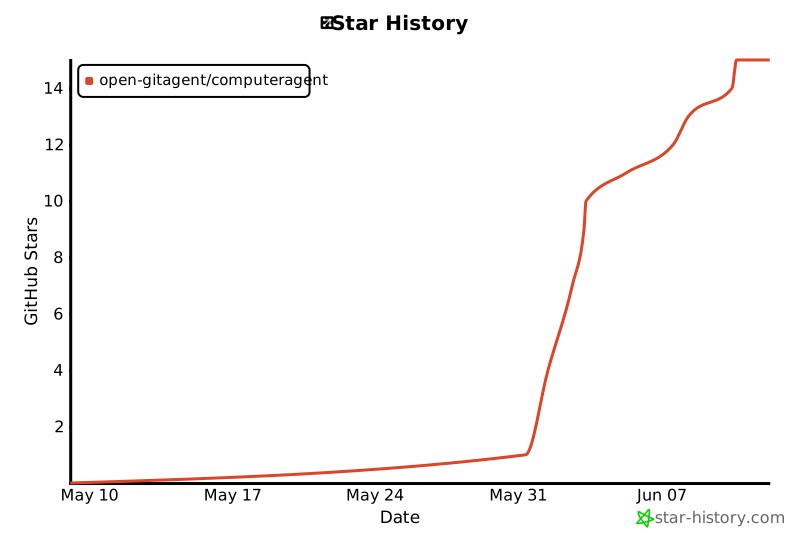](https://star-history.com/#open-gitagent/ComputerAgent&Date)
## License
[MIT](./LICENSE)