https://github.com/open-gitagent/gitagent
A framework-agnostic, git-native standard for defining AI agents
https://github.com/open-gitagent/gitagent
agent agent-framework agent-skills agents assistant claude-code gitagent open-standard openclaw skills
Last synced: 4 months ago
JSON representation
A framework-agnostic, git-native standard for defining AI agents
- Host: GitHub
- URL: https://github.com/open-gitagent/gitagent
- Owner: open-gitagent
- License: mit
- Created: 2026-02-24T16:08:24.000Z (5 months ago)
- Default Branch: main
- Last Pushed: 2026-03-23T14:13:21.000Z (5 months ago)
- Last Synced: 2026-03-24T11:54:32.037Z (5 months ago)
- Topics: agent, agent-framework, agent-skills, agents, assistant, claude-code, gitagent, open-standard, openclaw, skills
- Language: TypeScript
- Homepage: https://gitagent.sh
- Size: 23.4 MB
- Stars: 1,121
- Watchers: 8
- Forks: 115
- Open Issues: 21
-
Metadata Files:
- Readme: README.md
- Contributing: CONTRIBUTING.md
- Funding: .github/FUNDING.yml
- License: LICENSE
- Code of conduct: CODE_OF_CONDUCT.md
Awesome Lists containing this project
- awesome-harness-engineering - open-gitagent/gitagent
- awesome-agent-skills - open-gitagent/gitagent - agnostic, git-native standard for defining AI agents ⭐ 916 `TypeScript` `has-scripts` 📜 `multi-agent` 🌐 `spec-compliant` ✅ (📦 Skill Collections)
README

# gitagent | your repository becomes your agent
[](https://www.npmjs.com/package/@shreyaskapale/gitagent)
[](https://github.com/open-gitagent/gitagent/actions/workflows/ci.yml)
[](https://opensource.org/licenses/MIT)
[](https://github.com/open-gitagent/gitagent/blob/main/spec/SPECIFICATION.md)
[](https://nodejs.org)
A framework-agnostic, git-native standard for defining AI agents. Clone a repo, get an agent.
## Why
Every AI framework has its own structure. There's no universal, portable way to define an agent that works across Claude Code, OpenAI, LangChain, CrewAI, and AutoGen. **gitagent** fixes that.
- **Git-native** — Version control, branching, diffing, and collaboration built in
- **Framework-agnostic** — Export to any framework with adapters
- **Compliance-ready** — First-class support for FINRA, Federal Reserve, SEC, and segregation of duties
- **Composable** — Agents can extend, depend on, and delegate to other agents
## The Standard
Your repository becomes your agent. Drop these files into any git repo and it becomes a portable, framework-agnostic agent definition — everything else (CLI, adapters, patterns) builds on top of it.
```
my-agent/
│
│ # ── Core Identity (required) ──────────────────────────
├── agent.yaml # Manifest — name, version, model, skills, tools, compliance
├── SOUL.md # Identity, personality, communication style, values
│
│ # ── Behavior & Rules ──────────────────────────────────
├── RULES.md # Hard constraints, must-always/must-never, safety boundaries
├── DUTIES.md # Segregation of duties policy and role boundaries
├── AGENTS.md # Framework-agnostic fallback instructions
│
│ # ── Capabilities ──────────────────────────────────────
├── skills/ # Reusable capability modules (SKILL.md + scripts)
│ └── code-review/
│ ├── SKILL.md
│ └── review.sh
├── tools/ # MCP-compatible tool definitions (YAML schemas)
├── workflows/ # Multi-step procedures/playbooks
│
│ # ── Knowledge & Memory ────────────────────────────────
├── knowledge/ # Reference documents the agent can consult
├── memory/ # Persistent cross-session memory
│ └── runtime/ # Live agent state (dailylog.md, context.md)
│
│ # ── Lifecycle & Ops ───────────────────────────────────
├── hooks/ # Lifecycle event handlers (bootstrap.md, teardown.md)
├── config/ # Environment-specific overrides
├── compliance/ # Regulatory compliance artifacts
│
│ # ── Composition ───────────────────────────────────────
├── agents/ # Sub-agent definitions (recursive structure)
│ └── fact-checker/
│ ├── agent.yaml
│ ├── SOUL.md
│ └── DUTIES.md # This agent's role, permissions, boundaries
├── examples/ # Calibration interactions (few-shot)
│
│ # ── Runtime ───────────────────────────────────────────
└── .gitagent/ # Runtime state (gitignored)
```
Only two files are required: **`agent.yaml`** (the manifest) and **`SOUL.md`** (the identity). Everything else is optional — add what you need, ignore the rest.
## Patterns
These are the architectural patterns that emerge when you define agents as git-native file systems.
### Human-in-the-Loop for RL Agents
When an agent learns a new skill or writes to memory, it opens a branch + PR for human review before merging.

### Segregation of Duties (SOD)
No single agent should control a critical process end-to-end. Define roles (`maker`, `checker`, `executor`, `auditor`), a conflict matrix (which roles can't be the same agent), and handoff workflows — all in `agent.yaml` + `DUTIES.md`. The validator catches violations before deployment.
```yaml
compliance:
segregation_of_duties:
roles:
- id: maker
description: Creates proposals
permissions: [create, submit]
- id: checker
description: Reviews and approves
permissions: [review, approve, reject]
conflicts:
- [maker, checker] # maker cannot approve own work
assignments:
loan-originator: [maker]
credit-reviewer: [checker]
handoffs:
- action: credit_decision
required_roles: [maker, checker]
approval_required: true
enforcement: strict
```
### Live Agent Memory
The `memory/` folder holds a `runtime/` subfolder where agents write live knowledge — `dailylog.md`, `key-decisions.md`, and `context.md` — persisting state across sessions.

### Agent Versioning
Every change to your agent is a git commit. Roll back broken prompts, revert bad skills, and explore past versions — full undo history for your agent.

### Shared Context & Skills via Monorepo
Root-level `context.md`, `skills/`, `tools/` are automatically shared across every agent in the monorepo. No duplication, one source of truth.

### Branch-based Deployment
Use git branches (`dev` → `staging` → `main`) to promote agent changes through environments, just like shipping software.

### Knowledge Tree
The `knowledge/` folder stores entity relationships as a hierarchical tree with embeddings, letting agents reason over structured data at runtime.

### Agent Forking & Remixing
Fork any public agent repo, customize its `SOUL.md`, add your own skills, and PR improvements back upstream — open-source collaboration for AI agents.

### CI/CD for Agents
Run `gitagent validate` on every push via GitHub Actions. Test agent behavior in CI, block bad merges, and auto-deploy — treat agent quality like code quality.

### Agent Diff & Audit Trail
`git diff` shows exactly what changed between agent versions. `git blame` traces every line to who wrote it and when — full traceability out of the box.

### Tagged Releases
Tag stable agent versions like `v1.1.0`. Pin production to a tag, canary new versions on staging, and roll back instantly if something breaks.

### Secret Management via .gitignore
Agent tools that need API keys read from a local `.env` file — kept out of version control via `.gitignore`. Agent config is shareable, secrets stay local.

### Agent Lifecycle with Hooks
Define `bootstrap.md` and `teardown.md` in the `hooks/` folder to control what an agent does on startup and before it stops.

### SkillsFlow
Deterministic, multi-step workflows defined in `workflows/` as YAML. Chain `skill:`, `agent:`, and `tool:` steps with `depends_on` ordering, `${{ }}` template data flow, and per-step `prompt:` overrides. Every run follows the same path — no LLM discretion on execution order.
```yaml
name: code-review-flow
description: Full code review pipeline
triggers:
- pull_request
steps:
lint:
skill: static-analysis
inputs:
path: ${{ trigger.changed_files }}
review:
agent: code-reviewer
depends_on: [lint]
prompt: |
Focus on security and performance.
Flag any use of eval() or raw SQL.
inputs:
findings: ${{ steps.lint.outputs.issues }}
test:
tool: bash
depends_on: [lint]
inputs:
command: "npm test -- --coverage"
report:
skill: review-summary
depends_on: [review, test]
conditions:
- ${{ steps.review.outputs.severity != 'none' }}
inputs:
review: ${{ steps.review.outputs.comments }}
coverage: ${{ steps.test.outputs.report }}
error_handling:
on_failure: notify
channel: "#eng-reviews"
```
### Porting Framework Agents to GitAgent
Agents built in frameworks like NVIDIA AIQ, LangGraph, or CrewAI have their identity split across config files, Jinja2 templates, and Python code. gitagent extracts the **identity layer** — prompts, rules, roles, tool schemas — into a portable, versionable format.
> **What ports cleanly:** system prompts, persona definitions, hard constraints, tool schemas, role/SOD policies, model preferences.
>
> **What stays in the framework:** runtime orchestration (state machines, graph wiring), live tool execution, memory I/O, iterative loops.
This pattern is demonstrated with [NVIDIA's AIQ Deep Researcher](https://github.com/NVIDIA-AI-Blueprints/aiq) — a 3-agent hierarchy (orchestrator → planner → researcher) that produces cited research reports. The gitagent version captures the agent's identity, rules, and SOD policy so you can:
- **Fork for a new domain** — edit `SOUL.md` for legal/medical/finance research without touching Python
- **Version prompts independently** — `git diff` when the orchestrator's style regresses
- **Validate SOD** — `gitagent validate --compliance` ensures the orchestrator can't also be the researcher
- **Export to other runtimes** — same identity on Claude Code, OpenAI, or as a raw system prompt
```
examples/nvidia-deep-researcher/
├── agent.yaml # Manifest + SOD policy
├── SOUL.md # Orchestrator identity (from orchestrator.j2)
├── RULES.md # Citation rules, report constraints
├── DUTIES.md # Role separation: orchestrator ↔ planner ↔ researcher
├── agents/planner/ # Planner sub-agent (from planner.j2)
├── agents/researcher/ # Researcher sub-agent (from researcher.j2)
├── skills/{web,paper,knowledge}-search/
├── tools/*.yaml # MCP-compatible tool schemas
└── config/ # Model assignments per environment
```
See [`examples/nvidia-deep-researcher/`](examples/nvidia-deep-researcher/) for the full working example.
## Quick Start
```bash
# Install
npm i @open-gitagent/gitagent
# Create a new agent
gitagent init --template standard
# Validate
gitagent validate
# View agent info
gitagent info
# Export to system prompt
gitagent export --format system-prompt
```
## agent.yaml
The only file with a strict schema. Minimal example:
```yaml
spec_version: "0.1.0"
name: my-agent
version: 0.1.0
description: A helpful assistant agent
```
Full example with compliance:
```yaml
spec_version: "0.1.0"
name: compliance-analyst
version: 1.0.0
description: Financial compliance analysis agent
model:
preferred: claude-opus-4-6
compliance:
risk_tier: high
frameworks: [finra, federal_reserve, sec]
supervision:
human_in_the_loop: always
kill_switch: true
recordkeeping:
audit_logging: true
retention_period: 7y
immutable: true
model_risk:
validation_cadence: quarterly
ongoing_monitoring: true
segregation_of_duties:
roles:
- id: analyst
permissions: [create, submit]
- id: reviewer
permissions: [review, approve, reject]
conflicts:
- [analyst, reviewer]
assignments:
compliance-analyst: [analyst]
fact-checker: [reviewer]
enforcement: strict
```
## CLI Commands
| Command | Description |
|---------|-------------|
| `gitagent init [--template]` | Scaffold new agent (`minimal`, `standard`, `full`) |
| `gitagent validate [--compliance]` | Validate against spec and regulatory requirements |
| `gitagent info` | Display agent summary |
| `gitagent export --format ` | Export to other formats (see adapters below) |
| `gitagent import --from ` | Import (`claude`, `cursor`, `crewai`, `opencode`) |
| `gitagent run --adapter ` | Run an agent from a git repo or local directory |
| `gitagent install` | Resolve and install git-based dependencies |
| `gitagent audit` | Generate compliance audit report |
| `gitagent skills ` | Manage skills (`search`, `install`, `list`, `info`) |
| `gitagent lyzr ` | Manage Lyzr agents (`create`, `update`, `info`, `run`) |
## Compliance
gitagent has first-class support for financial regulatory compliance:
### FINRA
- **Rule 3110** — Supervision: human-in-the-loop, escalation triggers, kill switch
- **Rule 4511** — Recordkeeping: immutable audit logs, retention periods, SEC 17a-4 compliance
- **Rule 2210** — Communications: fair/balanced enforcement, no misleading statements
- **Reg Notice 24-09** — Existing rules apply to GenAI/LLMs
### Federal Reserve
- **SR 11-7** — Model Risk Management: validation cadence, ongoing monitoring, outcomes analysis
- **SR 23-4** — Third-Party Risk: vendor due diligence, SOC reports, subcontractor assessment
### SEC / CFPB
- **Reg S-P** — Customer privacy, PII handling
- **CFPB Circular 2022-03** — Explainable adverse action, Less Discriminatory Alternative search
### Segregation of Duties
- **Roles & Permissions** — Define maker, checker, executor, auditor roles with controlled permissions
- **Conflict Matrix** — Declare which role pairs cannot be held by the same agent
- **Handoff Workflows** — Require multi-agent participation for critical actions (credit decisions, regulatory filings)
- **Isolation** — Full state and credential segregation between roles
- **DUTIES.md** — Root-level policy + per-agent role declarations
- **Enforcement** — Strict (blocks deployment) or advisory (warnings only)
Inspired by [Salient AI](https://www.trysalient.com/)'s purpose-built agent architecture and the [FINOS AI Governance Framework](https://air-governance-framework.finos.org/mitigations/mi-22_multi-agent-isolation-and-segmentation.html).
Run `gitagent audit` for a full compliance checklist against your agent configuration.
## Adapters
Adapters are used by both `export` and `run`. Available adapters:
| Adapter | Description |
|---------|-------------|
| `system-prompt` | Concatenated system prompt (works with any LLM) |
| `claude-code` | Claude Code compatible CLAUDE.md |
| `openai` | OpenAI Agents SDK Python code |
| `crewai` | CrewAI YAML configuration |
| `lyzr` | Lyzr Studio agent |
| `github` | GitHub Actions agent |
| `git` | Git-native execution (run only) |
| `opencode` | OpenCode instructions + config |
| `gemini` | Google Gemini CLI (GEMINI.md + settings.json) |
| `openclaw` | OpenClaw format |
| `nanobot` | Nanobot format |
| `cursor` | Cursor `.cursor/rules/*.mdc` files |
```bash
# Export to system prompt
gitagent export --format system-prompt
# Run an agent directly
gitagent run ./my-agent --adapter lyzr
```
## Inheritance & Composition
```yaml
# Extend a parent agent
extends: https://github.com/org/base-agent.git
# Compose with dependencies
dependencies:
- name: fact-checker
source: https://github.com/org/fact-checker.git
version: ^1.0.0
mount: agents/fact-checker
```
## Examples
See the `examples/` directory:
- **`examples/minimal/`** — 2-file hello world (agent.yaml + SOUL.md)
- **`examples/standard/`** — Code review agent with skills, tools, and rules
- **`examples/full/`** — Production compliance agent with all directories, hooks, workflows, sub-agents, SOD with DUTIES.md, and regulatory artifacts
- **`examples/gitagent-helper/`** — Helper agent that assists with creating gitagent definitions
- **`examples/lyzr-agent/`** — Example Lyzr Studio integration
## Specification
Full specification at [`spec/SPECIFICATION.md`](spec/SPECIFICATION.md).
JSON Schemas for validation at `spec/schemas/`.
## Star History
[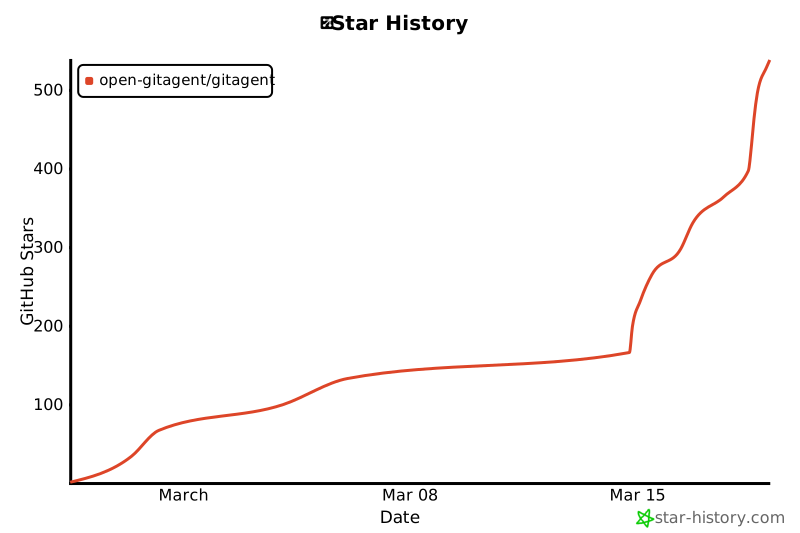](https://star-history.com/#open-gitagent/gitagent&Date)
## Built with gitagent?
If you've built an agent using gitagent, we'd love to hear about it! [Open a discussion](https://github.com/open-gitagent/gitagent/discussions) or add a `gitagent` topic to your repo.
## License
MIT