https://github.com/open-gitagent/shadowlm
A fine-tuning SDK — any open model, any harness, any method. 12 training methods behind one argument; pure-stdlib core.
https://github.com/open-gitagent/shadowlm
agents dpo fine-tuning grpo llm lora machine-learning mlx peft python pytorch qlora rlhf sdk
Last synced: about 2 months ago
JSON representation
A fine-tuning SDK — any open model, any harness, any method. 12 training methods behind one argument; pure-stdlib core.
- Host: GitHub
- URL: https://github.com/open-gitagent/shadowlm
- Owner: open-gitagent
- License: mit
- Created: 2026-06-10T23:25:28.000Z (about 2 months ago)
- Default Branch: main
- Last Pushed: 2026-06-18T23:10:21.000Z (about 2 months ago)
- Last Synced: 2026-06-18T23:20:09.634Z (about 2 months ago)
- Topics: agents, dpo, fine-tuning, grpo, llm, lora, machine-learning, mlx, peft, python, pytorch, qlora, rlhf, sdk
- Language: Python
- Homepage: https://shadowlm.sh/
- Size: 14.4 MB
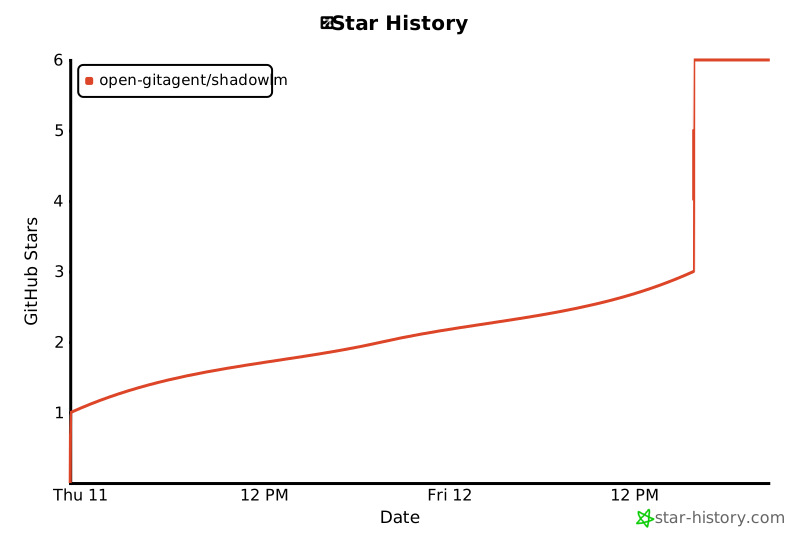
- Stars: 6
- Watchers: 0
- Forks: 1
- Open Issues: 1
-
Metadata Files:
- Readme: README.md
- License: LICENSE
Awesome Lists containing this project
README




# ShadowLM Trainer
**A fine-tuning SDK. Any open model — with any method, on any hardware, for any harness.**
Open source · built by [Lyzr Research Labs](https://lyzr.ai) · maintained by [Khush Patel](mailto:khush@lyzr.ai) & [Shreyas Kapale](mailto:shreyas@lyzr.ai) · `slm♥`
```bash
pip install shadowlm # batteries included — the full training stack
```
```python
import shadowlm as slm
ds = slm.Dataset.from_jsonl("data.jsonl").as_chat() # datasets
model = slm.load("mlx-community/Qwen2.5-0.5B-Instruct-4bit", # load
accelerator="shadow")
run = model.finetune(ds, method="lora", max_steps=60) # finetune
print(run.loss, run.sparkline()) # live metrics
print(model.generate("What is the capital of France?")) # inference
model.save("out/", fmt="adapter") # ship it
```
Change `method="lora"` to `qlora`, `dora`, `full`, `dpo`, `grpo`, `more`, `bitfit`,
`prompt`, `ptuning`, `adapter`, `cpt`, `more_plus` — and nothing else changes. That's the idea.
## What ShadowLM is for
Your agent runs on a rented frontier model — general, costly, someone else's.
ShadowLM moves **one task** to a small model **you own**, without touching the
agent: it keeps calling the same endpoint; only the model behind it changes.
What you end up with is **a shadowLM** — a small fine-tuned model that *shadows*
the frontier model, runs in its shadow on real traffic until it does the job as
well, then takes over. Lower cost, data stays inside, the weights are yours.
1. **Baseline** — your agent runs on the frontier model.
2. **Capture & fine-tune** — `slm.capture()` records the real traffic; train a small open model on it.
3. **Shadow mode** — the shadowLM runs behind the same agent, answering in parallel so you can compare.
4. **Gradual switch** — once it holds up, route traffic to the shadowLM. You own it.
This repo is the **engine** for that loop. The orchestration that wraps it into a
one-click migration is [ShadowLM Studio](#the-road-ahead).
## Agent tuning in three steps
```python
with slm.capture(model) as proxy: # 1. record your agent, unchanged
run_my_agent(base_url=proxy.base_url) # any OpenAI-client harness
group = slm.judge_group( # 2. score whole episodes (LLM judge)
slm.TrajectoryGroup(proxy.trajectories()), judge=judge)
run = model.finetune([group], method="grpo") # 3. train the shadowLM on them
```
No reward math, no rewriting the agent into an RL framework — the model API is
the one boundary every agent already has, so ShadowLM trains from it.
## What you get today
The whole **capture → judge → train → own a shadowLM** loop runs on these:
| Block | What it does | API |
|-------|--------------|-----|
| **Capture proxy** | drop-in OpenAI endpoint that records your agent's traffic into trajectories — agent unchanged | `slm.capture()` |
| **13 methods** | LoRA · QLoRA · DoRA · full · CPT · DPO · GRPO · MoRE · MoRE+ · BitFit · prompt · p-tuning · adapter | `method=` |
| **Judge → train** | score episodes with an LLM judge, train with trajectory-GRPO or DPO | `judge_group` |
| **APO** | optimize the *prompt* instead of weights — same capture/judge front end, no GPU | `slm.optimize_prompt()` |
| **VERL RL** | production multi-GPU GRPO (vLLM rollouts + FSDP) for cluster-scale RL | `backend="verl"` |
| **MoRE** | facts fused into attention — near-zero-hallucination recall | `method="more"` |
| **Any hardware** | CUDA · TPU · Trainium · Intel · Apple · CPU (whatever HF accelerate targets) | `device=` |
| **Shadow accelerator** | 4-bit, grad checkpointing, flash-attn, fused optimizer, optional Liger kernels — logged, never silent | `accelerator="shadow"` |
| **Checkpoints** | save every N steps, then load or A/B any version — `step 200` vs `final` — in the playground | `save_steps=` · `run.checkpoint_at(step)` |
| **Remote + server** | train on a GPU box or fleet over one JSON protocol; metrics stream back | `backend="remote"` · `shadowlm serve` |
| **Studio** | datasets → models → guided train → live runs (charts + console) → playground compare | `shadowlm serve` → `/` |
| **CLI** | finetune / runs / plot / chat / export / methods from the shell | `shadowlm …` |
| **Own the weights** | adapter/merged export, run records that survive restarts, nothing leaves your box | `model.save()` |
## Training methods
Each technique is a declarative spec under `shadowlm/methods/`; backends read the
spec (adapter kind, base requirements, data rendering), never the method name.
| method | what it does | base | default LR |
|--------|--------------|------|------------|
| `lora` | LoRA adapters | either | 2e-4 |
| `qlora` | LoRA on a 4-bit base, lowest memory | **4-bit** | 2e-4 |
| `dora` | weight-decomposed LoRA, better at low rank | either | 2e-4 |
| `full` | update every transformer weight | **unquantized** | 2e-5 |
| `cpt` | continued pretraining on raw domain text | either | 5e-5 |
| `dpo` | preference optimization on `{prompt, chosen, rejected}` | either | 5e-6 |
| `grpo` | RL from reward functions or scored `TrajectoryGroup`s | either | 5e-6 |
| `more` | **mixture of retrieval experts** — facts fused into attention | either | 1e-4 |
| `more_plus` | **decoupled MoE** — per-fact final-FFN LoRA experts, BM25+semantic routed, cache-safe merge | **unquantized** | 1e-4 |
| `bitfit`| train only the bias terms (~0.1% of params) | **unquantized** | 5e-4 |
| `prompt`/`ptuning` | soft prompts / p-tuning — learned virtual tokens | either | 5e-3 |
| `adapter` | bottleneck adapter modules after each layer | either | 1e-4 |
Base requirements are enforced with clear errors (e.g. `qlora` on a 16-bit model
tells you to load a 4-bit one). Adding your own method is one file —
`methods.register(TrainingMethod(...))`.
## Backends & hardware
`torch` (CUDA) is the production backend; `mlx` is the local-dev loop on Apple
Silicon; `remote` runs the same API against any ShadowLM server; `verl` is the
production, multi-GPU RL engine (vLLM rollouts + FSDP) for cluster-scale GRPO —
`pip install shadowlm[verl]`, then `slm.load(model, backend="verl").finetune(ds,
method="grpo", reward_fns=[…])`. `auto` picks the right one for SFT/local work.
The torch path rides HuggingFace `Trainer` + `accelerate`, so it trains on **any
accelerator HuggingFace supports** — pick it with `device=`:
| ecosystem | how |
|-----------|-----|
| NVIDIA CUDA | `device="cuda"` (+ 4-bit, flash-attn, fused optim) |
| AWS Trainium · Google TPU | `device="xla"` (Neuron / `torch-xla`) |
| Intel GPU | `device="xpu"` · Apple `backend="mlx"` · CPU `device="cpu"` |
On Microsoft Azure / any cloud you run on NVIDIA GPUs — the `cuda` path, nothing
to configure.
## Install
One command — installs the right backend for your machine and opens the studio:
```bash
curl -fsSL https://install.shadowlm.sh | sh
```
It detects your hardware and installs the matching stack — Apple Silicon → mlx,
NVIDIA → torch + Liger fused kernels, otherwise torch CPU — into an isolated env
in `~/.shadowlm/venv`, then launches `shadowlm serve` at `http://127.0.0.1:8329`.
Re-run any time to upgrade. Override with `SHADOWLM_EXTRAS=cli` (UI only),
`SHADOWLM_PORT=…`, or `SHADOWLM_NO_SERVE=1` (install without launching).
Or with pip — `pip install shadowlm` ships the full training stack (torch +
HuggingFace, retrieval, CLI). On Apple Silicon the mlx dev backend is pulled in
automatically. Two extras stay opt-in for specialized hardware:
| extra | adds |
|-------|------|
| `[kernels]` | fused Triton kernels on NVIDIA (Liger, Apache-2.0) |
| `[verl]` | the VERL distributed-RL backend (`backend="verl"`) |
```bash
git clone https://github.com/open-gitagent/shadowLM && cd shadowLM
python3 -m venv .venv && source .venv/bin/activate && pip install -e .
python examples/quickstart.py # datasets → finetune → inference, end to end
```
No hardware handy? Test-drive the whole thing — checkpoints, faiss MoRE, APO —
on a free Colab GPU:
[](https://colab.research.google.com/github/open-gitagent/shadowLM/blob/main/examples/colab_test_drive.ipynb)
Run output (mlx, a 0.5B model, ~3.5s):
```
[shadow] enabled: gradient checkpointing
[mlx:gpu] finetuning Qwen2.5-0.5B-Instruct-4bit · lora · 40 iters · lora r=16
[████████████████████████] step 40/40 loss 0.0718 lr 5.00e-05 1,048 tok/s
loss ▇▆█▇▆▇▇█▅▅▄▅▃▂▃▃▁▂▂▂▁▁▁▁▁▁▁▁▁▁▁▁▁▁▁▁▁▁▁▁ 4.2120 → 0.0718
♥ succeeded · 40 steps · 3.5s
```
## CLI & studio
```bash
shadowlm finetune data.jsonl --model Qwen/Qwen2.5-0.5B-Instruct --method lora
shadowlm finetune --config run.yaml --dry-run # reproducible runs, preview first
shadowlm chat out/adapter/ # talk to what you trained
shadowlm serve # studio UI + API on one port
```
Headline hyperparameters are typed flags; every other `TrainConfig` field is
reachable via `--set field=value` or a `--config` file (flags override config
override defaults). `shadowlm serve` opens the **studio** at `http://127.0.0.1:8329`
— Datasets (upload + HuggingFace) → Models → guided Train → live Runs (loss
charts + training console) → Playground (compare base ↔ finetuned). It's the
built React app, shipped in the wheel; the same JSON protocol powers
`backend="remote"`.
## The shadow accelerator
`accelerator="shadow"` turns on the optimizations that are safe for your model
and hardware — gradient checkpointing, flash-attention-2, a fused 8-bit
optimizer, 4-bit QLoRA, and optional [Liger](https://github.com/linkedin/Liger-Kernel)
fused Triton kernels (`[kernels]` extra, NVIDIA). Modes: `auto` / `shadow` /
`none`. It logs exactly what it enabled and no-ops when something isn't
available — ShadowLM integrates proven optimizations rather than shipping its own
GPU kernels, so no magic multipliers, just the standard wins turned on safely.
## The road ahead
The engine ships first; **ShadowLM Studio** (the hosted tier) wraps this exact
API — nothing reimplemented — to turn the blocks into a one-click migration:
- **Decision inbox** — captured traces surfaced for human approve/correct into chosen-vs-rejected pairs (today: auto-scored by an LLM judge).
- **Eval gates** — advance only when quality holds *and* savings beat cost: task-level evals + cost-per-task on the run records.
- **Shadow router** — the capture proxy evolved: run the shadowLM in parallel behind the live agent, then shift traffic % frontier → owned.
- **Fleet + teams** — GPU job queue, shared run history, dataset/adapter registry.
```
[x] SDK — datasets → finetune → inference on mlx / torch / remote
[x] 13 methods incl. MoRE, MoRE+ (decoupled MoE), trajectory GRPO, judge rewards
[x] Capture proxy · shadow accelerator · any-hardware
[x] Remote backend + reference server + the studio dashboard + CLI
[ ] Studio orchestration — decision inbox · eval gates · shadow router · switch
```
## Contributing
Adding a training method is one file; bug reports with a failing snippet are
gold. Fork → branch → PR. ⭐ the repo if it trains something for you — it helps
others find it.
[](https://star-history.com/#open-gitagent/shadowLM&Date)
## License
[MIT](./LICENSE) · `slm♥`