https://github.com/pablobernabeu/depictr-py
A unified, colourblind-safe toolkit for publication-ready statistical visualisation in Python (plotnine). The sibling of the depictr R package.
https://github.com/pablobernabeu/depictr-py
accessibility colorblind data-visualization ggplot plotnine plotting python scientific-visualization statistics visualization
Last synced: about 1 hour ago
JSON representation
A unified, colourblind-safe toolkit for publication-ready statistical visualisation in Python (plotnine). The sibling of the depictr R package.
- Host: GitHub
- URL: https://github.com/pablobernabeu/depictr-py
- Owner: pablobernabeu
- License: mit
- Created: 2026-06-24T21:54:06.000Z (6 days ago)
- Default Branch: main
- Last Pushed: 2026-06-25T22:49:36.000Z (5 days ago)
- Last Synced: 2026-06-26T00:10:26.830Z (5 days ago)
- Topics: accessibility, colorblind, data-visualization, ggplot, plotnine, plotting, python, scientific-visualization, statistics, visualization
- Language: Python
- Homepage: https://pablobernabeu.github.io/depictr-py/
- Size: 95.7 KB
- Stars: 0
- Watchers: 0
- Forks: 0
- Open Issues: 0
-
Metadata Files:
- Readme: README.md
- Changelog: CHANGELOG.md
- License: LICENSE
- Citation: CITATION.cff
Awesome Lists containing this project
README
# depictr (Python)
[](https://github.com/pablobernabeu/depictr-py/actions/workflows/ci.yml)
[](https://pablobernabeu.github.io/depictr-py/)
[](https://pypi.org/project/depictr/)
[](https://pypi.org/project/depictr/)
[](https://opensource.org/license/MIT)
Documentation and example gallery:
A unified, colourblind-safe toolkit for publication-ready statistical
visualisation, built on [plotnine](https://plotnine.org). It is the Python
sibling of the [depictr R package](https://github.com/pablobernabeu/depictr).
## Gallery
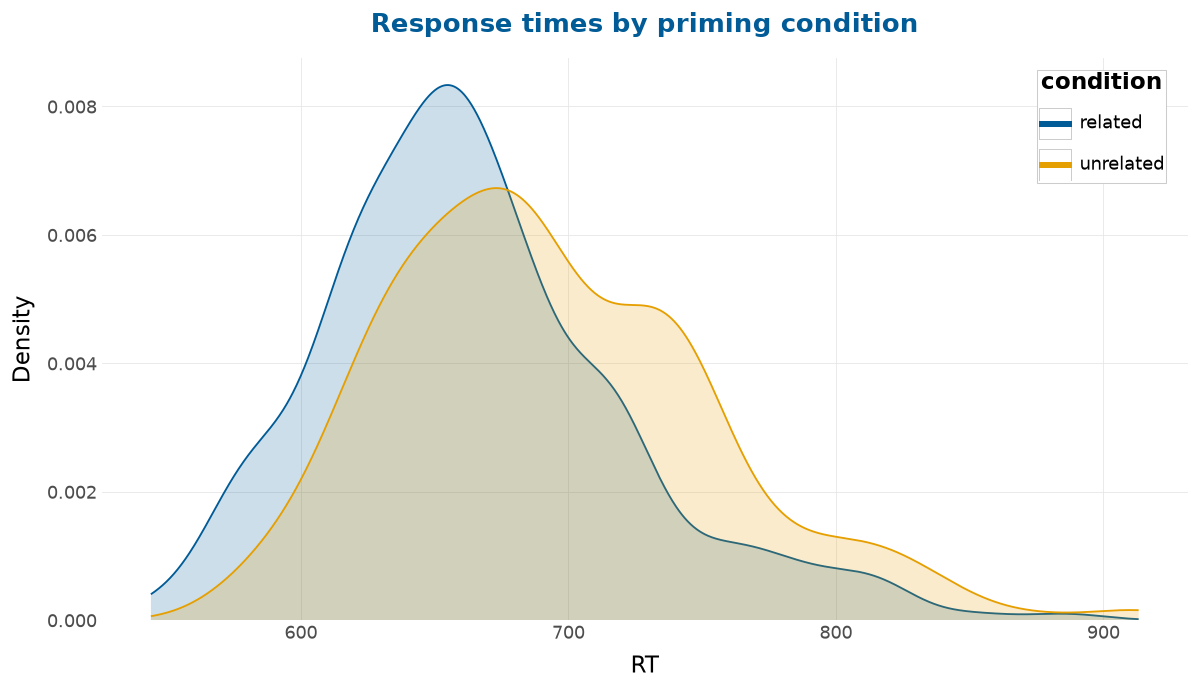
A grouped density (the default palette is the colourblind-safe Okabe-Ito set) and
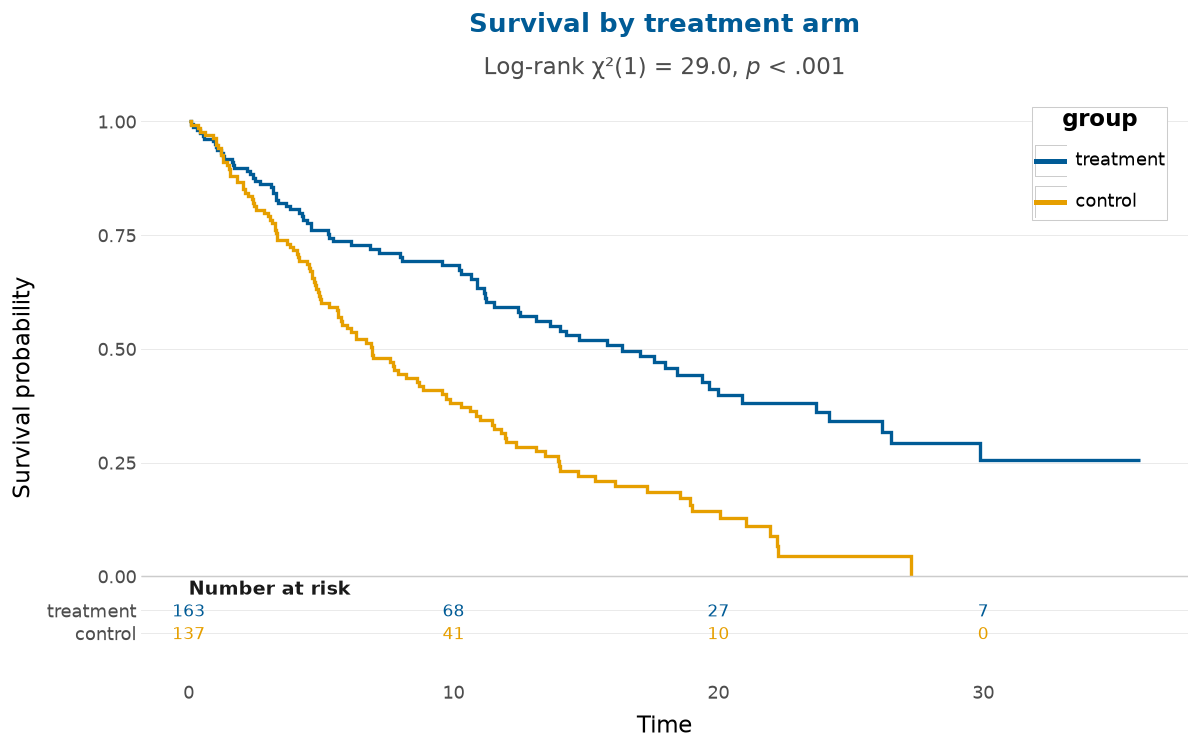
Kaplan-Meier survival curves with a log-rank test and a number-at-risk table,
both from a single function call:
More in the [example gallery](https://pablobernabeu.github.io/depictr-py/).
## What it is for
Python already has an excellent plot for almost any statistical task, but they
live in different packages with different defaults. A single figure set for a
paper might draw on seaborn, scikit-learn, statsmodels, lifelines and ArviZ,
each with its own look, its own API and its own colour scheme, and only one of
those defaults to colourblind-safe colours. Making the set consistent and
accessible then means repeating the same theming by hand on every plot.
depictr does that work once. It gives the whole workflow one theme, one
colourblind-safe palette and one calling convention, and returns plotnine
objects you can keep extending with `+`. Where a specialist package already
computes a quantity well, depictr delegates to it and redraws the result under
the shared theme, so you keep the trusted computation and gain a coherent,
accessible figure.
## Accessibility by default
The default palette is the Okabe-Ito set, and that choice is checked rather than
asserted. The package ships a simulator of colour-vision deficiency based on the
model of Machado, Oliveira and Fernandes (2009) and a CIE-Lab distance test that
measures how far apart the palette's colours stay under each deficiency:
```python
import depictr as dp
dp.palette_safety()
# {'min_delta_e': ..., 'by_condition': {'normal': ..., 'protan': ...,
# 'deutan': ..., 'tritan': ...}, 'safe': True, 'threshold': 10.0}
```
## Installation
depictr is on [PyPI](https://pypi.org/project/depictr/):
```bash
pip install depictr # core (plotnine, pandas, numpy)
pip install depictr[all] # plus the optional computation back-ends
```
The classification, model and survival plots delegate to scikit-learn,
statsmodels and lifelines respectively. Each is an optional dependency, so the
core stays light and you install only what your plots need
(`depictr[classification]`, `depictr[models]`, `depictr[survival]`).
## A short tour
```python
import depictr as dp
# Exploratory analysis
ld = dp.lexical_decision()
dp.explore_distribution(ld, "RT", group="condition", kind="both")
wb = dp.wellbeing_survey()
dp.correlation_heatmap(wb)
dp.missingness_map(wb)
# Model estimates: a fitted model OR a tidy data frame
import statsmodels.formula.api as smf
# Q() quotes "yield" because it is a Python keyword.
fit = smf.ols('Q("yield") ~ fertiliser + rainfall + soil_ph + treatment',
dp.crop_yield()).fit()
dp.coefficient_plot(fit)
# Classification: computed by scikit-learn, themed by depictr
ct = dp.clinical_trial()
dp.roc_curve_plot(ct["adverse_event"], ct["biomarker"])
# Survival: Kaplan-Meier with a log-rank test, in one call
dp.survival_plot(ct["time"], ct["event"], group=ct["arm"])
```
Every function returns a plotnine object, so the usual grammar-of-graphics
extensions apply:
```python
from plotnine import labs
dp.roc_curve_plot(ct["adverse_event"], ct["biomarker"]) + labs(title="Adverse event")
```
## The web app
A Streamlit app provides a gallery and a low-friction way to try the package: it
loads one of the bundled datasets (or a CSV you upload), draws the chosen plot,
shows the exact Python call that produced it, and offers a colourblind-vision
toggle that re-renders the figure as each deficiency would be seen. Run it with:
```bash
pip install depictr[app]
streamlit run app/streamlit_app.py
```
## Function families
| Family | Functions |
| --- | --- |
| Theme and palette | `theme_depictr`, `scale_colour_depictr`, `scale_fill_depictr`, `depictr_palette` |
| Accessibility | `palette_safety`, `simulate_cvd` |
| Exploratory analysis | `explore_distribution`, `explore_categorical`, `explore_bivariate`, `scatter_trend`, `correlation_heatmap`, `missingness_map`, `ecdf_plot`, `ridgeline_plot`, `dumbbell_plot`, `outlier_plot`, `group_comparison_plot`, `raincloud_plot`, `explore_pairs` |
| Estimation and tables | `estimation_plot` (single- or two-panel Gardner-Altman), `summary_table` |
| Model estimates | `coefficient_plot`, `tidy_estimates`, `effects_plot`, `interaction_plot`, `compare_models`, `random_effects_plot`, `posterior_plot`, `frequentist_bayesian_plot`, `power_curve_plot` |
| Diagnostics | `qq_plot`, `influence_plot`, `vif_plot`, `binned_residual_plot`, `residual_diagnostics_plot`, `model_report` |
| Classification | `roc_curve_plot`, `pr_curve_plot`, `confusion_matrix_plot`, `calibration_plot`, `gain_plot`, `lift_plot`, `threshold_plot` |
| Multivariate | `pca_plot`, `scree_plot`, `cluster_plot`, `dendrogram_plot`, `silhouette_plot` |
| Survival | `survival_plot` (with an optional number-at-risk table) |
| Time series | `acf_plot`, `decompose_plot`, `seasonal_plot`, `timeseries_plot` |
| Composition | `arrange_plots`, `save_plot` |
## Status
This is an early release (0.1.0), but coverage is now broad: the colourblind-safe
theme, the accessibility check, and the R package's plotting functions across
every family (EDA, estimation, model estimates, diagnostics, classification,
multivariate, survival and time series) are in place and tested. Multi-panel
composites are built on `arrange_plots`, which uses plotnine's native plot
composition: the four-panel `residual_diagnostics_plot`, the `model_report`
dashboard, the two-panel Gardner-Altman `estimation_plot`, the
frequentist-over-Bayesian overlay, and the survival number-at-risk table.
Two known limitations remain. plotnine compositions have no figure-level title,
so a grid carries its titles on each panel (the survival and estimation
composites place the title on their top panel). And `optimizer_fixef_plot` from
the R package is not ported, as there is no clean statsmodels equivalent of
`lme4::allFit`.
## Relationship to the R package
The two are siblings, not a shared codebase. The R package targets ggplot2 and
CRAN; this one targets plotnine and PyPI. They share the design: one accessible
theme across the whole workflow, model-or-data-frame input, and extensible plot
objects.
## Licence
MIT. See [LICENSE](https://github.com/pablobernabeu/depictr-py/blob/main/LICENSE).