https://github.com/pandarudra/ecrypto
Secure folder encryption with modern cryptography (XChaCha20-Poly1305 + Argon2id)
https://github.com/pandarudra/ecrypto
cli clitool decryption ecrypto encryption go golang security
Last synced: 6 months ago
JSON representation
Secure folder encryption with modern cryptography (XChaCha20-Poly1305 + Argon2id)
- Host: GitHub
- URL: https://github.com/pandarudra/ecrypto
- Owner: pandarudra
- License: mit
- Created: 2026-01-09T18:15:00.000Z (6 months ago)
- Default Branch: main
- Last Pushed: 2026-01-14T03:47:29.000Z (6 months ago)
- Last Synced: 2026-01-17T05:07:33.672Z (6 months ago)
- Topics: cli, clitool, decryption, ecrypto, encryption, go, golang, security
- Language: Go
- Homepage: https://pandarudra.github.io/ecrypto/
- Size: 164 KB
- Stars: 4
- Watchers: 0
- Forks: 2
- Open Issues: 3
-
Metadata Files:
- Readme: README.md
- Contributing: CONTRIBUTING.md
- License: LICENSE
- Code of conduct: CODE_OF_CONDUCT.md
- Security: SECURITY.md
Awesome Lists containing this project
README
# 🔐 ECRYPTO

**Military-Grade Folder Encryption Tool**
Encrypt entire folders into a single secure container using **XChaCha20-Poly1305** (AEAD) and **Argon2id** (KDF).
Protects filenames, metadata, and contents with cutting-edge cryptography.
[](https://github.com/pandarudra/ecrypto/releases/latest)
[](LICENSE)
[](https://golang.org)
[Download](#-installation) • [Quick Start](#-quick-start) • [Documentation](#-usage-examples) • [Security](#-security)
---
## ✨ Features
- 🔒 **Military-Grade Encryption**: XChaCha20-Poly1305 AEAD cipher (256-bit keys)
- 🔑 **Flexible Key Management**: Use passphrases or raw 32-byte key files
- 📦 **Single Secure Container**: Compress + encrypt entire folders into `.ecrypt` files
- 🎨 **Beautiful Interactive UI**: User-friendly menu system or powerful command-line interface
- 🛡️ **Secure by Default**: Argon2id KDF (256MB memory, 3 iterations) - winner of Password Hashing Competition
- ↶ **Undo Feature**: Easily decrypt and restore recently encrypted folders
- ⚡ **Fast & Lightweight**: Single binary, zero dependencies, cross-platform ready
- 🔍 **Tamper Detection**: Authentication tags prevent file modifications
- 📊 **Progress Tracking**: Real-time visual feedback during operations
- 🌐 **Cross-Platform**: Works on Windows, macOS, and Linux
---
## 📥 Installation
### Option 1: Download Pre-built Binary (Recommended)
#### Windows
```powershell
# Download the latest release
Invoke-WebRequest -Uri "https://github.com/pandarudra/ecrypto/releases/latest/download/ecrypto-windows-amd64.exe" -OutFile "ecrypto.exe"
# Run it
.\ecrypto.exe
```
**Or manually:**
1. Go to **[Releases](https://github.com/pandarudra/ecrypto/releases/latest)** 📦
2. Download `ecrypto-windows-amd64.exe`
3. Rename to `ecrypto.exe` and run!
#### macOS
```bash
# Download the latest release
curl -L -o ecrypto "https://github.com/pandarudra/ecrypto/releases/latest/download/ecrypto-darwin-amd64"
chmod +x ecrypto
# Move to PATH (optional)
sudo mv ecrypto /usr/local/bin/
```
#### Linux
```bash
# Download the latest release
wget -O ecrypto "https://github.com/pandarudra/ecrypto/releases/latest/download/ecrypto-linux-amd64"
chmod +x ecrypto
# Move to PATH (optional)
sudo mv ecrypto /usr/local/bin/
```
### Option 2: Install via npm (Global CLI)
Quickly install ECRYPTO as a global command-line tool:
```bash
npm install -g ecrypto-cli
# Then use it anywhere
ecrypto-cli --help
```
**Benefits:**
- Available from any directory
- Automatic updates: `npm update -g ecrypto-cli`
- Cross-platform (Windows, macOS, Linux)
- No manual binary management
### Option 3: Build from Source
**Requirements**: Go 1.24+
```bash
git clone https://github.com/pandarudra/ecrypto.git
cd ecrypto
go build -o ecrypto
# On Windows, this creates ecrypto.exe
# On macOS/Linux, run: chmod +x ecrypto
```
---
## 🚀 Quick Start
### 🎯 Interactive Mode (Perfect for Beginners!)
The easiest way to use ECRYPTO - just run the executable with no arguments:
```powershell
.\ecrypto.exe
```
You'll see an intuitive interactive menu:
```
██████ ▄█████ █████▄ ██ ██ █████▄ ██████ ▄████▄
██▄▄ ██ ██▄▄██▄ ▀██▀ ██▄▄█▀ ██ ██ ██
██▄▄▄▄ ▀█████ ██ ██ ██ ██ ██ ▀████▀
[1] [ENCRYPT] Encrypt a Folder
[2] [DECRYPT] Decrypt a File
[3] [KEYGEN] Generate Encryption Key
[4] [INFO] View Container Info
[5] [UNDO] Undo Recent Operation
[6] [EXIT] Quit Application
```
**Step-by-step walkthrough:**
1. Select `[1] ENCRYPT`
2. Enter your folder path (e.g., `C:\MyDocuments`)
3. Choose output location (e.g., `D:\backup.ecrypt`)
4. Enter a strong passphrase
5. Done! Your folder is now encrypted
### ⚡ Command-Line Mode (For Power Users)
#### If installed via npm:
```bash
# All commands use 'ecrypto-cli' instead of '.\ecrypto.exe'
ecrypto-cli encrypt --in "path/to/folder" --out "backup.ecrypt" --pass "YourPassword"
ecrypto-cli decrypt --in "backup.ecrypt" --out "restored" --pass "YourPassword"
ecrypto-cli keygen --out mykey.txt
```
#### If using direct binary:
```powershell
# Encrypt a folder with passphrase:
.\ecrypto.exe encrypt --in "C:\MyFolder" --out "backup.ecrypt" --pass "YourStrongPassphrase123!"
# Decrypt a container:
.\ecrypto.exe decrypt --in "backup.ecrypt" --out "restored" --pass "YourStrongPassphrase123!"
# Generate a random 32-byte encryption key:
.\ecrypto.exe keygen --out mykey.txt
# Encrypt with a raw key file (maximum security):
.\ecrypto.exe encrypt --in "C:\MyFolder" --out "backup.ecrypt" --key-file mykey.txt
# View container information (no decryption required):
.\ecrypto.exe info --file backup.ecrypt
```
**Pro Tip:** Key files provide stronger security than passphrases. Store them in a password manager!
---
## 📖 Usage Examples
### 💼 Example 1: Backup Personal Documents
Perfect for creating encrypted backups of your important files:
```powershell
# Encrypt your documents folder
.\ecrypto.exe encrypt --in "C:\Users\YourName\Documents" --out "documents_backup.ecrypt" --pass "MySecurePassword123!"
# Later, restore to a new location
.\ecrypto.exe decrypt --in "documents_backup.ecrypt" --out "C:\Restored\Documents" --pass "MySecurePassword123!"
```
**Use Case:** Regular backups, cloud storage, disaster recovery
### 🔐 Example 2: Secure File Transfer
Share sensitive data securely by encrypting with a key file:
```powershell
# Step 1: Generate a random encryption key
.\ecrypto.exe keygen --out transfer_key.txt
# Step 2: Encrypt your sensitive data
.\ecrypto.exe encrypt --in "C:\SensitiveData" --out "transfer.ecrypt" --key-file transfer_key.txt
# Step 3: Send transfer.ecrypt via one channel (email/cloud)
# Send transfer_key.txt via a DIFFERENT secure channel (Signal/WhatsApp)
# Recipient decrypts with the key:
.\ecrypto.exe decrypt --in "transfer.ecrypt" --out "received_data" --key-file transfer_key.txt
```
**Use Case:** Confidential file sharing, client deliverables, HIPAA/GDPR compliance
### 🖥️ Example 3: Optimize for Different Hardware
Adjust Argon2 parameters for slower machines or faster encryption:
```powershell
# Lower settings for older machines (128MB memory, 2 iterations)
.\ecrypto.exe encrypt --in "C:\MyFolder" --out "backup.ecrypt" --pass "password" --argon-m 131072 --argon-t 2
# Higher security for critical data (512MB memory, 5 iterations)
.\ecrypto.exe encrypt --in "C:\TopSecret" --out "critical.ecrypt" --pass "password" --argon-m 524288 --argon-t 5
```
**Use Case:** Performance tuning, high-security requirements, legacy systems
### 📂 Example 4: Batch Operations
Encrypt multiple folders programmatically:
```powershell
# Encrypt multiple project folders
$folders = @("C:\Project1", "C:\Project2", "C:\Project3")
foreach ($folder in $folders) {
$name = Split-Path $folder -Leaf
.\ecrypto.exe encrypt --in $folder --out "D:\Backups\$name.ecrypt" --pass "YourPassword"
}
```
**Use Case:** Automated backups, CI/CD pipelines, scheduled tasks
### ↶ Example 5: Undo & Restore
Accidentally encrypted something? Restore it with one click:
```powershell
# Encrypted a folder
.\ecrypto.exe encrypt --in "C:\MyFiles" --out "backup.ecrypt" --pass "password"
# Later: Need to undo the encryption
.\ecrypto.exe
→ [5] [UNDO] Undo Recent Operation
→ Select: C:\MyFiles | 450 files | 1.24 GB
→ Passphrase: password
→ ✓ Restored to: C:\MyFiles_restored
```
**Use Case:** Testing encryption settings, accidental encryption, backup verification
---
## 🔒 Security
### 🛡️ Cryptography Details
ECRYPTO uses industry-leading cryptographic standards:
- **Encryption Cipher**: XChaCha20-Poly1305
- AEAD (Authenticated Encryption with Associated Data)
- 256-bit keys for maximum security
- ChaCha20 stream cipher + Poly1305 MAC
- [RFC 8439](https://tools.ietf.org/html/rfc8439) compliant
- **Key Derivation**: Argon2id
- Winner of the Password Hashing Competition (2015)
- Resistant to GPU/ASIC attacks
- Default: 256 MB memory, 3 iterations, 1 thread
- [RFC 9106](https://datatracker.ietf.org/doc/html/rfc9106) compliant
- **Random Generation**: Cryptographically secure (Go's `crypto/rand`)
- 24-byte XChaCha20 nonce (never reused)
- 16-byte Argon2 salt
- True randomness from OS entropy sources
- **Data Integrity**: Poly1305 authentication tag
- 16-byte MAC prevents tampering
- Header authenticated as AAD (Additional Authenticated Data)
### ✅ What ECRYPTO Protects Against
| Threat | Protection |
| ------------------------- | ------------------------------------------- |
| Unauthorized file access | ✅ Strong 256-bit encryption |
| Filename/metadata leakage | ✅ Everything encrypted in container |
| Brute-force attacks | ✅ Argon2id makes cracking impractical |
| File tampering | ✅ Authentication tag detects modifications |
| Rainbow table attacks | ✅ Unique salt per container |
| Nonce reuse attacks | ✅ Random 24-byte nonce per encryption |
### ⚠️ Limitations & Threat Model
ECRYPTO **does NOT** protect against:
| Threat | Mitigation |
| ---------------------------- | -------------------------------------------------- |
| Physical memory extraction | Use full-disk encryption (BitLocker, FileVault) |
| Weak passphrases | Use 16+ character passphrases or key files |
| Malware/keyloggers on system | Keep OS updated, use antivirus software |
| Loss of encryption key | **Always backup your keys/passphrases!** |
| Side-channel attacks | Not designed for hostile multi-tenant environments |
### 🔐 Security Best Practices
#### 1. **Strong Passphrases**
```
❌ Weak: password123, qwerty, admin
✅ Strong: Correct-Horse-Battery-Staple-2026!
✅ Better: Use a key file generated with `keygen`
```
Recommendations:
- Minimum 16 characters
- Mix uppercase, lowercase, numbers, symbols
- Use a password manager (1Password, Bitwarden, KeePass)
- Never reuse passphrases across containers
#### 2. **Key File Security**
```powershell
# Generate key files for maximum security
.\ecrypto.exe keygen --out project_key.txt
# Store in password manager or encrypted USB drive
# Never store keys next to encrypted files
```
#### 3. **Backup Strategy**
```
Original Files → Encrypt → .ecrypt container
↓ ↓ ↓
(Delete) (Backup) (Store securely)
↓
Cloud Storage / External Drive
```
**Critical:** Test decryption BEFORE deleting original files!
#### 4. **Secure Deletion of Originals**
Windows:
```powershell
# Use SDelete (Sysinternals) for secure deletion
sdelete -p 3 "C:\OriginalFolder"
```
Linux/macOS:
```bash
# Use shred for secure deletion
shred -vfz -n 3 /path/to/file
```
#### 5. **Container Storage**
- ✅ Cloud storage (Google Drive, Dropbox) - encrypted container is safe
- ✅ External drives with additional disk encryption
- ✅ Network shares with proper access controls
- ❌ Public file-sharing sites (risk of corruption)
### 🔍 Verification & Testing
```powershell
# 1. Check container integrity
.\ecrypto.exe info --file backup.ecrypt
# 2. Test decryption to temporary location
.\ecrypto.exe decrypt --in backup.ecrypt --out test_restore --pass "YourPassword"
# 3. Verify files are intact
# Compare checksums or spot-check files
# 4. Delete test restore
Remove-Item -Recurse test_restore
```
### 📊 Security Audit
ECRYPTO has been designed with security in mind:
- ✅ No hardcoded secrets or backdoors
- ✅ Open-source code available for review
- ✅ Standard cryptographic libraries (Go's `crypto/*`)
- ✅ Minimal dependencies reduce attack surface
- ✅ No network connections or telemetry
**Want to contribute to security?** Report vulnerabilities via [GitHub Issues](https://github.com/pandarudra/ecrypto/issues) (use "Security" label)
---
## 🛠️ Command Reference
### `encrypt`
| Flag | Description | Default |
| ------------ | ----------------------- | -------------- |
| `--in` | Input folder path | (required) |
| `--out` | Output .ecrypt file | (required) |
| `--pass` | Passphrase (Argon2id) | - |
| `--key-file` | 32-byte Base64 key file | - |
| `--argon-m` | Argon2 memory (KiB) | 262144 (256MB) |
| `--argon-t` | Argon2 iterations | 3 |
| `--argon-p` | Argon2 parallelism | 1 |
### `decrypt`
| Flag | Description | Default |
| ------------ | ------------------ | ---------- |
| `--in` | Input .ecrypt file | (required) |
| `--out` | Output folder path | (required) |
| `--pass` | Passphrase | - |
| `--key-file` | Key file | - |
### `keygen`
| Flag | Description | Default |
| ------- | --------------- | ------------------ |
| `--out` | Output key file | (prints to stdout) |
### `info`
| Flag | Description | Default |
| -------- | ----------------- | ---------- |
| `--file` | .ecrypt file path | (required) |
---
## 🏗️ Architecture
```
.ecrypt Container Format (v1):
┌────────────────────────────────────────┐
│ Header (59 bytes) │
│ - Magic: "ECRYPT01" │
│ - Version: 1 │
│ - KDF: 0=raw, 1=Argon2id │
│ - Argon2 params (m, t, p) │
│ - Salt (16 bytes) │
│ - Nonce (24 bytes) │
├────────────────────────────────────────┤
│ Encrypted Data (XChaCha20-Poly1305) │
│ - Compressed folder (ZIP) │
│ - Authentication Tag (16 bytes) │
└────────────────────────────────────────┘
```
**File Flow:**
```
Input Folder → ZIP Archive → Encrypt (XChaCha20) → .ecrypt Container
```
---
## 🐛 Troubleshooting
### Common Issues & Solutions
❌ "Access is denied" error when encrypting
**Problem:** Output path is a directory instead of a file.
**Solution:** Specify a file path ending with `.ecrypt`:
```powershell
# ❌ Wrong - this is a directory
.\ecrypto.exe encrypt --in folder --out D:\backup
# ✅ Correct - this is a file
.\ecrypto.exe encrypt --in folder --out D:\backup.ecrypt
```
🔑 "Decryption failed: authentication tag mismatch"
**Problem:** Wrong passphrase/key or corrupted file.
**Solutions:**
1. Double-check your passphrase (case-sensitive!)
2. Verify you're using the correct key file
3. Check file integrity with `info` command:
```powershell
.\ecrypto.exe info --file backup.ecrypt
```
4. Ensure the file wasn't modified or corrupted during transfer
5. Try re-downloading the file if transferred over network
**Prevention:** Always test decryption immediately after encryption!
📁 "File not found" in interactive mode
**Problem:** Paths with spaces not recognized.
**Solution:** Use quotes around paths:
```
Enter folder path: "C:\My Documents\Folder"
```
Or use paths without spaces:
```
Enter folder path: C:\Users\John\Documents
```
⚠️ "Out of memory" during encryption
**Problem:** Argon2 memory settings too high for your system.
**Solution:** Reduce Argon2 memory parameter:
```powershell
# Default is 256MB - reduce to 128MB
.\ecrypto.exe encrypt --in folder --out backup.ecrypt --pass "password" --argon-m 131072
# For very low-memory systems (64MB)
.\ecrypto.exe encrypt --in folder --out backup.ecrypt --pass "password" --argon-m 65536
```
**Note:** Lower memory = faster cracking, so use strongest your system can handle.
🐌 Encryption/decryption is very slow
**Causes & Solutions:**
1. **Large Argon2 parameters:** Reduce `--argon-m` and `--argon-t`
2. **Large folders:** This is expected - compression + encryption takes time
3. **Slow storage:** Move to SSD instead of HDD
4. **Antivirus scanning:** Add exception for ecrypto or `.ecrypt` files
**Performance tips:**
- Use key files instead of passphrases (skips Argon2)
- Split large folders into smaller containers
- Disable real-time antivirus scanning during operations
❓ "Invalid command" errors
**Solution:** Check command syntax:
```powershell
# Correct syntax
.\ecrypto.exe --flag value
# Common mistakes
.\ecrypto.exe --in folder encrypt # ❌ Command must come first
.\ecrypto.exe encrypt -in folder # ❌ Use -- for flags
```
Use `--help` for syntax help:
```powershell
.\ecrypto.exe --help
.\ecrypto.exe encrypt --help
```
🔄 "Cannot restore folder structure"
**Problem:** Permissions issues or invalid output path.
**Solutions:**
1. Run as Administrator (right-click → Run as administrator)
2. Ensure output directory exists and is writable
3. Check available disk space
4. Avoid network drives if experiencing issues
### Still Having Issues?
1. **Check the logs:** Look for error messages in terminal output
2. **Verify system requirements:** Go 1.24+ if building from source
3. **Test with small files first:** Isolate whether issue is size-related
4. **Report bugs:** [Open an issue](https://github.com/pandarudra/ecrypto/issues) with:
- Operating system & version
- ECRYPTO version (`.\ecrypto.exe --version`)
- Command you ran (redact sensitive info)
- Full error message
---
## 🤝 Contributing
We welcome contributions from the community! Here's how you can help:
### Ways to Contribute
- 🐛 **Report bugs** - Found an issue? [Create a bug report](https://github.com/pandarudra/ecrypto/issues/new?labels=bug)
- 💡 **Suggest features** - Have an idea? [Open a feature request](https://github.com/pandarudra/ecrypto/issues/new?labels=enhancement)
- 📖 **Improve docs** - Fix typos, add examples, clarify instructions
- 🔐 **Security audits** - Review cryptographic implementation
- 💻 **Code contributions** - Fix bugs, implement features
### Development Setup
```bash
# Clone the repository
git clone https://github.com/pandarudra/ecrypto.git
cd ecrypto
# Install dependencies
go mod download
# Run tests
go test ./...
# Build
go build -o ecrypto
```
### Contribution Workflow
1. **Fork** the repository
2. **Create** a feature branch (`git checkout -b feature/amazing-feature`)
3. **Make** your changes with clear commit messages
4. **Test** thoroughly (`go test ./...`)
5. **Commit** changes (`git commit -m 'Add amazing feature'`)
6. **Push** to your fork (`git push origin feature/amazing-feature`)
7. **Open** a Pull Request with detailed description
### Code Guidelines
- Follow Go best practices and `gofmt` formatting
- Add tests for new features
- Update documentation for user-facing changes
- Keep commits atomic and well-described
- Ensure backwards compatibility with `.ecrypt` format
### Security Contributions
Found a security vulnerability? Please:
1. **DO NOT** open a public issue
2. Email details to [security contact] or use GitHub Security Advisories
3. Include: description, steps to reproduce, potential impact
4. We'll respond within 48 hours
---
## 📝 License
This project is licensed under the **MIT License** - see the [LICENSE](LICENSE) file for details.
**TL;DR:** You can use, modify, and distribute this software freely. Just include the license notice.
---
## 🔗 Links & Resources
### Project Links
- 📦 **[Download Latest Release](https://github.com/pandarudra/ecrypto/releases/latest)**
- 🐛 **[Report a Bug](https://github.com/pandarudra/ecrypto/issues/new?labels=bug)**
- 💡 **[Request a Feature](https://github.com/pandarudra/ecrypto/issues/new?labels=enhancement)**
- 📖 **[Documentation & Wiki](https://github.com/pandarudra/ecrypto/wiki)**
- 💬 **[Discussions](https://github.com/pandarudra/ecrypto/discussions)**
### Documentation
- 📘 **[How It Works](docs/index.html)** - Visual explanation of encryption pipeline
- ↶ **[Undo Feature](docs/UNDO_FEATURE.md)** - Restore encrypted folders easily
- 🎨 **[UI Enhancements](docs/UI_ENHANCEMENTS.md)** - User-friendly terminal experience
### Related Resources
- 📚 [XChaCha20-Poly1305 Specification](https://tools.ietf.org/html/rfc8439)
- 🔐 [Argon2 Password Hashing](https://datatracker.ietf.org/doc/html/rfc9106)
- 🛡️ [OWASP Cryptographic Storage](https://cheatsheetseries.owasp.org/cheatsheets/Cryptographic_Storage_Cheat_Sheet.html)
- 🔑 [Password Manager Recommendations](https://www.privacyguides.org/passwords/)
---
## ⭐ Support This Project
If you find ECRYPTO useful, please consider:
- ⭐ **Starring the repository** - Helps others discover the project
- 🐛 **Reporting bugs** - Makes the tool better for everyone
- 📢 **Sharing** - Tell colleagues and friends
- 💻 **Contributing** - Submit PRs or improve documentation
- ☕ **Sponsoring** - Support ongoing development
### Star History
[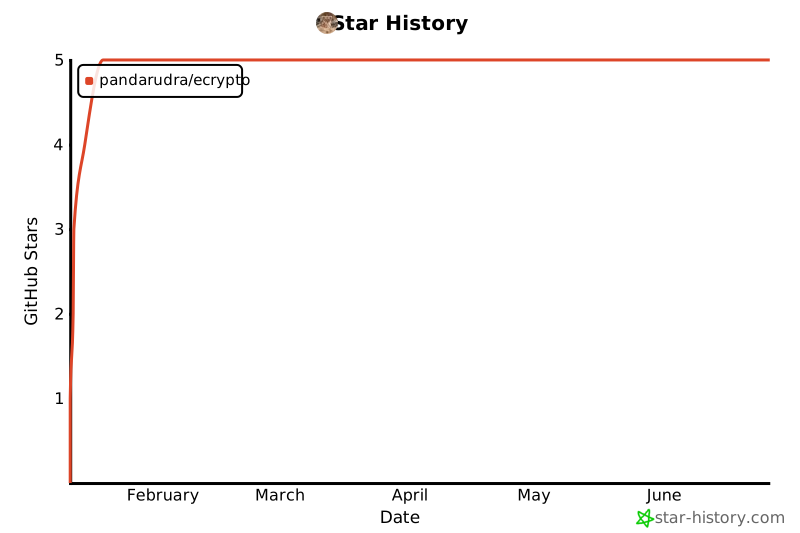](https://star-history.com/#pandarudra/ecrypto&Date)
---
## 🙏 Acknowledgments
ECRYPTO is built on top of excellent open-source libraries:
- **[golang.org/x/crypto](https://pkg.go.dev/golang.org/x/crypto)** - Cryptographic implementations
- **[github.com/spf13/cobra](https://github.com/spf13/cobra)** - CLI framework
- **[github.com/charmbracelet/lipgloss](https://github.com/charmbracelet/lipgloss)** - Terminal styling
Special thanks to the cryptography community for their research and implementations.
---
## 📊 Project Stats




---
## 🎯 Roadmap
Planned features for future releases:
- [ ] npm package for easy installation
- [ ] GUI application (Windows/macOS/Linux)
- [ ] Compression algorithm selection (ZSTD, GZIP)
- [ ] Multiple key support (multi-party encryption)
- [ ] Hardware security module (HSM) integration
- [ ] Cloud storage integration (S3, Azure Blob)
- [ ] Automated backup scheduling
- [ ] Mobile app (iOS/Android)
Vote for features in [Discussions](https://github.com/pandarudra/ecrypto/discussions/categories/ideas)!
---
**Made with ❤️ for Privacy and Security**
_"Your data, your control, your peace of mind."_
[⬆ Back to Top](#-ecrypto)