https://github.com/parcadei/Continuous-Claude-v3
Context management for Claude Code. Hooks maintain state via ledgers and handoffs. MCP execution without context pollution. Agent orchestration with isolated context windows.
https://github.com/parcadei/Continuous-Claude-v3
agents claude-code claude-code-cli claude-code-hooks claude-code-mcp claude-code-skills claude-code-subagents claude-skills mcp
Last synced: 7 months ago
JSON representation
Context management for Claude Code. Hooks maintain state via ledgers and handoffs. MCP execution without context pollution. Agent orchestration with isolated context windows.
- Host: GitHub
- URL: https://github.com/parcadei/Continuous-Claude-v3
- Owner: parcadei
- License: mit
- Created: 2025-12-23T00:12:49.000Z (8 months ago)
- Default Branch: main
- Last Pushed: 2026-01-10T16:56:50.000Z (7 months ago)
- Last Synced: 2026-01-11T00:39:15.435Z (7 months ago)
- Topics: agents, claude-code, claude-code-cli, claude-code-hooks, claude-code-mcp, claude-code-skills, claude-code-subagents, claude-skills, mcp
- Language: Python
- Homepage:
- Size: 1.5 MB
- Stars: 2,125
- Watchers: 21
- Forks: 153
- Open Issues: 10
-
Metadata Files:
- Readme: README.md
- Contributing: CONTRIBUTING.md
- License: LICENSE
Awesome Lists containing this project
- awesome-claude-skills - parcadei/Continuous-Claude-v3
- awesome-mcp - parcadei/Continuous-Claude-v3 - Continuous Claude is a context management system for Claude Code that maintains persistent, learning-driven context across sessions, orchestrates multi-agent workflows, and executes MCP without context pollution. (MCP Clients / Agent Orchestration Platforms)
- awesome-AI-driven-development - Continuous Claude - Continuous Claude transforms Claude Code into a continuously learning system that maintains context across sessions, orchestrates specialized agents, and eliminates wasting tokens through intelligent code analysis. (Frameworks & Libraries / Copilot Extensions & Alternatives)
- awesome-claude-code - parcadei/Continuous-Claude-v3 - Claude-v3?style=flat-square&logo=github) | Context management via hooks, ledgers, and handoffs | (Agent Orchestration)
- awesome-claude-code-and-skills - parcadei/Continuous-Claude-v3 - Claude-v3?style=flat-square) (Productivity Tools / Memory & Context Management)
- awesome-ai-agents - parcadei/Continuous-Claude-v3 - Continuous Claude is a persistent, learning multi-agent development environment built on Claude Code that maintains context across sessions, orchestrates specialized agents, and optimizes code analysis to enhance developer productivity. (Personal Assistants & Conversational Agents / Chatbots)
- claude-code-skills-zh - Continuous-Claude-v3
- awesome-openclaw-skills - parcadei/Continuous-Claude-v3
- awesome-claude-code-hooks - Continuous Claude v3 - Context management via hooks that maintain state through ledgers and handoffs. MCP execution without context pollution. Agent orchestration with isolated context windows. 3,619 stars. Triggers on: multiple lifecycle hooks. (Context and Memory)
- awesome-claude-agents - parcadei/Continuous-Claude-v3
- awesome-claude-code-workflows - Continuous Claude v3 - Context management via hooks that maintain state through ledgers and handoffs. MCP execution without context pollution. Agent orchestration with isolated context windows. 3,619 stars. (Context and Memory Management)
README
# Continuous Claude
> A persistent, learning, multi-agent development environment built on Claude Code
[](LICENSE)
[](https://claude.ai/code)
[](#skills-system)
[](#agents-system)
[](#hooks-system)
**Continuous Claude** transforms Claude Code into a continuously learning system that maintains context across sessions, orchestrates specialized agents, and eliminates wasting tokens through intelligent code analysis.
## Table of Contents
- [Why Continuous Claude?](#why-continuous-claude)
- [Design Principles](#design-principles)
- [How to Talk to Claude](#how-to-talk-to-claude)
- [Quick Start](#quick-start)
- [Architecture](#architecture)
- [Core Systems](#core-systems)
- [Skills (109)](#skills-system)
- [Agents (32)](#agents-system)
- [Hooks (30)](#hooks-system)
- [TLDR Code Analysis](#tldr-code-analysis)
- [Memory System](#memory-system)
- [Continuity System](#continuity-system)
- [Math System](#math-system)
- [Workflows](#workflows)
- [Installation](#installation)
- [Updating](#updating)
- [Configuration](#configuration)
- [Contributing](#contributing)
- [License](#license)
---
## Why Continuous Claude?
Claude Code has a **compaction problem**: when context fills up, the system compacts your conversation, losing nuanced understanding and decisions made during the session.
**Continuous Claude solves this with:**
| Problem | Solution |
|---------|----------|
| Context loss on compaction | YAML handoffs - more token-efficient transfer |
| Starting fresh each session | Memory system recalls + daemon auto-extracts learnings |
| Reading entire files burns tokens | 5-layer code analysis + semantic index |
| Complex tasks need coordination | Meta-skills orchestrate agent workflows |
| Repeating workflows manually | 109 skills with natural language triggers |
**The mantra: Compound, don't compact.** Extract learnings automatically, then start fresh with full context.
### Why "Continuous"? Why "Compounding"?
The name is a pun. **Continuous** because Claude maintains state across sessions. **Compounding** because each session makes the system smarter—learnings accumulate like compound interest.
---
## Design Principles
An agent is five things: **Prompt + Tools + Context + Memory + Model**.
| Component | What We Optimize |
|-----------|------------------|
| **Prompt** | Skills inject relevant context; hooks add system reminders |
| **Tools** | TLDR reduces tokens; agents parallelize work |
| **Context** | Not just *what* Claude knows, but *how* it's provided |
| **Memory** | Daemon extracts learnings; recall surfaces them |
| **Model** | Becomes swappable when the other four are solid |
### Anti-Complexity
We resist plugin sprawl. Every MCP, subscription, and tool you add promises improvement but risks breaking context, tools, or prompts through clashes.
**Our approach:**
- **Time, not money** — No required paid services. Perplexity and NIA are optional, high-value-per-token.
- **Learn, don't accumulate** — A system that learns handles edge cases better than one that collects plugins.
- **Shift-left validation** — Hooks run pyright/ruff after edits, catching errors before tests.
The failure modes of complex systems are structurally invisible until they happen. A learning, context-efficient system doesn't prevent all failures—but it recovers and improves.
---
## How to Talk to Claude
**You don't need to memorize slash commands.** Just describe what you want naturally.
### The Skill Activation System
When you send a message, a hook injects context that tells **Claude** which skills and agents are relevant. Claude infers from a rule-based system and decides which tools to use.
```
> "Fix the login bug in auth.py"
🎯 SKILL ACTIVATION CHECK
━━━━━━━━━━━━━━━━━━━━━━━━━━━━━━━━━━━━━━━
⚠️ CRITICAL SKILLS (REQUIRED):
→ create_handoff
📚 RECOMMENDED SKILLS:
→ fix
→ debug
🤖 RECOMMENDED AGENTS (token-efficient):
→ debug-agent
→ scout
ACTION: Use Skill tool BEFORE responding
━━━━━━━━━━━━━━━━━━━━━━━━━━━━━━━━━━━━━━━
```
### Priority Levels
| Level | Meaning |
|-------|---------|
| ⚠️ **CRITICAL** | Must use (e.g., handoffs before ending session) |
| 📚 **RECOMMENDED** | Should use (e.g., workflow skills) |
| 💡 **SUGGESTED** | Consider using (e.g., optimization tools) |
| 📌 **OPTIONAL** | Nice to have (e.g., documentation helpers) |
### Natural Language Examples
| What You Say | What Activates |
|--------------|----------------|
| "Fix the broken login" | `/fix` workflow → debug-agent, scout |
| "Build a user dashboard" | `/build` workflow → plan-agent, kraken |
| "I want to understand this codebase" | `/explore` + scout agent |
| "What could go wrong with this plan?" | `/premortem` |
| "Help me figure out what I need" | `/discovery-interview` |
| "Done for today" | `create_handoff` (critical) |
| "Resume where we left off" | `resume_handoff` |
| "Research auth patterns" | oracle agent + perplexity |
| "Find all usages of this API" | scout agent + ast-grep |
### Why This Approach?
| Benefit | How |
|---------|-----|
| **More Discoverable** | Don't need to know commands exist |
| **Context-Aware** | System knows when you're 90% through context |
| **Reduces Cognitive Load** | Describe intent naturally, get curated suggestions |
| **Power User Friendly** | Still supports /fix, /build, etc. directly |
### Skill vs Workflow vs Agent
| Type | Purpose | Example |
|------|---------|---------|
| **Skill** | Single-purpose tool | `commit`, `tldr-code`, `qlty-check` |
| **Workflow** | Multi-step process | `/fix` (sleuth → premortem → kraken → commit) |
| **Agent** | Specialized sub-session | scout (exploration), oracle (research) |
[See detailed skill activation docs →](docs/skill-activation.md)
---
## Quick Start
### Prerequisites
- Python 3.11+
- [uv](https://github.com/astral-sh/uv) package manager
- Docker (for PostgreSQL)
- Claude Code CLI
### Installation
```bash
# Clone
git clone https://github.com/parcadei/Continuous-Claude-v3.git
cd Continuous-Claude-v3/opc
# Run setup wizard (12 steps)
uv run python -m scripts.setup.wizard
```
> **Note:** The `pyproject.toml` is in `opc/`. Always run `uv` commands from the `opc/` directory.
### What the Wizard Does
| Step | What It Does |
|------|--------------|
| 1 | Backup existing .claude/ config (if present) |
| 2 | Check prerequisites (Docker, Python, uv) |
| 3-5 | Database + API key configuration |
| 6-7 | Start Docker stack, run migrations |
| 8 | Install Claude Code integration (32 agents, 109 skills, 30 hooks) |
| 9 | Math features (SymPy, Z3, Pint - optional) |
| 10 | TLDR code analysis tool |
| 11-12 | Diagnostics tools + Loogle (optional) |
### Remote Database Setup
By default, CC-v3 runs PostgreSQL locally via Docker. For remote database setups:
#### 1. Database Preparation
```bash
# Connect to your remote PostgreSQL instance
psql -h hostname -U user -d continuous_claude
# Enable pgvector extension (requires superuser or rds_superuser)
CREATE EXTENSION IF NOT EXISTS vector;
# Apply the schema (from your local clone)
psql -h hostname -U user -d continuous_claude -f docker/init-schema.sql
```
> **Managed PostgreSQL tips:**
> - **AWS RDS**: Add `vector` to `shared_preload_libraries` in DB Parameter Group
> - **Supabase**: Enable via Database Extensions page
> - **Azure Database**: Use Extensions pane to enable pgvector
#### 2. Connection Configuration
Set `CONTINUOUS_CLAUDE_DB_URL` in `~/.claude/settings.json`:
```json
{
"env": {
"CONTINUOUS_CLAUDE_DB_URL": "postgresql://user:password@hostname:5432/continuous_claude"
}
}
```
Or export before running Claude:
```bash
export CONTINUOUS_CLAUDE_DB_URL="postgresql://user:password@hostname:5432/continuous_claude"
claude
```
See `.env.example` for all available environment variables.
### First Session
```bash
# Start Claude Code
claude
# Try a workflow
> /workflow
```
### First Session Commands
| Command | What it does |
|---------|--------------|
| `/workflow` | Goal-based routing (Research/Plan/Build/Fix) |
| `/fix bug ` | Investigate and fix a bug |
| `/build greenfield ` | Build a new feature from scratch |
| `/explore` | Understand the codebase |
| `/premortem` | Risk analysis before implementation |
---
## Architecture
```
┌─────────────────────────────────────────────────────────────────────┐
│ CONTINUOUS CLAUDE │
├─────────────────────────────────────────────────────────────────────┤
│ │
│ ┌─────────────┐ ┌─────────────┐ ┌─────────────┐ │
│ │ Skills │ │ Agents │ │ Hooks │ │
│ │ (109) │───▶│ (32) │◀───│ (30) │ │
│ └─────────────┘ └─────────────┘ └─────────────┘ │
│ │ │ │ │
│ ▼ ▼ ▼ │
│ ┌─────────────────────────────────────────────────────────────┐ │
│ │ TLDR Code Analysis │ │
│ │ L1:AST → L2:CallGraph → L3:CFG → L4:DFG → L5:Slicing │ │
│ │ (95% token savings) │ │
│ └─────────────────────────────────────────────────────────────┘ │
│ │ │ │ │
│ ▼ ▼ ▼ │
│ ┌─────────────┐ ┌─────────────┐ ┌─────────────┐ │
│ │ Memory │ │ Continuity │ │ Coordination│ │
│ │ System │ │ Ledgers │ │ Layer │ │
│ └─────────────┘ └─────────────┘ └─────────────┘ │
│ │
└─────────────────────────────────────────────────────────────────────┘
```
### Data Flow: Session Lifecycle
```
SessionStart Working SessionEnd
│ │ │
▼ ▼ ▼
┌─────────┐ ┌─────────┐ ┌─────────┐
│ Load │ │ Track │ │ Save │
│ context │─────────────────▶│ changes │──────────────────▶│ state │
└─────────┘ └─────────┘ └─────────┘
│ │ │
├── Continuity ledger ├── File claims ├── Handoff
├── Memory recall ├── TLDR indexing ├── Learnings
└── Symbol index └── Blackboard └── Outcome
│
▼
┌─────────┐
│ /clear │
│ Fresh │
│ context │
└─────────┘
```
### The Continuity Loop (Detailed)
```
┌─────────────────────────────────────────────────────────────────────────────┐
│ THE CONTINUITY LOOP │
└─────────────────────────────────────────────────────────────────────────────┘
1. SESSION START 2. WORKING
┌────────────────────┐ ┌────────────────────┐
│ │ │ │
│ Ledger loaded ────┼──▶ Context │ PostToolUse ──────┼──▶ Index handoffs
│ Handoff loaded │ │ UserPrompt ───────┼──▶ Skill hints
│ Memory recalled │ │ Edit tracking ────┼──▶ Dirty flag++
│ TLDR cache warmed │ │ SubagentStop ─────┼──▶ Agent reports
│ │ │ │
└────────────────────┘ └────────────────────┘
│ │
│ ▼
│ ┌────────────────────┐
│ │ 3. PRE-COMPACT │
│ │ │
│ │ Auto-handoff ─────┼──▶ thoughts/shared/
│ │ (YAML format) │ handoffs/*.yaml
│ │ Dirty > 20? ──────┼──▶ TLDR re-index
│ │ │
│ └────────────────────┘
│ │
│ ▼
│ ┌────────────────────┐
│ │ 4. SESSION END │
│ │ │
│ │ Stale heartbeat ──┼──▶ Daemon wakes
│ │ Daemon spawns ────┼──▶ Headless Claude
│ │ Thinking blocks ──┼──▶ archival_memory
│ │ │
│ └────────────────────┘
│ │
│ │
└──────────────◀────── /clear ◀──────┘
Fresh context + state preserved
```
### Workflow Chains
```
┌─────────────────────────────────────────────────────────────────────────────┐
│ META-SKILL WORKFLOWS │
└─────────────────────────────────────────────────────────────────────────────┘
/fix bug /build greenfield
───────── ─────────────────
┌──────────┐ ┌──────────┐ ┌──────────┐ ┌──────────┐
│ sleuth │─▶│ premortem│ │discovery │─▶│plan-agent│
│(diagnose)│ │ (risk) │ │(clarify) │ │ (design) │
└──────────┘ └────┬─────┘ └──────────┘ └────┬─────┘
│ │
▼ ▼
┌──────────┐ ┌──────────┐
│ kraken │ │ validate │
│ (fix) │ │ (check) │
└────┬─────┘ └────┬─────┘
│ │
▼ ▼
┌──────────┐ ┌──────────┐
│ arbiter │ │ kraken │
│ (test) │ │(implement│
└────┬─────┘ └────┬─────┘
│ │
▼ ▼
┌──────────┐ ┌──────────┐
│ commit │ │ commit │
└──────────┘ └──────────┘
/tdd /refactor
──── ─────────
┌──────────┐ ┌──────────┐ ┌──────────┐ ┌──────────┐
│plan-agent│─▶│ arbiter │ │ phoenix │─▶│ warden │
│ (design) │ │(tests 🔴)│ │(analyze) │ │ (review) │
└──────────┘ └────┬─────┘ └──────────┘ └────┬─────┘
│ │
▼ ▼
┌──────────┐ ┌──────────┐
│ kraken │ │ kraken │
│(code 🟢) │ │(transform│
└────┬─────┘ └────┬─────┘
│ │
▼ ▼
┌──────────┐ ┌──────────┐
│ arbiter │ │ judge │
│(verify ✓)│ │ (review) │
└──────────┘ └──────────┘
```
### Data Layer Architecture
```
┌─────────────────────────────────────────────────────────────────────────────┐
│ DATA LAYER ARCHITECTURE │
├─────────────────────────────────────────────────────────────────────────────┤
│ │
│ TLDR 5-LAYER CODE ANALYSIS SEMANTIC INDEX │
│ ┌────────────────────────┐ ┌────────────────────────┐ │
│ │ L1: AST (~500 tok) │ │ BGE-large-en-v1.5 │ │
│ │ └── Functions, │ │ ├── All 5 layers │ │
│ │ classes, sigs │ │ ├── 10 lines context │ │
│ │ │ │ └── FAISS index │ │
│ │ L2: Call Graph (+440) │ │ │ │
│ │ └── Cross-file │──────────────│ Query: "auth logic" │ │
│ │ dependencies │ │ Returns: ranked funcs │ │
│ │ │ └────────────────────────┘ │
│ │ L3: CFG (+110 tok) │ │
│ │ └── Control flow │ │
│ │ │ MEMORY (PostgreSQL+pgvector) │
│ │ L4: DFG (+130 tok) │ ┌────────────────────────┐ │
│ │ └── Data flow │ │ sessions (heartbeat) │ │
│ │ │ │ file_claims (locks) │ │
│ │ L5: PDG (+150 tok) │ │ archival_memory (BGE) │ │
│ │ └── Slicing │ │ handoffs (embeddings) │ │
│ └────────────────────────┘ └────────────────────────┘ │
│ ~1,200 tokens │
│ vs 23,000 raw │
│ = 95% savings FILE SYSTEM │
│ ┌────────────────────────┐ │
│ │ thoughts/ │ │
│ │ ├── ledgers/ │ │
│ │ │ └── CONTINUITY_*.md│ │
│ │ └── shared/ │ │
│ │ ├── handoffs/*.yaml│ │
│ │ └── plans/*.md │ │
│ │ │ │
│ │ .tldr/ │ │
│ │ └── (daemon cache) │ │
│ └────────────────────────┘ │
│ │
└─────────────────────────────────────────────────────────────────────────────┘
```
---
## Core Systems
### Skills System
Skills are modular capabilities triggered by natural language. Located in `.claude/skills/`.
#### Meta-Skills (Workflow Orchestrators)
| Meta-Skill | Chain | Use When |
|------------|-------|----------|
| `/workflow` | Router → appropriate workflow | Don't know where to start |
| `/build` | discovery → plan → validate → implement → commit | Building features |
| `/fix` | sleuth → premortem → kraken → test → commit | Fixing bugs |
| `/tdd` | plan → arbiter (tests) → kraken (implement) → arbiter | Test-first development |
| `/refactor` | phoenix → plan → kraken → reviewer → arbiter | Safe code transformation |
| `/review` | parallel specialized reviews → synthesis | Code review |
| `/explore` | scout (quick/deep/architecture) | Understand codebase |
| `/security` | vulnerability scan → verification | Security audits |
| `/release` | audit → E2E → review → changelog | Ship releases |
#### Meta-Skill Reference
Each meta-skill supports modes, scopes, and flags. Type the skill alone (e.g., `/build`) to get an interactive question flow.
**`/build [options] [description]`**
| Mode | Chain | Use For |
|------|-------|---------|
| `greenfield` | discovery → plan → validate → implement → commit → PR | New feature from scratch |
| `brownfield` | onboard → research → plan → validate → implement | Feature in existing codebase |
| `tdd` | plan → test-first → implement | Test-driven development |
| `refactor` | impact analysis → plan → TDD → implement | Safe refactoring |
| Option | Effect |
|--------|--------|
| `--skip-discovery` | Skip interview phase (have clear spec) |
| `--skip-validate` | Skip plan validation |
| `--skip-commit` | Don't auto-commit |
| `--skip-pr` | Don't create PR description |
| `--parallel` | Run research agents in parallel |
**`/fix [options] [description]`**
| Scope | Chain | Use For |
|-------|-------|---------|
| `bug` | debug → implement → test → commit | General bug fix |
| `hook` | debug-hooks → hook-developer → implement → test | Hook issues |
| `deps` | preflight → oracle → plan → implement → qlty | Dependency errors |
| `pr-comments` | github-search → research → plan → implement → commit | PR feedback |
| Option | Effect |
|--------|--------|
| `--no-test` | Skip regression test |
| `--dry-run` | Diagnose only, don't fix |
| `--no-commit` | Don't auto-commit |
**`/explore [options]`**
| Depth | Time | What It Does |
|-------|------|--------------|
| `quick` | ~1 min | tldr tree + structure overview |
| `deep` | ~5 min | onboard + tldr + research + documentation |
| `architecture` | ~3 min | tldr arch + call graph + layers |
| Option | Effect |
|--------|--------|
| `--focus "area"` | Focus on specific area (e.g., `--focus "auth"`) |
| `--output handoff` | Create handoff for implementation |
| `--output doc` | Create documentation file |
| `--entry "func"` | Start from specific entry point |
**`/tdd`, `/refactor`, `/review`, `/security`, `/release`**
These follow their defined chains without mode flags. Just run:
```
/tdd "implement retry logic"
/refactor "extract auth module"
/review # reviews current changes
/security "authentication code"
/release v1.2.0
```
#### Key Skills (High-Value Tools)
**Planning & Risk**
- **premortem**: TIGERS & ELEPHANTS risk analysis - use before any significant implementation
- **discovery-interview**: Transform vague ideas into detailed specs
**Context Management**
- **create_handoff**: Capture session state for transfer
- **resume_handoff**: Resume from handoff with context
- **continuity_ledger**: Track state within session
**Code Analysis (95% Token Savings)**
- **tldr-code**: Call graph, CFG, DFG, slicing
- **ast-grep-find**: Structural code search
- **morph-search**: Fast text search (20x faster than grep)
**Research**
- **perplexity-search**: AI-powered web search
- **nia-docs**: Library documentation search
- **github-search**: Search GitHub code/issues/PRs
**Quality**
- **qlty-check**: 70+ linters, auto-fix
- **braintrust-analyze**: Session analysis, replay, and debugging failed sessions
**Math & Formal Proofs**
- **math**: Unified computation (SymPy, Z3, Pint) — one entry point for all math
- **prove**: Lean4 theorem proving with 5-phase workflow (Research → Design → Test → Implement → Verify)
- **pint-compute**: Unit-aware arithmetic and conversions
- **shapely-compute**: Computational geometry
The `/prove` skill enables machine-verified proofs without learning Lean syntax. Used to create the first Lean formalization of Sylvester-Gallai theorem.
#### The Thought Process
```
What do I want to do?
├── Don't know → /workflow (guided router)
├── Building → /build greenfield or brownfield
├── Fixing → /fix bug
├── Understanding → /explore
├── Planning → premortem first, then plan-agent
├── Researching → oracle or perplexity-search
├── Reviewing → /review
├── Proving → /prove (Lean4 formal verification)
├── Computing → /math (SymPy, Z3, Pint)
└── Shipping → /release
```
[See detailed skills breakdown →](docs/skills/)
---
### Agents System
Agents are specialized AI workers spawned via the Task tool. Located in `.claude/agents/`.
#### Agent Categories (32 active)
> **Note:** There are likely too many agents—consolidation is a v4 goal. Use what fits your workflow.
**Orchestrators (2)**
- **maestro**: Multi-agent coordination with patterns (Pipeline, Swarm, Jury)
- **kraken**: TDD implementation agent with checkpoint/resume support
**Planners (4)**
- **architect**: Feature planning + API integration
- **phoenix**: Refactoring + framework migration planning
- **plan-agent**: Lightweight planning with research/MCP tools
- **validate-agent**: Validate plans against best practices
**Explorers (4)**
- **scout**: Codebase exploration (use instead of Explore)
- **oracle**: External research (web, docs, APIs)
- **pathfinder**: External repository analysis
- **research-codebase**: Document codebase as-is
**Implementers (3)**
- **kraken**: TDD implementation with strict test-first workflow
- **spark**: Lightweight fixes and quick tweaks
- **agentica-agent**: Build Python agents using Agentica SDK
**Debuggers (3)**
- **sleuth**: General bug investigation and root cause
- **debug-agent**: Issue investigation via logs/code search
- **profiler**: Performance profiling and race conditions
**Validators (2)** - arbiter, atlas
**Reviewers (6)** - critic, judge, surveyor, liaison, plan-reviewer, review-agent
**Specialized (8)** - aegis, herald, scribe, chronicler, session-analyst, braintrust-analyst, memory-extractor, onboard
#### Common Workflows
| Workflow | Agent Chain |
|----------|-------------|
| Feature | architect → plan-reviewer → kraken → review-agent → arbiter |
| Refactoring | phoenix → plan-reviewer → kraken → judge → arbiter |
| Bug Fix | sleuth → spark/kraken → arbiter → scribe |
[See detailed agent guide →](docs/agents/)
---
### Hooks System
Hooks intercept Claude Code at lifecycle points. Located in `.claude/hooks/`.
#### Hook Events (30 hooks total)
| Event | Key Hooks | Purpose |
|-------|-----------|---------|
| **SessionStart** | session-start-continuity, session-register, braintrust-tracing | Load context, register session |
| **PreToolUse** | tldr-read-enforcer, smart-search-router, tldr-context-inject, file-claims | Token savings, search routing |
| **PostToolUse** | post-edit-diagnostics, handoff-index, post-edit-notify | Validation, indexing |
| **PreCompact** | pre-compact-continuity | Auto-save before compaction |
| **UserPromptSubmit** | skill-activation-prompt, memory-awareness | Skill hints, memory recall |
| **SubagentStop** | subagent-stop-continuity | Save agent state |
| **SessionEnd** | session-end-cleanup, session-outcome | Cleanup, extract learnings |
#### Key Hooks
| Hook | Purpose |
|------|---------|
| **tldr-context-inject** | Adds code analysis to agent prompts |
| **smart-search-router** | Routes grep to AST-grep when appropriate |
| **post-edit-diagnostics** | Runs pyright/ruff after edits |
| **memory-awareness** | Surfaces relevant learnings |
[See all 30 hooks →](docs/hooks/)
---
### TLDR Code Analysis
TLDR provides token-efficient code summaries through 5 analysis layers.
#### The 5-Layer Stack
| Layer | Name | What it provides | Tokens |
|-------|------|------------------|--------|
| **L1** | AST | Functions, classes, signatures | ~500 tokens |
| **L2** | Call Graph | Who calls what (cross-file) | +440 tokens |
| **L3** | CFG | Control flow, complexity | +110 tokens |
| **L4** | DFG | Data flow, variable tracking | +130 tokens |
| **L5** | PDG | Program slicing, impact analysis | +150 tokens |
**Total: ~1,200 tokens vs 23,000 raw = 95% savings**
#### CLI Commands
```bash
# Structure analysis
tldr tree src/ # File tree
tldr structure src/ --lang python # Code structure (codemaps)
# Search and extraction
tldr search "process_data" src/ # Find code
tldr context process_data --project src/ --depth 2 # LLM-ready context
# Flow analysis
tldr cfg src/main.py main # Control flow graph
tldr dfg src/main.py main # Data flow graph
tldr slice src/main.py main 42 # What affects line 42?
# Codebase analysis
tldr impact process_data src/ # Who calls this function?
tldr dead src/ # Find unreachable code
tldr arch src/ # Detect architectural layers
# Semantic search (natural language)
tldr daemon semantic "find authentication logic"
```
#### Semantic Index
Beyond structural analysis, TLDR builds a **semantic index** of your codebase:
- **Natural language queries** — Ask "where is error handling?" instead of grepping
- **Auto-rebuild** — Dirty flag hook tracks file changes; index rebuilds after N edits
- **Selective indexing** — Use `.tldrignore` to control what gets indexed
```bash
# .tldrignore example
__pycache__/
*.test.py
node_modules/
.venv/
```
The semantic index uses all 5 layers plus 10 lines of surrounding code context—not just docstrings.
#### Hook Integration
TLDR is automatically integrated via hooks:
- **tldr-read-enforcer**: Returns L1+L2+L3 instead of full file reads
- **smart-search-router**: Routes Grep to `tldr search`
- **post-tool-use-tracker**: Updates indexes when files change
[See TLDR documentation →](opc/packages/tldr-code/)
---
### Memory System
Cross-session learning powered by PostgreSQL + pgvector.
#### How It Works
```
Session ends → Database detects stale heartbeat (>5 min)
→ Daemon spawns headless Claude (Sonnet)
→ Analyzes thinking blocks from session
→ Extracts learnings to archival_memory
→ Next session recalls relevant learnings
```
The key insight: **thinking blocks contain the real reasoning**—not just what Claude did, but why. The daemon extracts this automatically.
#### Conversational Interface
| What You Say | What Happens |
|--------------|--------------|
| "Remember that auth uses JWT" | Stores learning with context |
| "Recall authentication patterns" | Searches memory, surfaces matches |
| "What did we decide about X?" | Implicit recall via memory-awareness hook |
#### Database Schema (4 tables)
| Table | Purpose |
|-------|---------|
| **sessions** | Cross-terminal awareness |
| **file_claims** | Cross-terminal file locking |
| **archival_memory** | Long-term learnings with BGE embeddings |
| **handoffs** | Session handoffs with embeddings |
#### Recall Commands
```bash
# Recall learnings (hybrid text + vector search)
cd opc && uv run python scripts/core/recall_learnings.py \
--query "authentication patterns"
# Store a learning explicitly
cd opc && uv run python scripts/core/store_learning.py \
--session-id "my-session" \
--type WORKING_SOLUTION \
--content "What I learned" \
--confidence high
```
#### Automatic Memory
The **memory-awareness** hook surfaces relevant learnings when you send a message. You'll see `MEMORY MATCH` indicators—Claude can use these without you asking.
---
### Continuity System
Preserve state across context clears and sessions.
#### Continuity Ledger
Within-session state tracking. Location: `thoughts/ledgers/CONTINUITY_.md`
```markdown
# Session: feature-x
Updated: 2026-01-08
## Goal
Implement feature X with proper error handling
## Completed
- [x] Designed API schema
- [x] Implemented core logic
## In Progress
- [ ] Add error handling
## Blockers
- Need clarification on retry policy
```
#### Handoffs
Between-session knowledge transfer. Location: `thoughts/shared/handoffs//`
```yaml
---
date: 2026-01-08T15:26:01+0000
session_name: feature-x
status: complete
---
# Handoff: Feature X Implementation
## Task(s)
| Task | Status |
|------|--------|
| Design API | Completed |
| Implement core | Completed |
| Error handling | Pending |
## Next Steps
1. Add retry logic to API calls
2. Write integration tests
```
#### Commands
| Command | Effect |
|---------|--------|
| "save state" | Updates continuity ledger |
| "done for today" / `/handoff` | Creates handoff document |
| "resume work" | Loads latest handoff |
---
### Math System
Two capabilities: **computation** (SymPy, Z3, Pint) and **formal verification** (Lean4 + Mathlib).
#### The Stack
| Tool | Purpose | Example |
|------|---------|---------|
| **SymPy** | Symbolic math | Solve equations, integrals, matrix operations |
| **Z3** | Constraint solving | Prove inequalities, SAT problems |
| **Pint** | Unit conversion | Convert miles to km, dimensional analysis |
| **Lean4** | Formal proofs | Machine-verified theorems |
| **Mathlib** | 100K+ theorems | Pre-formalized lemmas to build on |
| **Loogle** | Type-aware search | Find Mathlib lemmas by signature |
#### Two Entry Points
| Skill | Use When |
|-------|----------|
| `/math` | Computing, solving, calculating |
| `/prove` | Formal verification, machine-checked proofs |
#### /math Examples
```bash
# Solve equation
"Solve x² - 4 = 0" → x = ±2
# Compute eigenvalues
"Eigenvalues of [[2,1],[1,2]]" → {1: 1, 3: 1}
# Prove inequality
"Is x² + y² ≥ 2xy always true?" → PROVED (equals (x-y)²)
# Convert units
"26.2 miles to km" → 42.16 km
```
#### /prove - Formal Verification
5-phase workflow for machine-verified proofs:
```
📚 RESEARCH → 🏗️ DESIGN → 🧪 TEST → ⚙️ IMPLEMENT → ✅ VERIFY
```
1. **Research**: Search Mathlib with Loogle, find proof strategy
2. **Design**: Create skeleton with `sorry` placeholders
3. **Test**: Search for counterexamples before proving
4. **Implement**: Fill sorries with compiler-in-the-loop feedback
5. **Verify**: Audit axioms, confirm zero sorries
```
/prove every group homomorphism preserves identity
/prove continuous functions on compact sets are uniformly continuous
```
**Achievement**: Used to create the first Lean formalization of the Sylvester-Gallai theorem.
#### Prerequisites (Optional)
Math features require installation via wizard step 9:
```bash
# Installed automatically by wizard
uv pip install sympy z3-solver pint shapely
# Lean4 (for /prove)
curl https://raw.githubusercontent.com/leanprover/elan/master/elan-init.sh -sSf | sh
```
---
## Workflows
### /workflow - Goal-Based Router
```
> /workflow
? What's your goal?
○ Research - Understand codebase/docs
○ Plan - Design implementation approach
○ Build - Implement features
○ Fix - Investigate and resolve issues
```
### /fix - Bug Resolution
```bash
/fix bug "login fails silently"
```
**Chain:** sleuth → [checkpoint] → [premortem] → kraken → test → commit
| Scope | What it does |
|-------|--------------|
| `bug` | General bug investigation |
| `hook` | Hook-specific debugging |
| `deps` | Dependency issues |
| `pr-comments` | Address PR feedback |
### /build - Feature Development
```bash
/build greenfield "user dashboard"
```
**Chain:** discovery → plan → validate → implement → commit → PR
| Mode | What it does |
|------|--------------|
| `greenfield` | New feature from scratch |
| `brownfield` | Modify existing codebase |
| `tdd` | Test-first development |
| `refactor` | Safe code transformation |
### /premortem - Risk Analysis
```bash
/premortem deep thoughts/shared/plans/feature-x.md
```
**Output:**
- **TIGERS**: Clear threats (HIGH/MEDIUM/LOW severity)
- **ELEPHANTS**: Unspoken concerns
Blocks on HIGH severity until user accepts/mitigates risks.
---
## Installation
### Full Installation (Recommended)
```bash
# Clone
git clone https://github.com/parcadei/continuous-claude.git
cd continuous-claude/opc
# Run the setup wizard
uv run python -m scripts.setup.wizard
```
The wizard walks you through all configuration options interactively.
## Updating
Pull latest changes and sync your installation:
```bash
cd continuous-claude/opc
uv run python -m scripts.setup.update
```
This will:
- Pull latest from GitHub
- Update hooks, skills, rules, agents
- Upgrade TLDR if installed
- Rebuild TypeScript hooks if changed
### What Gets Installed
| Component | Location |
|-----------|----------|
| Agents (32) | ~/.claude/agents/ |
| Skills (109) | ~/.claude/skills/ |
| Hooks (30) | ~/.claude/hooks/ |
| Rules | ~/.claude/rules/ |
| Scripts | ~/.claude/scripts/ |
| PostgreSQL | Docker container |
### Installation Mode: Copy vs Symlink
The wizard offers two installation modes:
| Mode | How It Works | Best For |
|------|--------------|----------|
| **Copy** (default) | Copies files from repo to `~/.claude/` | End users, stable setup |
| **Symlink** | Creates symlinks to repo files | Contributors, development |
#### Copy Mode (Default)
Files are copied from `continuous-claude/.claude/` to `~/.claude/`. Changes you make in `~/.claude/` are **local only** and will be overwritten on next update.
```text
continuous-claude/.claude/ ──COPY──> ~/.claude/
(source) (user config)
```
**Pros:** Stable, isolated from repo changes
**Cons:** Local changes lost on update, manual sync needed
#### Symlink Mode (Recommended for Contributors)
Creates symlinks so `~/.claude/` points directly to repo files. Changes in either location affect the same files.
```text
~/.claude/rules ──SYMLINK──> continuous-claude/.claude/rules
~/.claude/skills ──SYMLINK──> continuous-claude/.claude/skills
~/.claude/hooks ──SYMLINK──> continuous-claude/.claude/hooks
~/.claude/agents ──SYMLINK──> continuous-claude/.claude/agents
```
**Pros:**
- Changes auto-sync to repo (can `git commit` improvements)
- No re-installation needed after `git pull`
- Contribute back easily
**Cons:**
- Breaking changes in repo affect your setup immediately
- Need to manage git workflow
#### Switching to Symlink Mode
If you installed with copy mode and want to switch:
```bash
# Backup current config
mkdir -p ~/.claude/backups/$(date +%Y%m%d)
cp -r ~/.claude/{rules,skills,hooks,agents} ~/.claude/backups/$(date +%Y%m%d)/
# Verify backup succeeded before proceeding
ls -la ~/.claude/backups/$(date +%Y%m%d)/
# Remove copies (only after verifying backup above)
rm -rf ~/.claude/{rules,skills,hooks,agents}
# Create symlinks (adjust path to your repo location)
REPO="$HOME/continuous-claude" # or wherever you cloned
ln -s "$REPO/.claude/rules" ~/.claude/rules
ln -s "$REPO/.claude/skills" ~/.claude/skills
ln -s "$REPO/.claude/hooks" ~/.claude/hooks
ln -s "$REPO/.claude/agents" ~/.claude/agents
# Verify
ls -la ~/.claude | grep -E "rules|skills|hooks|agents"
```
**Windows users:** Use PowerShell (as Administrator or with Developer Mode enabled):
```powershell
# Enable Developer Mode first (Settings → Privacy & security → For developers)
# Or run PowerShell as Administrator
# Backup current config
$BackupDir = "$HOME\.claude\backups\$(Get-Date -Format 'yyyyMMdd')"
New-Item -ItemType Directory -Path $BackupDir -Force
Copy-Item -Recurse "$HOME\.claude\rules","$HOME\.claude\skills","$HOME\.claude\hooks","$HOME\.claude\agents" $BackupDir
# Verify backup succeeded before proceeding
Get-ChildItem $BackupDir
# Remove copies (only after verifying backup above)
Remove-Item -Recurse "$HOME\.claude\rules","$HOME\.claude\skills","$HOME\.claude\hooks","$HOME\.claude\agents"
# Create symlinks (adjust path to your repo location)
$REPO = "$HOME\continuous-claude" # or wherever you cloned
New-Item -ItemType SymbolicLink -Path "$HOME\.claude\rules" -Target "$REPO\.claude\rules"
New-Item -ItemType SymbolicLink -Path "$HOME\.claude\skills" -Target "$REPO\.claude\skills"
New-Item -ItemType SymbolicLink -Path "$HOME\.claude\hooks" -Target "$REPO\.claude\hooks"
New-Item -ItemType SymbolicLink -Path "$HOME\.claude\agents" -Target "$REPO\.claude\agents"
# Verify
Get-ChildItem "$HOME\.claude" | Where-Object { $_.LinkType -eq "SymbolicLink" }
```
### For Brownfield Projects
After installation, start Claude and run:
```
> /onboard
```
This analyzes the codebase and creates an initial continuity ledger.
---
## Configuration
### .claude/settings.json
Central configuration for hooks, tools, and workflows.
```json
{
"hooks": {
"SessionStart": [...],
"PreToolUse": [...],
"PostToolUse": [...],
"UserPromptSubmit": [...]
}
}
```
### .claude/skills/skill-rules.json
Skill activation triggers.
```json
{
"rules": [
{
"skill": "fix",
"keywords": ["fix this", "broken", "not working"],
"intentPatterns": ["fix.*(bug|issue|error)"]
}
]
}
```
### Environment Variables
| Variable | Purpose | Required |
|----------|---------|----------|
| `DATABASE_URL` | PostgreSQL connection string | Yes |
| `BRAINTRUST_API_KEY` | Session tracing | No |
| `PERPLEXITY_API_KEY` | Web search | No |
| `NIA_API_KEY` | Documentation search | No |
| `CLAUDE_OPC_DIR` | Path to CC's opc/ directory (set by wizard) | Auto |
| `CLAUDE_PROJECT_DIR` | Current project directory (set by SessionStart hook) | Auto |
Services without API keys still work:
- Continuity system (ledgers, handoffs)
- TLDR code analysis
- Local git operations
- TDD workflow
---
## Directory Structure
```
continuous-claude/
├── .claude/
│ ├── agents/ # 32 specialized AI agents
│ ├── hooks/ # 30 lifecycle hooks
│ │ ├── src/ # TypeScript source
│ │ └── dist/ # Compiled JavaScript
│ ├── skills/ # 109 modular capabilities
│ ├── rules/ # System policies
│ ├── scripts/ # Python utilities
│ └── settings.json # Hook configuration
├── opc/
│ ├── packages/
│ │ └── tldr-code/ # 5-layer code analysis
│ ├── scripts/
│ │ ├── setup/ # Wizard, Docker, integration
│ │ └── core/ # recall_learnings, store_learning
│ └── docker/
│ └── init-schema.sql # 4-table PostgreSQL schema
├── thoughts/
│ ├── ledgers/ # Continuity ledgers (CONTINUITY_*.md)
│ └── shared/
│ ├── handoffs/ # Session handoffs (*.yaml)
│ └── plans/ # Implementation plans
└── docs/ # Documentation
```
---
## Contributing
See [CONTRIBUTING.md](CONTRIBUTING.md) for guidelines on:
- Adding new skills
- Creating agents
- Developing hooks
- Extending TLDR
---
## Acknowledgments
### Patterns & Architecture
- **[@numman-ali](https://github.com/numman-ali)** - Continuity ledger pattern
- **[Anthropic](https://anthropic.com)** - Claude Code and "Code Execution with MCP"
- **[obra/superpowers](https://github.com/obra/superpowers)** - Agent orchestration patterns
- **[EveryInc/compound-engineering-plugin](https://github.com/EveryInc/compound-engineering-plugin)** - Compound engineering workflow
- **[yoloshii/mcp-code-execution-enhanced](https://github.com/yoloshii/mcp-code-execution-enhanced)** - Enhanced MCP execution
- **[HumanLayer](https://github.com/humanlayer/humanlayer)** - Agent patterns
### Tools & Services
- **[uv](https://github.com/astral-sh/uv)** - Python packaging
- **[tree-sitter](https://tree-sitter.github.io/)** - Code parsing
- **[Braintrust](https://braintrust.dev)** - LLM evaluation, logging, and session tracing
- **[qlty](https://github.com/qltysh/qlty)** - Universal code quality CLI (70+ linters)
- **[ast-grep](https://github.com/ast-grep/ast-grep)** - AST-based code search and refactoring
- **[Nia](https://trynia.ai)** - Library documentation search
- **[Morph](https://www.morphllm.com)** - WarpGrep fast code search
- **[Firecrawl](https://www.firecrawl.dev)** - Web scraping API
- **[RepoPrompt](https://repoprompt.com)** - Token-efficient codebase maps
---
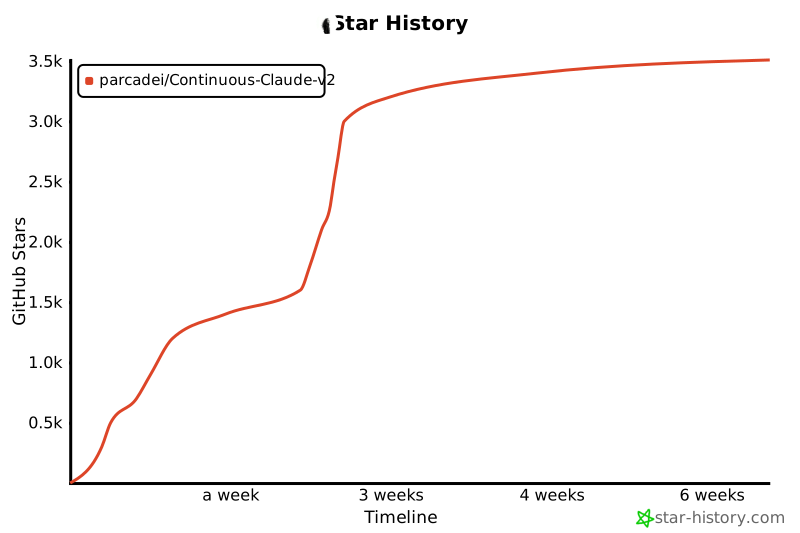
## Star History
[](https://star-history.com/#parcadei/Continuous-Claude-v2&Date)
---
## License
[MIT](LICENSE) - Use freely, contribute back.
---
**Continuous Claude**: Not just a coding assistant—a persistent, learning, multi-agent development environment that gets smarter with every session.