https://github.com/pfh/langevitour
Langevin dynamics based tours of data, in Javascript with R wrapper.
https://github.com/pfh/langevitour
javascript-applications langevin-dynamics r-package tour visualization
Last synced: 8 months ago
JSON representation
Langevin dynamics based tours of data, in Javascript with R wrapper.
- Host: GitHub
- URL: https://github.com/pfh/langevitour
- Owner: pfh
- License: other
- Created: 2022-02-17T10:02:54.000Z (over 4 years ago)
- Default Branch: main
- Last Pushed: 2025-05-24T02:18:39.000Z (about 1 year ago)
- Last Synced: 2025-10-11T16:57:45.307Z (9 months ago)
- Topics: javascript-applications, langevin-dynamics, r-package, tour, visualization
- Language: TypeScript
- Homepage: https://logarithmic.net/langevitour/
- Size: 2.28 MB
- Stars: 27
- Watchers: 2
- Forks: 3
- Open Issues: 3
-
Metadata Files:
- Readme: README.md
- Changelog: NEWS.md
- License: LICENSE
Awesome Lists containing this project
- awesome-shiny-extensions - langevitour - Interactive tours of 2D projections of high-dimensional data. (Visualization / Scatterplot)
README
# langevitour
langevitour is an HTML widget that randomly tours projections of a high-dimensional dataset with an animated scatter-plot. The user can manipulate the plot to use specified axes, or turn on Guided Tour mode to perform [projection pursuit](https://en.wikipedia.org/wiki/Projection_pursuit), finding an informative projection of the data. Groups within the data can be hidden or shown, as can particular axes. Known projections of interest can be added as "extra axes" and also manipulated. The widget can be used from within R or Python, or included in a self-contained Rmarkdown document, or a Shiny app, or used directly from Javascript.
langevitour is a twist on the "tour" concept from software such as [XGobi](https://lib.stat.cmu.edu/general/XGobi/), [GGobi](http://ggobi.org/), [tourr](http://ggobi.github.io/tourr/), [ferrn](https://huizezhang-sherry.github.io/ferrn/), [liminal](https://sa-lee.github.io/liminal/), [detourr](https://casperhart.github.io/detourr/index.html), [spinifex](https://nspyrison.github.io/spinifex/), and [loon.tour](https://great-northern-diver.github.io/loon.tourr/). The new element in langevitour is the use of [Langevin Dynamics](https://en.wikipedia.org/wiki/Langevin_dynamics) to generate the sequence of projections.
langevitour is described in:
> Harrison, Paul. 2023. "langevitour: Smooth Interactive Touring of High Dimensions, Demonstrated with scRNA-Seq Data." *The R Journal* 15 (2): 206–219. [https://doi.org/10.32614/RJ-2023-046](https://doi.org/10.32614/RJ-2023-046).
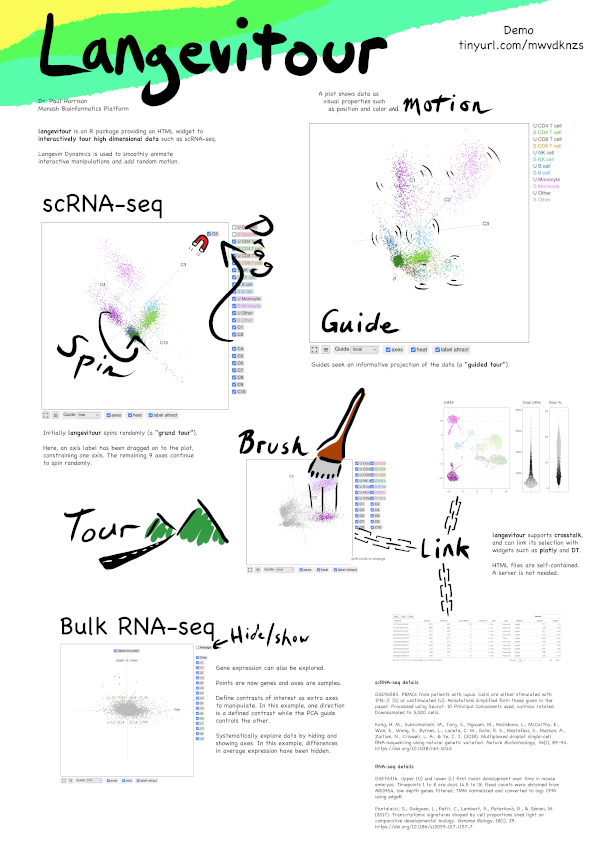
Further material:
* ABACBS Conference 2022 [poster (large image)](https://logarithmic.net/langevitour/2022-abacbs/abacbs-langevitour-poster-2022.png) and [demo](https://logarithmic.net/langevitour/2022-abacbs/)
* ABACBS Seminar 2022 [slides](https://logarithmic.net/langevitour/2022-09-abacbs/)
* useR! 2022 conference [slides](https://logarithmic.net/langevitour/2022-useR/) and [video (extended edition)](https://www.youtube.com/watch?v=vKv9P13UACw)
* IASC-ARS 2023 [slides](https://logarithmic.net/langevitour/2023-iasc-ars/) and [short video](https://www.youtube.com/watch?v=gwqU9OoFwjQ) for *Visualising high-dimensional genomics data: what Non-Linear Dimension Reduction hides and misrepresents.* Demonstrates some advanced tricks setting the state of the widget using buttons in a Quarto presentation.
* [R examples](https://logarithmic.net/langevitour/articles/examples.html)
* [Python example](https://colab.research.google.com/github/pfh/langevitour/blob/main/py/examples/langevitour.ipynb)
* [Javascript example](https://pfh.github.io/langevitour/example.html)
* [Observable Notebook example](https://observablehq.com/d/56b34c363af4dbca)
## R installation
Release version:
```r
install.packages("langevitour")
```
Development version:
```r
remotes::install_github("pfh/langevitour")
```
To build the documentation site:
```r
install.packages(c("devtools", "pkgdown", "BiocManager"))
devtools::install_dev_deps()
BiocManager::install(c("airway", "org.Hs.eg.db", "edgeR", "limma"))
pkgdown::build_site()
```
## R usage
Example:
```r
library(langevitour)
data(zeiselPC)
langevitour(zeiselPC[,-1], zeiselPC$type)
```
* [R documentation.](https://logarithmic.net/langevitour/reference/)
## JavaScript usage
* Get started by viewing source on [this example](https://pfh.github.io/langevitour/example.html).
* [JavaScript documentation.](https://logarithmic.net/langevitour/jsdoc/)
The minified and bundled version can be found in `inst/htmlwidgets/lib/langevitour-pack.js`.
### ESM module with npm
If using [node](https://nodejs.org/) and `npm` for development, langevitour can be added with:
```bash
npm install langevitour
```
This provides the widget as a modern ESM module. In your HTML page you can import it with:
```
import { Langevitour } from "langevitour";
// ...
```
You'll need to use a packager such as [parcel](https://parceljs.org/) or [webpack](https://webpack.js.org/) to use this. Please tell me if you run into any problems, I am fairly new to Javascript development.
### ESM module without npm
To avoid using npm, you could use [skypack.dev](https://www.skypack.dev/). You will still need to serve your page with some sort of web-server, such as `python3 -m http.server`.
```
import { Langevitour } from "https://cdn.skypack.dev/langevitour";
// ...
```
[Here](https://observablehq.com/d/56b34c363af4dbca) is an example using skypack in an Observable Notebook.
### JavaScript development
langevitour is written in TypeScript, which is compiled to JavaScipt, and then Webpack is used to produce a minified and bundled version. To make changes to the JavaScript side of langevitour, you will need to install [node](https://nodejs.org/), which includes the `npm` package manager. `npm` can then install the necessary build tools and dependencies. Build scripts are defined in `package.json` and used as below.
```bash
git clone https://github.com/pfh/langevitour.git
cd langevitour
# Install required packages
npm install
# ... edit source in src/ directory ...
# Compile TypeScript modules in src/ to JavaScript modules in lib/.
# Produce minified bundle inst/htmlwidgets/lib/langevitour.js
npm run js-build
# Complete Javascript+R build and documentation process.
npm run build
```
For example, to define a new guide you would:
* Add a new gradient function in `ts/guides.ts`.
* Add it to the `gradTable` in `ts/guides.ts`.
* Add it to the `guideSelect` select box in `ts/langevitour.ts`.
* Run `npm run js-build` and the new guide should appear when you load `example.html`.
## Python installation
```bash
pip install langevitour
```
## Python usage
```python
import numpy as np
from langevitour import Langevitour
# Generate a sample dataset
X = []
group = []
n = 20000
def r():
return np.random.normal(0, 0.02)
for i in range(n):
a = i/n * np.pi * 2
X.append([
10 + np.sin(a)/3 + r(),
20 + np.sin(a*2)/3 + r(),
30 + np.sin(a*3)/3,
40 + np.sin(a*4)/3,
50 + np.sin(a*5)/3
])
group.append(int(i*4/n))
# Extra axes (specified as columns of a matrix)
extra_axes = [[1], [2], [0], [0], [0]]
extra_axes_names = ["V1+2*V2"]
tour = Langevitour(
X,
group=group,
extra_axes=extra_axes,
extra_axes_names=extra_axes_names,
point_size=1,
)
tour.write_html("langevitour_plot.html")
```
langevitour also works in [jupyter notebooks](https://colab.research.google.com/github/pfh/langevitour/blob/main/py/examples/langevitour.ipynb).
## Authors
The Javascript and R package are written by Paul Harrison. The Python package was kindly contributed by Wytamma Wirth.
## Copyright
Langevitour is free software made available under the [MIT license](https://github.com/pfh/langevitour/blob/main/LICENSE.md). Included libraries [jStat](https://github.com/jstat/jstat) and [SVD-JS](https://github.com/danilosalvati/svd-js) are also provided under the MIT license. Included library [D3](https://github.com/d3/d3) is provided under the [ISC license](https://github.com/d3/d3/blob/main/LICENSE).