https://github.com/philiptheother/FeatureDecoupling
Self-Supervised Representation Learning by Rotation Feature Decoupling
https://github.com/philiptheother/FeatureDecoupling
Last synced: 9 months ago
JSON representation
Self-Supervised Representation Learning by Rotation Feature Decoupling
- Host: GitHub
- URL: https://github.com/philiptheother/FeatureDecoupling
- Owner: philiptheother
- License: mit
- Created: 2019-04-18T05:11:25.000Z (over 7 years ago)
- Default Branch: master
- Last Pushed: 2019-07-07T11:53:13.000Z (about 7 years ago)
- Last Synced: 2024-07-05T16:09:29.804Z (about 2 years ago)
- Language: Python
- Homepage:
- Size: 910 KB
- Stars: 96
- Watchers: 3
- Forks: 11
- Open Issues: 5
-
Metadata Files:
- Readme: README.md
- License: LICENSE
Awesome Lists containing this project
- awesome-self-supervised-learning - [code
- awesome-self-supervised-learning - [code
README
## *Self-Supervised Representation Learning by Rotation Feature Decoupling*
### Introduction
The current code implements on [pytorch](http://pytorch.org/) the following CVPR 2019 paper:
**Title:** "Self-Supervised Representation Learning by Rotation Feature Decoupling"
**Authors:** Zeyu Feng, Chang Xu, Dacheng Tao
**Institution:** UBTECH Sydney AI Centre, School of Computer Science, FEIT, University of Sydney, Australia
**Code:** https://github.com/philiptheother/FeatureDecoupling
**Link:** [pdf and supp](http://openaccess.thecvf.com/content_CVPR_2019/html/Feng_Self-Supervised_Representation_Learning_by_Rotation_Feature_Decoupling_CVPR_2019_paper.html)
**Abstract:**
We introduce a self-supervised learning method that focuses on beneficial properties of representation and their abilities in generalizing to real-world tasks. The method incorporates rotation invariance into the feature learning framework, one of many good and well-studied properties of visual representation, which is rarely appreciated or exploited by previous deep convolutional neural network based self-supervised representation learning methods. Specifically, our model learns a split representation that contains both rotation related and unrelated parts. We train neural networks by jointly predicting image rotations and discriminating individual instances. In particular, our model decouples the rotation discrimination from instance discrimination, which allows us to improve the rotation prediction by mitigating the influence of rotation label noise, as well as discriminate instances without regard to image rotations. The resulting feature has a better generalization ability for more various tasks. Experimental results show that our model outperforms current state-of-the-art methods on standard self-supervised feature learning benchmarks.
### Illustration
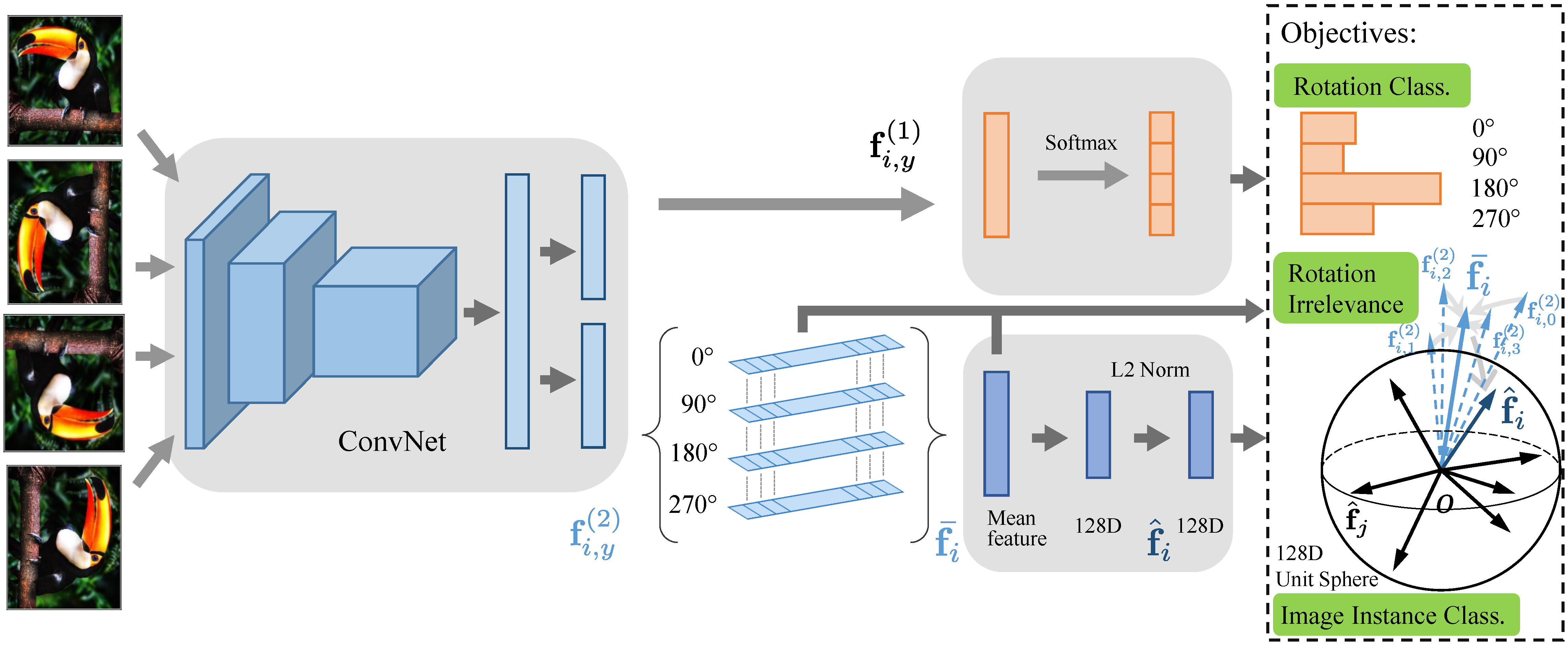
### Citing FeatureDecoupling
If you find the code useful in your research, please consider citing our CVPR 2019 paper:
```
@InProceedings{Feng_2019_CVPR,
author = {Feng, Zeyu and Xu, Chang and Tao, Dacheng},
title = {Self-Supervised Representation Learning by Rotation Feature Decoupling},
booktitle = {The IEEE Conference on Computer Vision and Pattern Recognition (CVPR)},
month = {June},
year = {2019}
}
```
### License
Please refer to License files for details.
### Notice
* Inside the [FeatureDecoupling](https://github.com/philiptheother/FeatureDecoupling) directory with the downloaded code, the experiments-related data will be stored in the directories [_experiments](https://github.com/philiptheother/FeatureDecoupling/tree/master/_experiments) and [_experiments_conversion](https://github.com/philiptheother/FeatureDecoupling/tree/master/_experiments_conversion).
* You have to make a copy of the file [config_env_example.py](https://github.com/philiptheother/FeatureDecoupling/blob/master/config_env_example.py) and rename it as *config_env.py*. Set in *config_env.py* the paths to where the caffe directory and datasets reside in your machine.
### Experiments
* In order to train a FeatureDecoupling model in an unsupervised way with AlexNet-like architecture on the ImageNet training images and then evaluate linear classifiers (for ImageNet and Places205) as well as non-linear classifiers (for ImageNet) on top of the learned features please visit the [pytorch_feature_decoupling](https://github.com/philiptheother/FeatureDecoupling/tree/master/pytorch_feature_decoupling) folder.
* For PASCAL VOC 2007 detection task please visit the [caffe_voc_detection](https://github.com/philiptheother/FeatureDecoupling/tree/master/caffe_voc_detection) folder.
### Download the already trained FeatureDecoupling model
* In order to download the FeatureDecoupling model (with AlexNet architecture) trained on the ImageNet training set, go to: [ImageNet_Decoupling_AlexNet](https://mega.nz/#!Wmh3WIDZ!e2TgkXEsMMpZNZvb1Tp8HsdBfeZOA3WKn5g0AkXEwAA). Note that:
1. The model is saved in pytorch format.
2. It expects RGB images that their pixel values are normalized with the following mean RGB values `mean_rgb = [0.485, 0.456, 0.406]` and std RGB values `std_rgb = [0.229, 0.224, 0.225]`. Prior to normalization the range of the image values must be [0.0, 1.0].
* In order to download the FeatureDecoupling model (with AlexNet architecture) trained on the ImageNet training set and convered in caffe format for PASCAL VOC 2007 classification and detection, go to: [ImageNet_Decoupling_AlexNet_caffe_cls](https://mega.nz/#!e65D3CLZ!jUvWfBt3NBcjZSI90X5mKKe-OHSswN9nWo_aPo1YCOQ). Note that:
1. The model is saved in caffe format.
2. It expects RGB images that their pixel values are normalized with the following mean RGB values `mean_rgb = [0.485, 0.456, 0.406]` and std RGB values `std_rgb = [0.229, 0.224, 0.225]`. Prior to normalization the range of the image values must be [0.0, 1.0].
3. The weights of the model are rescaled with the approach of [Krähenbühl et al, ICLR 2016](https://github.com/philkr/magic_init).
### To do
* Pytorch-Caffe converter
* PASCAL VOC experiments
* Pre-trained models