https://github.com/phizaz/cprop
CProp: Adaptive Learning Rate Scaling from Past Gradient Conformity
https://github.com/phizaz/cprop
Last synced: 9 months ago
JSON representation
CProp: Adaptive Learning Rate Scaling from Past Gradient Conformity
- Host: GitHub
- URL: https://github.com/phizaz/cprop
- Owner: phizaz
- Created: 2019-11-17T11:32:51.000Z (about 6 years ago)
- Default Branch: master
- Last Pushed: 2020-01-24T14:49:20.000Z (almost 6 years ago)
- Last Synced: 2025-03-25T19:21:28.532Z (10 months ago)
- Language: Jupyter Notebook
- Homepage:
- Size: 870 KB
- Stars: 8
- Watchers: 3
- Forks: 0
- Open Issues: 1
-
Metadata Files:
- Readme: README.md
Awesome Lists containing this project
README
# CProp: Adaptive Learning Rate Scaling from Past Gradient Conformity
Implementation of CProp in Pytorch.
[Looking for Tensorflow version?](https://github.com/phizaz/cprop/tree/master/tf)
A preprint Arxiv version can be found at https://arxiv.org/abs/1912.11493.
Paper is being reviewed.
## Installation
Requires Python with type-hint support (I guess 3.6+).
It seems to require Pytorch 1.2 due to its use of JIT.
```
# clone
...
# install
pip install -e .
```
## What's included
1. CPropSGD. CProp-augmented SGD.
2. CPropAdam. CProp-augmented Adam.
3. CProp universal wrapper. Slower but could be used with any optimizer.
## Usage
```
import cprop
opt = cprop.CPropSGD(net.parameters(), lr=0.1, cprop_beta=0.999, cprop_c=1, cprop_cdf='normal')
...
# use it as usual
opt.step()
```
`cprop_beta` is the gradient horizon. [0.999, 0.9997, 0.9999] work well depending on how long is your training job. You should choose for a larger `cprop_beta` if you aim to train for longer.
`cprop_c` is overconfidence coefficient. Default 1. Try it first. If you want better generalization, use larger `c`, e.g. 3, 5.
`cprop_cdf` how to compute CDF. `normal` is the most correct way to do it (but slowest). `bft` using Logistic approximation which is ~10% faster with no observable performance loss.
With any optimizer:
```
opt = any optimizer
opt = cprop.CProp(opt, beta=0.999, c=1, cdf='normal')
...
# use it as usual
opt.step()
```
## Plots
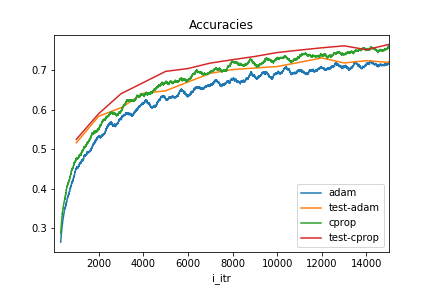
### Quick test on Cifar10
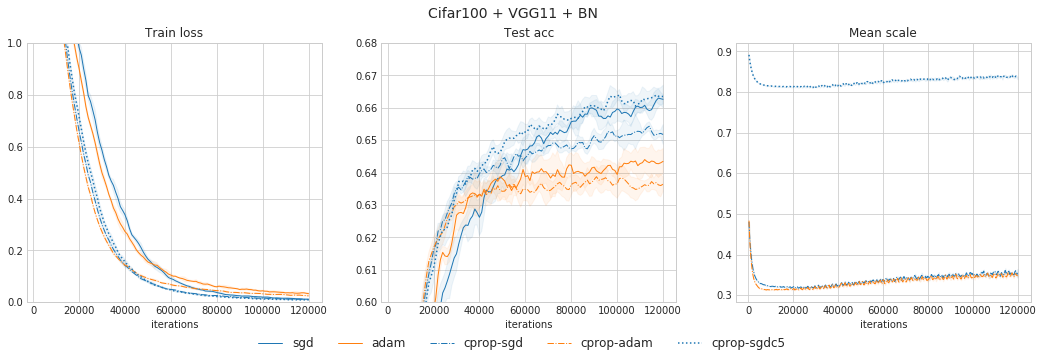
### Image classification:
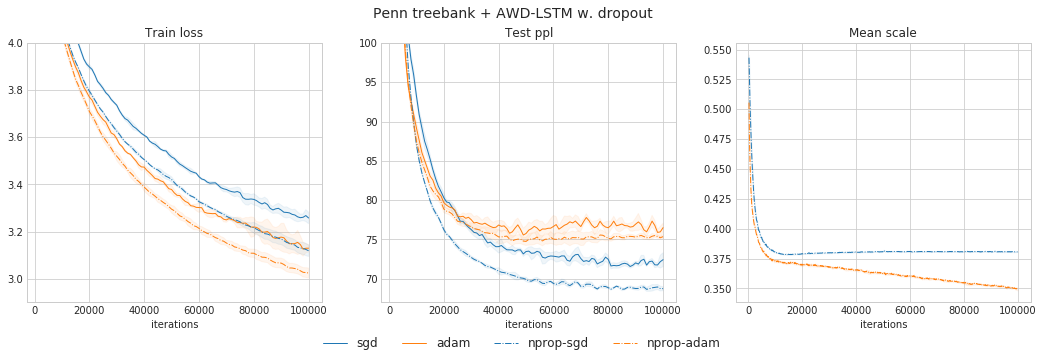
### Language modeling: