https://github.com/pikpikcu/airecon
AIRecon is an autonomous cybersecurity agent that combines a self-hosted Large Language Model (Ollama) with a Kali Linux Docker sandbox and a Textual TUI. It is designed to automate security assessments, penetration testing, and bug bounty reconnaissance — without any API keys or cloud dependency.
https://github.com/pikpikcu/airecon
ai-agents automation bugbounty cli ollama penetration-testing python reconnaissance
Last synced: 3 months ago
JSON representation
AIRecon is an autonomous cybersecurity agent that combines a self-hosted Large Language Model (Ollama) with a Kali Linux Docker sandbox and a Textual TUI. It is designed to automate security assessments, penetration testing, and bug bounty reconnaissance — without any API keys or cloud dependency.
- Host: GitHub
- URL: https://github.com/pikpikcu/airecon
- Owner: pikpikcu
- License: mit
- Created: 2026-03-05T20:02:08.000Z (5 months ago)
- Default Branch: main
- Last Pushed: 2026-04-19T09:31:13.000Z (3 months ago)
- Last Synced: 2026-04-19T10:31:30.121Z (3 months ago)
- Topics: ai-agents, automation, bugbounty, cli, ollama, penetration-testing, python, reconnaissance
- Language: Python
- Homepage:
- Size: 5.32 MB
- Stars: 385
- Watchers: 0
- Forks: 63
- Open Issues: 2
-
Metadata Files:
- Readme: README.md
- Changelog: CHANGELOG.txt
- Funding: .github/FUNDING.yml
- License: LICENSE
Awesome Lists containing this project
- awesome-ai-offensive-security - airecon - AIRecon is an autonomous cybersecurity agent that combines a self-hosted Large Language Model (Ollama) with a Kali Linux Docker sandbox and a Textual TUI. It is designed to automate security assessments, penetration testing, and bug bounty reconnaissance. (Pentest & Red Teaming Agents)
README

AI-Powered Autonomous Penetration Testing Agent





-orange.svg)

AIRecon is an autonomous penetration testing agent that combines a self-hosted **Ollama LLM** with a **Kali Linux Docker sandbox**, native **Caido proxy integration**, a structured **RECON → ANALYSIS → EXPLOIT → REPORT pipeline**, and a real-time **Textual TUI** — completely offline, no API keys required.

---
## Why AIRecon?
Commercial API-based models (OpenAI GPT-4, Claude, Gemini) become prohibitively expensive for recursive, autonomous recon workflows that can require thousands of LLM calls per session.
AIRecon is built 100% for local, private operation.
| Feature | AIRecon | Cloud-based agents |
|---------|---------|-------------------|
| API keys required | **No** | Yes |
| Target data sent to cloud | **No** | Yes |
| Works offline | **Yes** | No |
| Caido integration | **Native** | None |
| Session resume | **Yes** | Varies |
| Local knowledge base | **~1.09M records** | None |
- **Privacy First** — Target intelligence, tool output, and reports never leave your machine.
- **Caido Native** — 5 built-in tools: list, replay, automate (`§FUZZ§`), findings, scope.
- **Full Stack** — Kali sandbox + browser automation + custom fuzzer + Schemathesis API fuzzing + Semgrep SAST.
- **Skills Knowledge Base** — 57 built-in skill files, 289 keyword → skill auto-mappings. Extended by **[airecon-skills](https://github.com/pikpikcu/airecon-skills)** — a community skill library with 57 additional CLI-based playbooks for CTF, bug bounty, and pentesting.
- **Local Security Knowledge Base** — Optional **[airecon-dataset](https://github.com/pikpikcu/airecon-dataset)** indexes ~1.09M security records (CVEs, red team techniques, CTF writeups, nuclei templates, bug bounty payloads) into local SQLite FTS5. The LLM calls `dataset_search` autonomously before attempting unfamiliar techniques — grounding its decisions in real indexed data.
---
## Pipeline
```
RECON → ANALYSIS → EXPLOIT → REPORT
```
Each phase has specific objectives, recommended tools, and automatic transition criteria. Phase enforcement is **soft** — the agent is guided but never blocked. Checkpoints run every 5 (phase eval), 10 (self-eval), and 15 (context compression) iterations.
---
## Memory & Learning (What It Actually Does)
AIRecon does **not** fine-tune the LLM. Its "learning" is local, structured telemetry that guides tool choice and avoids repeating failed paths.
**Local persistence (all on disk, no cloud):**
- SQLite memory DB at `~/.airecon/memory/airecon.db` storing sessions, findings, patterns, target intel, tool usage, model performance, skill usage, and attack-chain discoveries.
- Adaptive learning state at `~/.airecon/learning/global_learning.json` (tool performance stats, strategy patterns, observation log, distilled insights).
- Per-target memory files under `~/.airecon/memory/by_target/` when persisted, containing endpoints, vulns, WAF bypasses, sensitive params, and auth endpoints.
- Payload memory snapshots can be saved under `workspace//payload_memory.json` when session persistence runs.
**How it affects behavior:**
- On session start, memory context is injected (target intel, similar findings, learned patterns, tool reliability).
- Every 8 iterations, learned patterns and similar findings can be re-injected based on detected tech.
- Adaptive tool ranking uses historical success/failure to order tools and suggest strategies.
- Payload memory (when enabled) skips payloads that repeatedly failed for the same target/param.
---
## Model Requirements
AIRecon requires a model with **extended thinking** (`` blocks) and **reliable tool-calling** capabilities. Capabilities are auto-detected via `ollama show` metadata.
> **⚠️ Tool calling support is REQUIRED.** The model must support native function/tool calling. Models without this capability will be unable to execute any tools (http_observe, execute, browser actions, etc.), making AIRecon completely non-functional.
>
> **Recommended minimum: 8B-9B parameters.** Models below 8B are technically usable but strongly discouraged — they frequently hallucinate tool output, invent CVEs, skip scope rules, and produce unreliable tool calls.
| Model | Pull | VRAM | Notes |
|-------|------|------|-------|
| **Qwen3.5 122B** | `ollama pull qwen3.5:122b` | 48+ GB | Best quality, most reliable |
| **Qwen3.5 35B** | `ollama pull qwen3.5:35b` | 20 GB | **Recommended for most users** |
| **Qwen3.5 35b** | `ollama pull qwen3.5:35b-a3b` | 16 GB | MoE — lower VRAM |
| **Qwen3.5 9B** | `ollama pull qwen3.5:9b` | 6 GB | **Minimum viable** — expect frequent errors |
**Model size guidance:**
- **≥32B:** Reliable for full recon pipelines, good tool calling accuracy
- **8B-14B:** Usable for simple tasks, expect 20-40% tool call errors and hallucinations
- **<8B:** Technically works but produces unreliable results — not recommended for serious testing
**Known issues:** DeepSeek R1 produces incomplete function calls. Models < 8B lack reliable tool calling support.
---
## Running Ollama on Google Colab (Limited Hardware)
If you don't have a GPU or your local VRAM is below the minimum, you can run Ollama on a **free Google Colab T4 GPU** and connect AIRecon to it via a public tunnel.
> **Open the notebook:**
> [](https://colab.research.google.com/github/pikpikcu/airecon/blob/main/scripts/airecon_colab.ipynb)
**How it works:**
```
Google Colab GPU Your Local Machine
┌─────────────────────────┐ ┌──────────────────────────┐
│ Ollama (qwen3.5:9b) │◄────────►│ AIRecon TUI │
│ cloudflared tunnel │ HTTPS │ ollama_url: tunnel URL │
└─────────────────────────┘ └──────────────────────────┘
```
**Steps:**
1. Open the Colab link above and select **Runtime → Change runtime type → T4 GPU**
2. Run all cells top to bottom (takes ~5–10 minutes first time)
3. Copy the config snippet printed in **Cell 6** into `~/.airecon/config.yaml`:
```yaml
ollama_url: "https://xxxx.trycloudflare.com" # printed by Cell 6
ollama_model: "qwen3.5:9b"
ollama_timeout: 300.0
ollama_chunk_timeout: 300.0
ollama_num_ctx: 32768
ollama_num_ctx_small: 16384
```
4. Start AIRecon normally: `airecon start`
**Colab GPU → model availability:**
| Colab GPU | VRAM | Available model | Plan |
|-----------|------|-----------------|------|
| T4 | 15 GB | `qwen3.5:9b` | Free |
| L4 | 22 GB | `qwen3.5:35b-a3b` (MoE) | Pro |
| A100 | 40 GB | `qwen3.5:35b` | Pro+ |
| H100 | 80 GB | `qwen3.5:122b` | Pro+ |
**Limitations:**
- Colab sessions last max **12 hours** (free) / **24 hours** (Pro) — tunnel URL changes on reconnect
- T4 with `qwen3.5:9b` is the minimum viable setup — expect slower responses and more tool-call errors than a local 35B+ model
- Not suitable for long autonomous sessions (deep recon can exceed session limits)
- The Colab notebook is located at [`scripts/airecon_colab.ipynb`](scripts/airecon_colab.ipynb) if you want to self-host or modify it
---
## Installation
**Prerequisites:** Python 3.12+, Docker 20.10+, Ollama (running), git, curl
### One-line install (recommended)
```text
curl -fsSL https://raw.githubusercontent.com/pikpikcu/airecon/refs/heads/main/scripts/install.sh | bash
```
The script auto-detects remote vs local mode, installs Poetry if missing (via official installer — no system package conflicts), builds the wheel, and installs to `~/.local/bin`.
### Manual install (from source)
```text
git clone https://github.com/pikpikcu/airecon.git
cd airecon
./install.sh
```
```text
# Add to ~/.bashrc or ~/.zshrc if needed
export PATH="$HOME/.local/bin:$PATH"
airecon --version
```
---
## Configuration
Config file: `~/.airecon/config.yaml` (auto-generated on first run). AIRecon will create `~/.airecon/` if it doesn't exist, including when a custom `~` path is used.
```yaml
# ======================================
# Ollama Connection
# ======================================
# Ollama API endpoint. REQUIRED — must be set. For local: http://127.0.0.1:11434. For remote: http://IP:11434
ollama_url: "http://127.0.0.1:11434"
# Model to use. 122B for best reasoning (requires 60GB+ VRAM). For 12GB VRAM: use qwen2.5:7b or smaller. For 8GB VRAM: use qwen2.5:1.8b.
ollama_model: "qwen3.5:122b"
# Total request timeout (seconds). 180s = 3 min. Stable for most models. Increase to 300s for slow remote servers or 122B models.
ollama_timeout: 180.0
# ======================================
# Ollama Model Settings
# ======================================
# Context window size. 65536 = 64K (stable for 12GB VRAM with 8B models). 131072 = 128K requires 30GB+ VRAM. Set -1 for server default.
ollama_num_ctx: 65536
# Context for CTF/summary mode. 32768 = 32K (stable for 12GB VRAM). Reduced from 64K for stability with 8B+ models.
ollama_num_ctx_small: 32768
# LLM output randomness. 0.0=deterministic, 0.15=recommended (strict), 0.3=creative. Does NOT affect thinking mode — controls output diversity only.
ollama_temperature: 0.15
# Max tokens to generate. 16384 = 16K (stable for 12GB VRAM). 32K requires more VRAM.
ollama_num_predict: 16384
# Enable extended thinking mode (for Qwen3.5+/Qwen2.5+). When enabled, model generates reasoning blocks before answering.
ollama_enable_thinking: true
# Thinking intensity: low|medium|high|adaptive. For 12GB VRAM: use 'low' or 'medium'. 'high' may cause OOM with 8B models. Low=only deep tools, Medium=ANALYSIS+deep tools, High=most iterations (high VRAM only).
ollama_thinking_mode: low
# Protect first N tokens from KV eviction. 4096 = 4K (reduced for 12GB VRAM stability). 8K for larger VRAM.
ollama_num_keep: 4096
# ======================================
# Proxy Server
# ======================================
# Host to bind proxy server. 127.0.0.1 = localhost only.
proxy_host: 127.0.0.1
# Port for proxy server. Default 3000.
proxy_port: 3000
# ======================================
# Timeouts
# ======================================
# Docker command timeout (seconds). 900s = 15 min for long scans (nmap, nuclei).
command_timeout: 900.0
# ======================================
# Docker Sandbox
# ======================================
# Container memory limit. '16g' = 16GB (stable for 32GB+ RAM host, 18GB image + Chromium). Prevents OOM kills. Set to '12g' for 32GB RAM, '8g' for 16GB systems, '4g' for 8GB systems.
docker_memory_limit: 16g
# ======================================
# Deep Recon
# ======================================
# Auto-start deep recon on session start.
deep_recon_autostart: true
# Recon execution mode: standard|full. standard=respect user scope, full=auto-expand simple target prompts into comprehensive recon.
agent_recon_mode: standard
# ======================================
# Safety
# ======================================
# Allow destructive tests (e.g., DELETE requests). Default: False for safety.
allow_destructive_testing: false
```
| Key | Default | Notes |
|-----|---------|-------|
| `ollama_temperature` | `0.15` | Keep 0.1–0.2. Higher values cause hallucination. |
| `ollama_num_ctx` | `131072` | Reduce to `32768` if VRAM is limited. |
| `ollama_keep_alive` | `"60m"` | How long to keep model in VRAM. |
| `deep_recon_autostart` | `true` | Bare domain inputs auto-expand to full recon. |
| `allow_destructive_testing` | `false` | Unlocks aggressive modes (SQLi confirm, RCE chains). |
| `command_timeout` | `900.0` | Max seconds per shell command in Docker. |
| `vuln_similarity_threshold` | `0.7` | Jaccard dedup threshold for vulnerabilities. |
**Remote Ollama** (LAN server or Google Colab tunnel):
```yaml
ollama_url: "http://192.168.1.100:11434" # LAN server
ollama_model: "qwen3.5:35b"
# or via Colab tunnel (see "Running Ollama on Google Colab" section above):
ollama_url: "https://xxxx.trycloudflare.com"
ollama_model: "qwen3.5:9b"
ollama_timeout: 300.0
ollama_chunk_timeout: 300.0
```
---
## MCP Integration
AIRecon can connect to external MCP servers and expose their tools dynamically as `mcp_` tools.
Config file: `~/.airecon/mcp.json`
**Example config:**
```json
{
"mcpServers": {
"hexstrike": {
"command": "python3",
"args": [
"/path/hexstrike-ai/hexstrike_mcp.py",
"--server",
"http://127.0.0.1:8888"
],
"env": {
"PYTHONUNBUFFERED": "1"
},
"enabled": true
},
"xssgen": {
"command": "python3",
"args": [
"/path/xssgen/xss_client.py",
"--server",
"http://127.0.0.1:8000"
],
"env": {
"PYTHONUNBUFFERED": "1"
},
"enabled": true
},
"recon": {
"transport": "sse",
"url": "https://example.com/mcp",
"enabled": true,
"headers": {
"Authorization": "Bearer xxxxx"
}
}
}
}
```
**Using MCP tools in chat:**
- Tool name format: `mcp_`
- Actions: `list_tools`, `search_tools`, `call_tool`
Example:
```json
{"name": "mcp_acme", "arguments": {"action": "list_tools"}}
```
---
## Knowledge Base (airecon-dataset)
**[airecon-dataset](https://github.com/pikpikcu/airecon-dataset)** is an optional companion that downloads security datasets from HuggingFace and indexes them locally into SQLite FTS5 databases. Once installed, the LLM queries them autonomously via the `dataset_search` tool.
**How it works:** `dataset_search` is a standard agent tool in `tools.json`. The LLM decides when to call it — AIRecon does not auto-trigger it. The system prompt instructs the agent to query the knowledge base before attempting unfamiliar techniques.
```bash
git clone https://github.com/pikpikcu/airecon-dataset.git
cd airecon-dataset && python install.py
```
**Datasets included (~1.09M records total, 100% offline):**
| Dataset | Records | Content |
|---------|---------|---------|
| Pentest Agent (ChatML) | 322,433 | CVE-based exploitation workflows (MITRE/NVD/ExploitDB) |
| CTF SaTML 2024 | 190,657 | Real attack/defense CTF interaction data |
| CTF Instruct | 141,182 | Pwn, web, crypto, forensics, reverse engineering |
| Cybersecurity CVE | 124,732 | CVE analysis, CVSS, exploitation context |
| SQL Injection Q&A | 50,632 | Conversational SQLi — detection, bypass, exploitation |
| Cybersecurity Fenrir | 83,918 | Attack/defense instruction pairs |
| Red Team Offensive | 78,430 | Lateral movement, privilege escalation, evasion |
| Cybersecurity Q&A | 53,199 | Broad security knowledge |
| StackExchange RE | 20,641 | Binary analysis, disassembly, debugging, malware |
| Nuclei Templates | 23,180 | Nuclei YAML template generation |
| NVD Security Instructions | 2,063 | Structured CVE analysis with severity and remediation |
| APT Privilege Escalation | 1,000 | Linux priv esc techniques with APT tactics |
| Bug Bounty & Pentest | 146 | Payloads, bypass methods, report templates |
**Example agent queries (called autonomously by the LLM):**
```
dataset_search: {"query": "log4j RCE exploitation chain"}
dataset_search: {"query": "SSRF bypass cloud metadata", "category": "bug-bounty"}
dataset_search: {"query": "nuclei template XSS detection"}
dataset_search: {"query": "CVE 2021 44228", "category": "vulnerability"}
```
Results are capped at 500 chars each. Special chars in CVE IDs (dashes, brackets) are sanitized automatically.
---
## Usage
```text
airecon start # start TUI
airecon start --session # resume session
```
**Example prompts:**
```
# Full pipeline
full recon on example.com
pentest https://api.example.com
# Specific tasks
find subdomains of example.com
scan ports on 10.0.0.1
check for XSS on https://example.com/search
test SQL injection on https://example.com/api/login parameter: username
run schemathesis on https://example.com/openapi.json
# Authenticated testing
login to https://example.com/login with admin@example.com / password123 then test for IDOR
test https://app.example.com with TOTP: JBSWY3DPEHPK3PXP
# Multi-agent
spawn an XSS specialist on https://example.com/search
run parallel recon on: example.com, sub.example.com, api.example.com
# Caido
replay request #1234 with a modified Authorization header
use Caido to fuzz the username parameter in request #45 with §FUZZ§ markers
```
---
## Workspace
```
workspace//
├── command/ # system-managed logs
├── output/ # Raw tool outputs (nmap, httpx, nuclei, subfinder, ...)
├── tools/ # AI-generated exploit scripts (.py, .sh)
└── vulnerabilities/ # Verified vulnerability reports (.md)
```
Sessions persist at `~/.airecon/sessions/.json` — subdomains, ports, technologies, URLs, vulnerabilities (Jaccard dedup), auth tokens, and completed phases.
---
## Troubleshooting
**Ollama OOM / HTML error page** — Most common on long sessions or large models near VRAM limits.
```text
sudo systemctl restart ollama
```
```json
{ "ollama_num_ctx": 32768, "ollama_num_ctx_small": 16384, "ollama_num_predict": 8192 }
```
**Agent loops/stalls** — Usually a reasoning failure. Try a larger model, or reduce `ollama_temperature` to `< 0.2`.
**Docker sandbox not starting:**
```text
docker build -t airecon-sandbox airecon/containers/kali/
```
**Caido connection refused** — Caido must be running before AIRecon. Default: `127.0.0.1:48080`.
**PATH not found after install:**
```text
export PATH="$HOME/.local/bin:$PATH" && source ~/.zshrc
```
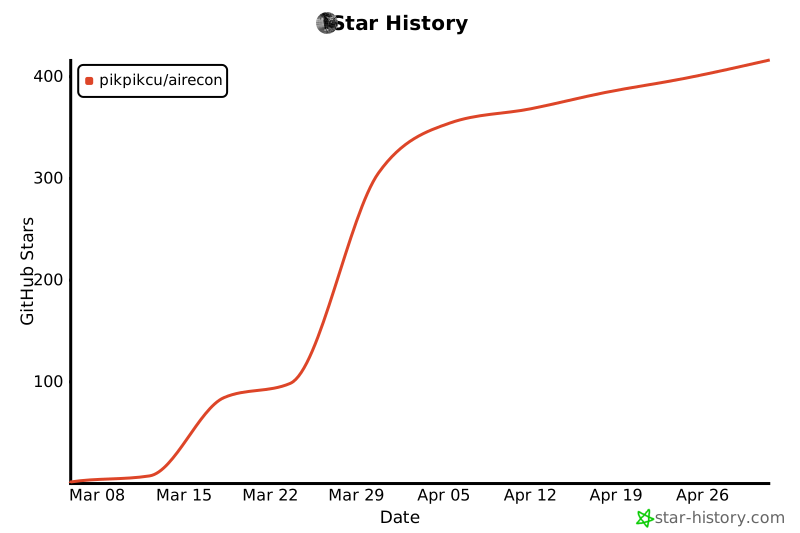
## Star History
## Contributing
Issues and PRs are welcome. If you report a bug, include logs, config, and minimal steps to reproduce.
## Responsible Use
AIRecon is for authorized security testing only. Always obtain explicit permission and follow applicable laws and program scope.
## License
See [LICENSE](LICENSE).