https://github.com/pints-team/pints
Probabilistic Inference on Noisy Time Series
https://github.com/pints-team/pints
bayesian-methods inverse-problems numerical-optimization parameter-estimation
Last synced: 3 months ago
JSON representation
Probabilistic Inference on Noisy Time Series
- Host: GitHub
- URL: https://github.com/pints-team/pints
- Owner: pints-team
- License: other
- Created: 2017-05-16T12:10:07.000Z (about 9 years ago)
- Default Branch: main
- Last Pushed: 2025-02-10T11:22:53.000Z (over 1 year ago)
- Last Synced: 2025-05-03T01:23:35.659Z (about 1 year ago)
- Topics: bayesian-methods, inverse-problems, numerical-optimization, parameter-estimation
- Language: Python
- Homepage: http://pints.readthedocs.io
- Size: 192 MB
- Stars: 235
- Watchers: 11
- Forks: 34
- Open Issues: 146
-
Metadata Files:
- Readme: README.md
- Changelog: CHANGELOG.md
- Contributing: CONTRIBUTING.md
- License: LICENSE.md
- Citation: CITATION
Awesome Lists containing this project
- awesome-sciml - pints-team/pints: Probabilistic Inference on Noisy Time Series
README
[](https://github.com/pints-team/pints/actions/workflows/unit-test-python-coverage.yml)
[](https://github.com/pints-team/pints/actions/workflows/unit-test-os-coverage.yml)
[](https://codecov.io/gh/pints-team/pints)
[](https://github.com/pints-team/change-point-testing)
[](https://www.cs.ox.ac.uk/projects/PINTS/functional-testing)
[](https://mybinder.org/v2/gh/pints-team/pints/main?filepath=examples)
[](http://pints.readthedocs.io/en/latest/?badge=latest)
# What is Pints?
PINTS (Probabilistic Inference on Noisy Time-Series) is a framework for optimisation and Bayesian inference.
Although it can be used as a general-purpose inference tool, it was developed specifically for models of noisy time-series, such as arise in electrochemistry and cardiac electrophysiology.
PINTS is described in [this publication in JORS](http://doi.org/10.5334/jors.252) and can be cited using the information given in our [CITATION file](https://github.com/pints-team/pints/blob/main/CITATION).
More information about PINTS papers can be found in the [papers directory](https://github.com/pints-team/pints/tree/main/papers).
## Using PINTS
PINTS can work with any model that implements the [pints.ForwardModel](http://pints.readthedocs.io/en/latest/core_classes_and_methods.html#forward-model) interface.
This has just two methods:
```
n_parameters() --> Returns the dimension of the parameter space.
simulate(parameters, times) --> Returns a vector of model evaluations at
the given times, using the given parameters
```
Experimental data sets in PINTS are defined simply as lists (or arrays) of `times` and corresponding experimental `values`.
If you have this kind of data, and if [your model (or model wrapper)](https://github.com/pints-team/pints/blob/main/examples/stats/custom-model.ipynb) implements the two methods above, then you are ready to start using PINTS to infer parameter values using [optimisation](https://github.com/pints-team/pints/blob/main/examples/optimisation/first-example.ipynb) or [sampling](https://github.com/pints-team/pints/blob/main/examples/sampling/first-example.ipynb).
A brief example is shown below:
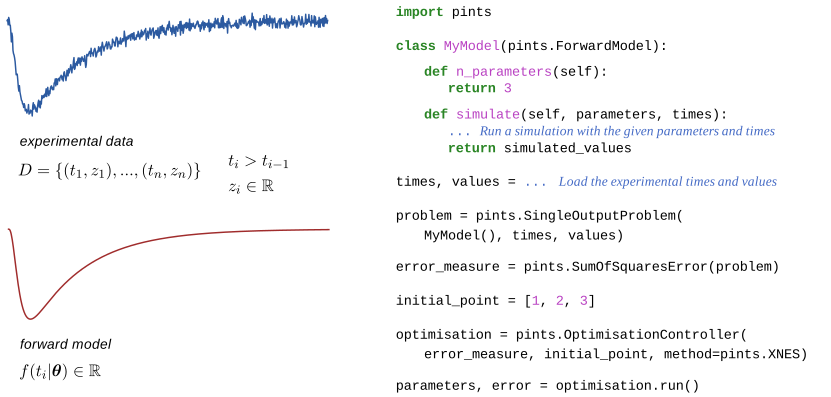
_(Left)_ A noisy experimental time series and a computational forward model.
_(Right)_ Example code for an optimisation problem.
The full code can be [viewed here](https://github.com/pints-team/pints/blob/main/examples/sampling/readme-example.ipynb) but a friendlier, more elaborate, introduction can be found on the [examples page](https://github.com/pints-team/pints/blob/main/examples/README.md).
Beyond time-series models, PINTS can be used on any error function or log-likelihood that takes real-valued, continuous parameters.
An overview of the methods provided by PINTS can be [viewed here](https://pints.readthedocs.io/en/latest/#provided-methods).
### Examples and documentation
PINTS comes with a number of [detailed examples](https://github.com/pints-team/pints/blob/main/examples/README.md), hosted here on github.
In addition, there is a [full API documentation](http://pints.readthedocs.io/en/latest/), hosted on readthedocs.io.
## Installing PINTS
The latest release of PINTS can be installed with `pip`, by opening a console and typing
```
$ pip install --upgrade pip
$ pip install pints
```
Note that you'll need Python 3.6 or newer.
If you prefer to have the latest cutting-edge version, you can instead install from the repository, by typing
```
$ git clone https://github.com/pints-team/pints.git
$ cd pints
$ pip install -e .[dev,docs]
```
To uninstall again, type:
```
$ pip uninstall pints
```
## What's new in this version of PINTS?
To see what's changed in the latest release, see the [CHANGELOG](https://github.com/pints-team/pints/blob/main/CHANGELOG.md).
## Contributing to PINTS
There are lots of ways to contribute to PINTS development, and anyone is free to join in.
For example, you can report problems or make feature requests on the [issues](https://github.com/pints-team/pints/issues) pages.
Similarly, if you want to contribute documentation or code you can tell us your idea on this page, and then provide a pull request for review.
Because PINTS is a big project, we've written extensive [contribution guidelines](https://github.com/pints-team/pints/blob/master/CONTRIBUTING.md) to help standardise the code — but don't worry, this will become clear during review.
## License
PINTS is fully open source.
For more information about its license, see [LICENSE](https://github.com/pints-team/pints/blob/main/LICENSE.md).
## Get in touch
Questions, suggestions, or bug reports?
[Start a discussion](https://github.com/pints-team/pints/discussions) or [open an issue](https://github.com/pints-team/pints/issues) to let us know!