https://github.com/posit-dev/pointblank
Data validation toolkit for assessing and monitoring data quality.
https://github.com/posit-dev/pointblank
data-quality data-testing data-validation easy-to-understand tabular-data
Last synced: 4 months ago
JSON representation
Data validation toolkit for assessing and monitoring data quality.
- Host: GitHub
- URL: https://github.com/posit-dev/pointblank
- Owner: posit-dev
- License: mit
- Created: 2024-10-23T23:55:57.000Z (over 1 year ago)
- Default Branch: main
- Last Pushed: 2026-04-01T16:25:17.000Z (4 months ago)
- Last Synced: 2026-04-01T16:26:22.950Z (4 months ago)
- Topics: data-quality, data-testing, data-validation, easy-to-understand, tabular-data
- Language: Python
- Homepage: https://posit-dev.github.io/pointblank/
- Size: 347 MB
- Stars: 402
- Watchers: 4
- Forks: 25
- Open Issues: 27
-
Metadata Files:
- Readme: README.md
- Contributing: CONTRIBUTING.md
- License: LICENSE
- Code of conduct: .github/CODE_OF_CONDUCT.md
- Citation: CITATION.cff
- Security: .github/SECURITY.md
Awesome Lists containing this project
- awesome-jupyter - pointblank - Notebook-friendly testing of DataFrames and database tables for data quality purposes. (Testing)
README
> [!TIP]
> **📺 Featured Talk: ['Making Things Nice in Python'](https://www.youtube.com/watch?v=J6e2BKjHyPg)**
>
> Discover how Pointblank and Great Tables (used in this library) prioritize user experience in Python package design. I go over why convenient options, extensive documentation, and thoughtful API decisions is better for everyone (even when they challenge conventional Python patterns/practices).
_Data validation toolkit for assessing and monitoring data quality._
[](https://pypi.python.org/pypi/pointblank)
[](https://pypi.org/project/pointblank/#history)
[](https://pepy.tech/projects/pointblank)
[](https://anaconda.org/conda-forge/pointblank)
[](https://img.shields.io/github/license/posit-dev/pointblank)
[](https://github.com/posit-dev/pointblank/actions/workflows/ci-tests.yaml)
[](https://codecov.io/gh/posit-dev/pointblank)
[](https://www.repostatus.org/#active)
[](https://posit-dev.github.io/pointblank/)
[](https://deepwiki.com/posit-dev/pointblank)
[](https://github.com/posit-dev/pointblank/graphs/contributors)
[](https://discord.com/invite/YH7CybCNCQ)
[](https://www.contributor-covenant.org/version/2/1/code_of_conduct.html)
Français |
Deutsch |
Italiano |
Español |
Português |
Nederlands |
简体中文 |
日本語 |
한국어 |
हिन्दी |
العربية
Pointblank takes a different approach to data quality. It doesn't have to be a tedious technical task. Rather, it can become a process focused on clear communication between team members. While other validation libraries focus solely on catching errors, Pointblank is great at both **finding issues and sharing insights**. Our beautiful, customizable reports turn validation results into conversations with stakeholders, making data quality issues immediately understandable and actionable for everyone on your team.
**Get started in minutes, not hours.** Pointblank's AI-powered [`DraftValidation`](https://posit-dev.github.io/pointblank/user-guide/draft-validation.html) feature analyzes your data and suggests intelligent validation rules automatically. So there's no need to stare at an empty validation script wondering where to begin. Pointblank can kickstart your data quality journey so you can focus on what matters most.
Whether you're a data scientist who needs to quickly communicate data quality findings, a data engineer building robust pipelines, or an analyst presenting data quality results to business stakeholders, Pointblank helps you to turn data quality from an afterthought into a competitive advantage.
## Getting Started with AI-Powered Validation Drafting
The `DraftValidation` class uses LLMs to analyze your data and generate a complete validation plan with intelligent suggestions. This helps you quickly get started with data validation or jumpstart a new project.
```python
import pointblank as pb
# Load your data
data = pb.load_dataset("game_revenue") # A sample dataset
# Use DraftValidation to generate a validation plan
pb.DraftValidation(data=data, model="anthropic:claude-sonnet-4-5")
```
The output is a complete validation plan with intelligent suggestions based on your data:
```python
import pointblank as pb
# The validation plan
validation = (
pb.Validate(
data=data,
label="Draft Validation",
thresholds=pb.Thresholds(warning=0.10, error=0.25, critical=0.35)
)
.col_vals_in_set(columns="item_type", set=["iap", "ad"])
.col_vals_gt(columns="item_revenue", value=0)
.col_vals_between(columns="session_duration", left=3.2, right=41.0)
.col_count_match(count=11)
.row_count_match(count=2000)
.rows_distinct()
.interrogate()
)
validation
```
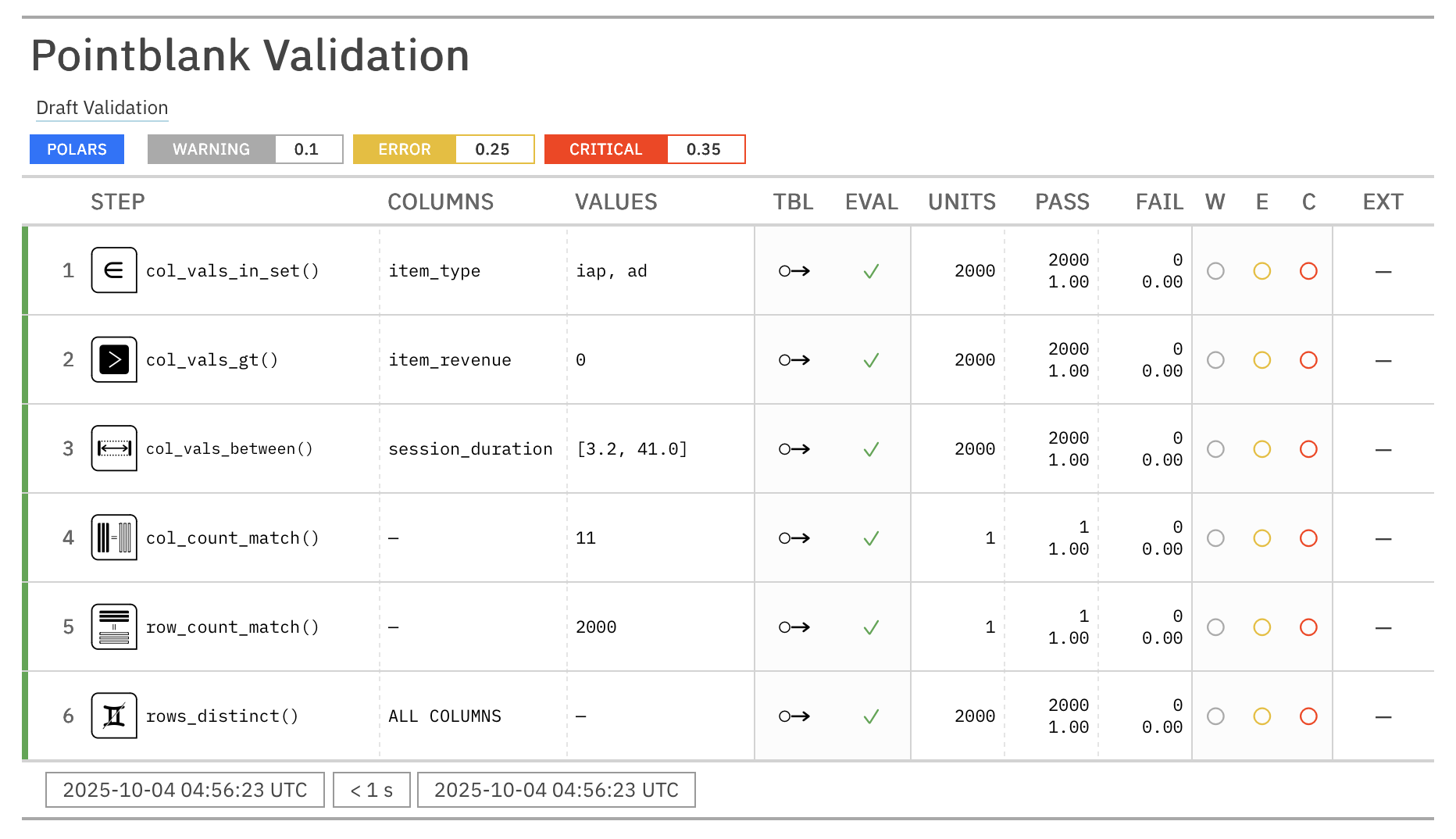
Copy, paste, and customize the generated validation plan for your needs.
## Chainable Validation API
Pointblank's chainable API makes validation simple and readable. The same pattern always applies: (1) start with `Validate`, (2) add validation steps, and (3) finish with `interrogate()`.
```python
import pointblank as pb
validation = (
pb.Validate(data=pb.load_dataset(dataset="small_table"))
.col_vals_gt(columns="d", value=100) # Validate values > 100
.col_vals_le(columns="c", value=5) # Validate values <= 5
.col_exists(columns=["date", "date_time"]) # Check columns exist
.interrogate() # Execute and collect results
)
# Get the validation report from the REPL with:
validation.get_tabular_report().show()
# From a notebook simply use:
validation
```
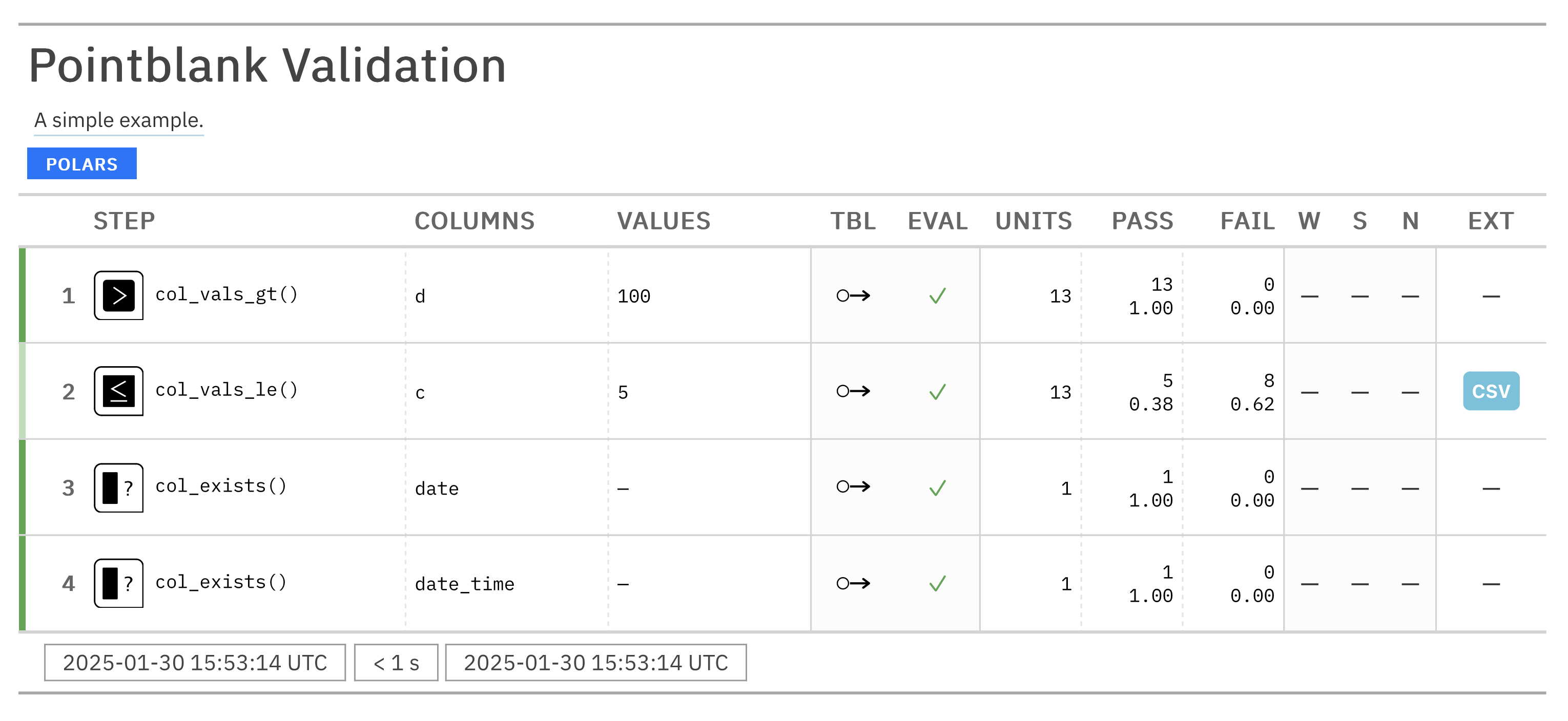
Once you have an interrogated `validation` object, you can leverage a variety of methods to extract insights like:
- getting detailed reports for single steps to see what went wrong
- filtering tables based on validation results
- extracting problematic data for debugging
## Why Choose Pointblank?
- **Works with your existing stack**: Seamlessly integrates with Polars, Pandas, DuckDB, MySQL, PostgreSQL, SQLite, Parquet, PySpark, Snowflake, and more!
- **Beautiful, interactive reports**: Crystal-clear validation results that highlight issues and help communicate data quality
- **Composable validation pipeline**: Chain validation steps into a complete data quality workflow
- **Threshold-based alerts**: Set 'warning', 'error', and 'critical' thresholds with custom actions
- **Practical outputs**: Use validation results to filter tables, extract problematic data, or trigger downstream processes
## Production-Ready Validation Pipeline
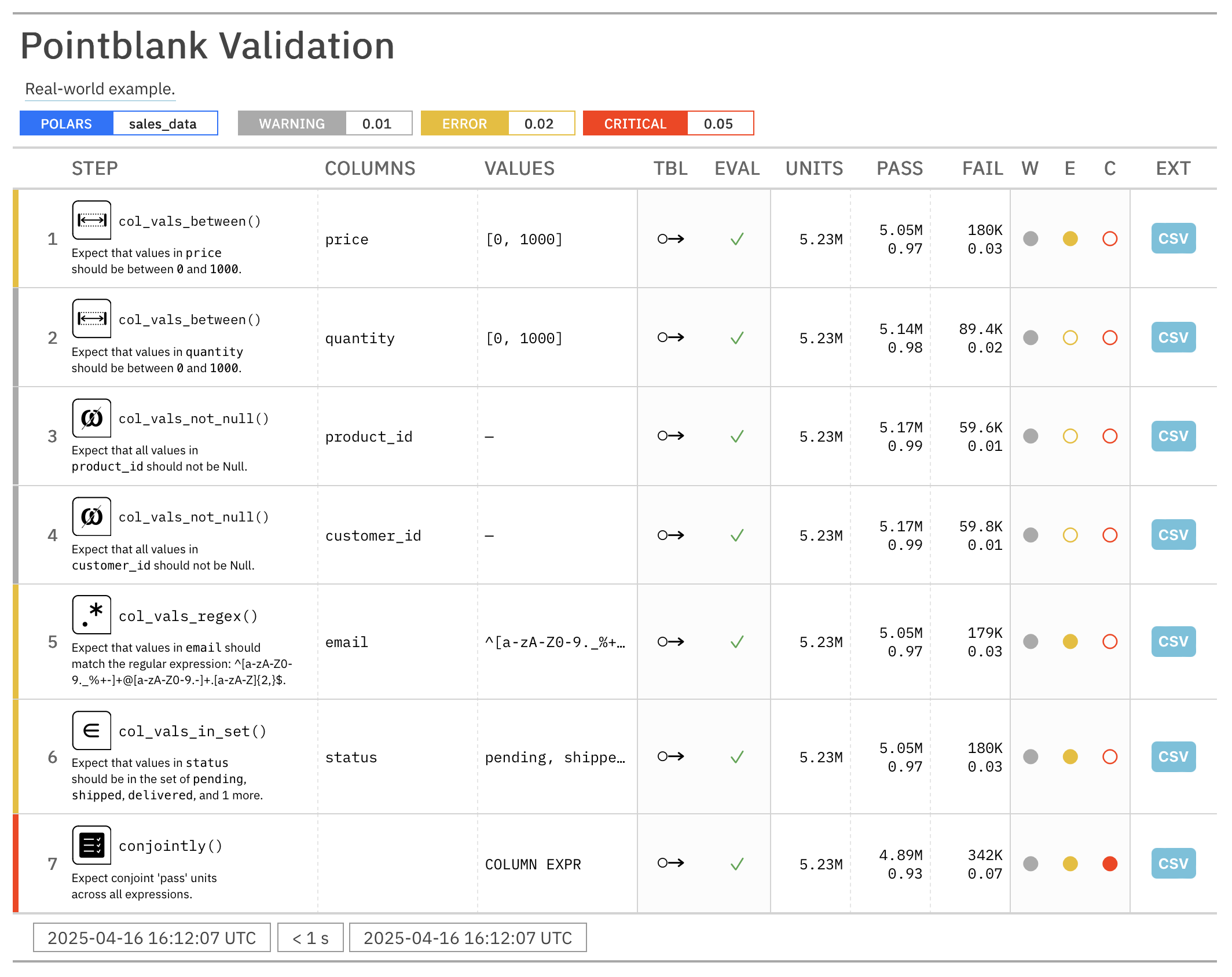
Here's how Pointblank handles complex, real-world scenarios with advanced features like threshold management, automated alerts, and comprehensive business rule validation:
```python
import pointblank as pb
import polars as pl
# Load your data
sales_data = pl.read_csv("sales_data.csv")
# Create a comprehensive validation
validation = (
pb.Validate(
data=sales_data,
tbl_name="sales_data", # Name of the table for reporting
label="Real-world example.", # Label for the validation, appears in reports
thresholds=(0.01, 0.02, 0.05), # Set thresholds for warnings, errors, and critical issues
actions=pb.Actions( # Define actions for any threshold exceedance
critical="Major data quality issue found in step {step} ({time})."
),
final_actions=pb.FinalActions( # Define final actions for the entire validation
pb.send_slack_notification(
webhook_url="https://hooks.slack.com/services/your/webhook/url"
)
),
brief=True, # Add automatically-generated briefs for each step
)
.col_vals_between( # Check numeric ranges with precision
columns=["price", "quantity"],
left=0, right=1000
)
.col_vals_not_null( # Ensure that columns ending with '_id' don't have null values
columns=pb.ends_with("_id")
)
.col_vals_regex( # Validate patterns with regex
columns="email",
pattern="^[a-zA-Z0-9._%+-]+@[a-zA-Z0-9.-]+\\.[a-zA-Z]{2,}$"
)
.col_vals_in_set( # Check categorical values
columns="status",
set=["pending", "shipped", "delivered", "returned"]
)
.conjointly( # Combine multiple conditions
lambda df: pb.expr_col("revenue") == pb.expr_col("price") * pb.expr_col("quantity"),
lambda df: pb.expr_col("tax") >= pb.expr_col("revenue") * 0.05
)
.interrogate()
)
```
```
Major data quality issue found in step 7 (2025-04-16 15:03:04.685612+00:00).
```
```python
# Get an HTML report you can share with your team
validation.get_tabular_report().show("browser")
```
```python
# Get a report of failing records from a specific step
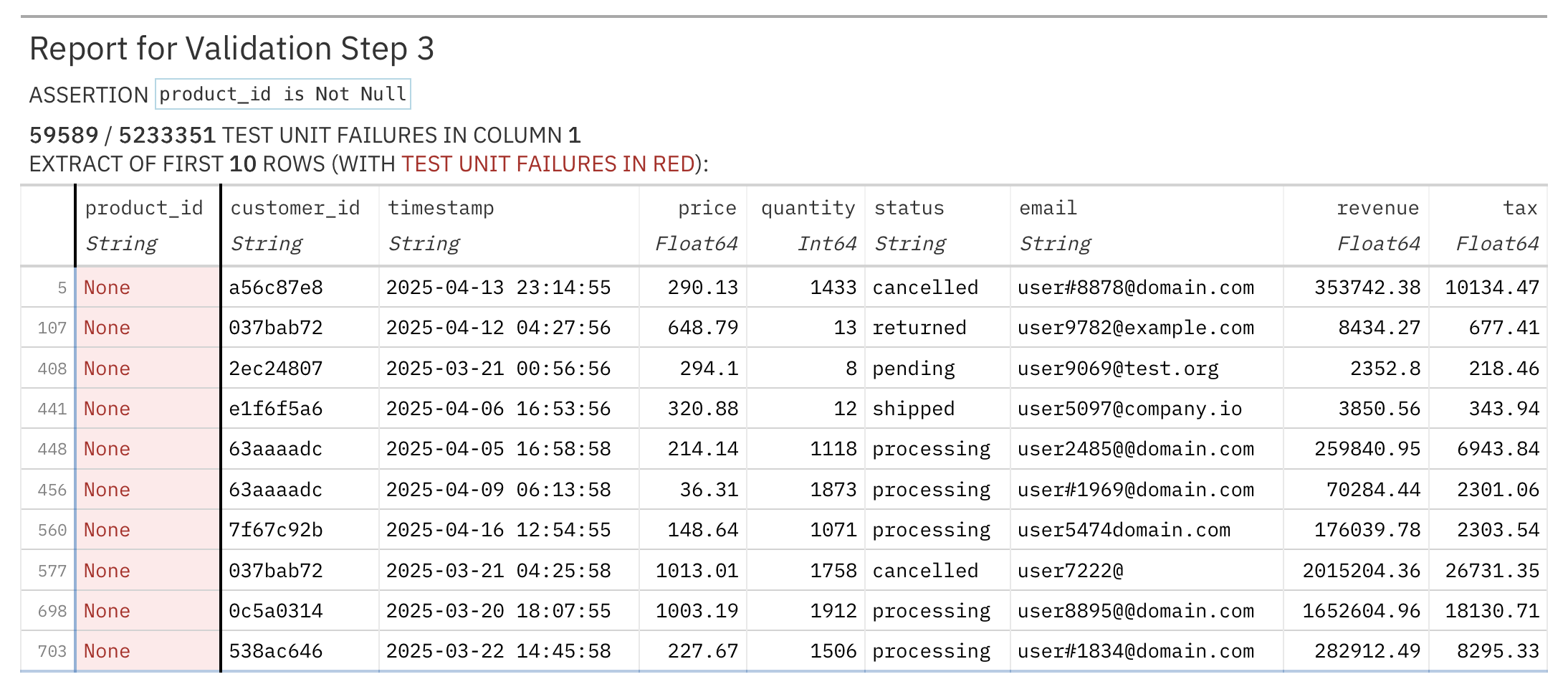
validation.get_step_report(i=3).show("browser") # Get failing records from step 3
```
## YAML Configuration
For teams that need portable, version-controlled validation workflows, Pointblank supports YAML configuration files. This makes it easy to share validation logic across different environments and team members, ensuring everyone is on the same page.
**validation.yaml**
```yaml
validate:
data: small_table
tbl_name: "small_table"
label: "Getting started validation"
steps:
- col_vals_gt:
columns: "d"
value: 100
- col_vals_le:
columns: "c"
value: 5
- col_exists:
columns: ["date", "date_time"]
```
**Execute the YAML validation**
```python
import pointblank as pb
# Run validation from YAML configuration
validation = pb.yaml_interrogate("validation.yaml")
# Get the results just like any other validation
validation.get_tabular_report().show()
```
This approach is suitable for:
- **CI/CD pipelines**: Store validation rules alongside your code
- **Team collaboration**: Share validation logic in a readable format
- **Environment consistency**: Use the same validation across dev, staging, and production
- **Documentation**: YAML files serve as living documentation of your data quality requirements
## Command Line Interface (CLI)
Pointblank includes a powerful CLI utility called `pb` that lets you run data validation workflows directly from the command line. Perfect for CI/CD pipelines, scheduled data quality checks, or quick validation tasks.

**Explore Your Data**
```bash
# Get a quick preview of your data
pb preview small_table
# Preview data from GitHub URLs
pb preview "https://github.com/user/repo/blob/main/data.csv"
# Check for missing values in Parquet files
pb missing data.parquet
# Generate column summaries from database connections
pb scan "duckdb:///data/sales.ddb::customers"
```
**Run Essential Validations**
```bash
# Run validation from YAML configuration file
pb run validation.yaml
# Run validation from Python file
pb run validation.py
# Check for duplicate rows
pb validate small_table --check rows-distinct
# Validate data directly from GitHub
pb validate "https://github.com/user/repo/blob/main/sales.csv" --check col-vals-not-null --column customer_id
# Verify no null values in Parquet datasets
pb validate "data/*.parquet" --check col-vals-not-null --column a
# Extract failing data for debugging
pb validate small_table --check col-vals-gt --column a --value 5 --show-extract
```
**Integrate with CI/CD**
```bash
# Use exit codes for automation in one-liner validations (0 = pass, 1 = fail)
pb validate small_table --check rows-distinct --exit-code
# Run validation workflows with exit codes
pb run validation.yaml --exit-code
pb run validation.py --exit-code
```
Click the following headings to see some video demonstrations of the CLI:
Getting Started with the Pointblank CLI

Doing Some Data Exploration

Validating Data with the CLI

Using Polars in the CLI

Integrating Pointblank with CI/CD

## Generate Realistic Test Data
Need test data for your validation workflows? The `generate_dataset()` function creates realistic, locale-aware synthetic data based on schema definitions. It's very useful for developing pipelines without production data, running CI/CD tests with reproducible scenarios, or prototyping workflows before production data is available.
```python
import pointblank as pb
# Define a schema with field constraints
schema = pb.Schema(
user_id=pb.int_field(min_val=1, unique=True),
name=pb.string_field(preset="name"),
email=pb.string_field(preset="email"),
age=pb.int_field(min_val=18, max_val=100),
status=pb.string_field(allowed=["active", "pending", "inactive"]),
)
# Generate 10 rows of realistic test data
data = pb.generate_dataset(schema, n=10, seed=23)
pb.preview(data)
```
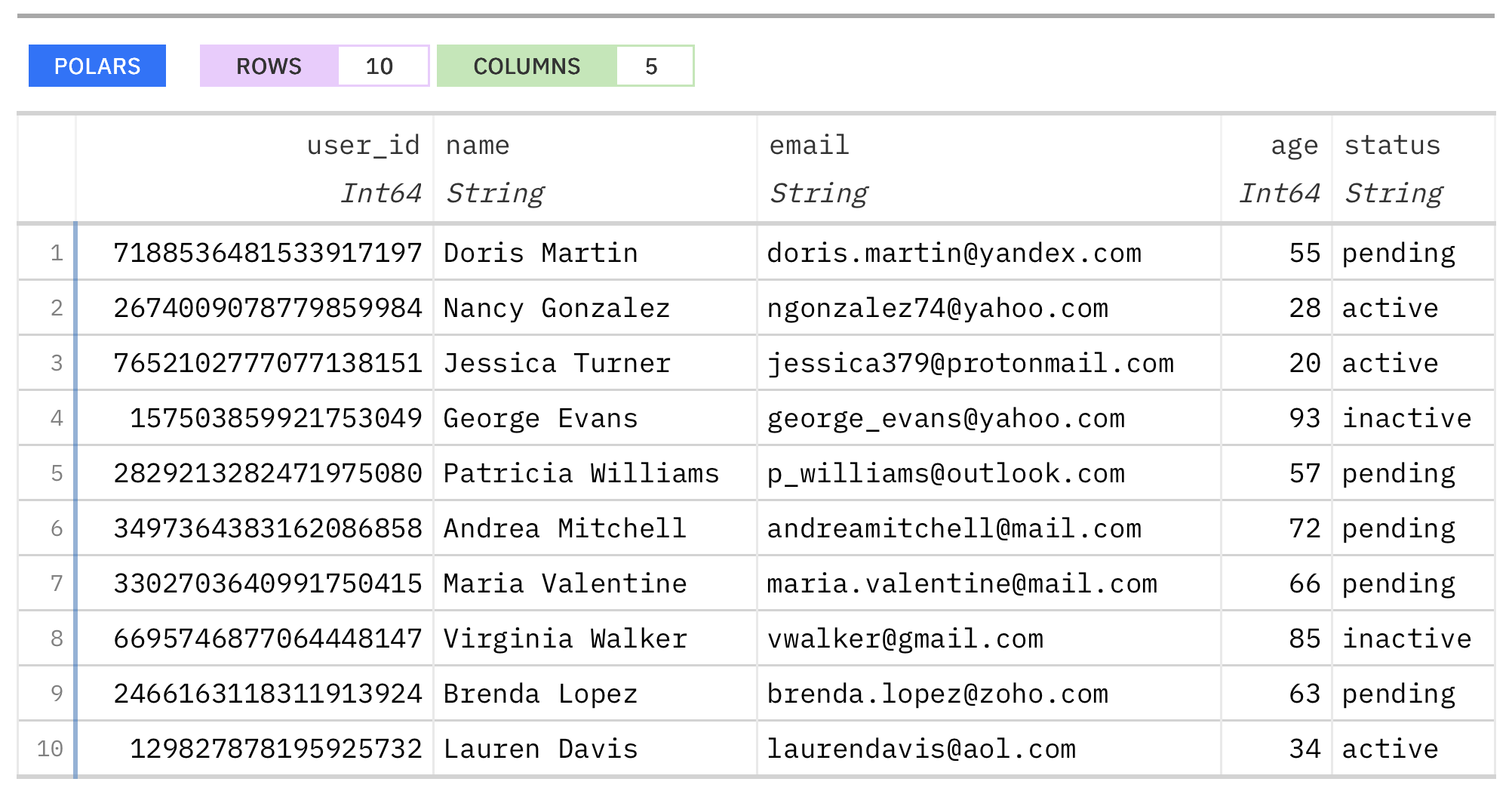
The generator supports sophisticated data generation with these capabilities:
- **Realistic data with presets**: Use built-in presets like `"name"`, `"email"`, `"address"`, `"phone"`, etc.
- **User agent strings**: Generate highly varied, realistic browser user agent strings from 17 browser categories with over 42,000 unique combinations
- **100 country support**: Generate locale-specific data (e.g., `country="DE"` for German addresses)
- **Field constraints**: Control ranges, patterns, uniqueness, and allowed values
- **Multiple output formats**: Returns Polars DataFrames by default, but also supports Pandas (`output="pandas"`) or dictionaries (`output="dict"`)
This makes it easy to generate test data that matches your validation rules, helping you develop and test data quality workflows without relying on real data.
## Features That Set Pointblank Apart
- **Complete validation workflow**: From data access to validation to reporting in a single pipeline
- **Built for collaboration**: Share results with colleagues through beautiful interactive reports
- **Practical outputs**: Get exactly what you need: counts, extracts, summaries, or full reports
- **Flexible deployment**: Use in notebooks, scripts, or data pipelines
- **Synthetic data generation**: Create realistic test data with 30+ presets, user agent strings, locale-aware formatting, and 100 country support
- **Customizable**: Tailor validation steps and reporting to your specific needs
- **Internationalization**: Reports can be generated in 40 languages, including English, Spanish, French, and German
## Documentation and Examples
Visit our [documentation site](https://posit-dev.github.io/pointblank) for:
- [The User Guide](https://posit-dev.github.io/pointblank/user-guide/)
- [API reference](https://posit-dev.github.io/pointblank/reference/)
- [Example gallery](https://posit-dev.github.io/pointblank/demos/)
- [The Pointblog](https://posit-dev.github.io/pointblank/blog/)
## Join the Community
We'd love to hear from you! Connect with us:
- [GitHub Issues](https://github.com/posit-dev/pointblank/issues) for bug reports and feature requests
- [_Discord server_](https://discord.com/invite/YH7CybCNCQ) for discussions and help
- [Contributing guidelines](https://github.com/posit-dev/pointblank/blob/main/CONTRIBUTING.md) if you'd like to help improve Pointblank
## Installation
You can install Pointblank using pip:
```bash
pip install pointblank
```
You can also install Pointblank from Conda-Forge by using:
```bash
conda install conda-forge::pointblank
```
If you don't have Polars or Pandas installed, you'll need to install one of them to use Pointblank.
```bash
pip install "pointblank[pl]" # Install Pointblank with Polars
pip install "pointblank[pd]" # Install Pointblank with Pandas
```
To use Pointblank with DuckDB, MySQL, PostgreSQL, or SQLite, install Ibis with the appropriate backend:
```bash
pip install "pointblank[duckdb]" # Install Pointblank with Ibis + DuckDB
pip install "pointblank[mysql]" # Install Pointblank with Ibis + MySQL
pip install "pointblank[postgres]" # Install Pointblank with Ibis + PostgreSQL
pip install "pointblank[sqlite]" # Install Pointblank with Ibis + SQLite
```
## Technical Details
Pointblank uses [Narwhals](https://github.com/narwhals-dev/narwhals) to work with Polars and Pandas DataFrames, and integrates with [Ibis](https://github.com/ibis-project/ibis) for database and file format support. This architecture provides a consistent API for validating tabular data from various sources.
## Contributing to Pointblank
There are many ways to contribute to the ongoing development of Pointblank. Some contributions can be simple (like fixing typos, improving documentation, filing issues for feature requests or problems, etc.) and others might take more time and care (like answering questions and submitting PRs with code changes). Just know that anything you can do to help would be very much appreciated!
Please read over the [contributing guidelines](https://github.com/posit-dev/pointblank/blob/main/CONTRIBUTING.md) for
information on how to get started.
## Pointblank for R
There's also a version of Pointblank for R, which has been around since 2017 and is widely used in the R community. You can find it at https://github.com/rstudio/pointblank.
## Roadmap
We're actively working on enhancing Pointblank with:
1. Additional validation methods for comprehensive data quality checks
2. Advanced logging capabilities
3. Messaging actions (Slack, email) for threshold exceedances
4. LLM-powered validation suggestions and data dictionary generation
5. JSON/YAML configuration for pipeline portability
6. CLI utility for validation from the command line
7. Expanded backend support and certification
8. High-quality documentation and examples
If you have any ideas for features or improvements, don't hesitate to share them with us! We are always looking for ways to make Pointblank better.
## Code of Conduct
Please note that the Pointblank project is released with a [contributor code of conduct](https://www.contributor-covenant.org/version/2/1/code_of_conduct/).
By participating in this project you agree to abide by its terms.
## 📄 License
Pointblank is licensed under the MIT license.
© Posit Software, PBC.
## 🏛️ Governance
This project is primarily maintained by
[Rich Iannone](https://bsky.app/profile/richmeister.bsky.social). Other authors may occasionally
assist with some of these duties.