https://github.com/puzl-cloud/kubesdk
Kubernetes client for Python + CRD<>API models (both ways) generator. Fast, fully typed, async.
https://github.com/puzl-cloud/kubesdk
asyncio client crd k8s kubernetes python
Last synced: 6 months ago
JSON representation
Kubernetes client for Python + CRD<>API models (both ways) generator. Fast, fully typed, async.
- Host: GitHub
- URL: https://github.com/puzl-cloud/kubesdk
- Owner: puzl-cloud
- License: mit
- Created: 2025-10-14T13:41:08.000Z (9 months ago)
- Default Branch: main
- Last Pushed: 2026-01-09T23:22:20.000Z (7 months ago)
- Last Synced: 2026-01-10T20:08:37.092Z (7 months ago)
- Topics: asyncio, client, crd, k8s, kubernetes, python
- Language: Python
- Homepage:
- Size: 930 KB
- Stars: 73
- Watchers: 1
- Forks: 1
- Open Issues: 9
-
Metadata Files:
- Readme: README.md
- License: LICENSE
- Security: SECURITY.md
Awesome Lists containing this project
- awesome-python - kubesdk - A modern async-first Kubernetes client and API model generator. (Projects / DevOps Tools)
- fucking-awesome-python - kubesdk - A modern async-first Kubernetes client and API model generator. (Projects / DevOps Tools)
README
[](https://pypi.org/project/kubesdk)
[](https://pypi.org/project/kube-models)
[](https://pypi.org/project/kubesdk-cli)
[](https://pypi.org/project/kubesdk)
[](https://coveralls.io/github/puzl-cloud/kubesdk)
[](https://github.com/puzl-cloud/kubesdk/actions/workflows/publish.yml)
# kubesdk
`kubesdk` is a modern, async-first Kubernetes client and API model generator for Python.
- Developer-friendly, with fully typed APIs so IDE auto-complete works reliably across built-in resources and your custom resources.
- Made for large multi-cluster workloads.
- Minimal external dependencies (client itself depends on `aiohttp` and `PyYAML` only).
The project is split into three packages:
## `kubesdk`
The core client library, which you install and use in your project.
## `kube-models`
Pre-generated Python models for all upstream Kubernetes APIs, for every Kubernetes version **1.23+**. All Kubernetes APIs are bundled under a single `kube-models` package version, so you don’t end up in model-versioning hell.
Separate models package gives you ability to use latest client version with legacy Kubernetes APIs and vice versa.
You can find the latest generated models [here](https://github.com/puzl-cloud/kube-models). They are automatically uploaded to an external repository to avoid increasing the size of the main `kubesdk` repo.
## `kubesdk-cli`
CLI that generates models from a live cluster or OpenAPI spec, including your own CRDs.
## Comparison with other Python clients
| Feature / Library | **kubesdk** | kubernetes-asyncio | Official client (`kubernetes`) | kr8s | lightkube |
|------------------------------------|-------------|-------------------|------------------------------|----------|----------|
| Async client | ✅ | ✅ | ✗ | ✅ | ✅ |
| IDE-friendly client methods typing | ✅ Full | ◑ Partial | ◑ Partial | ◑ Partial | ✅ Good |
| Typed models for all built-in APIs | ✅ | ✅ | ✅ | ◑ Partial | ✅ |
| Built-in multi-cluster ergonomics | ✅ | ◑ Manual | ◑ Manual | ◑ Manual | ◑ Manual |
| Easy API model generation (CLI) | ✅ | ✗ | ✗ | ◑ | ◑ |
| High-level JSON Patch helpers (typed) | ✅ | ✗ | ✗ | ✗ | ✗ |
| One API surface for core + CRDs | ✅ | ✗ | ✗ | ◑ | ✅ |
| Separated API models package | ✅ | ✗ | ✗ | ✗ | ✅ |
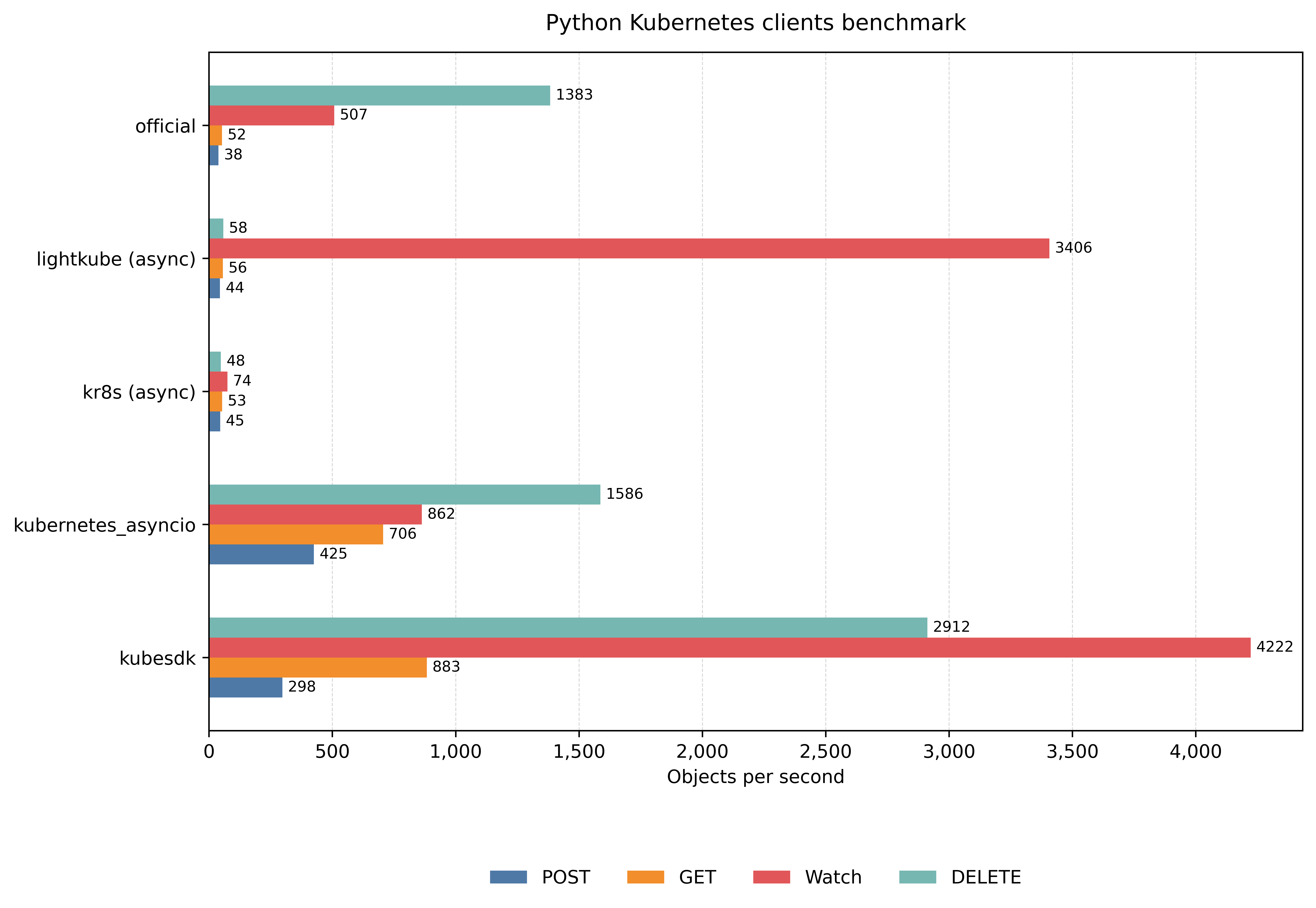
| Performance on large-scale workloads | ✅ >1000 RPS | ✅ >1000 RPS | <100 RPS | <100 RPS | <100 RPS |
### Benchmark
[Benchmark](https://github.com/puzl-cloud/k8s-clients-bench) results were collected against **[kind](https://github.com/kubernetes-sigs/kind) (Kubernetes in Docker)**, which provides a fast, consistent local environment for comparing client overhead under the same cluster conditions.
## Installation
```bash
pip install kubesdk[cli]
```
## Quick examples
### Create and read resource
```python
import asyncio
from kube_models.apis_apps_v1.io.k8s.api.apps.v1 import (
Deployment,
DeploymentSpec,
LabelSelector,
)
from kube_models.api_v1.io.k8s.api.core.v1 import (
PodTemplateSpec,
PodSpec,
Container,
)
from kube_models.api_v1.io.k8s.apimachinery.pkg.apis.meta.v1 import ObjectMeta
from kubesdk import login, create_k8s_resource, get_k8s_resource
async def main() -> None:
# Load available cluster config and establish cluster connection process-wide
await login()
deployment = Deployment(
metadata=ObjectMeta(name="example-nginx", namespace="default"),
spec=DeploymentSpec(
replicas=2,
selector=LabelSelector(matchLabels={"app": "example-nginx"}),
template=PodTemplateSpec(
metadata=ObjectMeta(labels={"app": "example-nginx"}),
spec=PodSpec(
containers=[
Container(
name="nginx",
image="nginx:stable",
)
]
),
),
),
)
# Create the Deployment
await create_k8s_resource(deployment)
# Read it back
created = await get_k8s_resource(Deployment, "example-nginx", "default")
# IDE autocomplete works here
print("Container name:", created.spec.template.spec.containers[0].name)
if __name__ == "__main__":
asyncio.run(main())
```
### Watch resources
```python
import asyncio
from kube_models.apis_apps_v1.io.k8s.api.apps.v1 import Deployment
from kubesdk import login, watch_k8s_resources
async def main() -> None:
await login()
async for event in watch_k8s_resources(Deployment, namespace="default"):
deploy = event.object
print(event.type, deploy.metadata.name)
if __name__ == "__main__":
asyncio.run(main())
```
### Delete resources
```python
import asyncio
from kube_models.apis_apps_v1.io.k8s.api.apps.v1 import Deployment
from kubesdk import login, delete_k8s_resource
async def main() -> None:
await login()
await delete_k8s_resource(Deployment, "example-nginx", "default")
if __name__ == "__main__":
asyncio.run(main())
```
### Patch resource
```python
from dataclasses import replace
from kube_models.api_v1.io.k8s.api.core.v1 import LimitRange, LimitRangeSpec, LimitRangeItem
from kube_models.api_v1.io.k8s.apimachinery.pkg.apis.meta.v1 import OwnerReference, ObjectMeta
from kubesdk import create_k8s_resource, update_k8s_resource, from_root_, path_, replace_
async def patch_limit_range() -> None:
"""
Example: bump PVC min storage and add an OwnerReference in a single,
server-side patch. kubesdk will compute the diff between `latest` and
`updated` and pick the best patch type (strategic/merge) automatically.
"""
# Create the initial LimitRange object.
namespace = "default"
initial_range = LimitRange(
metadata=ObjectMeta(
name="example-limit-range",
namespace=namespace,
),
spec=LimitRangeSpec(
limits=[
LimitRangeItem(
type="PersistentVolumeClaim",
min={"storage": "1Gi"},
)
]
),
)
# The client returns the latest version from the API server.
latest: LimitRange = await create_k8s_resource(initial_range)
#
# We want to make a few modifications, will do them one by one.
# First, append a new OwnerReference.
#
# IDE autocomplete works here
owner_ref_path = path_(from_root_(LimitRange).metadata.ownerReferences)
updated_range = replace_(
latest,
# IDE autocomplete works here
path=owner_ref_path,
# Typecheck works here
new_value=latest.metadata.ownerReferences + [
OwnerReference(
uid="9153e39d-87d1-46b2-b251-5f6636c30610",
apiVersion="v1",
kind="Secret",
name="test-secret-1",
),
]
)
#
# Then, set a new list of limits with updated PVC min storage.
#
# IDE autocomplete works here
limits_path = path_(from_root_(LimitRange).spec.limits)
updated_range = replace_(
updated_range,
# IDE autocomplete works here
path=limits_path,
# Typecheck works here
new_value=[
replace(lim, min={"storage": "3Gi"})
if lim.type == "PersistentVolumeClaim" else lim
for lim in latest.spec.limits
]
)
update_all_changed_fields = True
# Let kubesdk compute the diff and patch everything that changed
if update_all_changed_fields:
await update_k8s_resource(updated_range, built_from_latest=latest)
# Or, restrict the patch to specific paths only (optional)
else:
await update_k8s_resource(
updated_range,
built_from_latest=latest,
paths=[owner_ref_path, limits_path],
)
```
### Working with multiple clusters
```python
import asyncio
from dataclasses import replace
from kubesdk import login, KubeConfig, ServerInfo, watch_k8s_resources, create_or_update_k8s_resource, \
delete_k8s_resource, WatchEventType
from kube_models.api_v1.io.k8s.api.core.v1 import Secret
async def sync_secrets_between_clusters(src_cluster: ServerInfo, dst_cluster: ServerInfo):
src_ns, dst_ns = "default", "test-kubesdk"
async for event in watch_k8s_resources(Secret, namespace=src_ns, server=src_cluster.server):
if event.type == WatchEventType.ERROR:
status = event.object
raise Exception(f"Failed to watch Secrets: {status.data}")
# Optional
if event.type == WatchEventType.BOOKMARK:
continue
# Sync Secret on any other event
src_secret = event.object
if event.type == WatchEventType.DELETED:
# Try to delete, skip if not found
await delete_k8s_resource(
Secret, src_secret.metadata.name, dst_ns, server=dst_cluster.server, return_api_exceptions=[404])
continue
dst_secret = replace(
src_secret,
metadata=replace(src_secret.metadata, namespace=dst_ns,
# Drop all k8s runtime fields
uid=None,
resourceVersion=None,
managedFields=None))
# If the Secret exists, a patch is applied; if it doesn't, it will be created.
await create_or_update_k8s_resource(dst_secret, server=dst_cluster.server)
print(f"Secret {dst_secret.metadata.name} has been synced "
f"from `{src_ns}` ns in {src_cluster.server} to `{dst_ns}` ns in {dst_cluster.server}")
async def main():
default = await login()
eu_finland_1 = await login(kubeconfig=KubeConfig(context_name="eu-finland-1.clusters.puzl.cloud"))
# Endless syncing loop
while True:
try:
await sync_secrets_between_clusters(default, eu_finland_1)
except Exception as e:
print(e)
await asyncio.sleep(5)
if __name__ == "__main__":
asyncio.run(main())
```
### Custom Resource Definitions
You can generate your custom resource models from your Kubernetes cluster API directly using CLI. Another option is to define them manually. Below is the example of a `FeatureFlag` CR.
#### Operator
A `FeatureFlag` CR is a simple k8s resource that drives a progressive rollout by updating Nginx `Ingress` canary annotations (assumed you are using Nginx).
- Operator watches `FeatureFlag` objects and sets `nginx.ingress.kubernetes.io/canary=true` and `nginx.ingress.kubernetes.io/canary-weight=<0..100>` on the referenced `spec.canary_ingress`.
- When the flag is disabled or resource is deleted, the operator forces the canary weight to `0` (no canary traffic).
```python
# operator.py
from __future__ import annotations
import asyncio
from dataclasses import dataclass
from kubesdk import login, watch_k8s_resources, update_k8s_resource, WatchEventType, path_, from_root_, replace_, \
K8sAPIRequestLoggingConfig
from kubesdk.crd import CustomK8sResourceDefinition, CustomK8sResource, crd_field, PrinterColumn, CRDFieldSpec
from kube_models import Loadable
from kube_models.api_v1.io.k8s.apimachinery.pkg.apis.meta import ObjectMeta
from kube_models.apis_networking_k8s_io_v1.io.k8s.api.networking.v1 import Ingress
# Log each API request
from kubesdk.client import DEFAULT_LOGGING
DEFAULT_LOGGING.on_success = True
@dataclass(kw_only=True, frozen=True, slots=True)
class FeatureFlagSpec(Loadable):
# You can use standard k8s property settings in CRDFieldSpec
enabled: bool = crd_field(spec=CRDFieldSpec(default=False))
rollout_percent: int = crd_field(spec=CRDFieldSpec(minimum=0, maximum=100, default=0))
# Name of the canary Ingress (points to canary Service)
# PrinterColumn will show this field's value in `Ingress` column in kubectl output
canary_ingress: str = crd_field(spec=CRDFieldSpec(printer_column=PrinterColumn(name="Ingress")))
@dataclass(kw_only=True, frozen=True, slots=True)
class FeatureFlagV1Alpha1(CustomK8sResource):
is_namespaced_ = True
group_ = "my-beautiful-saas.com"
plural_ = "featureflags"
apiVersion = f"{group_}/v1alpha1"
kind = "FeatureFlag"
spec: FeatureFlagSpec
@dataclass
class FeatureFlagCRD(CustomK8sResourceDefinition):
versions = [FeatureFlagV1Alpha1]
crd_short_names_ = ["ff"]
async def operator():
finalizer_name = FeatureFlagV1Alpha1.group_
await login()
async for event in watch_k8s_resources(FeatureFlagV1Alpha1):
if event.type == WatchEventType.BOOKMARK:
continue
flag, meta = event.object, event.object.metadata
deleting = meta.deletionTimestamp is not None
actually_enabled = False if deleting or event.type == WatchEventType.DELETED else flag.spec.enabled
weight = int(flag.spec.rollout_percent or 0) if actually_enabled else 0
# Add finalizer on create/normal updates (so we clean up on delete safely)
fin_path = path_(from_root_(FeatureFlagV1Alpha1).metadata.finalizers)
if not deleting and event.type != WatchEventType.DELETED and finalizer_name not in meta.finalizers:
new_finalizers = meta.finalizers + [finalizer_name]
updated_flag = replace_(flag, fin_path, new_finalizers)
await update_k8s_resource(updated_flag, paths=[fin_path]) # patch finalizers only
new_annotations = {
"nginx.ingress.kubernetes.io/canary": "true",
"nginx.ingress.kubernetes.io/canary-weight": str(weight)
}
desired_ingress = Ingress(metadata=ObjectMeta(
name=flag.spec.canary_ingress,
namespace=meta.namespace,
annotations=new_annotations
))
annotations_path = path_(from_root_(Ingress).metadata.annotations) # patch annotations only
await update_k8s_resource(desired_ingress, paths=[annotations_path])
# On delete: remove finalizer so the CR can be deleted
if deleting and finalizer_name in meta.finalizers:
new_finalizers = [f for f in meta.finalizers if f != finalizer_name]
updated_flag = replace_(flag, fin_path, new_finalizers)
do_not_log_404 = K8sAPIRequestLoggingConfig(not_error_statuses=[404])
await update_k8s_resource(updated_flag, paths=[fin_path], return_api_exceptions=[404], log=do_not_log_404)
if __name__ == "__main__":
asyncio.run(operator())
```
#### CRD
Before running the operator, you need to generate and apply your CRD in the Kubernetes cluster. Call generator in the dir with your `operator.py` from above:
```shell
kubesdk generate crd --from-dir . --output ./my-crd
kubectl apply -f ./my-crd/featureflags.my-beautiful-saas.yaml
```
#### Run and test the operator
1. Create demo `Ingress` resource
```yaml
apiVersion: networking.k8s.io/v1
kind: Ingress
metadata:
name: checkout-canary
namespace: default
spec:
ingressClassName: nginx
rules:
- host: checkout-canary.local
http:
paths:
- path: /
pathType: Prefix
backend:
service:
name: dummy-service
port:
number: 80
```
```shell
kubectl apply -f checkout-canary-ingress.yaml
```
2. Apply your `FeatureFlag` custom resource spec into cluster
```yaml
apiVersion: my-beautiful-saas.com/v1alpha1
kind: FeatureFlag
metadata:
name: checkout-canary # the same as Ingress metadata.name
namespace: default # in the same namespace
spec:
enabled: true
rollout_percent: 20
canary_ingress: checkout-canary
```
```shell
kubectl apply -f checkout-canary-feature-flag.yaml
```
3. Check both annotations' values
```shell
kubectl get ingress checkout-canary -n default -o jsonpath="{.metadata.annotations.nginx\.ingress\.kubernetes\.io/canary}{'\n'}{.metadata.annotations.nginx\.ingress\.kubernetes\.io/canary-weight}{'\n'}"
```
The command must return
```
true
20
```
### CLI
Generate models directly from a live cluster OpenAPI:
```shell
kubesdk generate models \
--url https://my-cluster.example.com:6443 \
--output ./kube_models \
--module-name kube_models \
--http-headers "Authorization: Bearer $(cat /path/to/token)" \
--skip-tls
```