https://github.com/pyccel/psydac
Python 3 library for isogeometric analysis
https://github.com/pyccel/psydac
bsplines high-performance-computing isogeometric-analysis python
Last synced: 5 months ago
JSON representation
Python 3 library for isogeometric analysis
- Host: GitHub
- URL: https://github.com/pyccel/psydac
- Owner: pyccel
- License: mit
- Created: 2018-02-16T13:42:54.000Z (over 8 years ago)
- Default Branch: devel
- Last Pushed: 2026-02-18T14:06:36.000Z (5 months ago)
- Last Synced: 2026-02-18T15:50:23.729Z (5 months ago)
- Topics: bsplines, high-performance-computing, isogeometric-analysis, python
- Language: Python
- Homepage: https://pyccel.github.io/psydac/
- Size: 24.8 MB
- Stars: 61
- Watchers: 8
- Forks: 21
- Open Issues: 109
-
Metadata Files:
- Readme: README.md
- Changelog: CHANGELOG.md
- License: LICENSE
- Citation: CITATION.bib
- Authors: AUTHORS
Awesome Lists containing this project
README
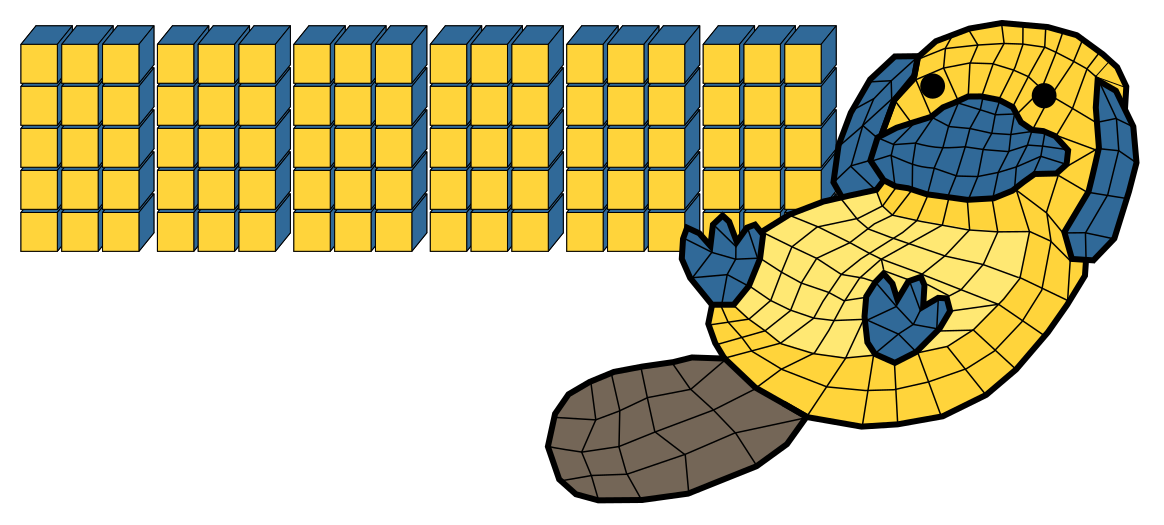
# 
[](https://github.com/pyccel/psydac/actions/workflows/testing.yml)
[](https://github.com/pyccel/psydac/actions/workflows/documentation.yml)
PSYDAC is a Python 3 library for isogeometric analysis.
It is an academic, open-source project created by numerical mathematicians at the [Max Planck Institute for Plasma Physics](https://www.ipp.mpg.de/en) ([NMPP](https://www.ipp.mpg.de/ippcms/eng/for/bereiche/numerik) division, [FEM](https://www.ipp.mpg.de/5150531/fem) group).
PSYDAC can solve general systems of partial differential equations in weak form, which users define using the domain-specific language provided by [SymPDE](https://github.com/pyccel/sympde).
It supports finite element exterior calculus ([FEEC](https://en.wikipedia.org/wiki/Finite_element_exterior_calculus)) with tensor-product spline spaces and handles multi-patch geometries in various ways.
PSYDAC automatically generates Python code for the assembly of user-defined functionals and linear and bilinear forms from the weak formulation of the problem.
This Python code is then accelerated to C/Fortran speed using [Pyccel](https://github.com/pyccel/pyccel).
The library also enables large parallel computations on distributed-memory supercomputers using [MPI](https://en.wikipedia.org/wiki/Message_Passing_Interface) and [OpenMP](https://en.wikipedia.org/wiki/OpenMP).
> [!NOTE]
> The name PSYDAC stands for "Python Spline librarY for Differential equations with Automatic Code generation".
> It is pronounced like the famous Pokémon character, from which the developers draw inspiration for its psychic powers.
## Citing
If PSYDAC has been significant in your research, and you would like to acknowledge the project in your academic publication, we would ask that you cite the following paper:
Güçlü, Y., S. Hadjout, and A. Ratnani. “PSYDAC: A High-Performance IGA Library in Python.” In 8th European Congress on Computational Methods in Applied Sciences and Engineering. CIMNE, 2022. https://doi.org/10.23967/eccomas.2022.227.
The associated BibTeX file can be found [here](https://github.com/pyccel/psydac/blob/devel/CITATION.bib).
## Installation
PSYDAC requires a certain number of components to be installed on the machine:
- Fortran and C compilers with OpenMP support
- OpenMP library
- BLAS and LAPACK libraries
- MPI library
- HDF5 library with MPI support
The installation instructions depend on the operating system and on the packaging manager used.
It is particularly important to determine the **HDF5 root folder**, as this will be needed to install the [`h5py`](https://docs.h5py.org/en/latest/build.html#source-installation) package in parallel mode.
Detailed instructions can be found in the [documentation](https://pyccel.github.io/psydac/installation.html).
Once those components are installed, we recommend using [`venv`](https://packaging.python.org/en/latest/guides/installing-using-pip-and-virtual-environments/#creating-a-virtual-environment) to set up a fresh Python virtual environment at a location ``:
```bash
python3 -m venv
source /bin/activate
```
PSYDAC and its Python dependencies can now be installed in the virtual environment using [`pip`](https://pip.pypa.io/en/stable/), the Python package manager:
```bash
export CC="mpicc"
export HDF5_MPI="ON"
export HDF5_DIR=
pip install --upgrade pip
pip install h5py --no-cache-dir --no-binary h5py
pip install "psydac[test]"
```
Here `` is the path to the HDF5 root folder, such that `/lib/` contains the HDF5 dynamic libraries with MPI support.
The last command above installs the latest version of PSYDAC found on [PyPI](https://pypi.org), the Python Package Index, together with some optional packages needed for running the unit tests.
A developer wanting to modify the latest source code on GitHub should skip that command, and instead clone the PSYDAC repository (by default, in the branch `devel`) to perform an **editable install**:
```bash
git clone --recurse-submodules https://github.com/pyccel/psydac.git
cd psydac
pip install meson-python "pyccel>=2.1.0"
pip install --no-build-isolation --editable ".[test]"
```
The last install command will create a local `build/` folder, which can be inspected in the case of an error.
We recommend removing such a folder before running the command again (e.g. when installing PSYDAC in multiple virtual environments) in order to avoid conflicts in library path resolution.
Again, for more details we refer to our [documentation](https://pyccel.github.io/psydac/installation.html).
> [!TIP]
> PSYDAC provides the functionality to convert its MPI-parallel matrices and vectors to their [PETSc](https://petsc.org) equivalent, and back.
> This gives the user access to a wide variety of linear solvers and other algorithms.
> Instructions for installing [PETSc](https://petsc.org) and `petsc4py` can be found in our [documentation](https://pyccel.github.io/psydac/installation.html#id9).
## Running Tests
We strongly advice users and developers to run the test suite of PSYDAC to verify the correct installation on their machine (possibly a supercomputer).
All unit tests are based on [`pytest`](https://docs.pytest.org/en/stable/) and are installed together with the library.
For convenience, PSYDAC provides the `psydac test` command as shown below.
In order to run all serial and parallel tests which do not use PETSc, just type:
```bash
psydac test
psydac test --mpi
```
If PETSc and petsc4py were installed, additional serial and parallel tests can be run:
```bash
psydac test --petsc
psydac test --petsc --mpi
```
## Speeding up PSYDAC's core
Many of PSYDAC's low-level Python functions can be translated to a compiled language using the [Pyccel](https://github.com/pyccel/pyccel) transpiler.
Currently, all of those functions are collected in modules which follow the name pattern `[module]_kernels.py`.
For both classical and editable installations, *all kernel files are translated to Fortran __without user intervention__*.
If the user adds or edits a kernel file within an editable install, they should use the command `psydac compile` in order to be able to see the changes at runtime.
This command applies Pyccel to all the kernel files in the source directory.
The default language is Fortran, and C is also available.
- **Only in development mode**:
```bash
psydac compile [--language {fortran, c}]
```
## Examples and Tutorials
Our [documentation](https://pyccel.github.io/psydac/examples.html) provides Jupyter notebooks that present many aspects of this library.
Additional [tutorials](https://pyccel.github.io/IGA-Python/intro.html) on isogeometric analysis, with many example notebooks where various PDEs are solved with PSYDAC, is under construction in the [IGA-Python](https://github.com/pyccel/IGA-Python) repository.
Some other examples can be found [here](https://github.com/pyccel/psydac/blob/devel/examples).
## Library Documentation
- [Output formats](https://pyccel.github.io/psydac/output.html)
- [Mesh generation](https://pyccel.github.io/psydac/psydac-mesh.html)
- [Modules](https://pyccel.github.io/psydac/modules.html)
## Contributing
There are several ways to contribute to this project!
If you find a problem, please check if this is already discussed in one of [our issues](https://github.com/pyccel/psydac/issues) and feel free to add your opinion; if not, please create a [new issue](https://docs.github.com/en/issues/tracking-your-work-with-issues/using-issues/creating-an-issue).
If you want to fix an issue, improve our notebooks, or add a new example, please [fork](https://docs.github.com/en/pull-requests/collaborating-with-pull-requests/working-with-forks/fork-a-repo) our Git repository, make and commit your changes, and create a [pull request](https://docs.github.com/en/pull-requests/collaborating-with-pull-requests/proposing-changes-to-your-work-with-pull-requests/creating-a-pull-request) (PRs).
All PRs are reviewed by the project maintainers.
During the PR review, GitHub workflows are triggered on various platforms.
We keep an up-to-date list of maintainers and contributors in our [AUTHORS](https://github.com/pyccel/psydac/blob/devel/AUTHORS) file.
Thank you!